
Portia Po Chapman Painting My Creation Artist Talk Question and Answer Transcript Queen’s University
Q: How has your artistic journey been shaped by your lived experiences?
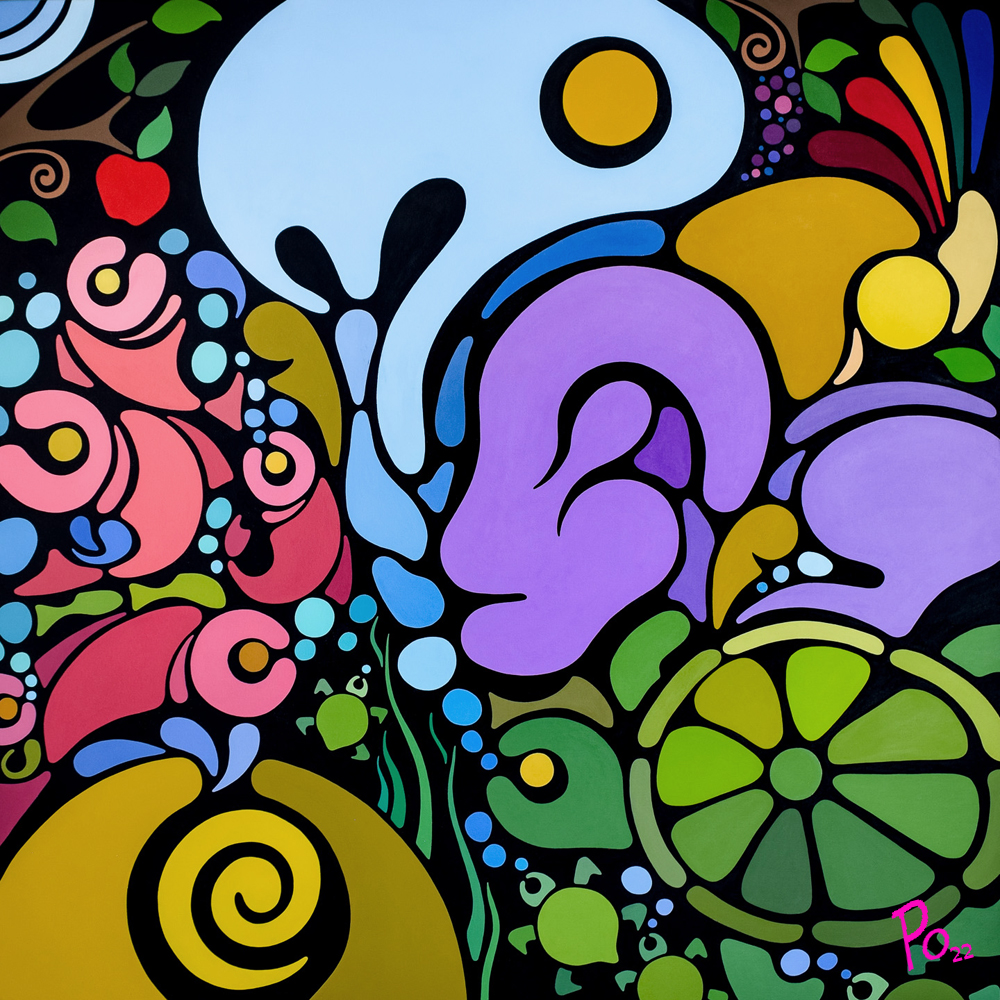
A: A cute story, on the first day of my BFA we were asked to introduce ourselves. Pretty much everybody came from an urban or suburban background, me, I walked straight out of the woods. I told my story and from that day on, my BFA colleagues referred to me as Snow White. I will explain, very much like a Disney character, I really lived without many friends, playing in the woods, talking to little people, and animals and plants. My artistic development began playing in a creek. Other than crayons, my early art pieces were from rocks, and bark, and feathers. I never thought I needed many friends because whether I was in the lake, the creek, or gathering water from the spring, nature provided me with all the friends I ever needed. You can see from “My Creation” and most of my other artworks, that I have included friends of mine in the imagery. I didn’t have salmon as friends, but I had a lot of other fish. Like sunfish who would nibble on my toes as I swam through the lake. I remember at about 5 years old just sitting in the shallow water and the little fish coming up to say “hi.”
I come from a very artistic family. I was raised in a house that had plywood interior walls built for artworks to be nailed on their surfaces or repainted. You see, my parents allowed my sister and I to draw and paint on our walls whenever we felt like it. And whether it was a scribble or figurative drawing, it was cherished in the house just as if the Mona Lisa was just hung upon the wall. My dad’s a line artist and choral vocalist, my mom’s a seamstress and pianist. They are both graduates of Queen’s University. I started taking art class in Grade 11. There was a prerequisite to take Grade 9 or 10 art before taking Grade 11, but the Art teacher thought I was so talented (as I had won the ALCDSB’s Faith in Action logo contest the year before), so he let me skip ahead. As an artist, I never had restrictions. I was able to create with pretty much anything I put my hands on. I mean, I swear I grew up in a yarn box crocheting in my parent’s yarn shop. When I was about 7, my dad had a sudden urge to paint, but we couldn’t afford a canvas, so I remember fetching a screwdriver and him deciding to remove the kitchen cupboard doors to paint on. He has received the highest offers from art collectors for those paintings, and he will not sell them because they represent a time when money was not going to stop our family from creating beautiful works. As being an indigenous artist, I come from a family who were subject to colonial displacement. My dad’s family celebrated our Indigeneity, but tried to keep it quiet in the public. For generations they chose not to reveal their Indigeneity because of colonial persecution. Just before my grandfather died, he gave permission for us to publicly celebrate our Indigeneity. When I came to Queen’s, it was soon after he gave our family this permission. My mother’s family, they only recently started talking about their Indigeneity openly. So it was at Queen’s, during my BFAH, that I began to share who I was through my artworks. And it is because of that celebration, and Queen’s University’s welcome to self-identify that I began to flourish as an artist.
Q: Your website mentions that art has supported you in reclaiming your Indigenous identity. How do you think art has supported you in this way?
A: Having never lived on a reserve or with an Indigenous community, my experience has been different than people who have. I continue to state that I express my Indigeneity through my connection with Creation. My life has been lived in communion with the life of Creation. Sadly, for many years of my life it felt like I was the only one with that lived experience. You can see this expression of my Indigeneity in my many artworks. So where did my art take an Indigenous direction? I think it was in the early 2000s when on a walk with my parents I went on a scavenger hunt gathering various things from nature, like feathers, bark, acorns, stones, thinks like that. When I got home, I arranged them on a piece of birch bark and hung it on our living room wall. Then, I travelled with my parents to various art shows whereby my dad was a guest to draw. At that time, he was not telling people about his Indigeneity, but his artwork seemed to tell people anyway. There was never a time that we were at a show and someone didn’t ask, if he was Indigenous. Of course he would proudly tell a story, because his Indigenous ancestry is very precious to him. Because of these art shows, our family became close friends with many Indigenous people from and near various reserves. Although we did not hold any band cards, we were welcome into Indigenous families and never made to feel as though we were outsiders. So as a little girl, I experienced first-hand how art could tell our story and how it encouraged us to share with others. When I began preparing for my Queen’s BFA application portfolio, viewers of my artwork began questioning me about my Indigeneity. As you can see from my artwork, I am not a propagandist, I am simply an Indigenous woman happy to share my view and relationship with Creation. Because of my artwork, I am meeting and sharing with other Indigenous people and developing wonderful relationships with families, friends and organizations. In so doing I am reclaiming my Indigeneity.
Q: Given the challenges of Covid-19, how has art supported you as an outlet during this period?
A: When the spread of Covid began, in the winter of 2020, I was at my teaching practicum at a local school in the Indigenous Art class. I remember taking the bus from my downtown residence in Kingston to the school and many people on the bus were coughing. As a germaphobe, it was my total nightmare. Just before the lockdown, I had taken a placement at the Agnes Etherington Art Centre. My placement lasted 1 day. The next day the World Health Organization declared a pandemic and the whole province was locked down. So here I was, an artist not able to work in an art gallery and an art teacher not able to teach art! My art equipment was in multiple storage units in and out of Kingston and they had rules about retrieving your things. I’d swear the only thing that kept me going as an artist at that moment was that my apartment was filled with my paintings, sculptures, tool boxes, and most of all my cats. In the summer, I graduated from Con. Ed as a high school art teacher and within 3 weeks, I was teaching Junior Kindergarten online for the ALCDSB remote school. I taught full time for 10 straight months followed by another month of summer literacy school. I must profess, that Junior Kindergarten was the single most beneficial event that kept me going as a visual artist. There’s just something about teaching 3 and 4 year olds that brought me back to teaching arts and crafts every single day. My students became the most advanced students at working a pair of scissors. I had them cutting out snowflakes in no time. We used art to teach every single subject. We mixed up acting, dancing, singing and art. In fact, I think we all had the times of our lives. There was no way that I was going to let this seeming diversion from my art career hold me back as an artist. So I created arts and crafts out of egg shells, recycled materials, extra cereal boxes, and other things that were piling up around the house because we couldn’t get out.
It is said that a person knows of their calling when 3 unrelated people or events happen that confirm that calling. As amazing as this sounds, this actually happened. My emails started exploding with people seemingly out of the blue asking about art commissions. And then the “Truth” image was featured on the Queen’s Landing page during the week of the National Day for Truth and Reconciliation. Now this is how the Great Spirit works, being a self-proclaimed germaphobe, I was terrified to teach this fall, so unlike the previous year, I was unemployed. I literally had nothing to do but stare at myself in the mirror. Then, the “Truth” image went public big time. I was able to entertain commission requests and the requests came to me. And what’s even more amazing about this, I had already created two studio spaces in my family home overlooking the beautiful Bay of Quinte. So other than August and part of September 2021, I have been working on my art almost solidly during the Pandemic. And that is how I got here today.
Q: As mentioned, you are a Queen’s alumnus, how did your time with Queen’s both in and outside of the classroom shape your growth as an artist?
A: It was a difficult decision choosing Queen’s University to pursue my art career. I was accepted on scholarships everywhere I applied. My decision at first was based upon my ability to pursue the Bachelors of Fine Art degree while simultaneously doing Concurrent Education (Con. Ed.). It was the first year the BFA students could be Con. Ed students as well. I think we were kind of an experiment, but it worked out. I couldn’t really grasp why the Queen’s BFA program taught so many skills rather than freedom of creation that some other well known art schools take as their direction. So I found it really frustrating, but then, in the 3rd year, the program takes a drastic turn and we begin to specialize. By the 4th year, we were working on our thesis projects with our own mentors, and creating what we chose to create. Now the amazing thing about this program direction is that it does come with great gain. In other words, by our 4th years, I found that we were very well prepared to create amazing artworks. In my 4th year, I had several interviews with gallery representatives and well-known professional artists. They truly helped me as a young artist appreciate my direction and the struggle that it would take to compete in an art world that can at times seem like there is no possible way to succeed as an emerging artist.
One of the things about being in the art program was that we were able to show our work in galleries even in 1st year. The Union Gallery really provided a boost in confidence and enthusiasm to continue toward a career as a professional artist. I found that Cezanne’s Closet was one of my best experiences. It was really thrilling to see my “Our Worlds” stone lithography triptych hanging on the walls of a well known professor’s studio apartment. I had won a few art awards before this happened, but seeing these prints on this professor’s wall was really a thrilling moment that recognized my success as an emerging artist. Because of the Medal in Visual Art that I received at my 2019 BFAH Graduation, I have gained respect from clients seeking commissioned works.
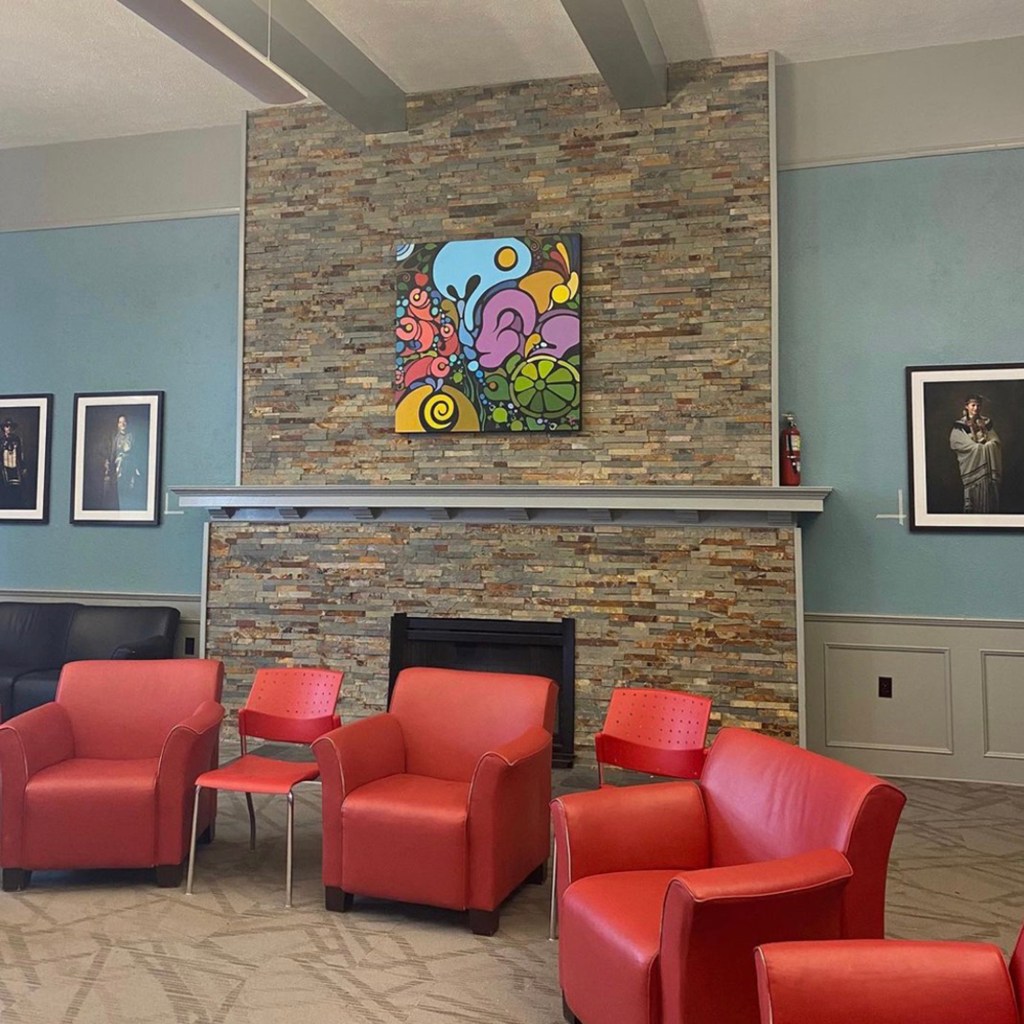
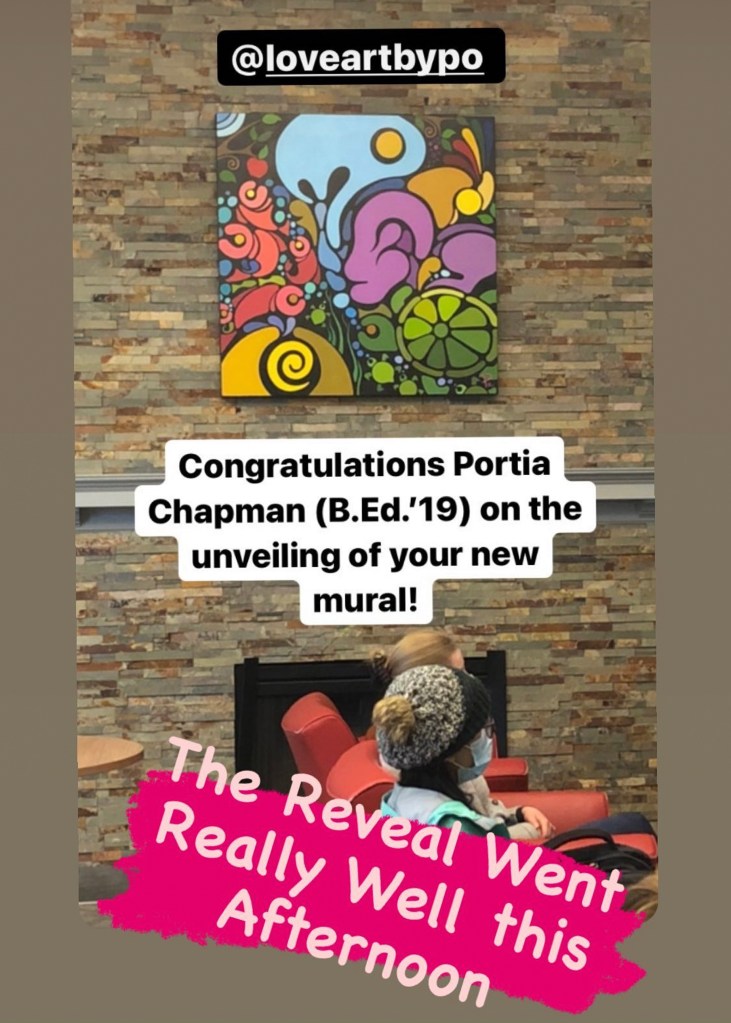
It was really amazing that I was able to work on the images for the Office of Indigenous Initiatives while I was finishing my Con. Ed. Degree. Had Queen’s not offered me to be part of this experiment (completing BFAH concurrently with BEd), I may have had to leave Queen’s to do my BEd. And if that were the case, a series of art opportunities would have never come my way. As an Indigenous artist, the 4 Directions along with a few other Indigenous professors were very supportive. When I first began mentioning my Indigenous background, or creating artworks that were viewed as being in the style of popular Indigenous artists, I was frequently told by others that I was not in any way Indigenous because I looked too white. These ladies helped me weather the storm that I faced during my early years of self-identification. I have found that my artwork has become more beautiful, expressive, and vibrant because I celebrate who I am and my Indigeneity. It was because of Queen’s that you see this very colourful mural before you today.
Q: If you had one piece of advice for someone looking to begin a career in art, what would it be?
A: My advice is, get yourself a BFA in studio art and possibly follow it up with an MFA. The reason I think this is very important is that when galleries, competitions, and granting organizations ask for proof of being a professional artist, one of the pieces of evidence they may request is a BFA. As a new emerging artist, without much gallery experience on one’s CV, the BFA makes a world of difference. It seems that with a BFA, people seem to take you more seriously as a visual artist. My second piece of advice, is to create artworks that you like creating. And my 3rd piece of advice is to know who you are and without apology celebrate your identity as an expression echoed in your artwork. Even without the BFA, these 2 things go a long way in the art world because collectors, galleries, and commissioning patrons are interested in you as a person and as an artist. I believe that your voice as an artist needs to leap off the canvas no matter what your voice is saying. There will always be an audience.
 Love Art by Po
2 thoughts on “Portia Po Chapman Painting My Creation Artist Talk Question and Answer Transcript Queen’s University”
Comments are closed.