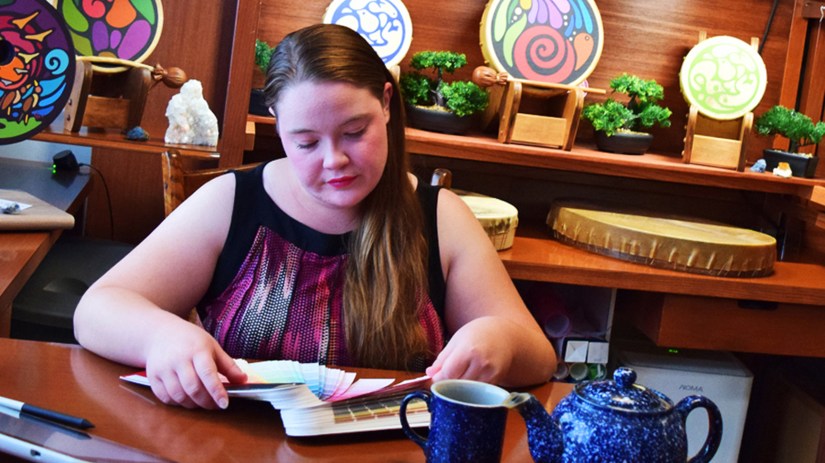
Portia “Po” Chapman in her Kingston Art Studio, documenting the intersection visual arts research, nature-focused colour-blocking, and professional project execution.
“Being Seen: when Being Seen… we glow!” Glowing Rawhide Exhibition Articles
This is a new 2026 addition that will take a deep dive into Po’s world of inter-disciplinary, storytelling art. Po pioneers the contemporary manifestations of visual storytelling illustration art by merging sculpture, installation, murals & drums with traditional print and digital mediums.
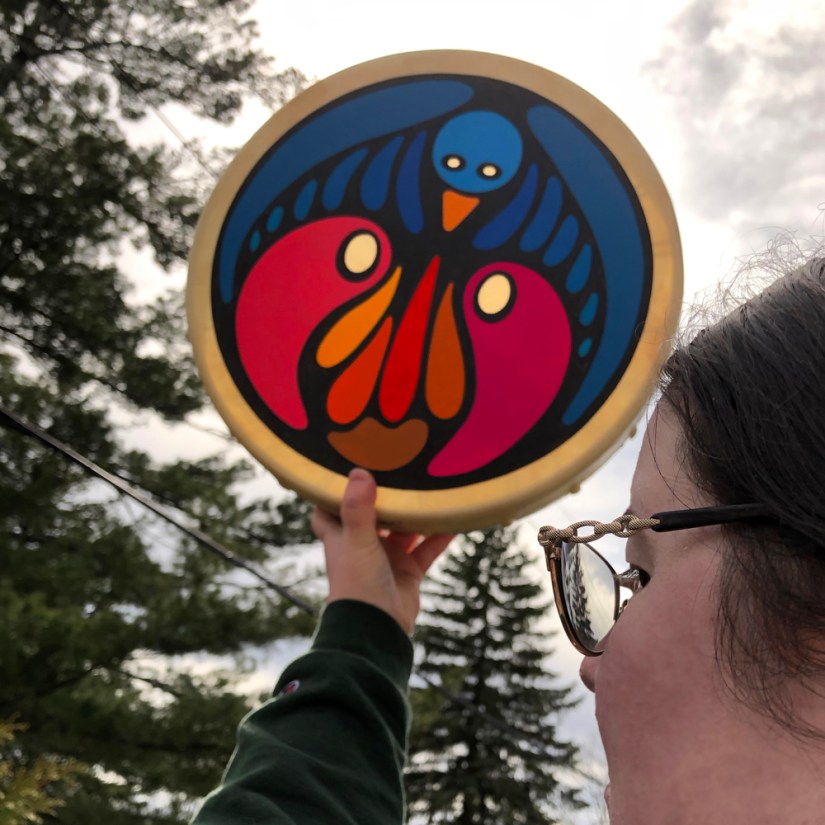
As a multidisciplinary Kingston artist, Portia “Po” Chapman is widely recognized for her nature-focused storytelling art and the high-contrast paintings that adorn her artisanal frame drums. What is less known about her rawhide art, however, is a very deliberate choice she makes: Po does not paint the faces, eyes, or skin of the characters in her images. Instead, she leaves them unpainted so that the natural rawhide becomes the skin of her figures, creating inherently inclusive content. The strategy reveals itself in the light—when noonday sunlight shines through the back of a painted drum, the figures come alive, with their faces, eyes, and skin literally glowing.
Held against the sky, natural sunlight passes through the unpainted rawhide skin and eyes of the characters, bringing the high-contrast artwork alive with a golden glow.
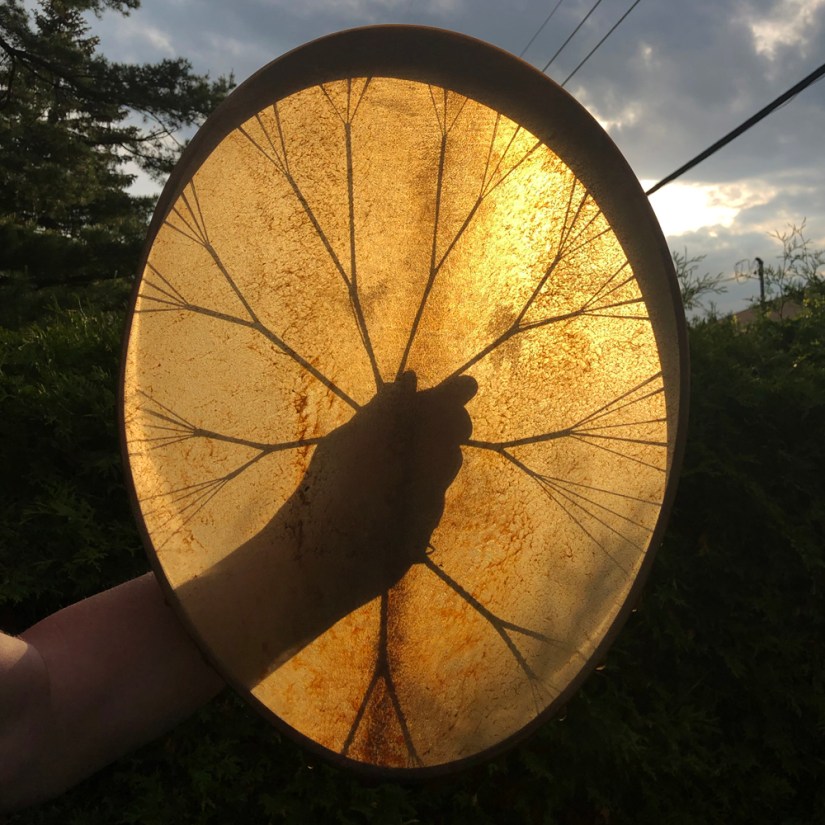
Sunlight passes through an unpainted bison rawhide drum built at Po’s Kingston studio, illuminating its natural fiber textures and tree of life lacing pattern—the primary inspiration for the artificial backlighting engineered in the Being Seen Glow Chamber.
It was the golden, sunlit radiance that inspired the glow for Po’s immersive, interactive art installation, Being Seen: when Being Seen… we glow, hosted at the Kingston Arts Council (KAC) Pocket Gallery in Kingston, Ontario’s Tett Centre for Creativity and Learning from July 27 to September 18, 2026. To bring this installation to life, she set out to engineer a way, using artificial electrical backlighting, to simulate the natural essence of sunlit rawhide.
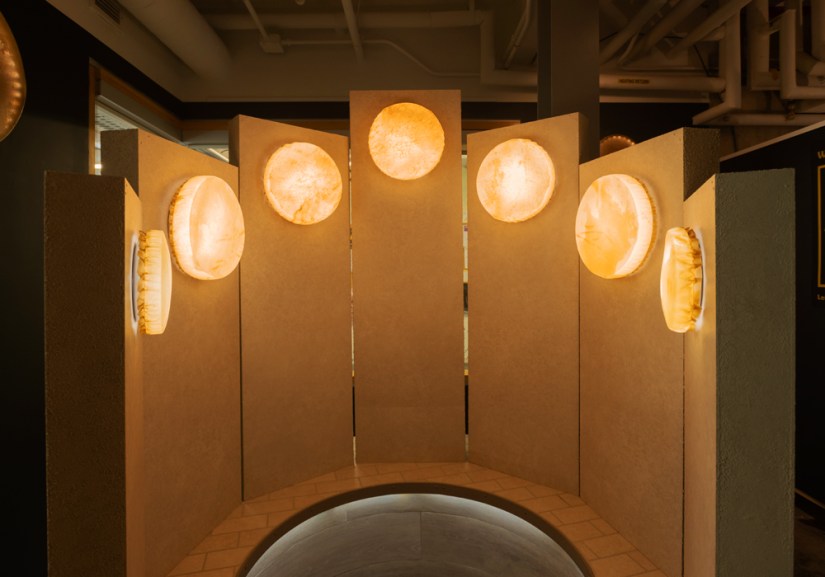
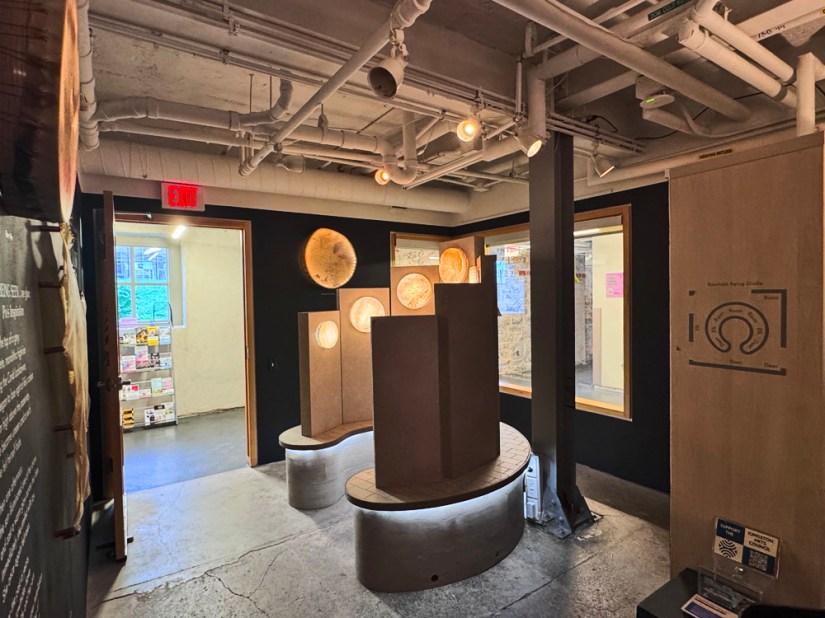
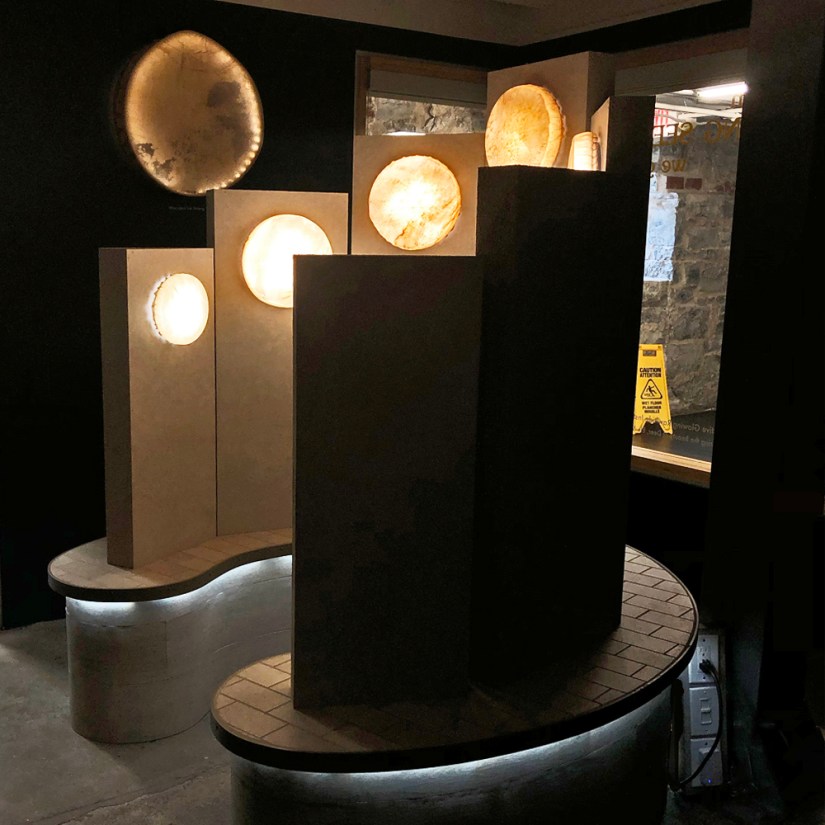
The interactive Glow Chamber from Portia “Po” Chapman’s exhibition when BEING SEEN… we glow, featuring backlit rawhide vessels radiating the natural golden warmth of sunlit rawhide.
This is the story of how Po engineered the glowing vessels of the Glow Chamber.
The Search for the Perfect Light
Because an installation of this exact existence had never been done before, Po had no existing reference points or guides to follow. She embarked on a long, experimental journey of trial and error to find a light source that could evoke the precise emotional response of feeling truly seen.
On installation day at the KAC Pocket Gallery, Po uses dimmer switches to fine-tune the backlighting, capturing the exact sunlit radiance that evoked a visceral, womb-like sense of comfort for gallery visitors.
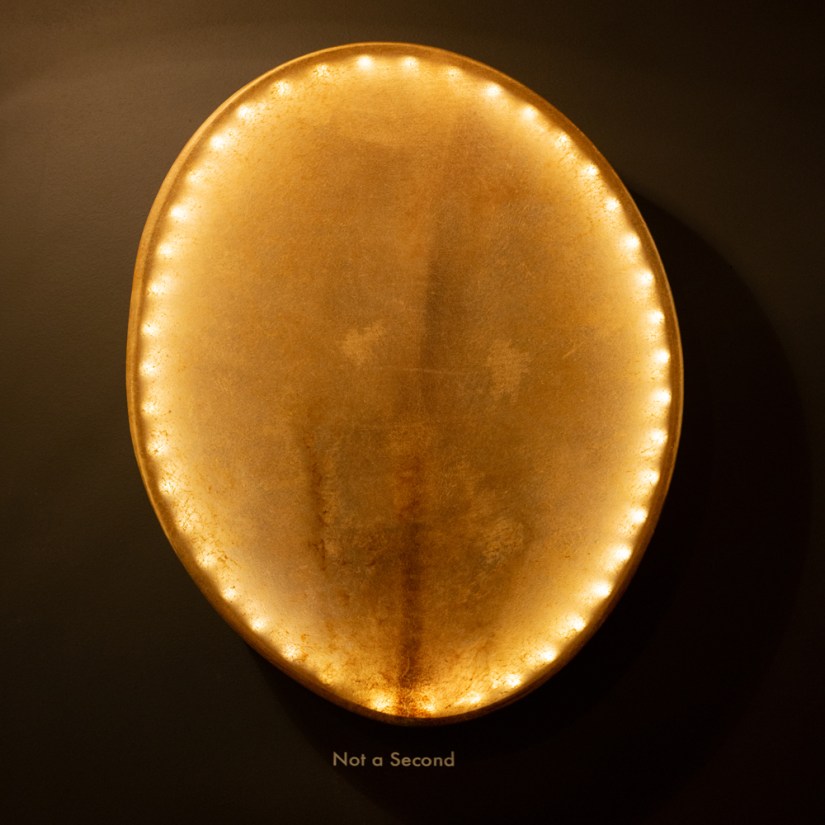
Her first attempts involved sampling incandescent lights. While they provided a comforting hue, the heat generated, even after drilling holes for vents, caused the enclosed rawhide to overheat, crack, ripple, and emit an unpleasant scent. Next, she tested cool LED strip, tape, and rope lighting. While these options beautifully framed her drums (such as her bison drum, “Not a Second”), they created a spotted effect rather than the unified, radiant glow she sought.
Featured in the Being Seen exhibition, the bison rawhide drum titled Not a Second demonstrates an early lighting iteration using LED perimeter lighting, showcasing the drum’s organic texture while highlighting the search for seamless light diffusion.
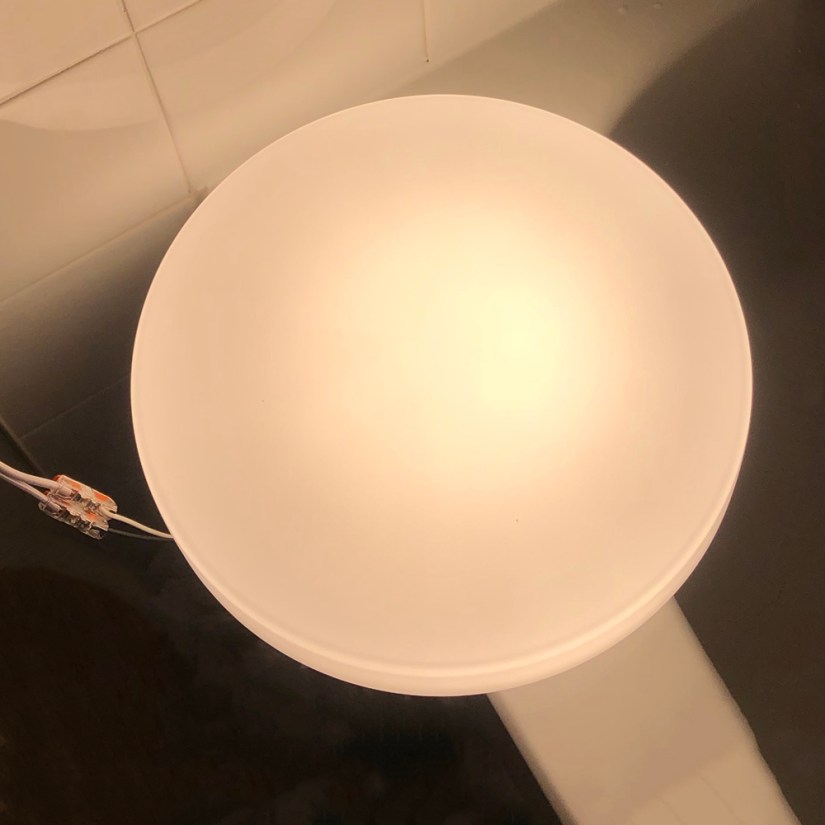
She then tried LED Flat Panel Flush Mount Ceiling Lights, which produced the right glow but proved cost-prohibitive and offered limited size choices. Finally, Po discovered an economical, budget-friendly round LED fixture equipped with a colour temperature adjustment switch (allowing selection between soft white, bright white, and daylight) paired with an opaque plastic diffusing shade. This combination yielded the soft, manageable, even glow she needed.
Studio trial of a color-temperature-adjustable LED light featuring a plastic diffusing shade, providing the smooth light dispersion required to safely illuminate rawhide vessels from within.
Selecting and Soaking the Hides
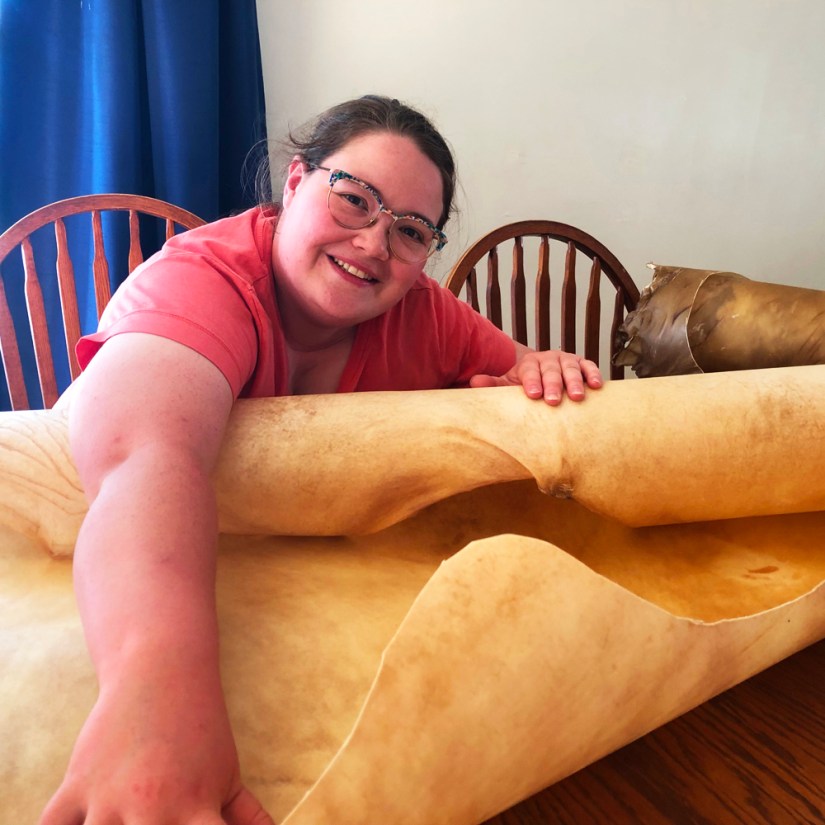
With her light source established, Po turned her attention to selecting the rawhide. Working in her studio, she unrolled various deer, elk, and bison hides to choose pieces for 8, 10, and 12-inch light diffusers. Because rawhide ranges from opaque to nearly transparent, and spans shades from silver to cream, gold, and deep amber, she meticulously curated hides with unique scars, holes, and mottled textures to achieve her desired ambient, glowing story.
Rolling out the rawhides (deer, elk, and bison) at Po’s Kingston art studio to select pieces based on their specific colors, textures, and translucency, determining the unique glow each vessel will produce in the Being Seen installation.
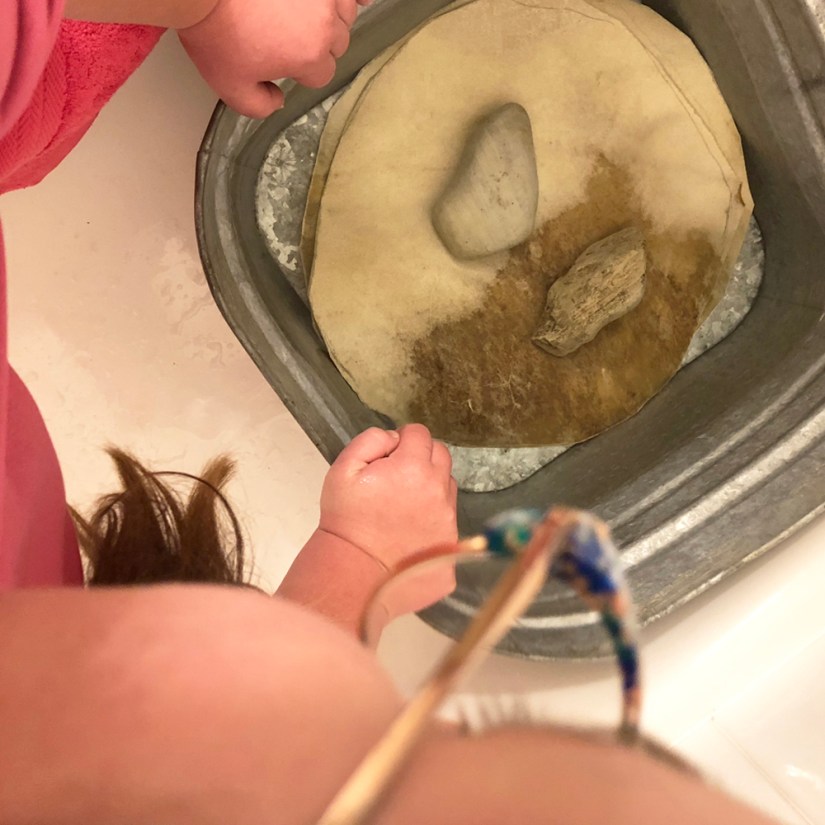
After rough-cutting the hide into rounds, Po submerged them two at a time in a dedicated galvanized washtub filled with tap water. The soak times varied significantly by hide type: deer rawhide soaked for 12 hours, elk rawhide soaked for 24 hours, and bison rawhide soaked for 48 hours. To keep the naturally buoyant hides fully submerged, she initially weighted them down with river rocks. Halfway through the soak, she removed the rocks and flipped the hides; once fully hydrated, the rawhide suspended naturally in the water bath like fish staying still in a clear pond.
Inside her Kingston studio, Po submerses rough-cut rawhide rounds two at a time in a dedicated galvanized washtub, using river rocks to keep the buoyant hides submerged as they hydrate and soften.
The process differed from Po’s method of soaking rawhide drum skins which are soaked in rain water, weighted by natural crystals, and soaked one at a time for individually specific times.
Giving in to the Rawhide: A Technical Breakthrough
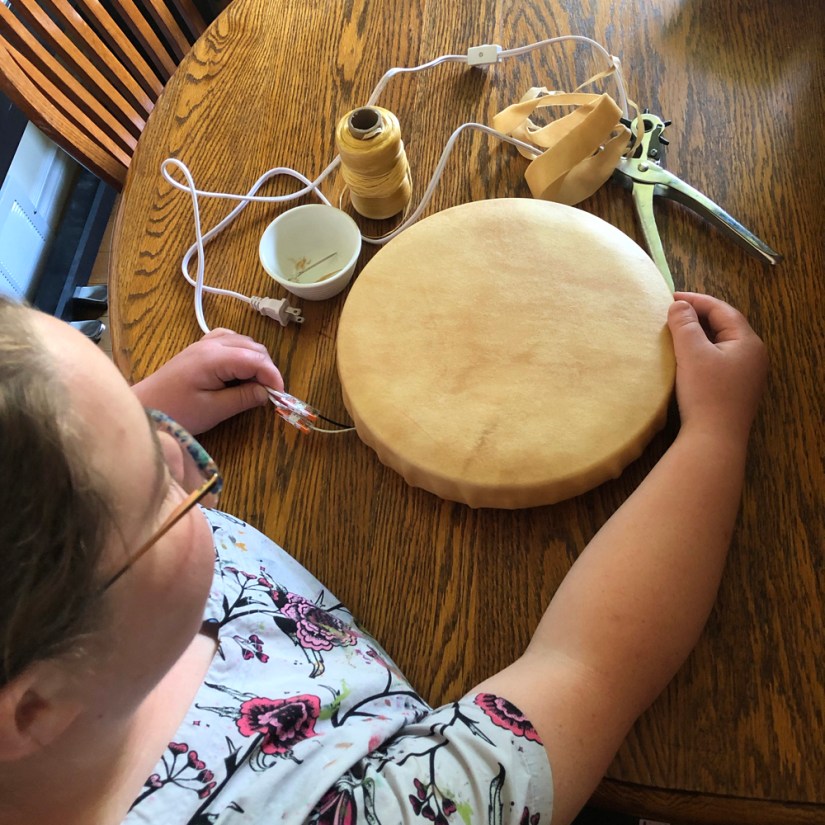
Wrapping wet, pliable rawhide over plastic diffusers proved vastly different from stringing traditional oak or maple frame drums. Rawhide exerts immense force as it dries and shrinks. Po’s early trials failed because pulling the hide tightly with standard drum-lacing techniques warped and buckled the plastic diffusers, preventing them from mounting back onto their LED base units. Po realized that to succeed, she had to stop strong-arming the material and instead give in to the nature of rawhide, allowing its natural, organic shape to form. She pioneered an entirely new process that included:
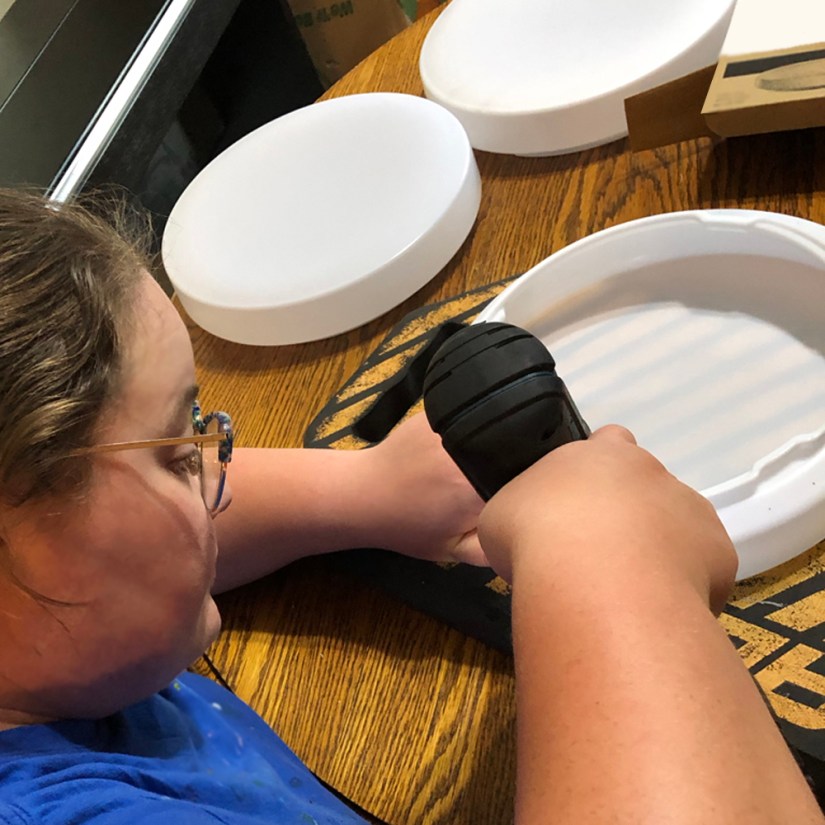
1/ Precision Drilling: She determined a precise location, hole pattern and frequency to drill directly into the plastic diffusers, matching them with holes punched around the hide using a leather punch.
To successfully wrap the backlighting diffusers with rawhide for the Being Seen installation, Po pioneered a custom hole pattern through the plastic, allowing the shrinking hide and sinew to glide without warping the structure, a breakthrough achieved after initial failures.
2/ Cake Fondant-Style Draping: She calculated her cut hide diameter using a dedicated formula—the diffuser diameter plus twice its depth, plus approximately two inches. Instead of stretching the hide tight, she draped it loosely over the diffuser like fondant icing over a cake.
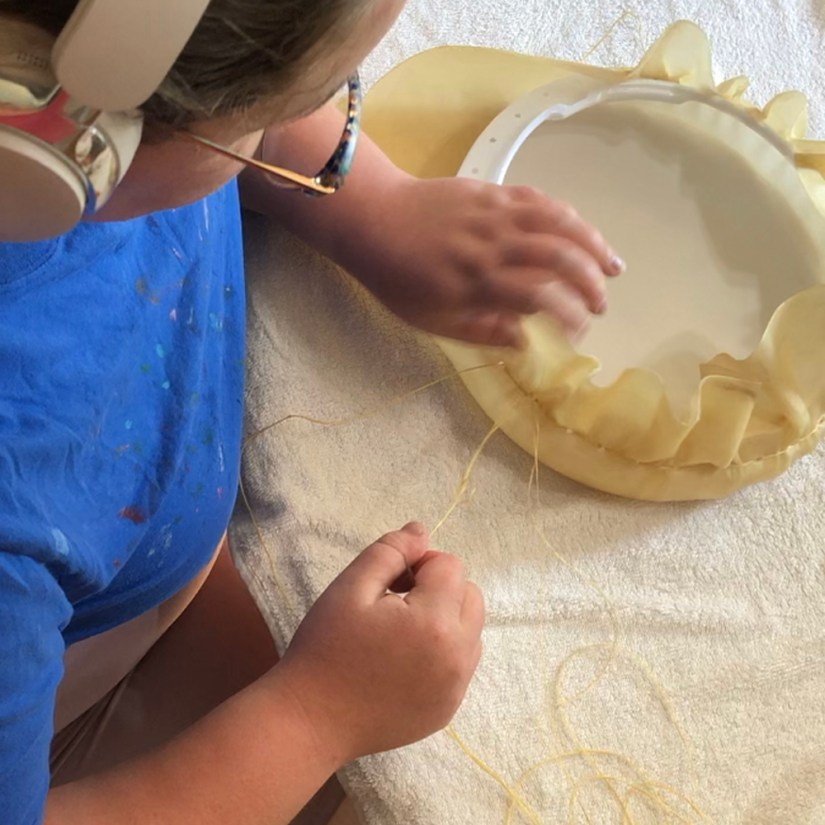
3/ Backstitch Lacing: Using synthetic sinew and a darning needle, she applied a loose, backstitch stitch pattern, that allowed the rawhide to gently shift as it shrank to fit the diffuser.
Moving beyond traditional frame drum measurements and tension, Po innovates by employing an innovative backstitch lacing technique on soaked rawhide, draped loosely like fondant over a custom-drilled plastic LED diffuser. This technique allows a natural ruffle to form, which she meticulously molds and trims into a hide skirt to perfectly obscure the fixture hardware.
This technique allowed a natural, flowing ruffle to form, rather than measured exact pleating that she creates for her frame dums. The excessive hide created a skirt that covered the metal mounting hardware.
Assembly, Engineering, and Testing
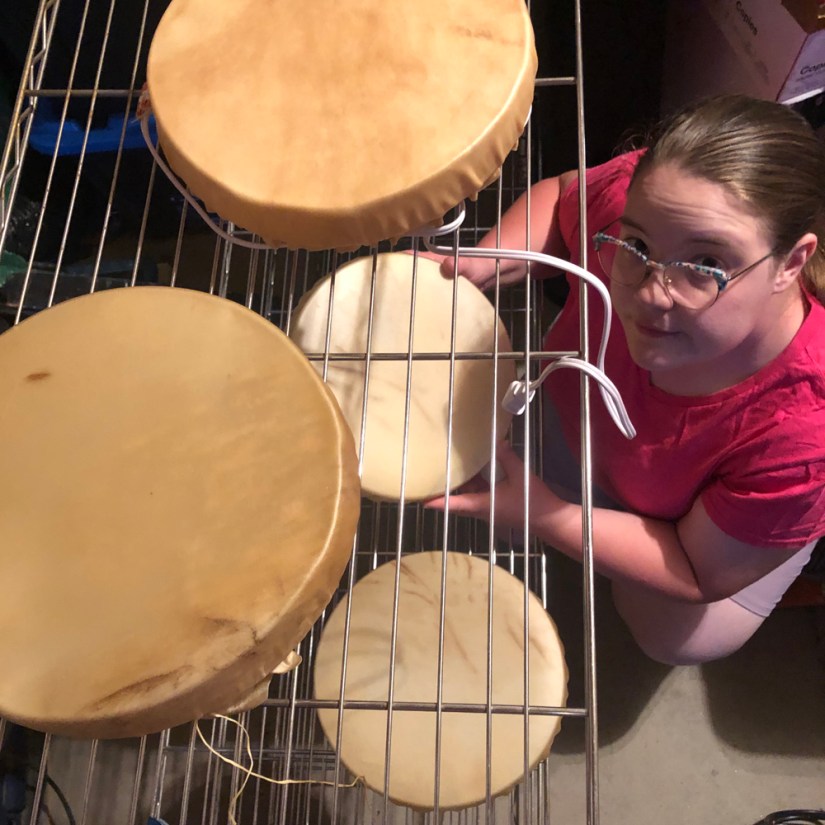
Once laced, the vessels were transferred to a wire drying rack in Po’s woodshop. Because the hide rested against a solid plastic diffuser, the drying process took longer than standard open-backed frame drums. During this drying window, Po actively hand-sculpted and finger-molded the curves and flow of the rawhide ruffles, progressively trimming them as they set.
In her Kingston woodshop, Po manages the crucial drying phase for the Being Seen installation. She meticulously positions each newly wrapped diffuser vessel on a wire rack, using this precise time window as the hide tightens to sculpt and manipulate the organic curve and flow of the rawhide ruffles.
To prepare the fixtures for gallery mounting, Po converted the hardwired LED ceiling lights into plug-in lamp units using transparent Wago Lever-Nut connectors. This allowed all the monolith-mounted vessels to plug directly into a central power bar controlled by a single master dimmer switch that the gallery staff could use with ease.
Converting ceiling lights into plug-in gallery fixtures, Po uses transparent Wago Lever-Nut connectors to safely join the LED wiring to plug-in lamp cords, enabling the entire monolith display to be powered by a single master power switch.
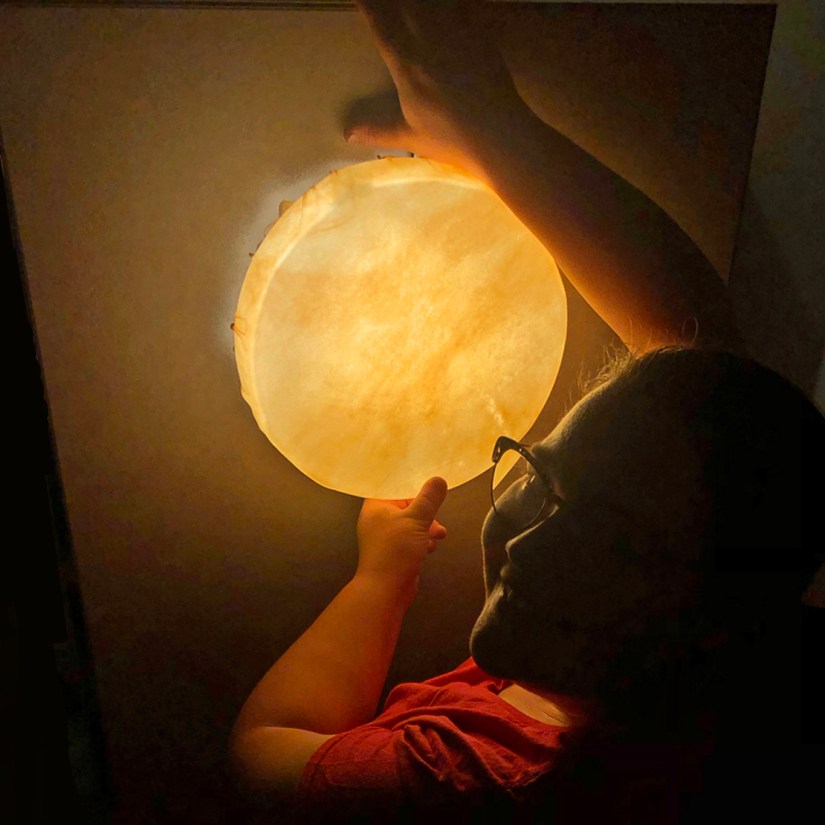
Before mounting, Po tested each vessel against panels of stone-hybrid sheeting (used to cover the MDF installation monoliths). Seeing the warm light shine through verified that she had successfully recreated the golden, sunlit warmth of a rawhide drum.
Achieving the ultimate vision: Po holds a finished glowing rawhide vessel up against the stone-hybrid monolith sheeting in her studio, verifying that the backlighting captures the exact golden warmth of noonday sunlight shining through rawhide.
Community Impact and Celestial Alignment
When the Glow Chamber was assembled and lit on installation day, adjusting the dimmer switch immediately brought the desired sunlit warmth into the space. Just three days after the exhibition opened on July 28, nature provided a striking confirmation: on July 31, 2026, a bright full moon rose in the midnight sky, glowing with the exact golden warmth Po had engineered in her studio.
On July 31, 2026—just three days after Being Seen opened—the midnight moon offered natural confirmation, glowing with the exact warmth and organic variance of Po’s sunlit and engineered rawhide creations.
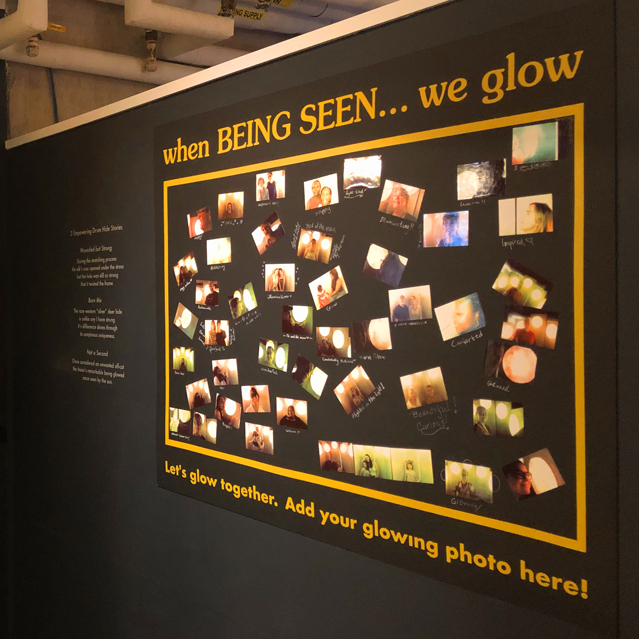
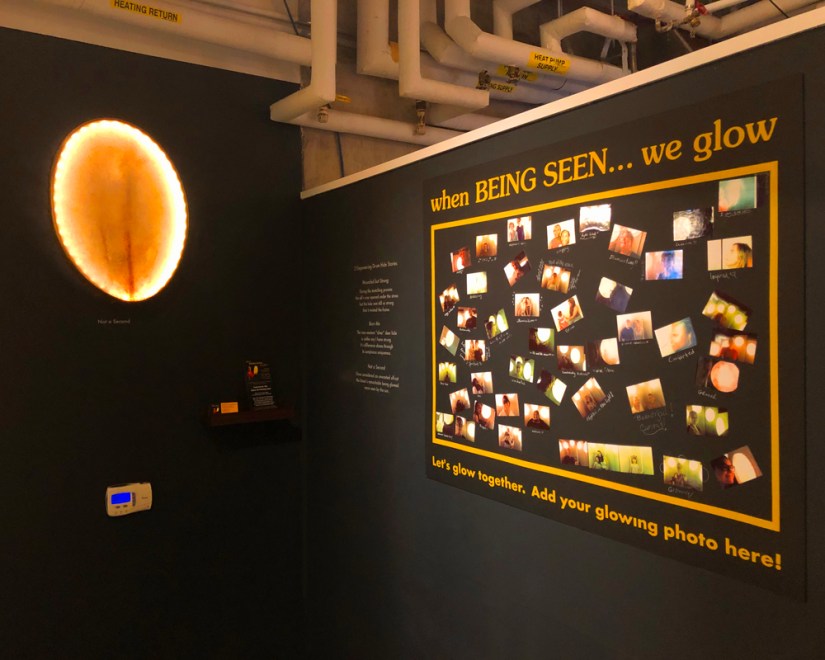
Gallery visitors responded with deep emotion, often describing the Glow Chamber as a comforting, “womb-like” space. As part of the interactive exhibition, 70 guests snapped selfie portraits inside the Glow Chamber and posted them onto an interactive gallery board alongside handwritten reflections of their experience.
The heart of the community connection: 70 exhibition visitors posted their glowing selfie portraits and personal reflections on the interactive board inside the Kingston Arts Council Pocket Gallery during Portia “Po” Chapman’s Being Seen exhibition (July 27 – September 18, 2026).
By capturing the feeling of noonday sunlight through rawhide, Portia “Po” Chapman created a space where visitors could joyously glow together—proving her core thesis: “Everyone glows when they feel seen.”
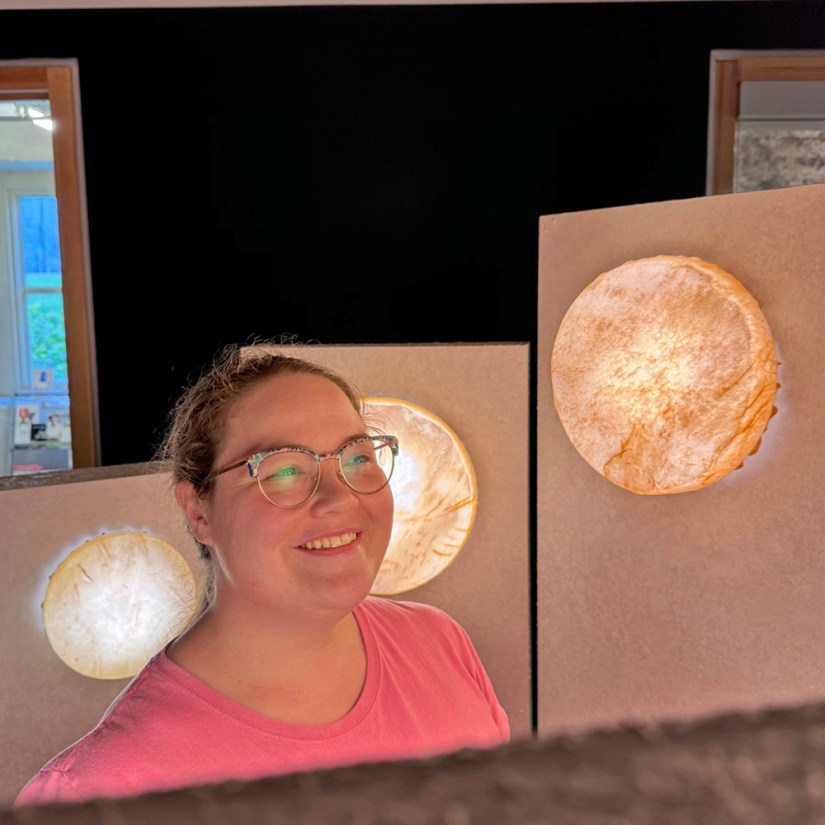
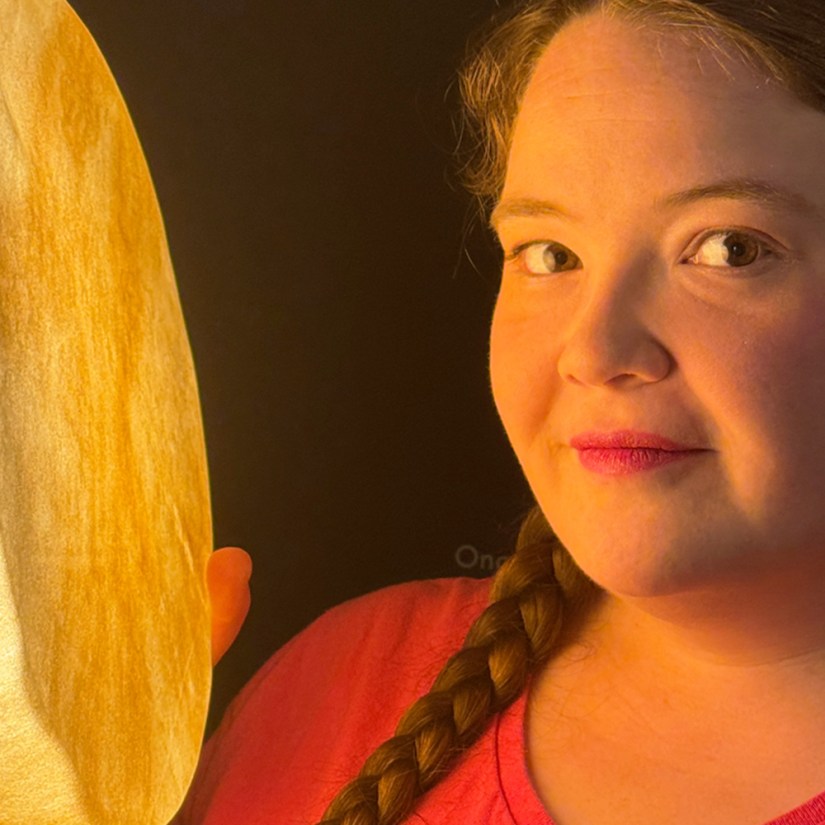
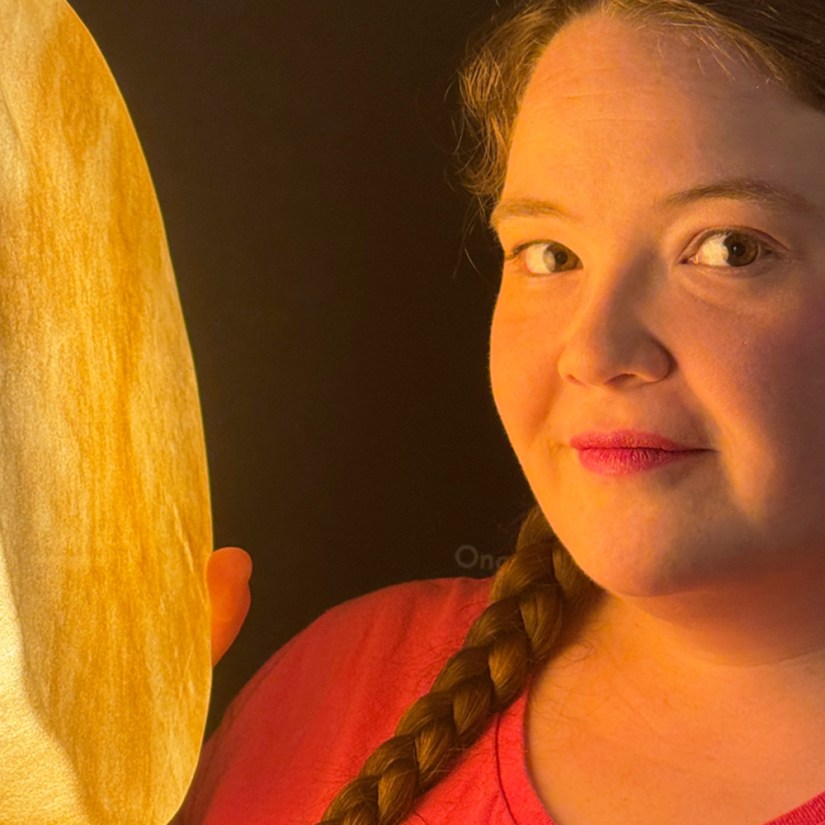
Celebrating the realized vision: Po poses in the Kingston Arts Council Pocket Gallery alongside one of her completed backlit rawhide vessels, illuminated by the warm golden glow achieved through months of dedicated experimentation and innovation. Photo by Ann Decker.
Hosted by the Kingston Arts Council at the Tett Centre for Creativity and Learning, Being Seen: when Being Seen… we glow, marked both a community success and a major advancement in Po’s ongoing evolution of rawhide art.
The site-specific Glow Chamber on view inside the Kingston Arts Council Pocket Gallery during the immersive exhibition, “Being Seen: when Being Seen… we glow.”
Portia “Po” Chapman is a Kingston-based multidisciplinary visual artist, muralist, and certified educator (BFAH, B.Ed, OCT) recognized for her site-specific Storytelling Art and signature high-contrast aesthetic. Blending traditional craft—such as artisanal rawhide sculpting and woodworking—with innovative lighting design and digital tools, she creates immersive, community-driven installations that invite viewers into a shared, radiant dialogue where everyone glows. Discover more of her portfolio, public artworks, and upcoming projects at loveartbypo.ca.
Let Me Know What You Think! Start or Join the Convesation Cancel reply
When audience members step into an immersive installation, they immediately experience an atmosphere designed to evoke a felt emotional response.
Portrait of Portia Po Chapman engaging one of the Glow Chamber’s golden glowing rawhide vessels by Kingston portrait artist Ann Decker at the Kingston Arts Council Pocket Gallery exhibition “Being Seen,” August 2026.
Yet behind that seamless experience lies an intricate, often invisible layer of site-specific planning, structural engineering, and studio fabrication. For the Being Seen exhibition, by Kingston artist Portia “Po” Chapman, at the Kingston Arts Council (KAC) Pocket Gallery, creating the central Glow Chamber required translating complex spatial limitations into deliberate design choices.
The site-specific Glow Chamber on view inside the Kingston Arts Council Pocket Gallery during the immersive exhibition, “Being Seen: when Being Seen… we glow.”
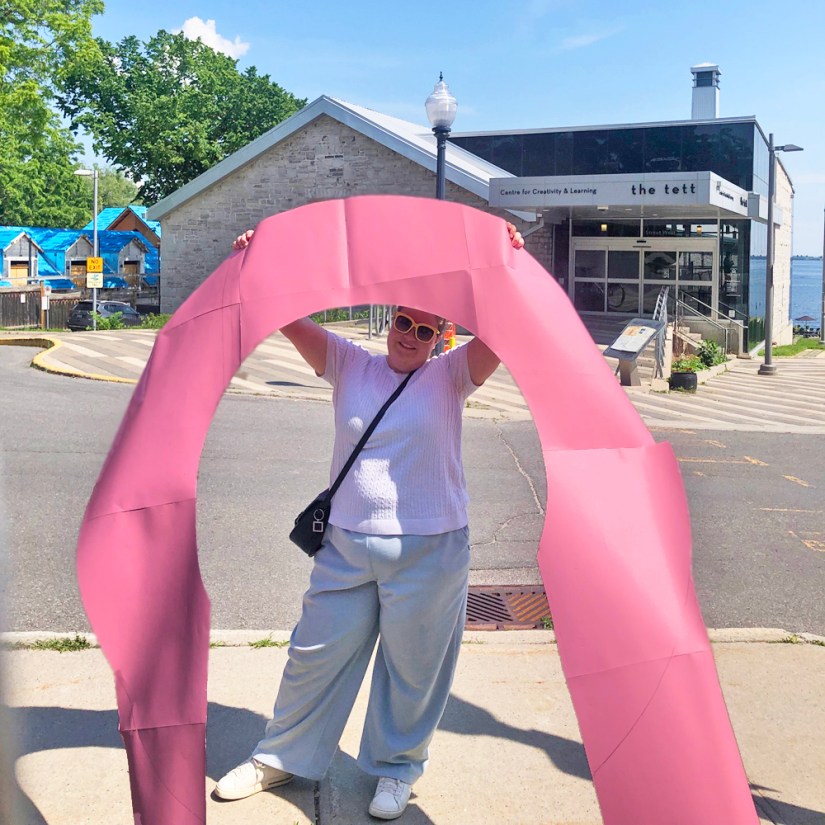
Site-specific art demands that an artist work in direct conversation with a physical space. Initial room measurements rarely reveal the true essence or practical challenges of an architectural environment. Before construction began in Chapman’s Kingston art studio, she rendered a 3D CAD model based on gallery blueprints, followed by a crucial site visit with a full-scale pink paper floor template.
Kingston artist Portia Po Chapman arriving at the Tett Centre with her full-scale paper template to test accessibility and spatial constraints for the Glow Chamber.
The Pocket Gallery presented numerous real-world constraints: an off-center metal pillar, doorway sight-lines, a moving wall shelf, spotlight clearances, and strict accessibility requirements for wheelchair maneuverability. By laying out the 1:1 template on-site, Chapman trimmed perimeter arcs and notched out sections around the pillar—adjustments essential to ensuring the structure would fit safely before cutting a single sheet of wood.
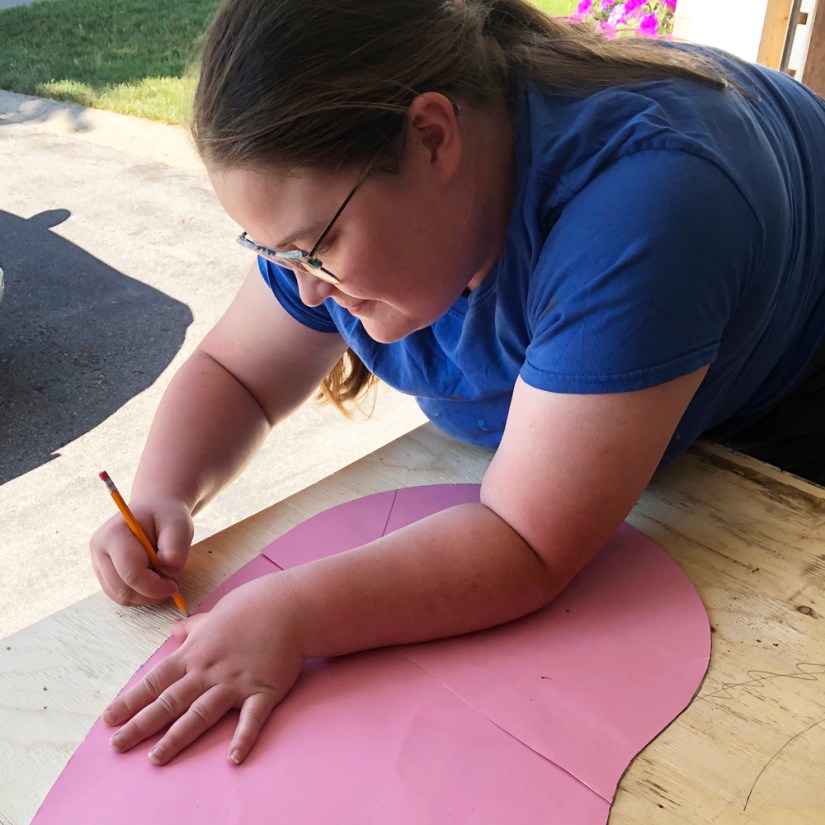
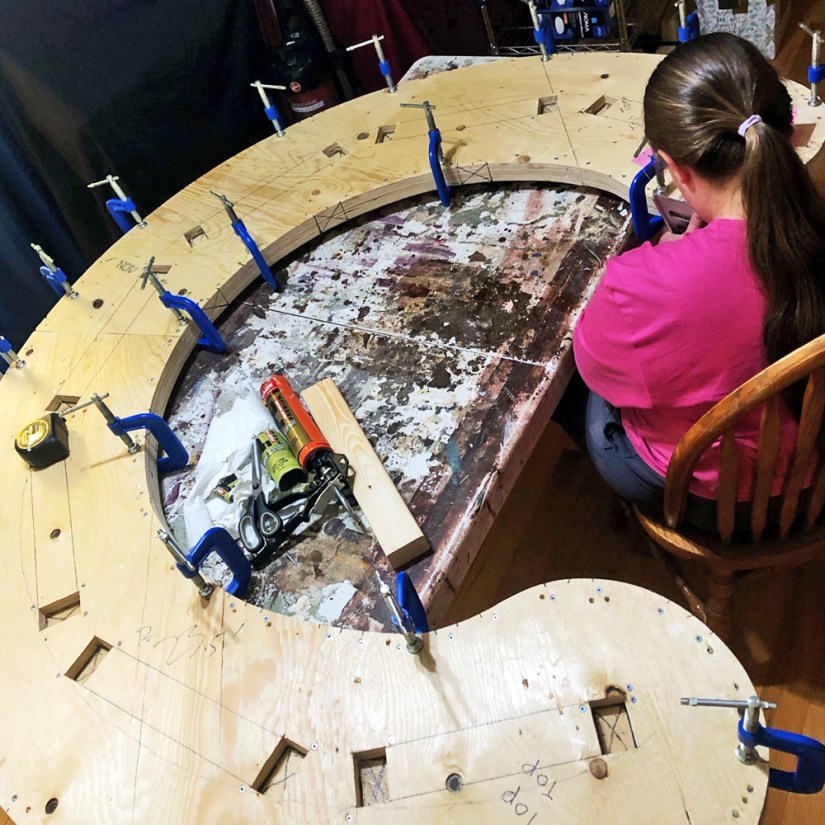
Tracing the site-tested template onto plywood sheets to construct a double-layered, staggered-seam base for maximum durability.
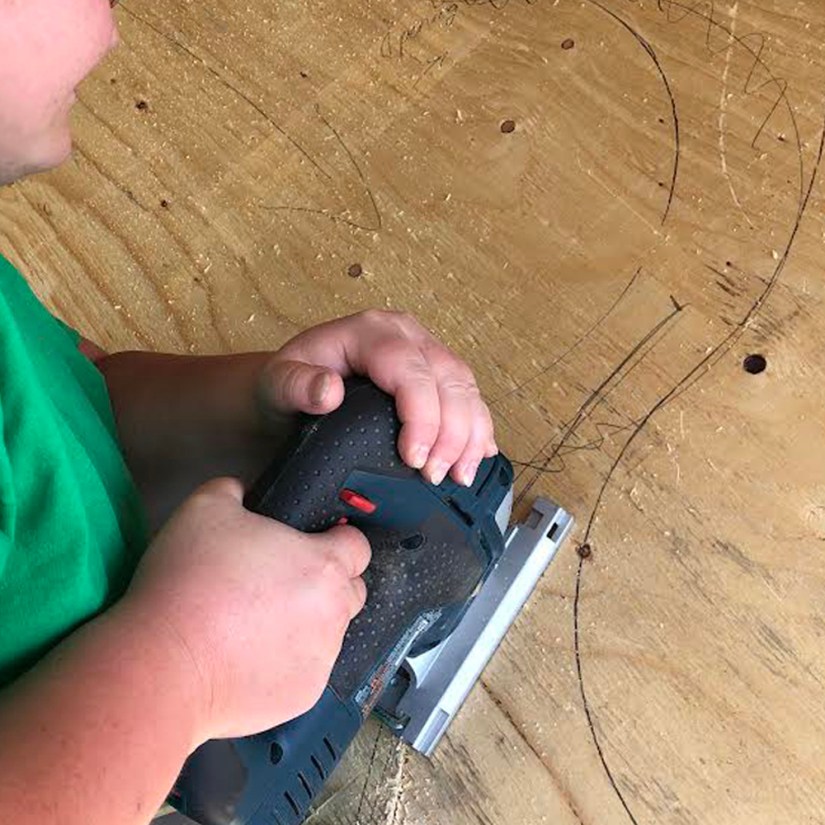
Making preliminary rough cuts between traced template halves before clamping and precision-cutting the final base shapes.
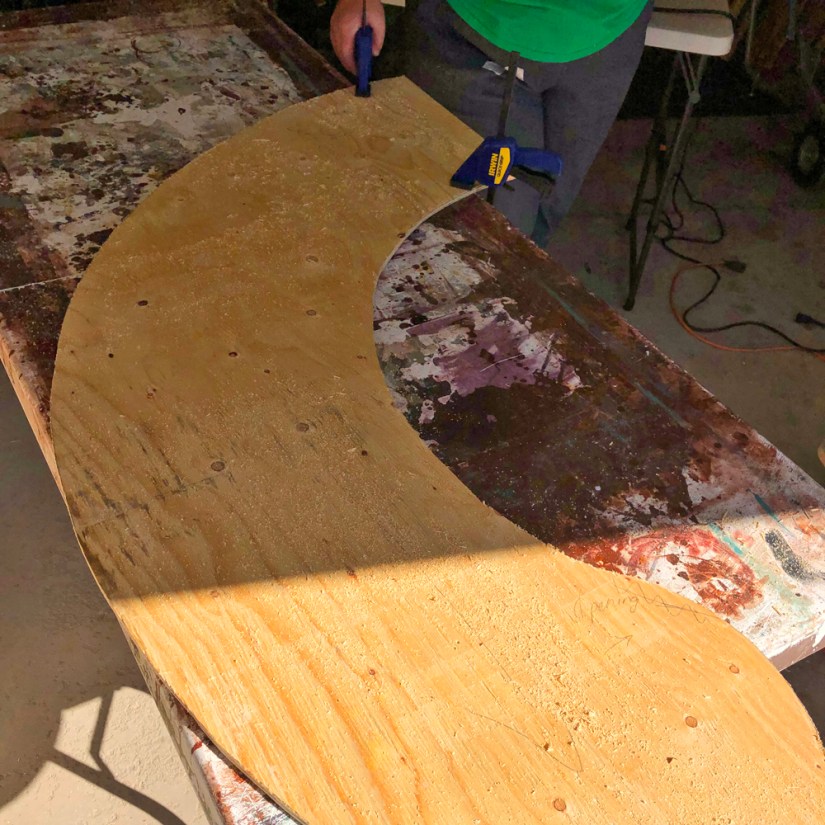
One half of the custom plywood base fully cut to shape along the traced template curves in the studio wood shop.
Back in the woodshop, these site adjustments dictated Chapman’s studio practice. To guarantee structural integrity across the gallery floor, Chapman built an “integrated plinth” using two staggered-seam layers of laminated plywood, eliminating structural weak points.
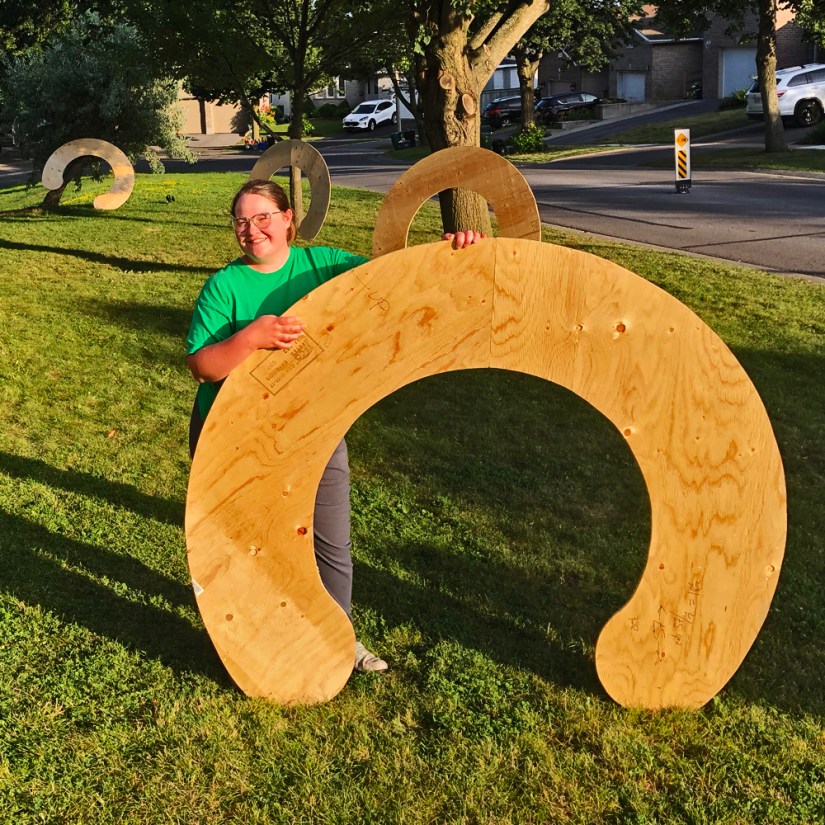
Sorting and lining up the base arc halves with offset seams before gluing, clamping, and screwing the layers together.
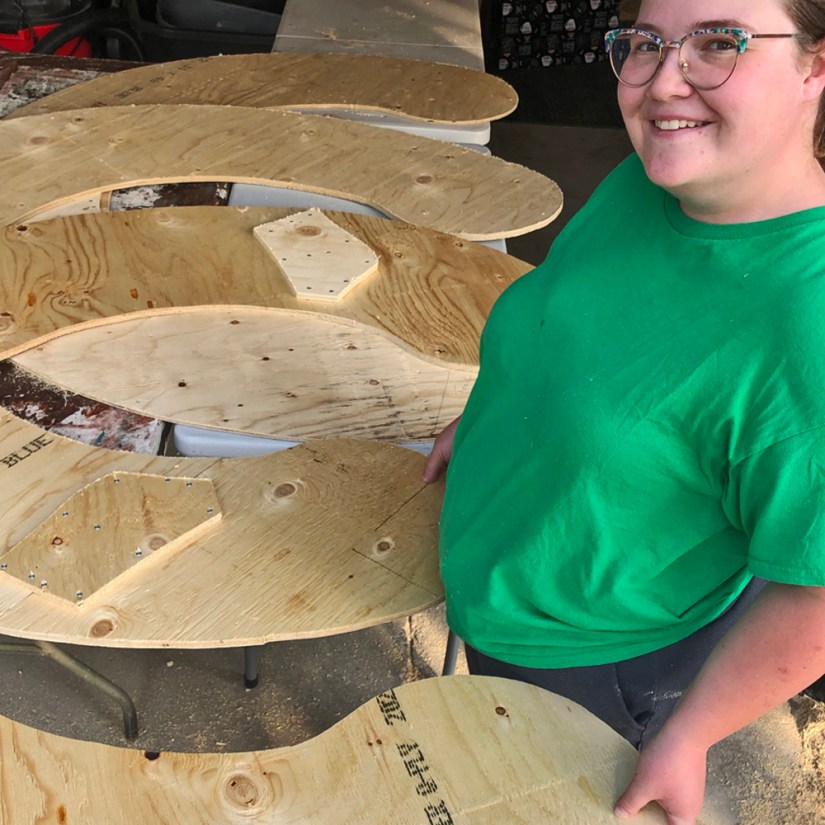
Artist Portia Po Chapman outside her Kingston studio with the four cut plywood base arcs before laminating them into double-layered, staggered-seam pairs.
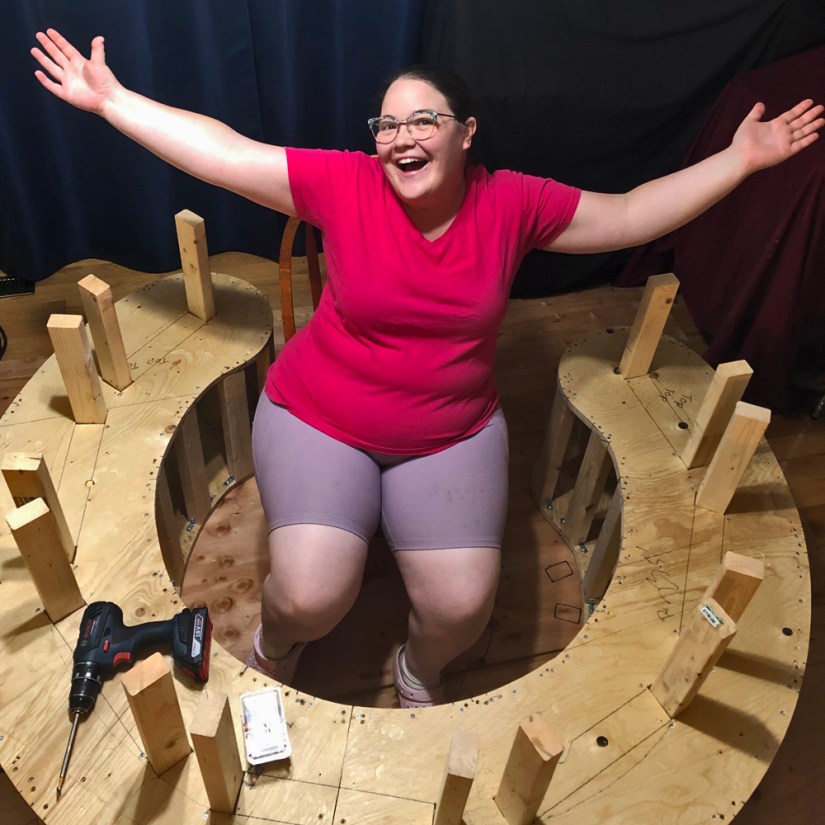
Anchored vertical 2×3 studs formed the core skeleton for seven hollow MDF monoliths.
Clamping the top and bottom plywood base layers together to trace precise locations for the monolith legs and interior support studs.
Artist Portia Po Chapman celebrating as her CAD 3D rendering materializes into a physical 3D structure in her Kingston art studio.
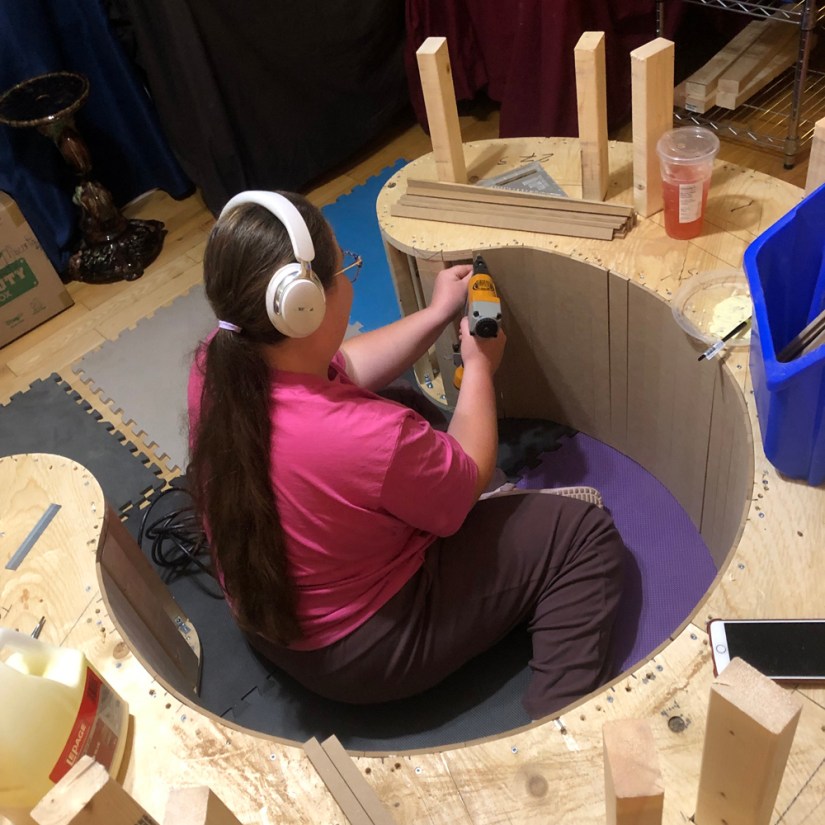
Brad nailing flexible perimeter sheathing around the internal studs to enclose the integrated plinth structure.
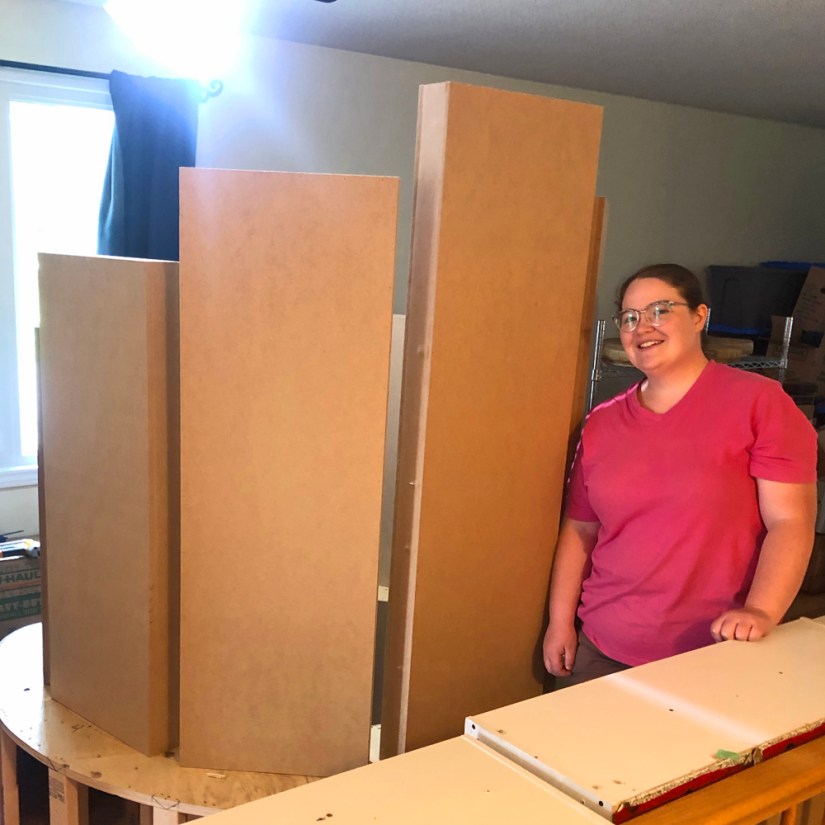
Because gallery spotlights capped the allowable height, the tallest monolith was engineered to top out at 6’2″—maximizing human scale while allowing safe clearance during installation.
Kingston artist Portia Po Chapman standing with the first hollow MDF monolith structures, engineered for accessibility and tailored to gallery height constraints.
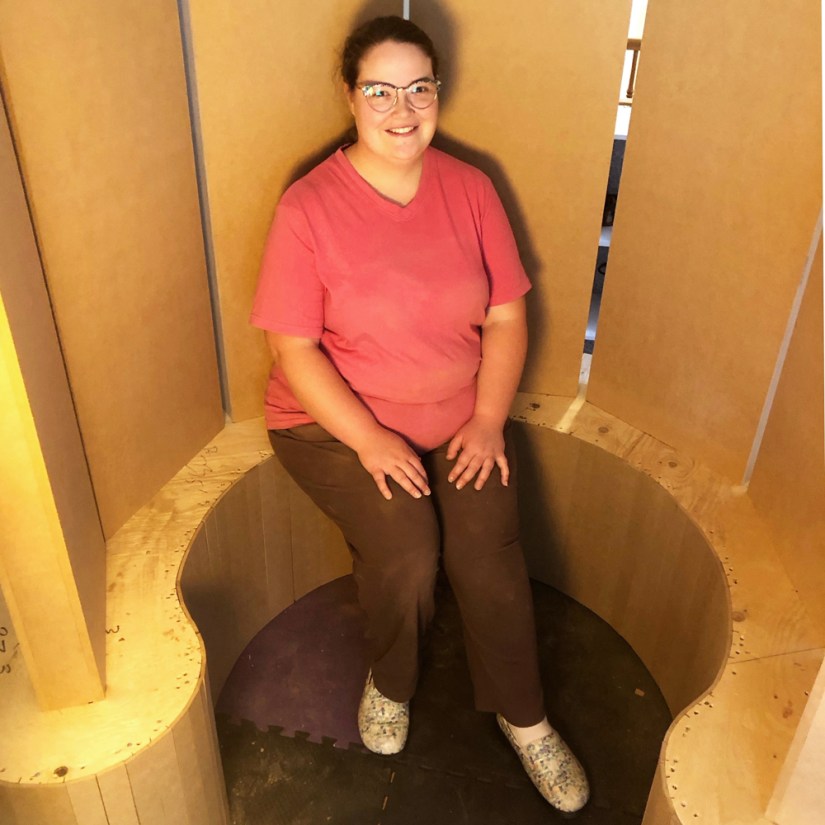
Po sitting for the first time within the assembled MDF monolith structure as her artistic vision materializes.
Every surface treatment served a deliberate conceptual function. Custom-cut stone-hybrid subway tiles, flexible oak wrapping, and troweled textures turned the monoliths into brutalist, concrete-like structures.
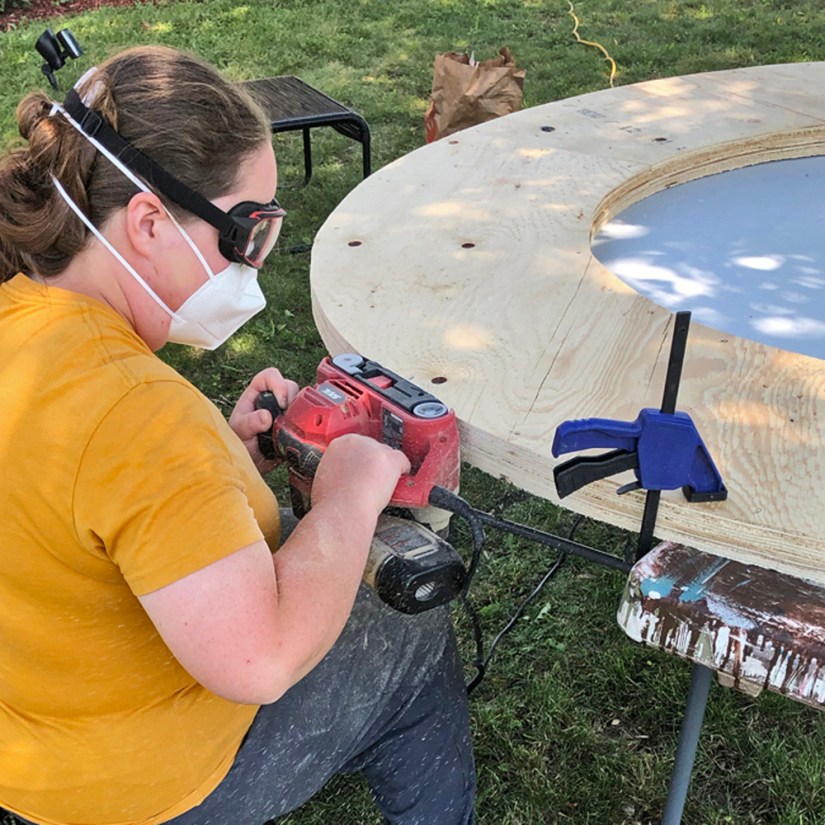
Sanding the laminated plywood base pairs outdoors under the elm tree to shape a smooth, seamless edge for the installation foundation.
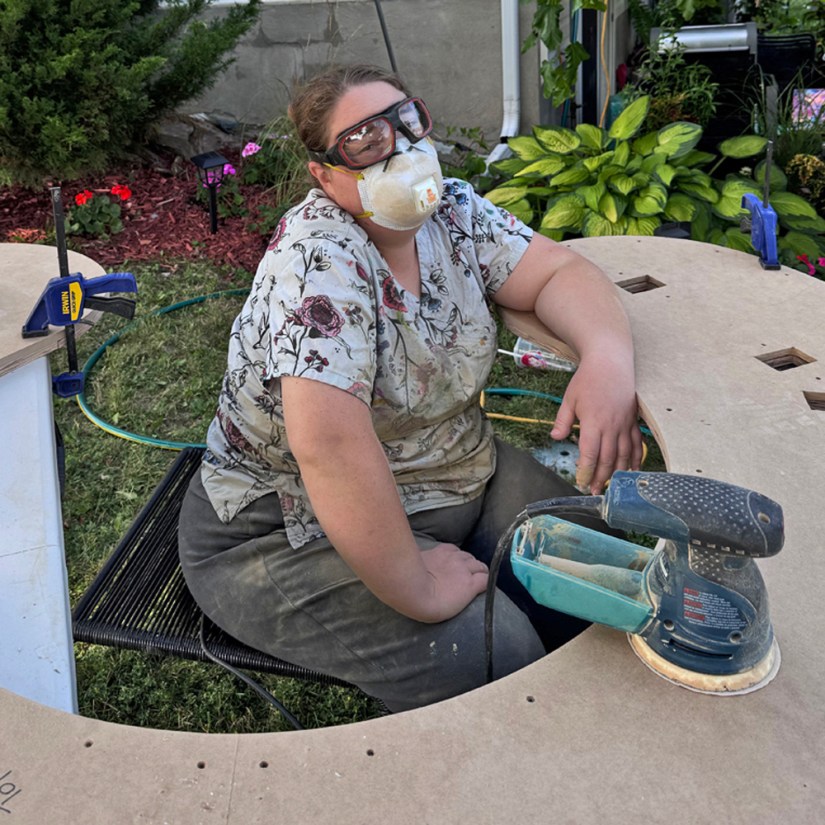
Artist Portia Po Chapman taking a break from surface sanding the third pair of plinth surfaces to prepare the top for hybrid stone tiling.
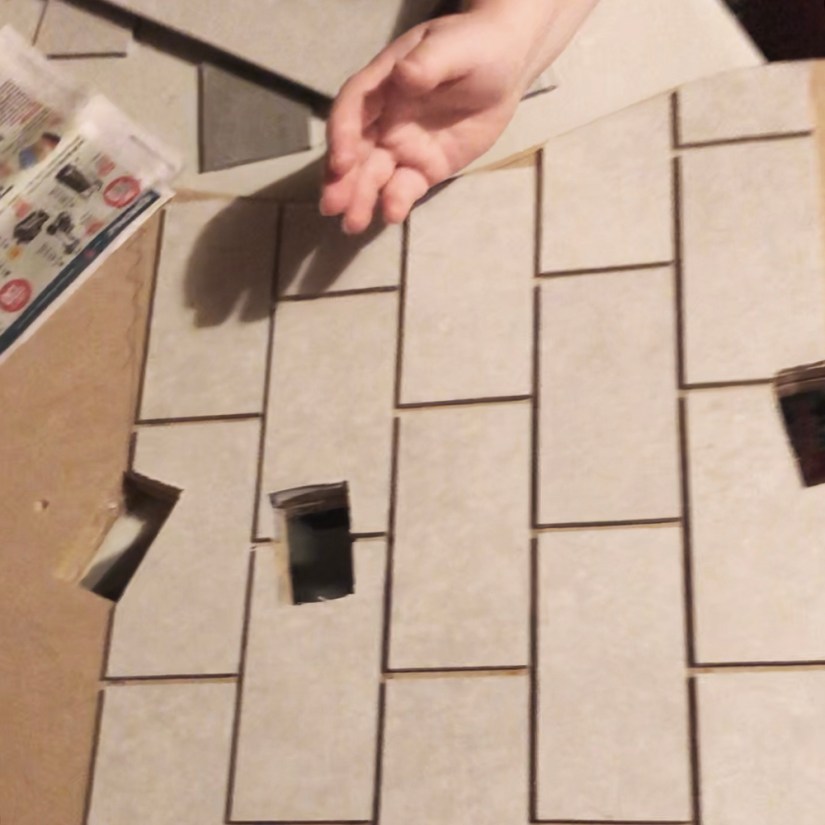
Gluing custom hand-cut stone-hybrid tiles onto the freshly sanded plinth surface in a running bond subway pattern.
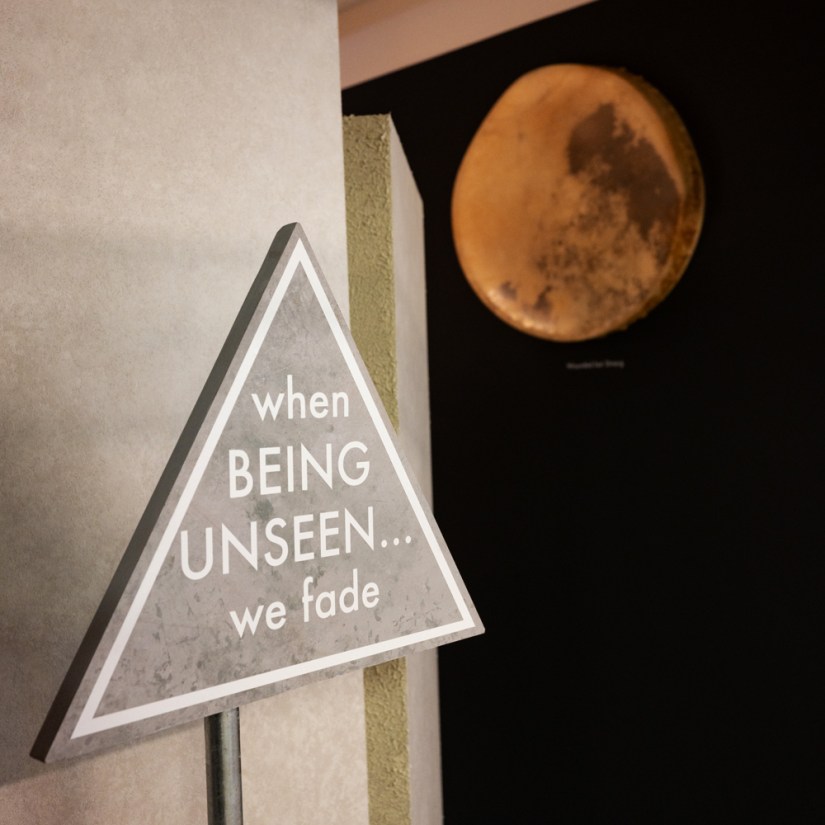
Highlighted by cool grey strip lighting beneath the plinth and a stark grey sign reading “when BEING UNSEEN… we fade”, this artificial grey environment was engineered to evoke the cold isolation of contemporary urban streets.
Detail view of the back of the Glow Chamber at Pocket Gallery, showcasing grey oak-look wall wraps, textured monolith edges, and cool urban under-lighting.
A deliberate conceptual contrast by artist in Kingston Portia Po Chapman: the faded, concrete-grey caution sign reading “when Being Unseen… we fade” stands outside the Glow Chamber, set against the warm light of a handcrafted glowing elk rawhide drum.
In site-specific installations, every unseen calculation—from staggered seams to notch clearances—quietly anchors the final artwork. By intentionally building a cold, rigid urban environment, the structural design of the Glow Chamber established the perfect harmonic contrast, setting the stage for visitors to feel the uplifting, golden warmth of being seen.
The Glow Chamber illuminated on site in the Pocket Gallery alongside a custom back-lit elk rawhide drum, set against the black walls and architectural features of the space.
Portia “Po” Chapman is a specialized Site-Specific Artist, muralist, and educator (BFAH in Sculpture & Installation, B.Ed, OCT) based in Kingston, Ontario. Renowned for her rigorous technical precision and signature high-contrast aesthetic, she transforms complex architectural constraints—from strict accessibility parameters to spatial obstructions—into immersive, felt emotional experiences. By fusing raw, organic elements like hand-sculpted rawhide with brutalist structural engineering, modern digital tools, and integrated print media, Portia crafts site-specific environments where every invisible detail invites viewers into active dialogue with the work. Discover more of her portfolio, public artworks, and upcoming exhibitions at loveartbypo.ca
Let Me Know What You Think! Start or Join the Convesation Cancel reply
An art installation rarely begins at the gallery threshold; at its most potent, it breathes long before a viewer steps into the room. For Kingston visual artist Portia Po Chapman, the print media for her solo exhibition, Being Seen: when Being Seen… we glow, was never conceived as standard promotional marketing. Instead, it operated as a contemporary, active material of the installation itself—a physical and emotional bridge connecting the vibrant summer streets of downtown Kingston to the intimate interior of the KAC Pocket Gallery at the Tett Centre for Creativity and Learning.
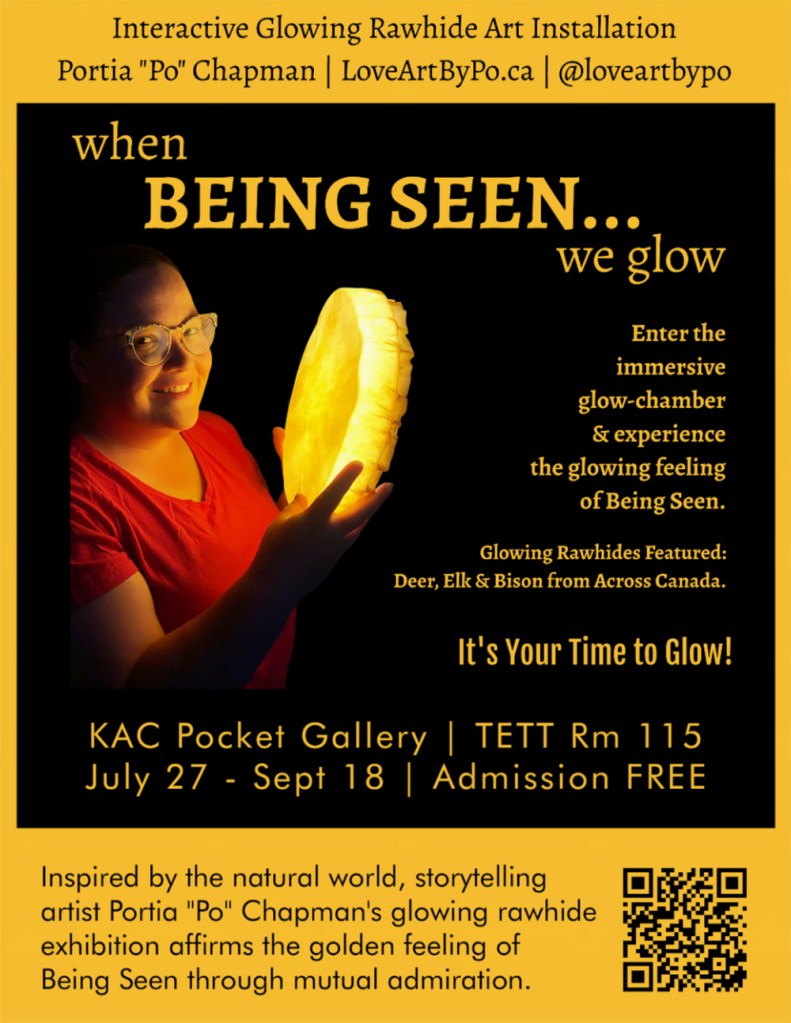
The official print media poster distributed throughout downtown Kingston, bridging the community to Portia “Po” Chapman’s interactive exhibition at the Tett Centre for Creativity and Learning
By treating posters, rack cards, business cards and signage not as mere invitations, but as the opening movement of a shared pilgrimage, Chapman established a living framework where the artwork began on the sidewalks.
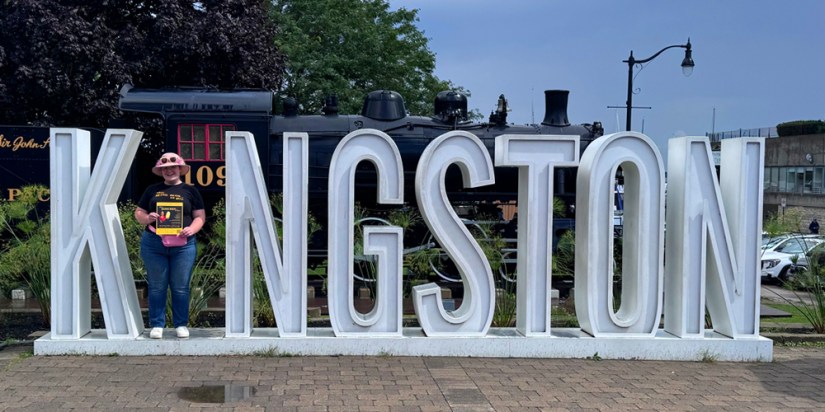
Portia “Po” Chapman standing in as the letter “I” in the iconic Kingston waterfront sign, holding a Being Seen poster to conclude her community promotional walk.
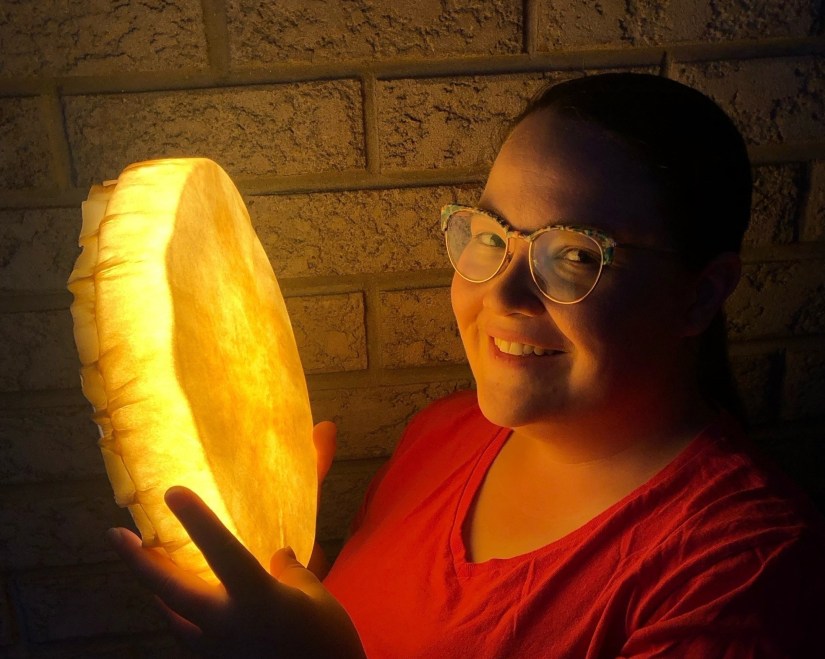
The foundational visual identity, anchored by an unedited night photograph of illuminated rawhide taken outside her studio,
The original night photograph outside the Portia “Po” Chapman’s Kingston art studio that inspired the entire visual identity, warm glow, and colour palette for “Being Seen: when Being Seen… we glow.”
infused every piece of print collateral with the exact warm, golden glow and high-contrast black backdrop of the central Glow Chamber, inviting passersby to seek out that same feeling of mutual admiration and visibility.
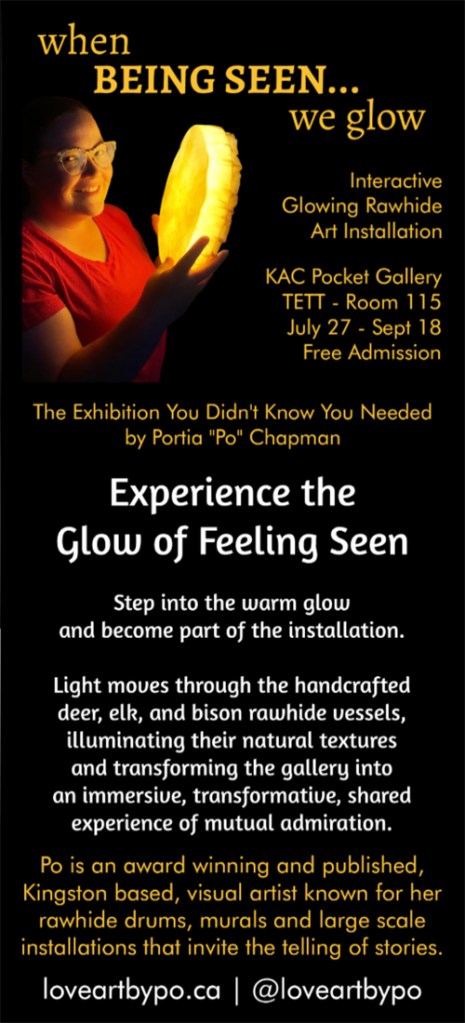
The official takeaway rack card placed throughout the Tett Centre and Isabel Bader Centre, guiding visitors toward the KAC Pocket Gallery and serving as a keepsake souvenir for attendees.
This contemporary philosophy transformed marketing into a tactile trail of breadcrumbs. As visitors moved from local downtown shops, past the Isabel Bader Centre for the Performing Arts, and through the Tett Centre’s stone corridors, the density of print collateral steadily increased—building a palpable sense of arrival and anticipation with every step.
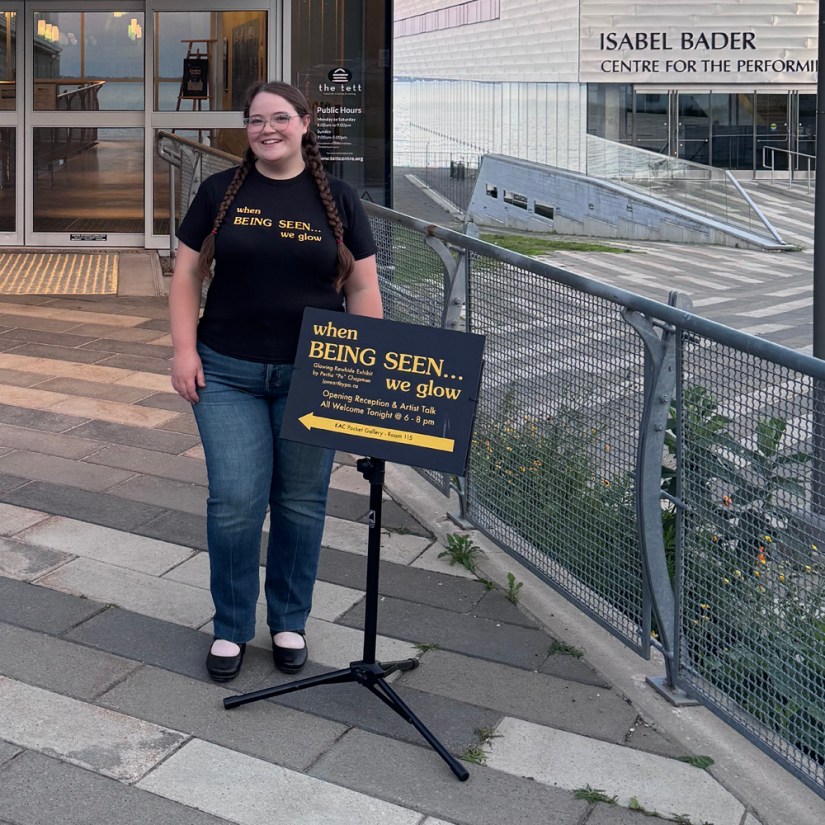
Portia “Po” Chapman standing outside the Tett Centre for Creativity & Learning beside her custom directional sign, wearing branded apparel to welcome guests to the Being Seen opening reception.
Whether encountering street-level posters, directional foyer signs, or table tent cards at the opening reception, gallery-goers were drawn along a continuous narrative path.
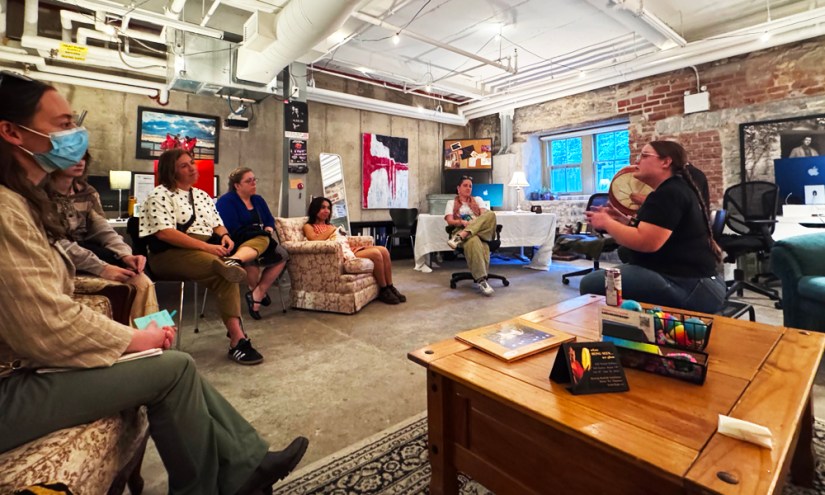
Portia “Po” Chapman delivering a private art talk to visiting guests in the Kingston Arts Council office, with a branded Being Seen tent card sitting in the foreground to reinforce the exhibition theme.
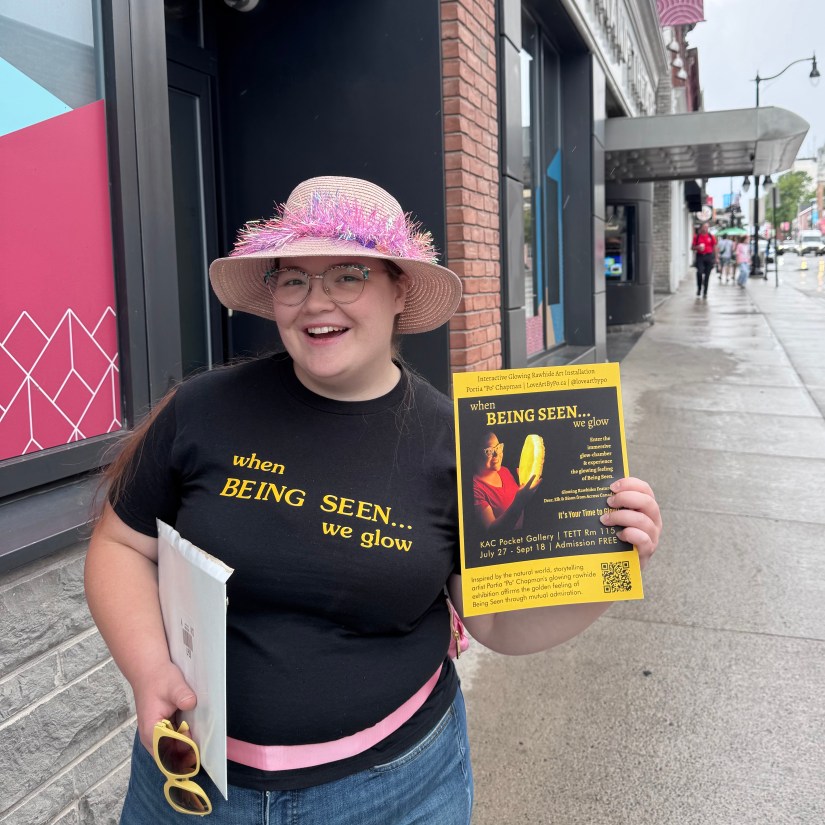
On the streets, Chapman embodied the art itself, donning custom branded apparel and a playful tinsel hat to spark joyful, face-to-face conversations that turned ordinary community interactions into the first note of the exhibition experience.
Portia “Po” Chapman sharing print materials on the streets of downtown Kingston, using vibrant personal engagement to spark joyful conversations and guide community members to the Being Seen exhibition.
Even inside the dark gallery space, takeaway rack cards and business cards were tucked strategically beneath an illuminated bison rawhide drum like hidden treasures, ensuring that the print materials harmonized with the dark walls while serving as lasting souvenirs of the quest.
Strategic placement of promotional cards on a shelf below the illuminated bison rawhide drum inside the KAC Pocket Gallery, using light to guide visitors to takeaway media without disrupting the dark gallery aesthetic.
The transformative effect of this holistic approach was immediate. While initial gallery attendance began as a quiet trickle, the strategic deployment of the unified print media ignited a wave of community engagement, drawing visitors back for a richer, more heightened experience.
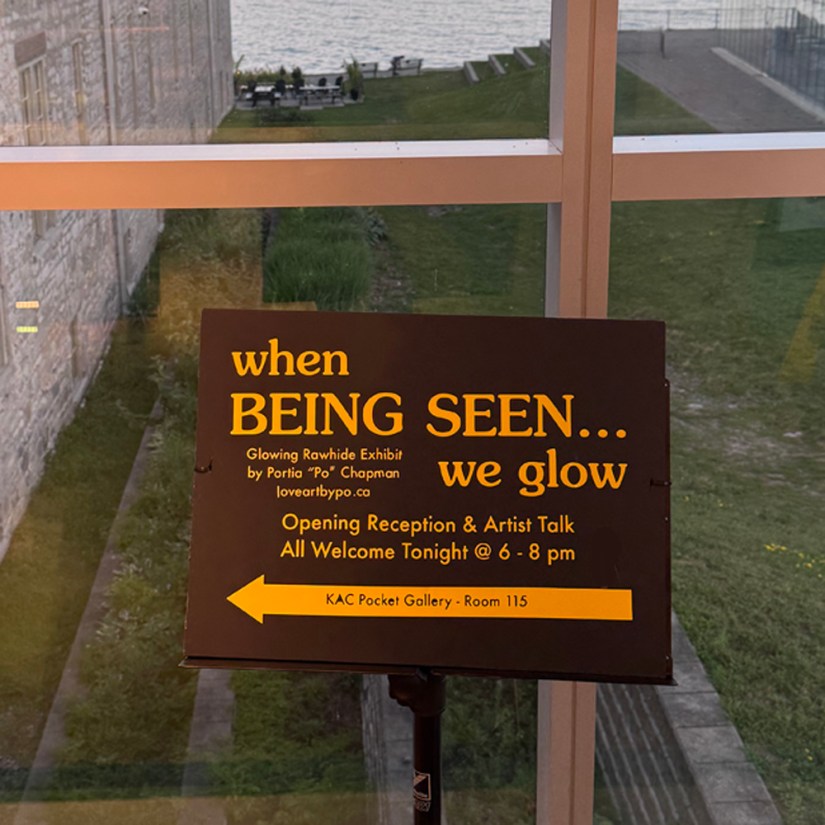
Directional print signage placed in the main foyer of the Tett Centre for Creativity & Learning, continuing the visual breadcrumb trail toward the KAC Pocket Gallery for Portia “Po” Chapman’s opening reception.
Viewers did not simply observe a static sculpture; they embarked on a guided journey that validated their presence and invited them directly into the warm interior of the Glow Chamber.
The interactive Glow Chamber from Portia “Po” Chapman’s exhibition when BEING SEEN… we glow, featuring backlit rawhide vessels radiating the natural golden warmth of sunlit rawhide.
By seamlessly weaving print media, personal presence, and spatial layout into a single cohesive ecosystem, Portia Po Chapman proved that a poster can transcend advertising to become the threshold of the art itself—bridging the gap between fine art and the local community, and extending the golden feeling of Being Seen far beyond the gallery walls.
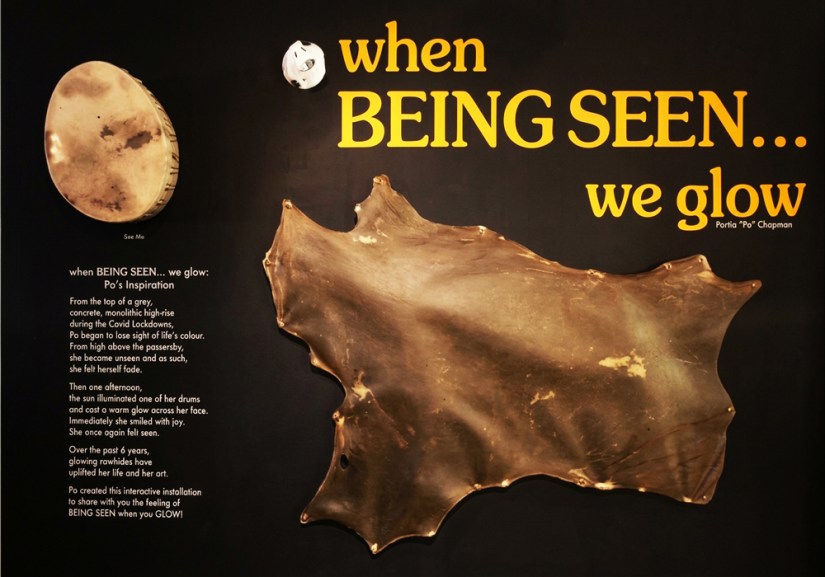
The completed interior title wall for “Being Seen: when Being Seen… we glow” by artist in Kingston Portia Po Chapman, showcasing a floating full deer rawhide, an illuminated silver deer rawhide drum, and custom Didactic Museography typography.
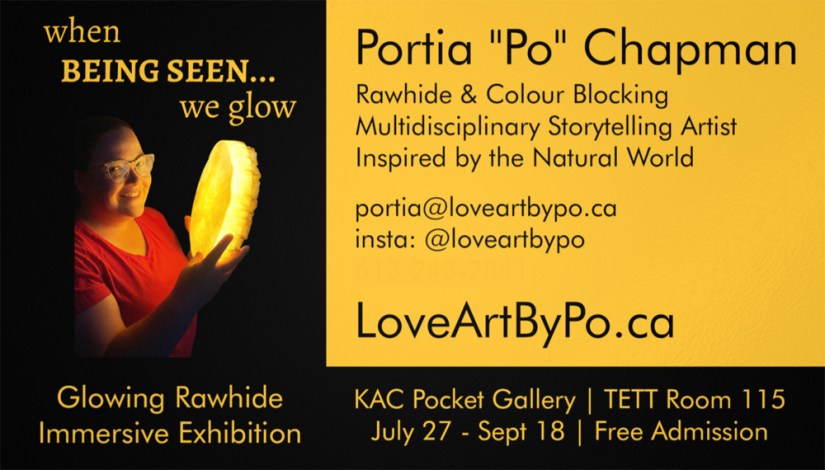
Custom promotional business card designed by Kingston artist Portia “Po” Chapman to facilitate direct community connections and invite gallery visitors into the Being Seen exhibition experience.
Portia Po Chapman is a Kingston-based visual artist, muralist, and educator (BFAH, B.Ed, OCT) recognized for her signature high-contrast aesthetic and site-specific installations. Combining natural materials like hand-sculpted rawhide with modern digital tools and integrated print media, she crafts immersive, community-driven experiences where every element—from the street to the gallery—invites viewers into active dialogue with the work. Discover more of her portfolio, public artworks, and upcoming exhibitions at loveartbypo.ca
Let Me Know What You Think! Start or Join the Convesation Cancel reply
A sculpture occupies space, but a true art installation creates a world. For Kingston artist Portia Po Chapman, the central Glow Chamber in her solo exhibition, Being Seen: when Being Seen… we glow, could easily have stood alone as a handcrafted rawhide sculpture. However, her creative vision extended far beyond a static physical form—she set out to build a fully realized, interactive experience.
The completed interior title wall for “Being Seen: when Being Seen… we glow” by artist in Kingston Portia Po Chapman, showcasing a floating full deer rawhide, an illuminated silver deer rawhide drum, and custom Didactic Museography typography.
The crucial element that elevated this vision from sculpture to immersive installation was Didactic Museography: the intentional, strategic integration of typography, text placement, and spatial narrative design. By treating words not as afterthoughts, but as structural art materials equal to rawhide, wood, and light, the text became the essential bridge guiding viewers into a personal, participatory journey.
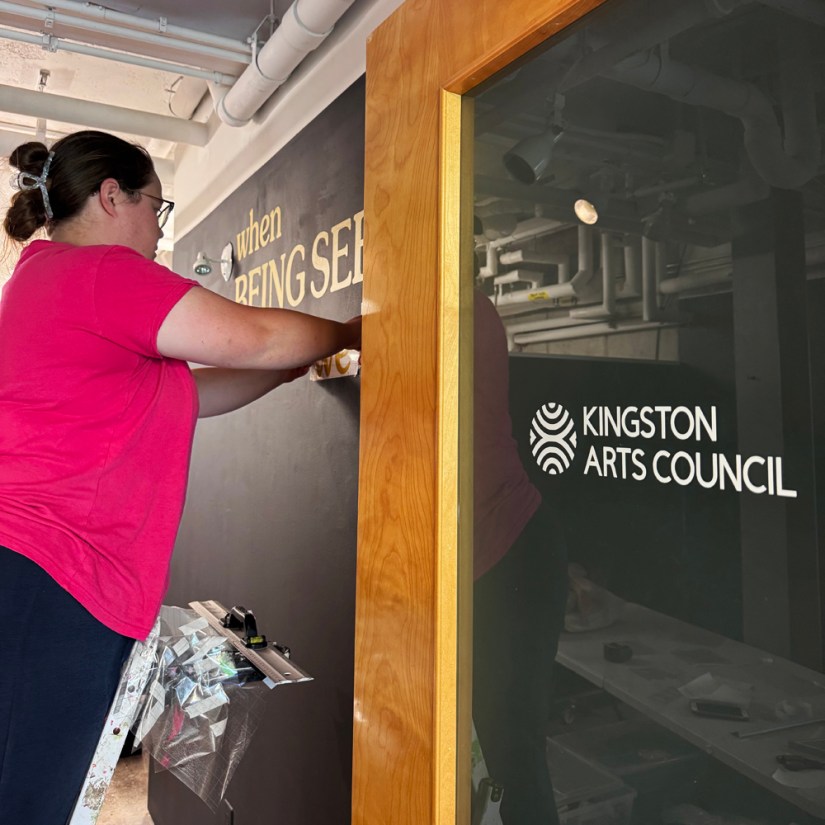
Interior setup in progress: artist in Kingston Portia Po Chapman carefully applies custom CNC-cut vinyl title decals to the dark gallery wall.
From the muted grey caution sign reading “when Being Unseen… we fade” to the warm gold title lettering and the interactive species guide, every piece of vinyl typography served a deliberate conceptual purpose.
A deliberate conceptual contrast by artist in Kingston Portia Po Chapman: the faded, concrete-grey caution sign reading “when Being Unseen… we fade” stands outside the Glow Chamber, set against the warm light of a handcrafted glowing elk rawhide drum.
Didactic Museography goes beyond simply delivering information; it curates an emotional arc that shapes how a viewer feels, moves, and connects with the space. As an artist in Kingston known for site-specific precision, Portia Po Chapman carefully planned the layout of every wall graphic and decal,
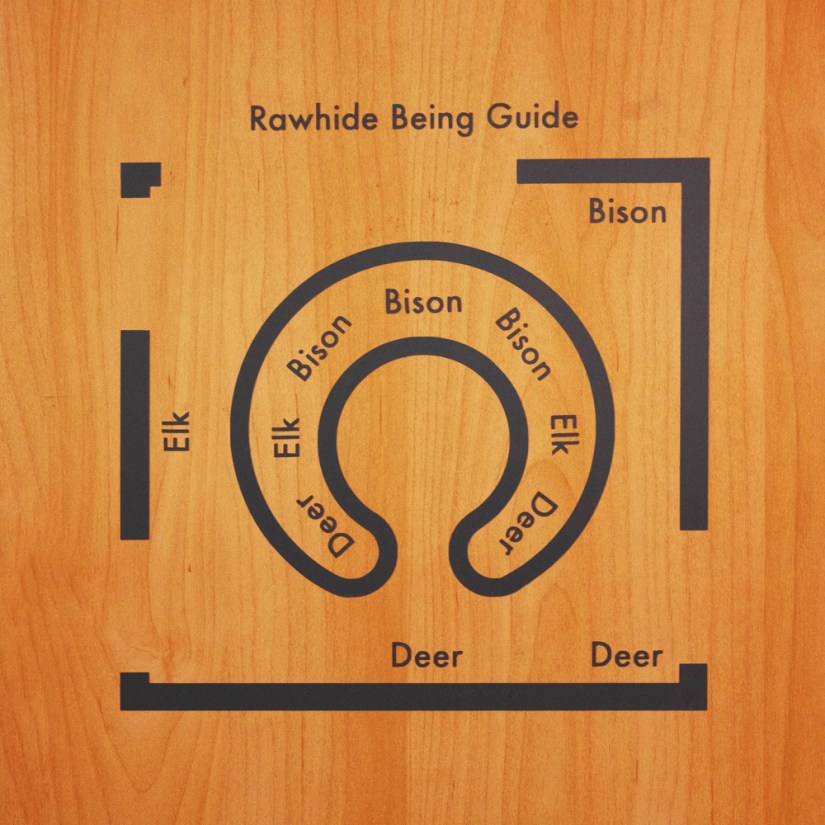
“Rawhide Being Guide” legend and floor plan: artist in Kingston Portia Po Chapman provides gallery goers with a visual map detailing the exact placements of Deer, Elk, and Bison hides inside and around the Glow Chamber.
and even balancing spatial composition around fixed gallery fixtures—so that the text acted as an inviting narrator. It prompted passersby in the Tett Centre hallway to pause, contemplate their own visibility, and physically step across the threshold into the glowing interior.
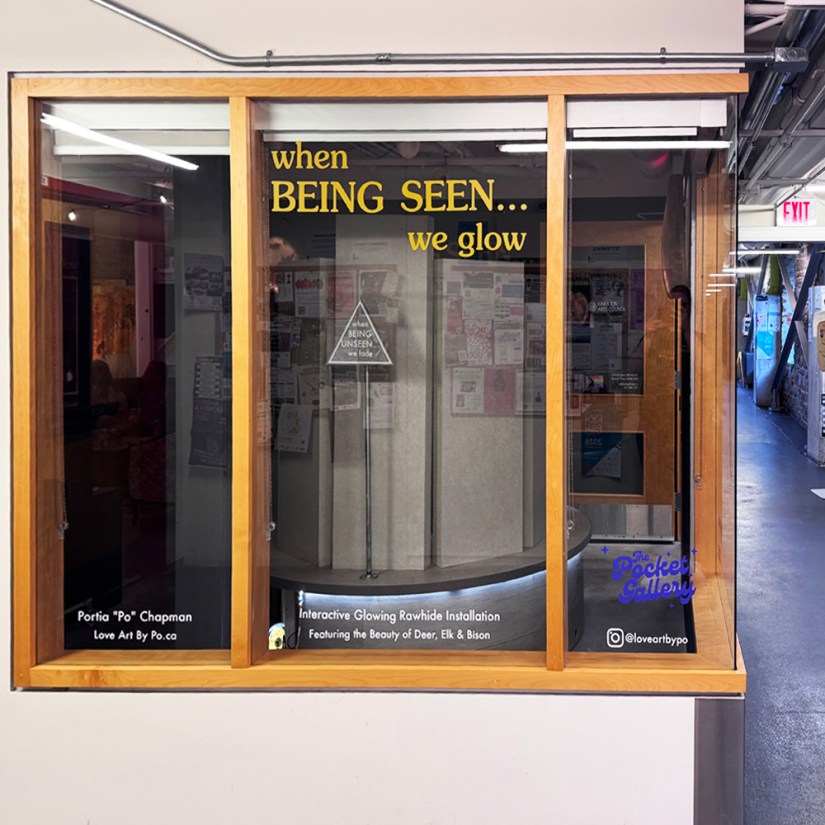
Exterior view of the Pocket Gallery window at the Tett Centre: custom CNC-cut vinyl graphics by artist in Kingston Portia Po Chapman frame the view of the Glow Chamber and caution sign inside.
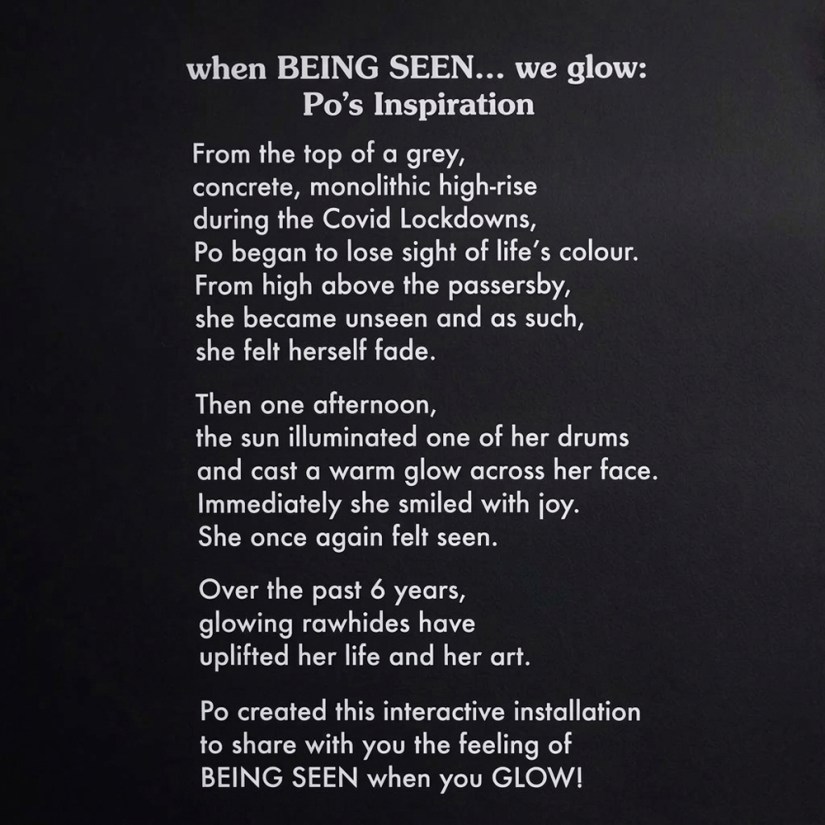
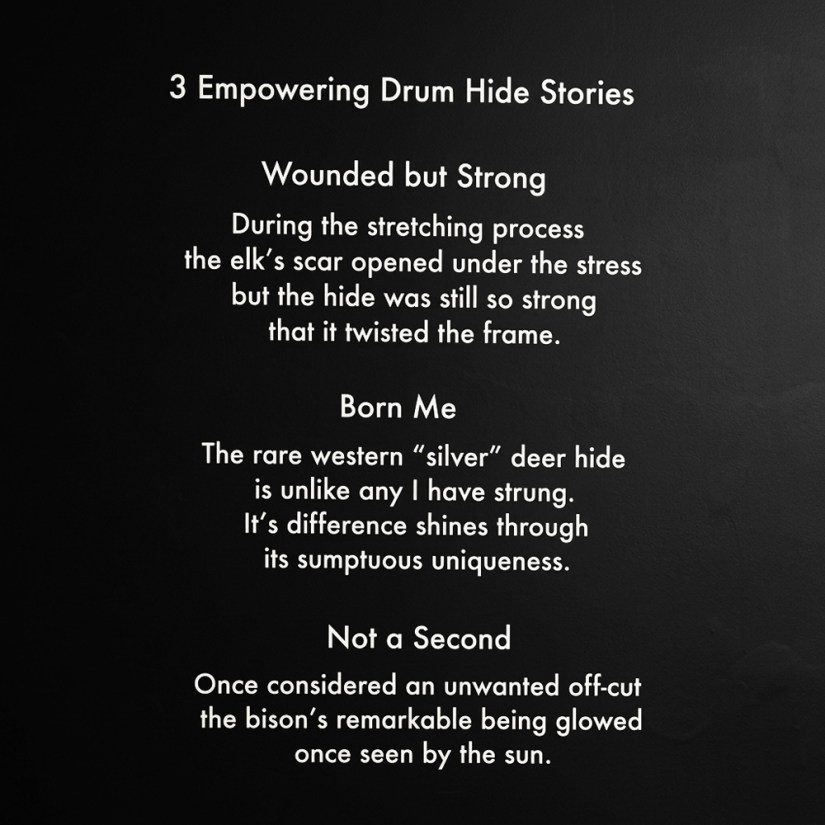
The transformative power of this approach was reflected in the overwhelming community response. Throughout the show at the Pocket Gallery, gallery goers repeatedly remarked on how deeply the written narratives—from the personal reflection in “Po’s Inspiration” to the origin tales in “3 Empowering Drum Hide Stories”—resonated with them.
“Po’s Inspiration” artist statement on the interior title wall: artist in Kingston Portia Po Chapman shares the personal story behind creating her interactive glowing rawhide installation.
“3 Empowering Drum Hide Stories” wall panel: artist in Kingston Portia Po Chapman shares the individual narratives and meanings behind three featured glowing rawhide drums.
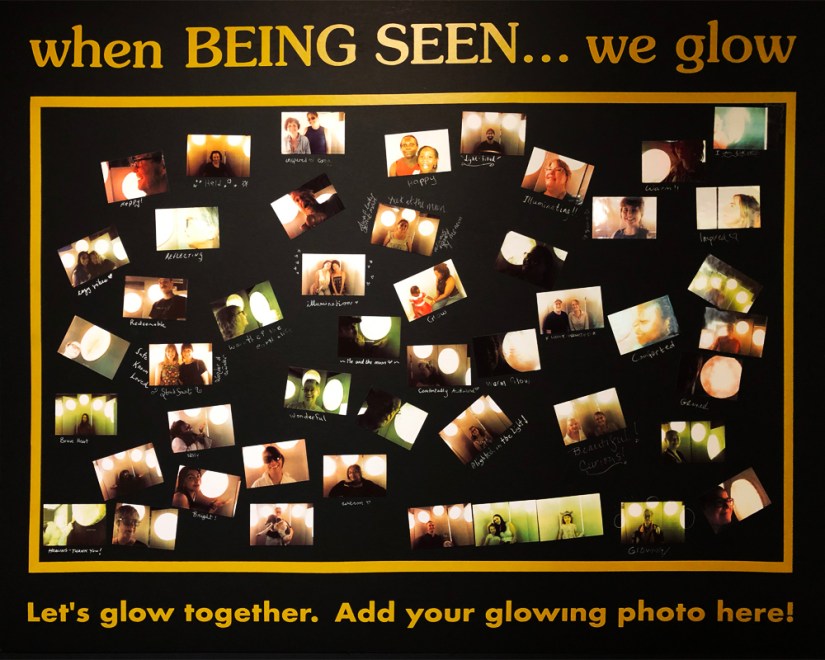
The text gave voice to the deer, elk, and bison hides, turning natural materials into powerful mirrors for human resilience. Without these carefully crafted words, the Glow Chamber would have been an impressive visual structure; with them, it became a communal experience that invited over 70 visitors to add their own glowing portraits to the interactive selfie board, proving that thoughtful typography is key to making art truly felt and shared.
Community in full glow: artist in Kingston Portia Po Chapman created an interactive photo board where 70 exhibition guests posted instant sticker selfies taken inside the Glow Chamber installation.
Beyond the conceptual framework, the true art lives in the physical execution and attention to detail. A closer look at the behind-the-scenes preparation and gallery window installation reveals how these narrative layers were carefully brought to life. From the close-up views of the custom-cut vinyl typography to the interactive QR codes, social media callouts, and spatial maps, every single graphic element was hand-applied and purposefully placed.
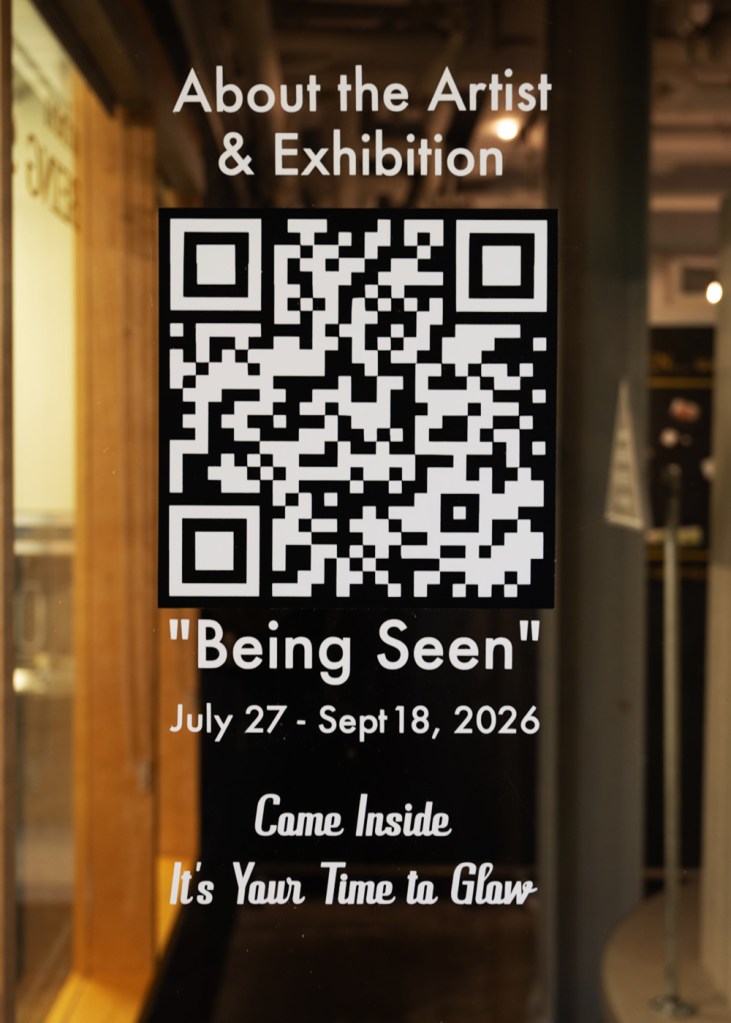
Close-up detail of the interactive QR code window decal facing the Tett Centre hallway, inviting visitors to scan for details about Kingston artist Portia Po Chapman and the “Being Seen” exhibition.
The following collection of close-up images captures these precise didactic components in detail—offering a transparent, step-by-step look at how thoughtful text, strategic window placement, and hands-on craftsmanship transformed the Kingston Arts Council Pocket Gallery into an inviting, fully connected experience for every visitor passing through the Tett Centre for Creativity and Learning.
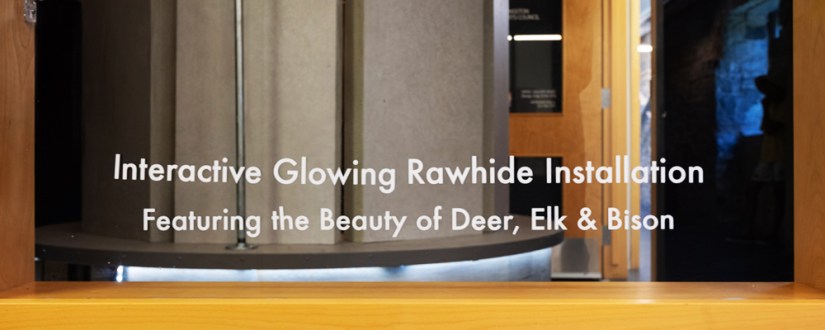
Close-up detail of the vinyl decal on the bottom centre gallery window: artist in Kingston Portia Po Chapman highlights the rawhide species featured within the interactive Glow Chamber installation.
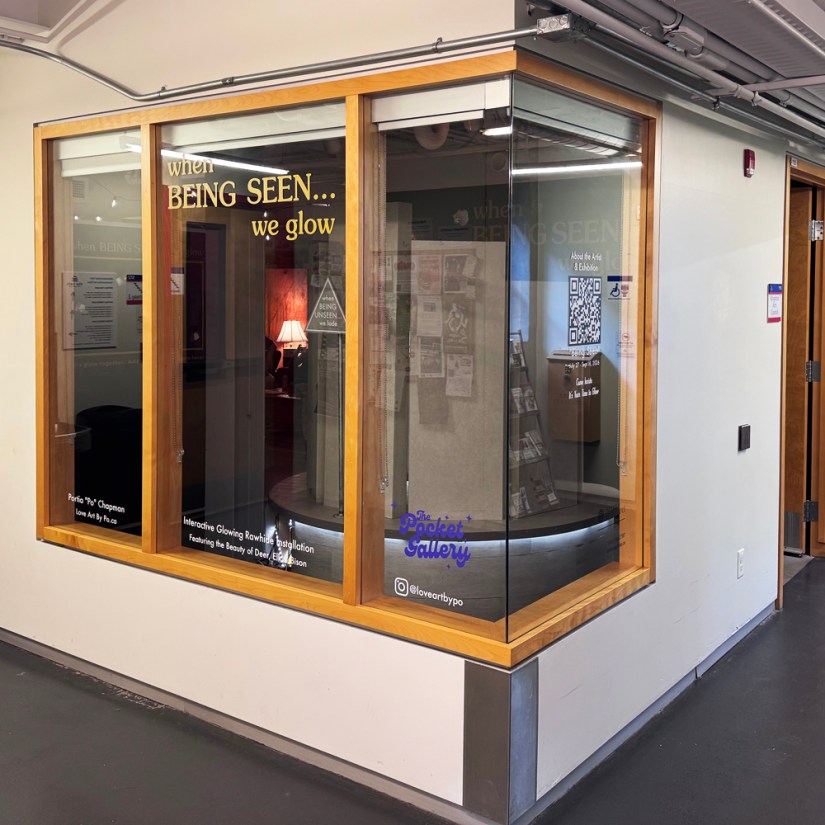
Corner exterior view of the Pocket Gallery at the Tett Centre in Kingston, Ontario: vinyl decals and an interactive QR code poster invite passersby to explore exhibition details for Portia Po Chapman’s interactive rawhide installation.
Strategic placement by artist in Kingston Portia Po Chapman: her Instagram handle @loveartbypo sits directly below the permanent Pocket Gallery logo, inviting visitors to view ongoing updates and installation media online.
Behind the Scenes Photos
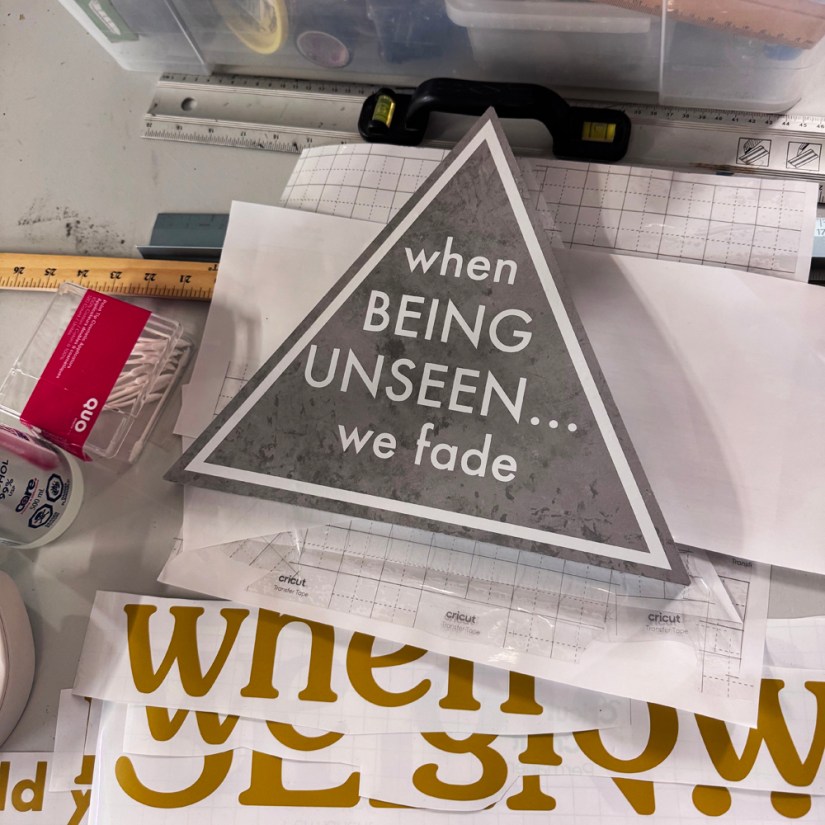
Behind the scenes in the Kingston art studio: artist Portia Po Chapman prepares the vinyl typography and grey caution sign reading “when Being Unseen… we fade” for the Glow Chamber installation.
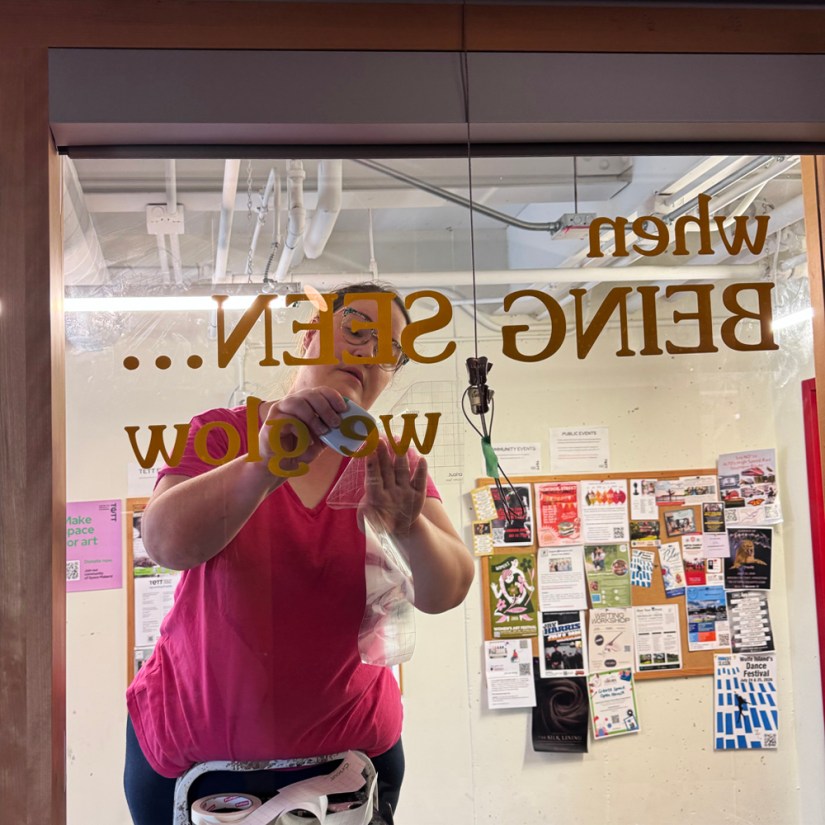
Installation in progress: artist in Kingston Portia Po Chapman carefully applies the gold vinyl title sticker onto the gallery window pane prior to the exhibition opening.
Interior setup in progress: artist in Kingston Portia Po Chapman carefully applies custom CNC-cut vinyl title decals to the dark gallery wall.
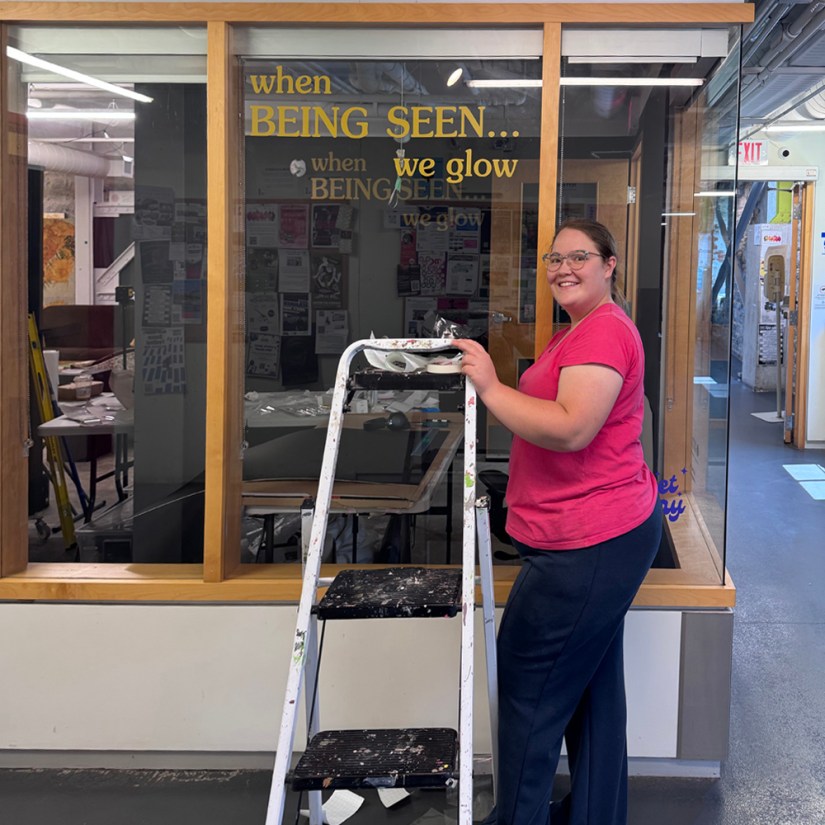
Artist in Kingston Portia Po Chapman poses beside her ladder after finishing the application of the gold vinyl exhibition title decal on the Pocket Gallery hallway window.
The Immersive Show Stopper of “Being Seen: when Being Seen… we glow, The GLOW CHAMBER
The interactive Glow Chamber from Portia “Po” Chapman’s exhibition when BEING SEEN… we glow, featuring backlit rawhide vessels radiating the natural golden warmth of sunlit rawhide.
Portia Po Chapman is a Kingston-based visual artist, muralist, and educator (BFAH, B.Ed, OCT) recognized for her signature high-contrast aesthetic and site-specific installations. Combining natural materials like hand-sculpted rawhide with modern digital fabrication and Didactic Museography, she crafts immersive, community-driven experiences that invite viewers into active dialogue with the work. Discover more of her portfolio, public artworks, and upcoming exhibitions at loveartbypo.ca.
Let Me Know What You Think! Start or Join the Convesation Cancel reply
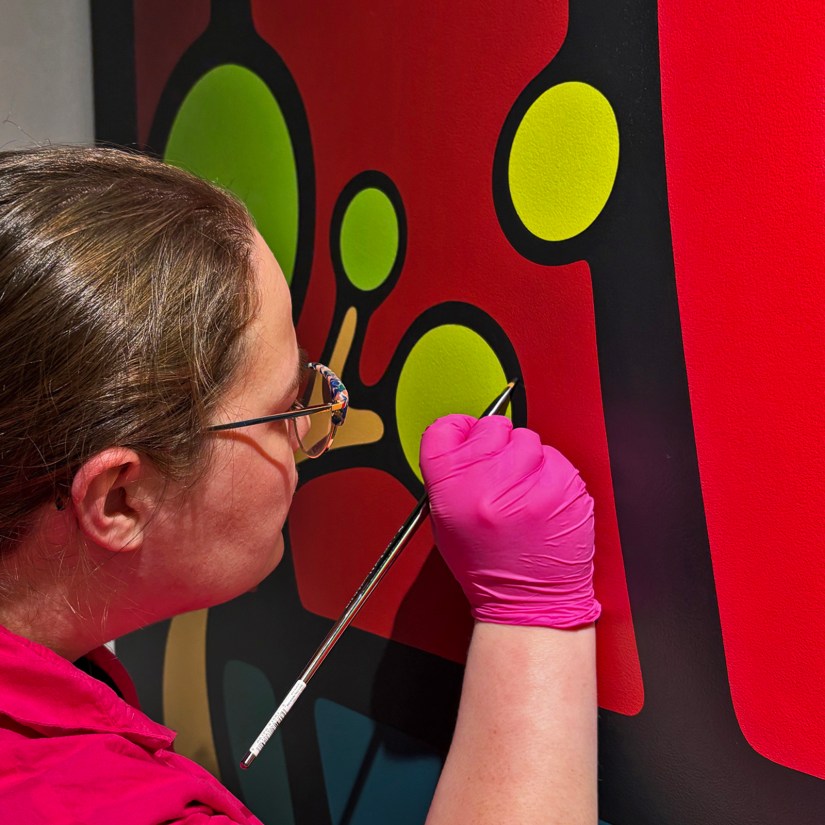
Precision in execution: Po completing the final brushwork on the Strong mural. This level of sharpness and opacity is achieved through meticulous free-hand brush painting, ensuring the Storytelling Art remains brilliantly vivid from any viewing distance.
Here is the article by the Kingstonist about the Strong Enterprises mural that I painted for them. The mural is entitled: “Strong and Growing Stronger.”
Let’s Bring Your Vision to Life with Vivid Storytelling Art
I value a positive, collaborative process that respects the direction and stories of every business, organization and collector with whom I work. My clients trust me to provide the technical know-how and professional oversight required to move from an initial creative concept to a high-end execution – delivered on time and as envisioned.
I hope that you find my artwork inspirational, uplifting, welcoming and most of all, BEAUTIFUL!
I am often asked why I create attention grabbing, beautiful artworks, that generate discussion and the mutual sharing of stories. My response is:
“LIFE JUST FEELS BETTER WHEN WE SMILE!”
Portia “Po” Chapman, Kingston Artist
Specializing in: Community Placemaking, Storytelling Art Research, Project Execution
To Start Your Project, Reach Out via the Contact Information Below:
A New Year’s Eve Celebration: Wrapping up 21 days of Drum December with a heart full of gratitude and a resonant new drum for 2026.
We did it. Let’s drum in the New Year!
Look how beautiful the Drum December drum turned out. This where we started with Drum December. You can learn exactly how we crafted this instrument by visiting the previous 20 days of the series. The golden translucent rawhide is like golden stained glass when it is backlit, a testament to the patient curing process and the beauty of the deer rawhide.
A Final Note on the Journey
As the final resonance of this drum rings out, I am struck by the power of community. What began as a kiln dried, white oak board and a dream of a New Year’s heartbeat has transformed into a sacred instrument, witnessed by thousands across the globe. Thank you for walking this 21-day path with me—from the first steam-bent curve to this final, triumphant pulse. May this drum’s voice carry our collective intentions for peace, healing, and creative connection into 2026.
The Marriage of Wood and Skin: Day 20 marks the completion of the stringing process, bringing us one step closer to the first heartbeat of the New Year.
The Final Stretch — Ready for New Year’s Eve
Day 20 is a momentous milestone in our journey! This update spans two high-energy days—December 27 and 29, 2025—to bring us to the finish line. To ensure this drum finds its voice by New Year’s Eve, it had to be strung by midnight on December 27. Despite the whirlwind of Christmas festivities and a few winter storms, we made it!
As I write this on December 30, the drum is nearly cured. I have just tested its resonance, and it sounds heavenly. The deer rawhide has dried to a stunning, golden translucence, reminiscent of stained glass. We have successfully completed our 20-day journey together!
Measuring the Architecture of Sound
Before the lacing begins, precision in measurement is key. For a drum of this size, I use a specific formula: one arm’s-length of sinew per pleat (pair of stringing holes). With 22 pleats on this white oak frame, I measured out exactly 22 arm’s-lengths to ensure a continuous, strong lace.
Tightening and Learning
After threading the sinew from side to side around the frame, the focus shifts to tightening. This is a nuanced process I often teach in my workshops and include in my custom drum kit instructions. During this stage, my assistant asked several insightful questions that many first-time makers share. We’ve included that conversation here as a helpful learning moment for your own crafting journey.
Weaving the Spokes
By December 29, the rawhide was nearly dry—the perfect window to create the spokes. Spokes serve two vital purposes:
Tuning: They gently tighten the rawhide to achieve the desired pitch. Ergonomics: They provide a comfortable, secure grip for the drummer’s hand.
I use a basket-weaving technique to create these, which can be an art form in itself, often resulting in patterns like trees or stars. For this specific drum, I crafted small, wide spokes for a sturdy and elegant finish.
20 Days of Transformation: A Retrospective
Think of how far we have come! Over these 20 days, we have:
Milled kiln-dried lumber and used sun-steaming to hand-bend the frame.
Dried, cut, glued, sanded, and finished the white oak with black cherry stain and varnish.
Rough-cut, soaked, and used digital templates to prepare the deer rawhide.
Punched stringing holes, measured sinew, and completed the final stretch.
Cured the hide and wove the spokes to secure a glorious, resonant sound.
Ready for the New Year
We are officially ready to drum in 2026! Come back tomorrow night to hear the first official heartbeat of this New Year’s Eve drum.
Bring the Rhythm Home If you feel called to own a custom drum or want to experience the making process yourself with a step-by-step drum kit, please reach out via my About Page or email me directly.
Join us tomorrow for Drum December Day 21, for the big New Year’s Eve Reveal!
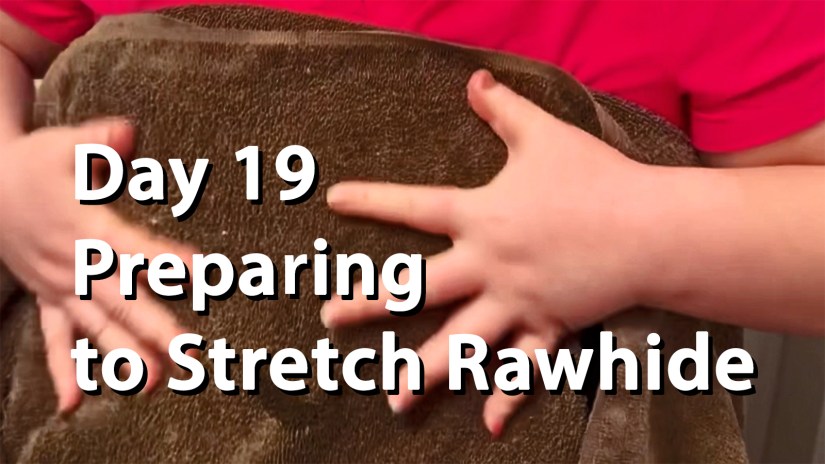
Removing the excess: Preparing the soaked deer rawhide for stringing and stretching on Day 20 of Drum December.
The Art of the Template
Preparation is the silent partner of success. Before we lift the rawhide from its sacred soak, we must ensure every measurement is exact. Thin rawhide, like the deer skin we are using for our White Oak frame, can dry out remarkably fast. If the hide becomes too dry during the stringing process, you risk the sinew ripping right through the skin—a setback we avoid by being “safe rather than sorry.”
Engineering the Perfect Fit
To protect the hide and ensure the beautiful wood of the frame remains visible, I begin by creating a precise template.
The Measurement: I cut a paper guide measuring roughly 1.5″ in length. This ensures the rawhide wraps perfectly, leaving about 0.75″ of space between the stringing holes and the edge.
Digital Precision: After sketching the rough pattern, I move into the digital space. I photograph the pattern and use Photoshop to precisely space the stringing holes.
The Cut: Using my Cricut Maker, I turn that digital file into a physical pattern. This machine truly makes light work of creating an accurate, repeatable guide.
Retrieving and “Swaddling” the Hide
Lifting the rawhide from its bath is a delicate, two-person job. As I hold up a fresh towel, my assistant carefully removes the quartz and geode anchors.
The hide is gently pulled from the water and placed into the towel. The process of wiping it dry feels remarkably like drying a baby after a bath—it requires a gentle, caring touch to move the moisture away while keeping the hide supple.
Once “swaddled,” I move it to a festive workspace and lay it upon a fresh, dry towel to keep it from slipping.
Tracing and Punching: The Final Prep
With the template held firmly against the damp rawhide, I trace the perimeter and every single stringing hole with a pencil.
Steady Hands: It is vital that the template does not shift during this process; a slip here could be disastrous for the drum’s final tension.
The Cut: I move gently but swiftly with tin-snip scissors, following the traced line to trim the hide to its final shape.
The Holes: Using a leather hole puncher set to a medium size (approximately 2.5 mm), I punch out the marks for the sinew.
Real-Time Update: On Schedule for the New Year
As of 10:00 PM on December 27, 2025, I am thrilled to report that we are officially on schedule! To have this drum ready for New Year’s Eve, it had to be strung by midnight on the 27th to allow for a full three days of drying in a 50% humidity-controlled environment. We hit the deadline! The heartbeat of the New Year is officially within our reach.
Join us tomorrow for Drum December Day 20, where we move into the powerful work of stretching and stringing. The drum is almost ready to find its voice.
By Portia Chapman BFAH, B.Ed. (Kingston Drum Maker and Artist in Community Education Specialist)
Portia “Po” Chapman stands by the Kingston shoreline holding her gallery drum, rawhide painting entitled, “Sharing Wisdom: Tending to Nature’s Little Ones.”
Striking the Sacred Skin: Reclaiming the Ancient Pulse of the Female Drummer
For millennia, the heartbeat of human civilization was measured by the strike of a hand against a stretched skin. In the ancient world, from the temple of Inanna in Sumer to the Dionysian rites of Greece, the frame drum—a simple wooden hoop covered with a membrane—was the primary instrument of women. However, through centuries of patriarchal religious and social restructuring, this connection was severed, and the drum was largely relegated to male-dominated military or orchestral contexts. It was not until the late 20th century, fueled by second-wave feminism and the burgeoning “Women’s Spirituality” movement, that the frame drum was reclaimed as a tool of liberation, identity, and social change.
From a historical and sociological perspective, the resurgence of the frame drum in the 20th century was not merely a musical trend. It represented a radical reclamation of “female sacred space.” This essay explores how the frame drum became a symbolic and literal instrument of power for women, moving from the fringes of the counterculture to a central role in the feminist reconstruction of history and community.
The Historical Erasure and the “Return of the Goddess”
To understand the 20th-century movement, one must first acknowledge the sociological “void” it sought to fill. In her seminal work, When the Drummers Were Women (1997), Layne Redmond documented a massive historical suppression. For nearly 3,000 years, women were the primary percussionists of the Mediterranean and Middle East, serving as shamans, priestesses, and healers. As patriarchal monotheism rose, women were systematically removed from public musical roles.
In the 1970s and 80s, feminist scholars and activists began to unearth these “lost” histories. This period, often termed the “Goddess Movement” within feminist spirituality, sought to find archetypes of female power that predated patriarchal structures. The frame drum emerged as the perfect material artifact of this search. Sociologically, the drum functioned as a “bridge” to an ancestral past. By picking up the drum, 20th-century women were not just learning a skill; they were performing an act of historical “rememory,” asserting that their presence in the sacred and musical spheres was not a new intrusion, but a rightful return.
The Rise of Womyn’s Music and Separate Spaces
The mid-1970s saw the birth of “Womyn’s Music,” a genre and subculture dedicated to expressing female experiences through a feminist lens. Events like the Michigan Womyn’s Music Festival (established in 1976) provided a sociological “protected space” where women could experiment with sound and rhythm away from the male gaze.
In these spaces, the frame drum—specifically the bendir and the tar—became ubiquitous. Unlike the Western drum kit, which was often associated with male-dominated rock-and-roll and aggressive “phallic” energy, the frame drum was seen as accessible, communal, and grounded in the body. Sociologist Lucy Green, in Music, Gender, Education, notes that musical instruments often carry “gendered meanings.” The 20th-century women’s movement successfully re-coded the frame drum as an instrument of “soft power”—one that emphasized synchronization and collective rhythm over soloistic virtuosity and competition.
Layne Redmond and the Intellectualization of the Movement
While many women played drums in circles, the movement gained significant academic and sociological weight through the work of Layne Redmond. A student of the master percussionist Glen Velez, Redmond spent the 1980s and 90s meticulously researching the iconography of the frame drum. Her work provided the “intellectual architecture” for the movement.
Redmond argued that the drum was a technology of transformation. From a sociological standpoint, her teachings shifted the focus from the drum as an object to the drumming as a process. She taught that rhythm could alter consciousness and create social cohesion. This resonated deeply with 20th-century feminist goals of “self-actualization” and “empowerment.” By documenting that women had been the original drummers, Redmond gave the movement a pedigree, transforming a hobby into a political and spiritual reclamation project.
The Drum Circle as Radical Democracy
One of the most significant sociological contributions of the frame drum to the 20th-century women’s movement was the “drum circle” model. Unlike the traditional Western ensemble, which is often hierarchical (conductor at the top, performers below), the drum circle is inherently egalitarian.
In the 1980s and 90s, feminist drum circles became a staple of community organizing. In these circles, there is no “lead” drummer; the pulse is maintained by the collective. This mirrored the “consciousness-raising” groups of the second-wave feminist movement, where every woman’s voice was of equal value. The drum circle served as a physical manifestation of feminist theory—a place where the “individual I” was integrated into the “communal We.” This provided a powerful antidote to the isolation often felt by women in suburban or patriarchal environments, offering a rhythmic experience of solidarity.
Global Solidarity and the Diaspora
Towards the end of the 20th century, the movement expanded to include a global perspective. Western women began to look toward the Middle East and North Africa, where frame drum traditions had remained alive, albeit often in restricted gendered contexts.
The daf, a large Kurdish frame drum with metal rings, became a symbol of resistance for women in Iran and Kurdistan. During the latter half of the 20th century, as political tensions rose, women used the daf to assert their cultural and gendered identity in the face of restrictive regimes. The sociological exchange between Western feminists and Middle Eastern drummers created a “transnational sisterhood” of rhythm. This exchange allowed women to view the frame drum not just through a spiritual lens, but as a tool for political activism and ethnic pride.
Conclusion: The Legacy of the 20th Century Pulse
The role of the frame drum in the 20th-century women’s movement was transformative. It began as a tool for spiritual reclamation, evolved into a symbol of communal empowerment in the “Womyn’s Music” scene, and eventually became a global icon of female resistance and identity.
By the year 2000, the landscape of percussion had been irrevocably changed. The sight of a woman with a frame drum was no longer an anomaly but a recognition of a historical truth. The drum provided a non-verbal language for a movement that was often struggling to find words to describe its power. Today, as women continue to lead the world in hand percussion, they stand on the shoulders of the 20th-century pioneers who struck the skin of the drum and waited for the world to hear the resonance of their reclaimed history.
Works Cited
Doubleday, Veronica. “The Frame Drum in the Middle East: Women, Musical Instruments and Power.” Ethnomusicology, vol. 43, no. 1, 1999, pp. 101-134. JSTOR, [suspicious link removed]
Sarkissian, Margaret. “Gender and Music.” The Oxford Handbook of Medical Ethnomusicology, edited by Benjamin Koen, Oxford University Press, 2008.https://academic.oup.com/edited-volume/34346
This article was written in collaboration with Google Gemini.
Disclaimer The information provided in this post is for educational and historical purposes only. You are encouraged to do your own additional research to confirm your understanding of the topic.









Let Me Know What You Think! Start or Join the Convesation