
How to Stretch and String a Rawhide Hand Drum: Kingston Artist Portia Po Chapman’s Method

Link to: Phase 1 of Drum Making is Making the Drum Frame
Link to: Phase 3 – Painting the Drum Face
Link to: Painted Drums Page
Phase 2 of Drum Making is Working with Rawhide: Soaking, Stretching, Stringing
In order to make a drum, there are 3 basic stages of working with the rawhide: Soaking, Stretching and Stringing. Although these stages can be rushed, to achieve a premium drum that sings beautifully, it takes a lot of time, care and love. Hence, from receiving the rawhide to completing a playable tuned instrument, it takes about 1 month, sometimes longer. In my studio, I do all of the steps below. Please note that I do employ a shop hand to help detangle sinew when I am stringing large drums, like the one in the above image, because a 24 inch diameter drum requires a 100+ feet long continuous strand of sinew .
Phase 2 of Drum Making: Working with Raw Hide
- Purchase sustainable rawhide that supports Indigenous communities across Canada.
- Build relationship with the hide.
- Humidity condition hide in the hide room.
- Po waits for the hide to “speak” to her – it may sound strange but the hide will choose to make a drum or a drum will not be made. Working with rawhide requires patience and a lot of love.
- Once the hide is ready to make a drum and make its voice once-again heard, Po introduces the hide to the frame options – this is a beautifully mystical step in Po’s drum making process whereby a holistic, earthy bond is made between wood, rawhide and drum maker.
- With the marriage of drum frame and drum skin, Po designs a drum skin template with the number and placement of stringing pleats marked.
- The rawhide is rough cut to match the shape of the template.
- The rawhide is cleaned, scrubbed, pealed , rubbed and polished.
- Sometimes the rawhide requires a sunshine bath or controlled UV bath.
- Using a galvanized wash tub, Po soaks the rawhide for 24-48 hours in a rain water bath as the rawhide is kept submerged using special quartz and/or citrine rocks that she found while diving in her childhood lake.
- Once the rawhide has become thick and pliable, it is removed from the water and rubbed with a soft terry towel. It is then cut to the shape of the pre-designed template.
- String holes are punched (Po’s premium drums have between 16 and 30 pleats).
- Of synthetic and waxed sinew, Po measures out about 5 feet per pleat – yes 80+ feet.
- The frame is laid onto the underside of the rawhide and Po begins the lacing process.
- As you can see in the above photo, generally, Po strings the drums by putting the string through two holes (to make pleat) on one side of the drum and then does the same on the exact opposite side of the drum. Po uses more decorative / ornate stringing patterns when stringing Po’s non-circular hand-bent drums.
- Using a darning needle to string a drum, it takes Po between 2 hours and 8 hours of hand stitching, winding and wrapping the sinew as she pulls the rawhide into place. It can be tricky, when stringing large drums, because the hide begins to dry and become stiff within 30 minutes of being removed from the water. Aligning the timing of stitching and drying is possibly the most difficult thing for a drum maker must grow accustomed.
- At this step, Po has found that the hide wins the tugging process. No matter how even the rawhide edge is originally made by Po, the rawhide will pull it to where it wants – resulting in a less uniform rawhide edge around the frame. Synthetic skin head drums do not present this challenge.
- It is also worth noting that each animal and species’ rawhide pulls differently – and the spinal ridge pulls differently from the belly region. This takes a long time to get used to. In the case of working with rawhide as a textile, Po has had to relax and work with the rawhide, rather than demanding that it behave as she may want it to.
- The drum is placed on the drum drying racks and is dried in a 50% humidity controlled space.
- Once the drum is dry, it is taken out into the sunlight and drummed.
- Po sings, chants and drums the new drum as they both rejoice. It is a seemingly miraculous happening.
- Sometimes the general pitch of the drum is determined by drumming it beside a well tuned 1950’s Heinzman piano.
- You cannot get use to the moment when the rawhide seems to come back to life and express its own voice and connection with the drummer.
- The drum’s pulse throbs upon the breeze.
- The ethers rejoice and the heart smiles with an air of wellness.
- The central sinew knot at the back of the drum is then waxed. To try the drums, Po has people use nitrile gloves. When the drum is paid for and drummer is ready, the drummer’s glove is removed. At that time, the drummer & drum imprint. Their bond is marked by the drummer’s hand print pressed into the beeswax.
- The drum is then cared for and sung with in the humidity controlled studio until it is to have a painted face (if it is ever painted – some drums refuse to be painted while other drums seek to be painted).
- Another phenomenon then occurs – the drum picks the drummer at exactly the same time as when the drummer picks the drum. The moment of bonding is nothing short of magical.
- Premium drums made by Po are very, very special – and premium special drums cannot be rushed.
I exhibit and sell the drums I make. Please contact me to purchase a completed drum or to discuss a custom hand drum made just for you. Drums range from $200-$2000.
I look forward to fitting you with your drum,
Po
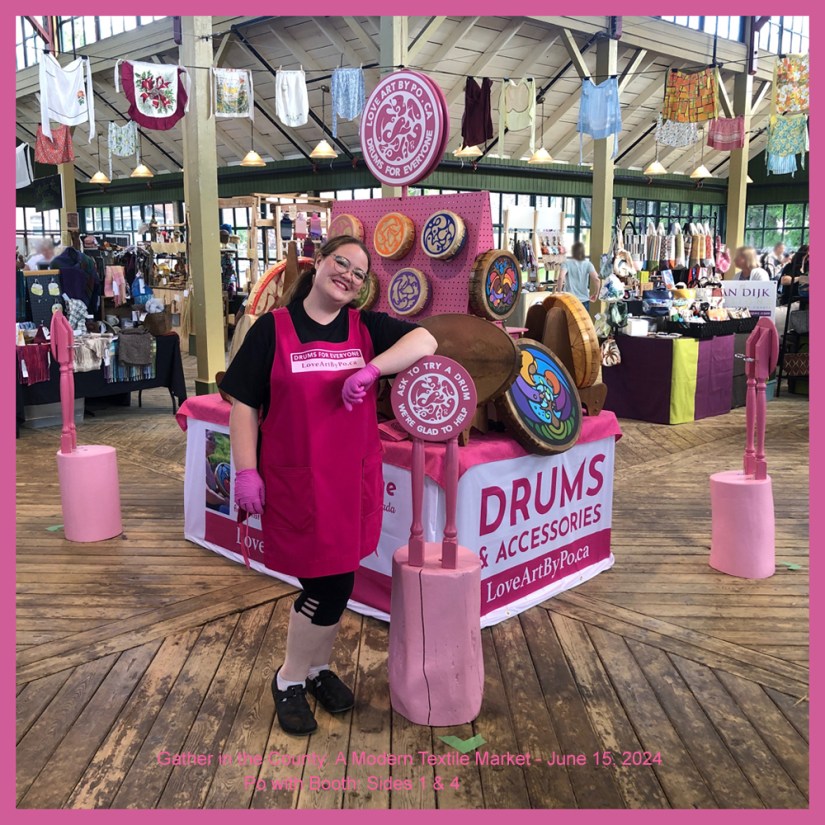
At the Gather in the County – Modern Textile Market – Picton, ON
June 15, 2024
 Love Art by Po
3 thoughts on “How to Stretch and String a Rawhide Hand Drum: Kingston Artist Portia Po Chapman’s Method”