
How to Make a Painted Drum: Kingston Artist Portia Po Chapman’s Method of Painting a Drum Face
Link to Phase 1: How Po Makes a Drum Frame
Link to Phase 2: How Po Works with Rawhide – Stretching and Stringing
Link to Painted Drum Page
Phase 3: How Po Paints the Face the Drums She Makes
Painting the face of a rawhide drum sounds much simpler than it is. The artist must keep in mind the nature of rawhide. Rawhide stretches and shrinks depending on humidity and temperature. Rawhide vibrates and flexes when it is drummed. Rawhide, is not smooth and sometimes has scars, hair, and wrinkles too. Most of all, each rawhide drum has its own sweet spots – where the drum sounds its best when drummed. Some drums even have multiple sweet spots and a couple locations whereby it makes a quiet sound when drummed. Therefore the paint needs to be thin, flat, translucent, and able to stretch. Po’s drums have addressed all of these issues in order to assure/improve longevity while enabling the drum to be drummed in both interior and exterior environments. When meeting the public at drum shows and art shows, Po is frequently told stories of paint cracking on drums made by other drum makers. Rest assured that Po drums every drum before selling them. Po also encourages clients to drum the drums before purchase as well. As far as the paint longevity – so far so good. Although many of the drums Po makes are sold to clients seeking works of art, Po still seeks to make beautiful drums that can be drummed. In short, whether you want to hang the drum on the wall or take the drum to a drum circle, the same amount of love and time is spent creating your masterpiece – and in so doing, every drum made by Po can be drummed. Po views drum making like this: “Why make a drum if you cannot drum it?!”
Po’s Phase 3 Drum Face Painting is as follows:
- The image creation stage can happen overnight or as much as 3 months, it depends on the drum.
- Usually Po will see an image in her mind while drumming the drum, but sometimes images visit her in her dreams.
- Again, as strange as it sounds, Po says: “I just wait until I see what the drum wants me to see – and each rawhide is different.”
- It is something like suddenly knowing what one will knit with the fleece that one has cleaned, carded, spun and dyed – each time is different – and so too is the sheep/goat that offered it in the first place.
- Nature has a way of reaching through the noise and smiling upon us.
- The image is sketched with a marker and then refined using a light table.
- The flow of the lines begin to take over and the image you see appears.
- The image is digitally cleaned up and a template is cut using a Cricut.
- Upon the dry face of the rawhide drum, the template is traced using a 4H graphite pencil.
- It is worthy to note that rawhide is a textile that varies widely in flexibility, texture, scarring marks and amount of hairs still present. This means that each drum is painted using a slightly different method.
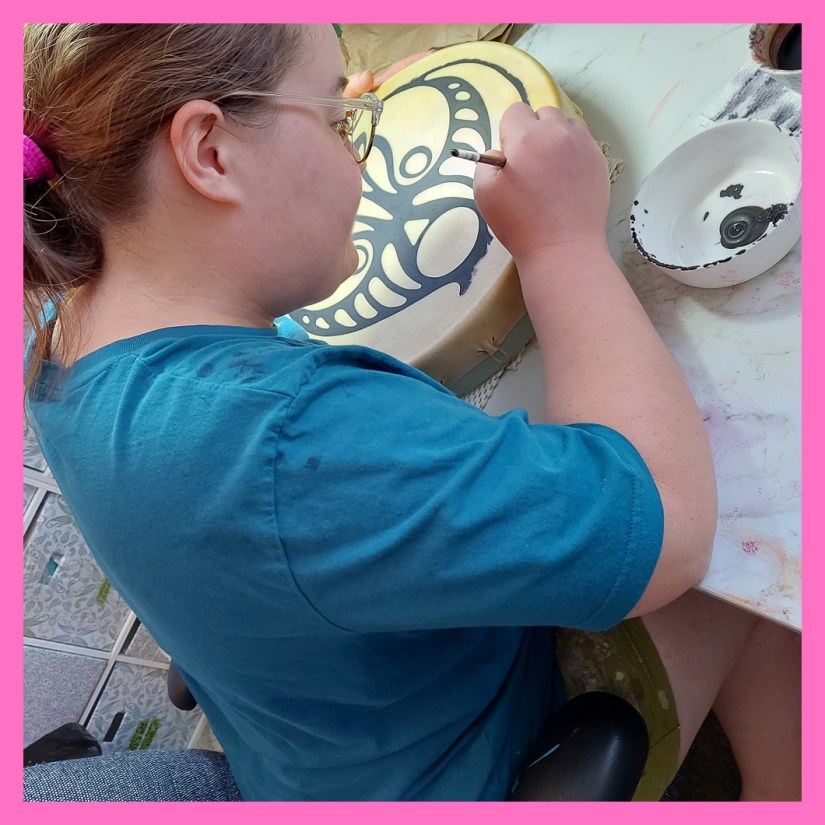
- Using a very special, flexible acrylic paint the images are lined (free hand brush painted) with “black” (if at all). The “black” is usually a deep, earthy purple.
- Po thinly paints the images using #1 to #3 professional grade round acrylic or equivalent watercolour brushes. The images are not stensilled, stamped, or air brushed. The images are not stickers, which some people think because the painted images can appear to float due to the depth of the rawhide’s transparency.
- Using Po’s innovative colour-blocking style, Po pulls apart the shades and hues. The result is an unblended image that invites the mind to seam together the colours in its own way. The images shift in different lighting conditions and when drummed, the image appears to leap off the face of the drum.
- The image is briefly held up to an intense studio light, enabling Po to see where a second or third coat of paint is preferred.
- Once dry, the painted face is lightly sprayed with a mist of archival UV resistant varnish.
I exhibit and sell the drums I make. Please contact me to purchase a completed drum of to discuss a custom hand drum made just for you. I am happy to paint you a drum with the image you choose or one that I create just for you. Custom images are from $250. Drums, with painted and not-painted faces, range from $200-$2000.
I look forward to fitting you with your drum.
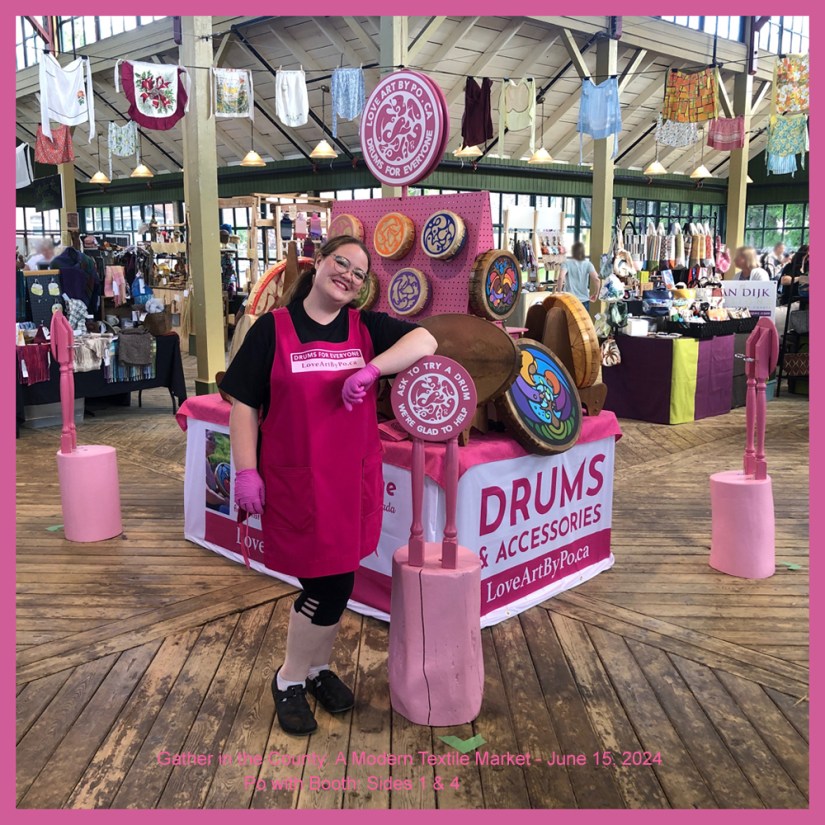
At the Gather in the County – Modern Textile Market – Picton, ON
June 15, 2024
 Love Art by Po
3 thoughts on “How to Make a Painted Drum: Kingston Artist Portia Po Chapman’s Method of Painting a Drum Face”