
By Portia “Po” Chapman BFAH, B.Ed. (Kingston Drum Maker and Artist in Community Education Specialist)
Beyond the Pharmacy: The Drum as an Ancient Instrument of Healing
In the modern world, we are accustomed to viewing medicine as something we ingest—a pill, a syrup, or a surgery. We tend to separate “healing” from “art.” However, for the vast majority of human history, these two fields were indistinguishable. Art was medicine, and the primary medical instrument was often not a scalpel, but a drum.
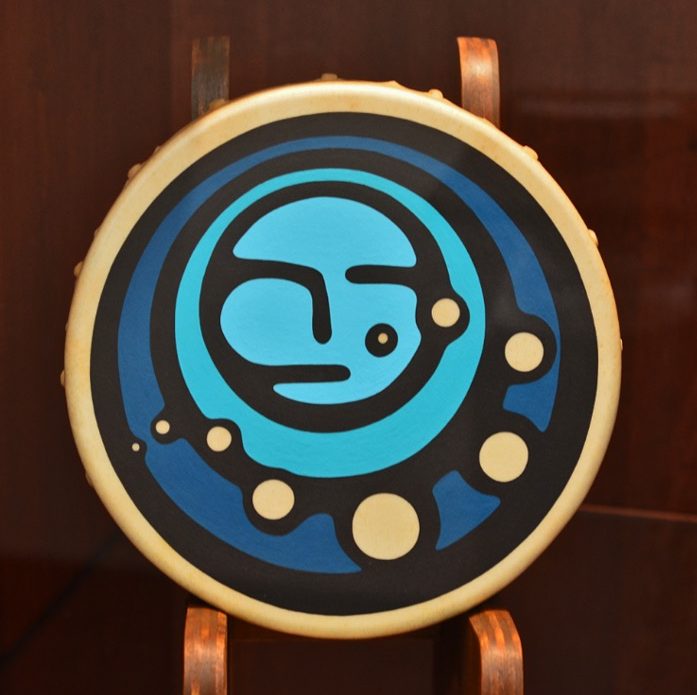
As a drum maker, I spend hours with the raw materials of the frame drum—white oak, deer hide, and sinew. When I stretch a skin over a frame, I am aware that I am constructing a musical instrument. But looking through the lens of history and emerging neuroscience, it becomes clear that I am also constructing a technological device designed for natural healing.
The frame drum is perhaps humanity’s oldest therapeutic tool. From the ancient healing rituals of the Tuva Republic to the modern clinical setting of trauma therapy, the drum has been used as a vehicle to transport the human body and mind from a state of disease (dissonance) to a state of ease (resonance). By exploring the historical philosophy and modern science of drumming, we can understand why this ancient instrument remains a potent force for natural healing today.
The Shamanic Tradition: Rhythm as a Bridge
To understand the healing power of the drum, we must first look to its roots in shamanism. In traditional hunter-gatherer societies, the shaman acted as the doctor, psychotherapist, and spiritual leader wrapped into one. Their primary tool for diagnosis and treatment was the frame drum.
Anthropologist Michael Winkelman, in his research on shamanism and neurotheology, argues that the drumming was not merely symbolic. It was a physiological technology used to induce “Altered States of Consciousness” (ASC). Winkelman posits that the repetitive, driving beat of the shaman’s drum—typically ranging from 3 to 6 beats per second—drives the brain into “theta” wave synchronization. This state, which lies on the border of sleep and wakefulness, allows the brain to integrate information, process emotion, and access deep states of relaxation that are conducive to healing (Winkelman 8-12).
In this historical context, the drum was the vehicle that allowed the healer to enter the “spirit world” to retrieve the patient’s lost soul or extract the spiritual cause of an illness. Philosophically, this establishes the drum as a bridge. It connects the physical body with the unseen, and the conscious mind with the subconscious. For the modern player, this ancient mechanic remains valid: the drum quiets the “chatter” of the analytical mind (Beta waves) and opens the door to a deeper, meditative state where natural healing can occur.
The Biology of the Beat: Tuning the Immune System
While ancient cultures explained healing in terms of spirits and energy, modern science is beginning to explain it in terms of biology and neurochemistry. The philosophy of “natural healing” often centres on the body’s innate ability to repair itself—a capacity that is frequently suppressed by modern stress.
One of the most significant studies bridging this gap was conducted by Dr. Barry Bittman and his team. Published in Alternative Therapies in Health and Medicine, the study examined the biological effects of group drumming. The researchers found that after just one hour of group drumming, subjects showed a statistically significant increase in “Natural Killer” (NK) cell activity. NK cells are the white blood cells responsible for seeking out and destroying cancer cells and viruses (Bittman et al. 38-47).
This finding is profound for our understanding of the drum. It suggests that the act of drumming does not just make us “feel good” emotionally; it flips a biological switch. By reducing the stress response (cortisol) and stimulating the immune system, the drum acts as a biological regulator. It returns the body to a state of homeostasis. Philosophically, this validates the ancient view of the drum as a “healer.” The drum does not cure the disease from the outside; rather, it wakes up the body’s internal doctor to do the work.
Wiring the Brain: Rhythm and Trauma
Another fascinating dimension of the drum’s healing capacity is found in the field of trauma recovery. Dr. Bruce Perry, a leading expert on child trauma and the brain, has written extensively on how trauma impacts the brainstem—the primitive, regulatory part of the brain.
Perry explains that trauma disregulates the brainstem, leaving the individual in a persistent state of “fight or flight.” Talk therapy often fails to reach this deep, non-verbal part of the brain. However, “patterned, repetitive, rhythmic activity”—like drumming—can regulate the brainstem (Perry 23-25).
This aligns with the concept of “entrainment.” Just as a room full of pendulum clocks will eventually swing in unison, the human body entrains to the rhythm of a drum. The heart rate slows, respiration deepens, and the brainstem calms down. For survivors of trauma, the frame drum offers a non-verbal method of self-regulation. It is a form of somatic (body-based) healing that bypasses the need for words, allowing the nervous system to “reset” itself naturally.
The Communal Resonance
Historically, the frame drum was rarely played in isolation. It was an instrument of community. French sociologist Émile Durkheim described the concept of “collective effervescence”—a moment where a group of people, connected by ritual and rhythm, feel their individual selves dissolve into a greater whole.
In the context of natural healing, this social connection is vital. Isolation is a known risk factor for poor health, while social connection is a buffer against stress. A drum circle functions as a “social immune system.” When people drum together, they are not just making music; they are synchronizing their physical movements and their emotional states.
Dr. Michael Thaut, a pioneer in Neurologic Music Therapy, discusses how rhythm acts as a “temporal scaffold” for the brain (Thaut 120). In a group setting, this scaffold holds everyone together. For someone suffering from depression, anxiety, or grief, the drum circle provides a container where they can be “held” by the rhythm of others without the pressure of conversation. The drum becomes a vehicle for connection, curing the modern ailment of loneliness.
The Maker’s Reflection: Crafting the Medicine
As a maker, these perspectives shift how I approach the workbench. When I sand the rim of a drum or tighten the sinew, I am not just building a noisemaker. I am crafting a tool that has the potential to lower cortisol, increase immune function, and regulate the nervous system.
The “natural” in “natural healing” is doubly true for the frame drum. First, the materials are natural—wood from the earth, hide from the animal. Second, the mechanism of healing is natural—it relies on the body’s own response to rhythm. There are no side effects, only side benefits.
When we pick up a frame drum, we are tapping into a lineage of healing that stretches back to the dawn of humanity. We are using the same technology that our ancestors used to make sense of the cosmos and to heal their communities. Whether you are a professional musician or someone just looking for a way to unwind after work, the drum offers a path to wellness that is accessible, primal, and profoundly effective.
It reminds us that sometimes, the best medicine doesn’t come from a pharmacy. Sometimes, it comes from the steady, heartbeat rhythm of a hand on a drum.
Works Cited
Bittman, Barry B., et al. “Composite Effects of Group Drumming Music Therapy on Modulation of Neuroendocrine-Immune Parameters in Normal Subjects.” Alternative Therapies in Health and Medicine, vol. 7, no. 1, 2001, pp. 38-47. ResearchGate, https://www.researchgate.net/publication/12059819_Composite_effects_of_group_drumming_music_therapy_on_modulation_of_neuroendocrine-immune_parameters_in_normal_subjects. Accessed 26 Dec. 2025.
Perry, Bruce D. “Resilience: Where Does It Come From?” Journal of Zero to Three: National Center for Infants, Toddlers and Families, vol. 26, no. 4, 2006, pp. 20-30. ChildTrauma Academy, https://www.childtrauma.org/wp-content/uploads/2013/11/Resilience_Where_Paper.pdf. Accessed 26 Dec. 2025.
Redmond, Layne. When the Drummers Were Women: A Spiritual History of Rhythm. Three Rivers Press, 1997.
Thaut, Michael H. “Neurologic Music Therapy in Cognitive Rehabilitation.” Music Perception, vol. 27, no. 4, 2010, pp. 281-285. University of California Press, https://online.ucpress.edu/mp/article-abstract/27/4/281/62657/Neurologic-Music-Therapy-in-Cognitive. Accessed 26 Dec. 2025.
Winkelman, Michael. “Shamanism and the Altered States of Consciousness: An Introduction.” Sacred Hoop, vol. 26, 2002, pp. 12-17. Arizona State University, https://public.asu.edu/~atmxw/shamanism-asc.html. Accessed 26 Dec. 2025.
Read more about my art and contact information at Love Art By Po and the many drums I make.
To contact me directly, please use this email:
3 responses to “The Pharmacopoeia of Rhythm: The Frame Drum as a Tool for Natural Healing”
-

[…] The Frame Drum as a Tool for Natural Healing […]
-
Oh my goodness I hope that God would allow this to work.
-
I didn’t really know of any science or research backing this before I thought that I’d look into it with the help of AI searches. I knew someone who was in a car accident years ago. He sustained traumatic brain/brainstem injury and he ended up losing much of his life to PTSD. About 10 years ago, he said that he heard in a dream to drum himself back to health. So he started drumming. Since then, he progressively found wellness in ways that every medical professional told him was impossible. Is it because of the drumming? He seems to think so.
-


Keep coming back to read more about Frame Drums and their contribution to life over ages.
This article was written in collaboration with Google Gemini.
Disclaimer
The information provided in this post is for educational and historical purposes only. You are encouraged to do your own additional research to confirm your understanding of the topic. This post is not medical advice. Always consult with your qualified healthcare practitioner or medical professional before embarking on a new healing or wellness journey.
 Love Art by Po
Let Me Know What You Think! Start or Join the Convesation