Behind the Art, Behind the scenes, Drum December, Drum Works, How Po Makes Hand Drums, Kingston Artist, Po's Drum Making Process, Portia Chapman, Uncategorized, woodworking

Drum December Day 6 โ€” A Small Split, But a Successful First Bend

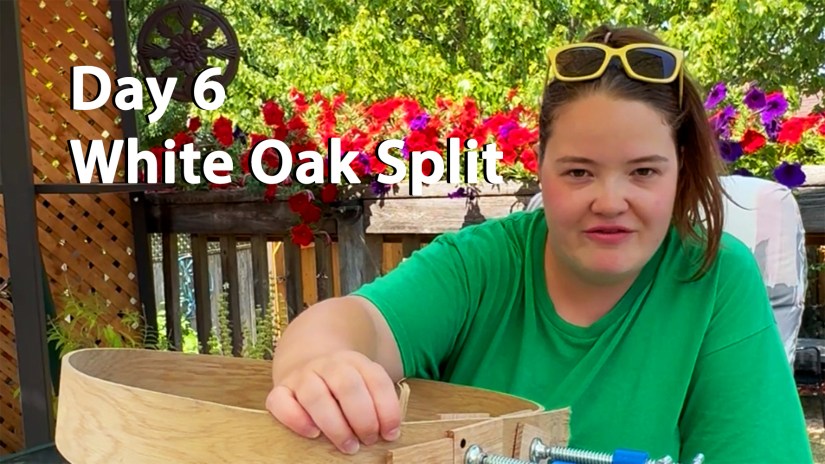
A close-up of Portia โ€œPoโ€ Chapman examining a freshly bent white oak drum frame outdoors, pointing to a small split formed during the tight first bend, with bright flowers and summer greenery behind her.
Day 6: A small white oak split appears after the first bend โ€” an expected part of pushing hardwood to its limits.

Today marks the moment of truth for the first bend of the white oak drum frame. After spending the night under clamps, the wood finally revealed how it responded to yesterdayโ€™s bending session โ€” and as always, the material had a story to tell.

If youโ€™re new here and want to learn more about who I am and the work I do, you can visit my About & Contact page.

When I brought the frame into the studio this morning, the very first thing I did was check the inside curve. And there it was:
a small split along the tightest part of the bend.

For many people, that might feel alarming. But for me, this isnโ€™t unusual at all โ€” especially with a dense hardwood like white oak. Pushing any wood to the minimum bend radius it can tolerate means youโ€™re working right at the threshold where the fibres must stretch, compress, and adapt. Sometimes, a small split appears as part of that process.


What a Split Really Means in Drum Making

A split doesnโ€™t automatically mean failure.

Itโ€™s a diagnostic clue.

It tells me:

  • how far the wood was willing to travel,
  • how much internal tension remains in the frame,
  • and whether the second bend โ€” the glued dry-bend โ€” will seat properly.

In this case, the split is shallow and controlled. That tells me the clamps did exactly what they were supposed to do:
prevent the fibres from opening too far while still allowing the bend to hold.

This is why clamp placement is a true art form in drum making. You donโ€™t just tighten clamps to tighten clamps. You tighten them in anticipation of how the wood is likely to react.

If youโ€™d like to explore my handmade drums, see past builds, or learn about upcoming workshops, visit my Drum Page here.

White oak is expressive โ€” and today, it expressed itself in a way that still sets us up for a strong final frame. As well, the location of the minor breakage will be cut off before gluing the final bend. I don’t sweat these things now, but when I first started bending drum frames, I was totally panicked when the first breakage happened. It was a learning experience – that is for sure!


Reading Tension, Relaxation, and โ€œFeelโ€

Every wood species responds differently during the first bend.
White oak? Well…It hums with a very particular kind of density.

When I picked up the bent frame today, I could feel subtle tension still living inside the curve. Thatโ€™s not unexpected โ€” in fact, with white oak, itโ€™s quite normal. White oak, unlike red oak, doesn’t particularly like being bent.

The key for Day 6 is simply evaluating:

  • Did the bend hold its overall shape?
  • Is the curve even?
  • Is the split stable and non-progressive?
  • Does the wood want to spring open dramatically or gently?

All signs today point to a solid first bend. It was a success. PHEW!!!


Come back tomorrow, Day 7, to watch and read about the what happened when I released the clamps.

The next step โ€” which comes tomorrow โ€” is the careful release of the clamps. Thatโ€™s where I discover how much reflex the wood has stored and whether it settles into the intended diameter or pushes back aggressively.

For now, the job is simply to observe, interpret, and prepare.

White oak may be challenging, but todayโ€™s results show that this drum frame is very much on track.

See you tomorrow for Day 7 of Drum December!

โ€” Po

๐Ÿ“ง Portia@loveartbypo.ca

Let Me Know What You Think! Start or Join the Convesation

To go to Google Maps / Business Platform

Portia Chapman

Drum December โ€“ Day 5: Time for Clamping

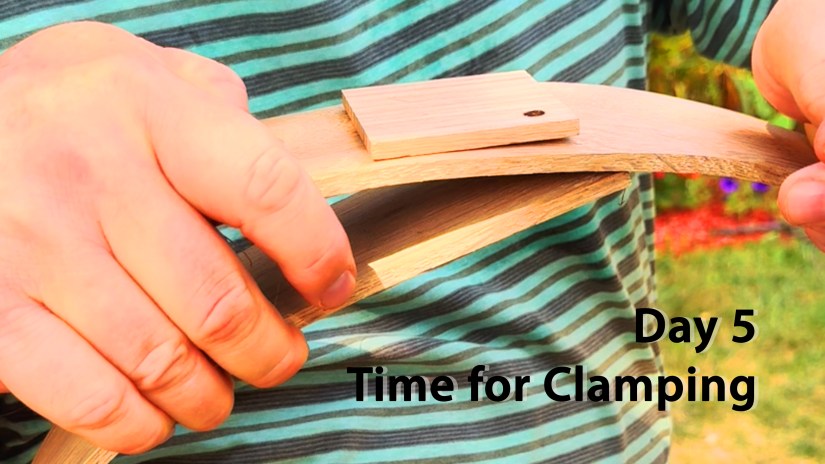
Close-up of hands holding the softened red oak board after sun-steaming, preparing the ends for clamping during Poโ€™s frame drum-making process on Drum December Day 5.
Po prepares the sun-steamed red oak board for its first clamp โ€” the moment the drumโ€™s circular form begins.

Today marks a major turning point in Poโ€™s sun-steamed red oak experiment โ€” the moment when softened hardwood, warm from the solar tubes, is guided into its first held shape. After days of heating, coaxing, and patiently encouraging the wood fibres to relax, itโ€™s finally time for the clamp.

Freehand bending is never a one-person job. With red oak especially โ€” two sets of hands are essential. One pair holds the ends together, and the other manages the clamps with steady confidence.

As the camera rolls, Poโ€™s assistant lifts one end of the oak over the other. You can see immediately that the top end doesnโ€™t lie flat; instead, it sticks out stubbornly, like a child refusing bedtime. This is normal. In every bend, no matter the length, one end refuses to behave. The wood always tries to return to straightness โ€” its original memory.

To protect the tender, freshly steamed wood, Po uses two small oak offcuts as buffers. The cut-offs keep the clamp from denting the softened wood, which is especially vulnerable before it dries.

The First Clamp: Where Courage Meets Making

Po tightens the lower piece first, then holds the top piece and slowly turns the clamp. With each rotation, the ends of the red oak pull closer together. This is the first of two clamping stages in Poโ€™s innovative dry-bending technique โ€” a method she has refined through experimentation, intuition, and respect for the material.

This first loop must dry with the clamps on for about two days.
Only then will the wood be ready to release, be cut to size, glued, and clamped again into its final drum frame shape.

What the video doesnโ€™t show is just how lively the wood can be. Even at this stage, red oak is strong and springy. If it suddenly opens, the clamp can fly across the room โ€” a heavy steel reminder that wood is a living material. Some drum makers use ratcheting straps to control this, but Po avoids this method. The hooks and pressure points donโ€™t sit flush, and can scar the damp wood just before it snaps back.

Instead, Po trusts the method shown here โ€” a method that gives her control, precision, and the markings she demands from her handcrafted drum frames.

Freehand bending sun-steamed wood may look simple, but it takes courage, strength, intuition, and sometimesโ€ฆ a little prayer.

And today, with hands steady and clamps in place, Po brings her drum loop one step closer to becoming the finished frame that will hold the heartbeat of future songs.


Check back for Day 6 to see how the bend holds โ€” and what surprises the wood reveals next.

๐Ÿ“ง Portia@loveartbypo.ca

2 responses to “Drum December โ€“ Day 5: Time for Clamping”

  1. Drum December Day 11 – How to Clamp a Drum Frame – Love Art by Po Avatar

    […] comes time for the final clamp. If you missed the early stages of this journey, you can catch up on Day 5 and Drum December Begins to see how we prepare the wood to be […]

  2. Drum December Day 10 | How to Glue Before Clamping Drum Frame – Love Art by Po Avatar

    […] before the glue is ever applied. You can see the foundation of this technique in my previous posts: Day 5, Day 7, and Day […]

Let Me Know What You Think! Start or Join the Convesation