
The Art of the Template
Preparation is the silent partner of success. Before we lift the rawhide from its sacred soak, we must ensure every measurement is exact. Thin rawhide, like the deer skin we are using for our White Oak frame, can dry out remarkably fast. If the hide becomes too dry during the stringing process, you risk the sinew ripping right through the skin—a setback we avoid by being “safe rather than sorry.”
Engineering the Perfect Fit
To protect the hide and ensure the beautiful wood of the frame remains visible, I begin by creating a precise template.
The Measurement: I cut a paper guide measuring roughly 1.5″ in length. This ensures the rawhide wraps perfectly, leaving about 0.75″ of space between the stringing holes and the edge.
Digital Precision: After sketching the rough pattern, I move into the digital space. I photograph the pattern and use Photoshop to precisely space the stringing holes.
The Cut: Using my Cricut Maker, I turn that digital file into a physical pattern. This machine truly makes light work of creating an accurate, repeatable guide.
Retrieving and “Swaddling” the Hide
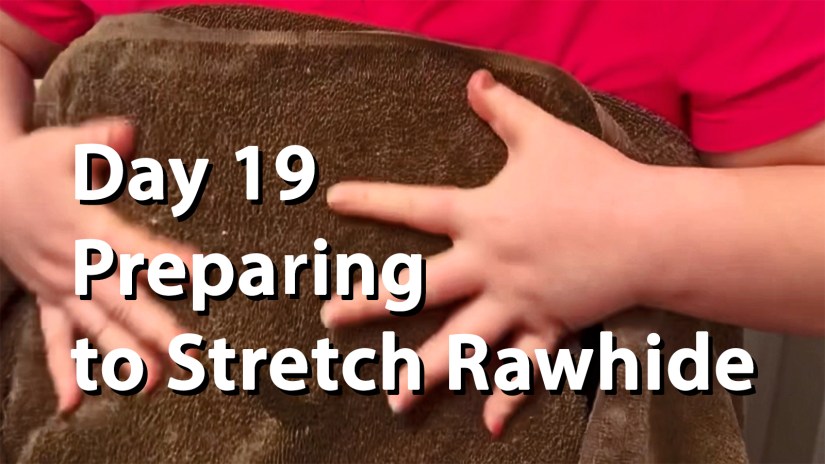
Lifting the rawhide from its bath is a delicate, two-person job. As I hold up a fresh towel, my assistant carefully removes the quartz and geode anchors.
The hide is gently pulled from the water and placed into the towel. The process of wiping it dry feels remarkably like drying a baby after a bath—it requires a gentle, caring touch to move the moisture away while keeping the hide supple.
Once “swaddled,” I move it to a festive workspace and lay it upon a fresh, dry towel to keep it from slipping.
Tracing and Punching: The Final Prep
With the template held firmly against the damp rawhide, I trace the perimeter and every single stringing hole with a pencil.
Steady Hands: It is vital that the template does not shift during this process; a slip here could be disastrous for the drum’s final tension.
The Cut: I move gently but swiftly with tin-snip scissors, following the traced line to trim the hide to its final shape.
The Holes: Using a leather hole puncher set to a medium size (approximately 2.5 mm), I punch out the marks for the sinew.
Real-Time Update: On Schedule for the New Year
As of 10:00 PM on December 27, 2025, I am thrilled to report that we are officially on schedule! To have this drum ready for New Year’s Eve, it had to be strung by midnight on the 27th to allow for a full three days of drying in a 50% humidity-controlled environment. We hit the deadline! The heartbeat of the New Year is officially within our reach.
Join us tomorrow for Drum December Day 20, where we move into the powerful work of stretching and stringing. The drum is almost ready to find its voice.
Read more about my art and contact information at Love Art By Po and the many drums I make.
To contact me directly, please use this email:
One response to “Drum December Day 19 – Preparing to Stretch the Deer Rawhide”
-

[…] Day 19: Preparing to Stretch […]
 Love Art by Po
Let Me Know What You Think! Start or Join the Convesation