A New Year’s Eve Celebration: Wrapping up 21 days of Drum December with a heart full of gratitude and a resonant new drum for 2026.
We did it. Let’s drum in the New Year!
Look how beautiful the Drum December drum turned out. This where we started with Drum December. You can learn exactly how we crafted this instrument by visiting the previous 20 days of the series. The golden translucent rawhide is like golden stained glass when it is backlit, a testament to the patient curing process and the beauty of the deer rawhide.
A Final Note on the Journey
As the final resonance of this drum rings out, I am struck by the power of community. What began as a kiln dried, white oak board and a dream of a New Year’s heartbeat has transformed into a sacred instrument, witnessed by thousands across the globe. Thank you for walking this 21-day path with me—from the first steam-bent curve to this final, triumphant pulse. May this drum’s voice carry our collective intentions for peace, healing, and creative connection into 2026.
Removing the excess: Preparing the soaked deer rawhide for stringing and stretching on Day 20 of Drum December.
The Art of the Template
Preparation is the silent partner of success. Before we lift the rawhide from its sacred soak, we must ensure every measurement is exact. Thin rawhide, like the deer skin we are using for our White Oak frame, can dry out remarkably fast. If the hide becomes too dry during the stringing process, you risk the sinew ripping right through the skin—a setback we avoid by being “safe rather than sorry.”
Engineering the Perfect Fit
To protect the hide and ensure the beautiful wood of the frame remains visible, I begin by creating a precise template.
The Measurement: I cut a paper guide measuring roughly 1.5″ in length. This ensures the rawhide wraps perfectly, leaving about 0.75″ of space between the stringing holes and the edge.
Digital Precision: After sketching the rough pattern, I move into the digital space. I photograph the pattern and use Photoshop to precisely space the stringing holes.
The Cut: Using my Cricut Maker, I turn that digital file into a physical pattern. This machine truly makes light work of creating an accurate, repeatable guide.
Retrieving and “Swaddling” the Hide
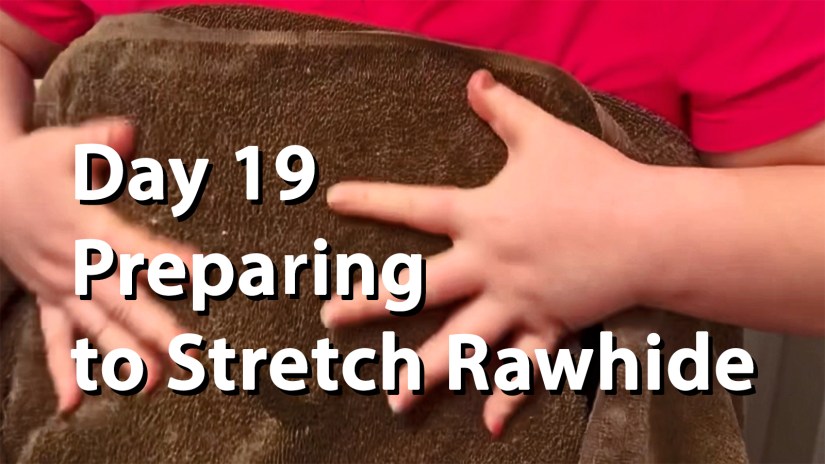
Lifting the rawhide from its bath is a delicate, two-person job. As I hold up a fresh towel, my assistant carefully removes the quartz and geode anchors.
The hide is gently pulled from the water and placed into the towel. The process of wiping it dry feels remarkably like drying a baby after a bath—it requires a gentle, caring touch to move the moisture away while keeping the hide supple.
Once “swaddled,” I move it to a festive workspace and lay it upon a fresh, dry towel to keep it from slipping.
Tracing and Punching: The Final Prep
With the template held firmly against the damp rawhide, I trace the perimeter and every single stringing hole with a pencil.
Steady Hands: It is vital that the template does not shift during this process; a slip here could be disastrous for the drum’s final tension.
The Cut: I move gently but swiftly with tin-snip scissors, following the traced line to trim the hide to its final shape.
The Holes: Using a leather hole puncher set to a medium size (approximately 2.5 mm), I punch out the marks for the sinew.
Real-Time Update: On Schedule for the New Year
As of 10:00 PM on December 27, 2025, I am thrilled to report that we are officially on schedule! To have this drum ready for New Year’s Eve, it had to be strung by midnight on the 27th to allow for a full three days of drying in a 50% humidity-controlled environment. We hit the deadline! The heartbeat of the New Year is officially within our reach.
Join us tomorrow for Drum December Day 20, where we move into the powerful work of stretching and stringing. The drum is almost ready to find its voice.
Moving from the deep stain of Day 16 to the protective glow of Day 17: Preparing to varnish the white oak drum frame.
Making the Drum Frame Shine
Varnishing is rarely a single-day task; it is a meticulous 2–3 day process that requires patience, a steady hand, and a keen ear for the wood’s texture. While the varnish gets harder the longer it dries—which is our ultimate goal for a durable instrument—this hardness can make it difficult for the next layer to bond. To ensure a professional, glass-like finish, we must navigate the delicate balance of drying times and sanding.
Choosing the Right Finish: Water-Based vs. Spar Varnish
For drums intended for rugged, outdoor drum circles, I typically use a natural spar varnish. It applies thickly and offers heavy-duty protection, though it requires significant drying time.
However, for this white oak frame, I chose a clear, non-yellowing water-based Varathane finish.
The Benefit: It dries much faster than oil-based alternatives.
The Challenge: The coats are much thinner, meaning the wood grain often “raises” after the first application.
In the video below, you can actually hear the raised grain as I sweep my hand across the dry surface. This texture must be smoothed before we can move forward.
The Secret to Sanding First Coats
Sanding the first coat of dry varnish is easier than it looks, provided you have the right technique. Because I am on a strict timeline—with the goal of stringing this drum on Day 19 (December 27, 2025)—I chose to sand after just one coat.
Pro Tip for Sanding:
Wet the surface: Lubricating the varnish prevents the sandpaper from “grabbing” too aggressively.
The Paper: Use 400-grit wet/dry sandpaper.
The Motion: Lightly draw the paper along the surface, always following the direction of the grain.
Note: If you are using a very thin acrylic “varnish,” it is often safer to wait until the 3rd coat to sand.
Once sanded, the frame must be wiped down and dried. Always use a tack cloth as your final step to remove every microscopic speck of dust before the next coat of varnish touches the wood.
Controlling the Environment
Timing is everything. I applied the first coat roughly eight hours ago, but the humidity outside was climbing. To ensure the frame dried in time for the second coat, I moved it into my humidity-controlled drum painting studio, which I keep strictly between 45% and 50% humidity. This controlled environment is essential for a consistent cure.
Efficiency on the Turntable: The Game Changer
The way you physically handle the drum during varnishing dictates the final look. I prefer to use a lazy-susan (turntable) painting surface equipped with risen bars.
Why use a turntable?
Continuous Motion: It allows for long, fluid brush strokes that follow the grain without the artist having to change positions.
Self-Leveling: Fewer brush strokes mean the varnish has a better chance to self-level, resulting in a smoother finish.
Drip Management: If excess varnish begins to pool at the bottom edge, you can easily catch and wipe it with just the tips of your bristles as the frame spins.
Using a turntable was a complete game changer for my craft, and it is the secret behind the flawless finish on this white oak frame.
Come back tomorrow when we cut the rawhide and put in the water to soak.
See you on Day 18!
Read more about my art and contact information at Love Art By Po and the many drums I make. To contact me directly, please use this email:
The final sanding stages begin in the woodshop for Day 15.
Levelling the Joint: Precision Sanding in the Winter Workshop
Welcome back to the workshop! Today is all about the “Great Sanding.” The dust is flying as we move into the first and most critical stage of finishing: leveling that joint.
In today’s video, I’m at the drum sander, pink shop apron on, getting to work on the white oak frame. You’ll see me focusing on the seam where the wood overlaps.
“We are sanding the sharp edges off of the seam. We are using a RIDGIDOscillating Edge/Belt Spindle Sander so that the seam is really nice and even. Some of my competitors leave this inside edge. But you won’t find that here at Love Art By Po.”
The “Po” Difference
For me, the inside of the drum is just as important as the outside. By using the drum sander to level those sharp edges, I ensure the frame feels like one continuous, seamless piece of wood. It’s a small detail, but it’s what makes a Love Art By Po drum a professional piece of art.
The Holiday Schedule
We are moving fast to hit our December 27th stringing deadline! Here is what the next few days look like:
Day 16 (Tomorrow, Dec 24): I’ll be finishing the hand-sanding and moving straight into the custom staining process.
Christmas Day (Dec 25): The studio will be closed. I’ll be taking the day to celebrate with family while the first layers of our work cure.
Day 17 (Boxing Day, Dec 26): We hit the ground running with the first coats of varnish in the painting studio.
Come back tomorrow for Day 16 to see these frames finally get their colour!
See You Tomorrow for Day 16
Read more about my art and contact information at Love Art By Po and the many drums I make. To contact me directly, please use this email:
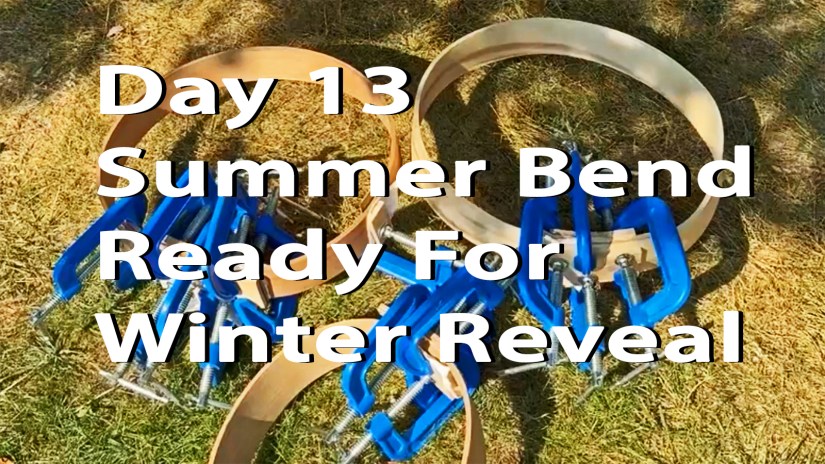
Clamped wood drum frames from the summer bending sessions, ready to be finished in the winter studio.
Beyond the Clamps: Wrapping the Summer Bend for a Winter Reveal
We have reached Day 13 of Drum December. Using my innovative dry-bend technique and the disciplined 6-clamp method for freehand organic formation, the drum frames are now set. They have been glued and secured into their unique shapes and sizes—now, we must give them the gift of time.
The Art of the Cure
In the heat of the summer, I prefer to hang the clamped frames in the maple tree at the Love Art By Po studio. I’ve found that the blazing summer sun and a hot woodshop can be too aggressive; the glue and wood need to work their magic at their own pace. This stage cannot be rushed.
Whether they are hanging in the cool shade of a tree or resting in my humidity-controlled studio, the environment must be just right. To ensure the wood “remembers” its new shape without stress, I maintain these optimal conditions:
Temperature Range: 18–27°C (65–80°F)
Humidity: 55%
Lighting: Reduced UV exposure with dappled, indirect sunlight
More Than Craft: The Living Drum
Once dry, the frames move into my controlled environment for about 30 days. But this isn’t just storage—it is an introduction. I bring them into a living space filled with family conversation, singing, and music. I introduce them to their “sister drums” by playing the finished drums that surround them.
Some might think of drum making as simple carpentry, like crafting a coffee table, but the wood tells a different story. If you do not acknowledge their living nature, they rebel. For years, I heard stories of drums as family members who “talk” in their own ways. I never truly comprehended how that was possible until I began making them myself. Now, I know the truth: Drum making, most assuredly, becomes LIFE.
The Pivot: Moving to Real-Time
Today is December 21, 2025. Our summer-bent frames have dried, been unclamped, and are fully conditioned to the spirit of my studio. Starting tomorrow, Day 14, we leave the archives behind and move into real-time.
We are officially on a countdown to New Year’s Eve. To drum in 2026 with a newly finished piece, I must have the rawhide strung by December 27. Rawhide requires three days to dry in perfect conditions, and with the shifting winter weather outside my stringing studio, this will be a true nail-biter.
Nature will do as Nature does, and the drum is a part of that natural world. Join me tomorrow for Day 14 as we step into the workshop to begin the sanding and finishing.
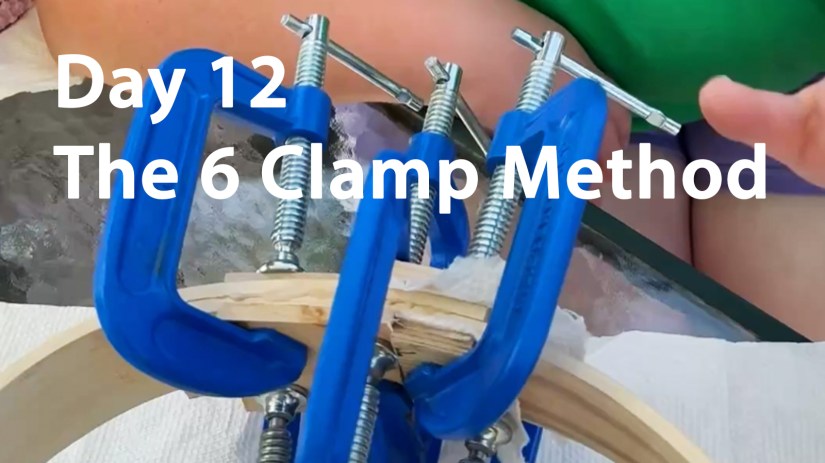
Mastering the “6 Clamp Method” to ensure a secure, even bond on the dry-bent drum frame.
Drum December Day 12: Mastering the 6-Clamp Method
Welcome to Day 12 of Drum December! Today is the day we tackle dry-bending and clamping head-on. In this tutorial, you’ll learn the vital “what-to-dos” (and the painful “what-not-to-dos”) of securing your frame.
Clamping hardwood is a bit like attending your grandmother’s third wedding and being asked to dance by a gentleman who took lessons from Chubby Checker. Just like a dancer from the ’60s, the wood keeps trying to “Twist.” By following my innovative 6-Clamp Method, you’ll have no problem taking the lead in this clamping dance.
The Anatomy of the Dance: Twist and Circularity
When making drum frames, there are two primary style considerations you must face:
The Twist: How much natural “sport” or torsion your finished frame will carry.
The Shape: How perfectly circular or organic you want your finished drum to be.
Both of these decisions are finalized during the clamping stage. This is exactly why I developed the 6-Clamp Method—to give the maker total control over the wood’s final expression.
Avoiding the Tangled Clamp: The Staggering Method
In Day 11, I explained how the shape changes depending on which end overlaps on the outside. Today, we focus on the direction of the clamps.
Because you are using six heavy-duty C-clamps in very close proximity, the handles can easily get stuck against each other. It can be a deeply frustrating process! Below is a video of my own experience trying to turn clamp handles that weren’t staggered. If you find it painful to watch, just imagine being the one trying to turn them under pressure!
To solve this, we stagger the clamps—top and bottom—in a disciplined sequence. This allows us to intricately pull the seam together while “reading” the bend and twist of the frame.
The 6-Clamp Sequence: A Step-by-Step Guide
I have created this incremental schematic to show you the exact order of operations. Note how each clamp is placed to manage the tension of the 3″ to 5″ glued seam:
Clamp #1: Placed on the top, dead-center of the seam.
Clamp #2: Placed directly beneath the first, but facing the opposite direction.
Clamps #3 & #4: Placed on the side of the center clamps closest to the inner board end.
Clamps #5 & #6: Placed on the remaining opposite side.
Shaping with Baffles: Controlling the Curve
In the schematic video above, I omitted the cutoff baffles (the hardwood blocks that protect your frame) for clarity. However, you must use them!
The size of the baffle on the inside of the frame actually alters the drum’s final shape.
The Standard: I typically use a 1″ x 3″ piece of oak.
The Adjustment: If you want to flatten a side or create an egg-shaped drum, you do this by widening the inner baffle. The wider the baffle, the flatter that section of the frame becomes.
The Rule of Thumb: I generally use a 1″ wide piece on the inside and a 2″ wide piece on the outside, adjusting the spacing as I feel the wood react.
The Goldilocks Grip: Just Enough Pressure
By alternating your clamps, you aren’t just preventing a handle jam—you are managing the twist. When the first clamp goes on, you can adjust the shift and slide of the frame. The second clamp adds stability, and clamps three through six do the heavy lifting.
Tighten them as firmly as your hand can turn—no need for tools. You are looking for the glue to “squeeze out” evenly along the seam. Be careful not to over-tighten! If you squeeze out too much glue, you’ll create a “starved” joint. This results in a fragile frame that may snap when the powerful tension of the rawhide eventually pulls it into its final form.
Looking Ahead
If you think a tree has a long memory, just wait until you see the nature of rawhide. Keep following the Drum December series to see how we work with animal skins in the coming days.
Even if you never pick up a clamp yourself, I hope you’ve learned how to straighten out “The Twist.” Just start in the middle of the floor and lead your partner—side-stepping and swaying until the song is done and you both become one with the true drumbeat of life.
Day 11: Applying high-pressure clamps to the glued frame is the final step to ensuring a rattle-free, resonant instrument.
Drum December Day 11: Mastering the Compression and Clamping of Your Drum Frame
Welcome back to Drum December! Today, we are diving into one of the most transformative stages of the process: using my innovative dry-bending technique to compress and clamp the drum frame. This method is born from my preference for non-polyurethane glues, which we explored in our Day 10 tutorial.
By utilizing sun-steamed wood that has been “trained” during the pre-bending phase, we gain incredible creative flexibility when it comes time for the final clamp. If you missed the early stages of this journey, you can catch up on Day 5 and Drum December Begins to see how we prepare the wood to be shaped.
The “impossible” C-Shape
After trimming the frame on Day 9, you are left with a piece of wood that has a massive 16-inch gap between the ends. It looks like a giant letter “C,” and honestly, it looks impossible to close. But this is where the magic happens.
Choosing Your Bending Method
There are two primary ways to bring those ends together:
Mechanical Bending: Using a dedicated jig or form to force the wood into a circle.
Freehand Bending: Bending the wood by hand and clamping the ends using only hardwood cutoffs as buffers.
I personally prefer the freehand dry-bending method. My clients love it because it results in a more organic, natural shape and a superior sound.
The Critical Decision: Inside or Outside?
Before you apply a single clamp, you must decide which end of the wood will overlap on the outside. This might seem minor, but it is vital:
The choice of which end goes on the outside literally alters the final shape and resonance of the drum.
The inner end experiences a much tighter curve than the outer end.
Even with identical ends, swapping the overlap order can create a completely different hoop shape.
The Miracle of Elasticity
The most remarkable part of this technique is the elastic response of the hardwood. Because of the sun-steaming and pre-bending, the wood becomes incredibly flexible. In my demonstrations, you can see a cherry wood frame compressed over 16 inches with ease.
I view myself as a facilitator for the tree. When you encourage the wood to bend naturally, it “sings”. If you force it, the wood rebels, cracks, and the sound becomes muted. A drum maker’s job is to unlock that voice, not silence it.
Letting the Tree Sing: The Philosophy of the Bend
It is truly a remarkable thing to witness, and I often wonder why this method isn’t the gold standard. When we dry-bend, the results are simply superior to clamping freshly steamed wood—especially when crafting those challenging, small-radius frames.
Using this technique feels less like “construction” and more like an act of listening. In the forest, trees are designed to dance; their limbs are built to bend when the wind caresses them. In my workshop, I see myself as a facilitator of that natural expression.
When you allow the wood to bend on its own terms, it sings. When you force it, the wood rebels; it cracks, it groans, and its spirit becomes muted. As a drum maker, my calling is to encourage the drum to find its voice, not to silence it through force.
The “Vet Visit”: Understanding Wood’s Resistance
Once the wood has agreed to take its shape and the decisions of Day 10 are behind us, we move into the physical intensity of the clamping stage.
Even a willing tree has its limits. Wood has a memory and a will of its own, and it behaves much like a dog on the way to the veterinarian. The pup is perfectly calm in the car until you turn that final corner—the moment she realizes what’s happening, she “flips out.”
The drum frame does the same. It will rest quietly in your hands until the moment you bring the glue bottle near. It is the strangest, most miraculous sensation: you can feel the frame shift from a gentle yield to a spirited push-back against the compression. To navigate this, you need a sturdy vice and quick clamps within arm’s reach—or a very strong, steady assistant to help you hold the tension.
The Trick of the Trade: Precision and Protection
Because the wood is alive and moving, using C-clamps is a high-stakes, time-sensitive dance. The second the clamp touches the wood, everything wants to slide and shift. I used to panic during this stage, but I eventually learned the secret: The One-Inch Rule.
Keep it Tight: Ensure your C-clamp is open less than an inch. This allows you to turn the handle and lock it down before the wood has a chance to escape.
The Safety Net: If you can’t turn the handle fast enough, snap a couple of quick clamps on either side of the joint. They will hold the frame long enough for you to seat your heavy-duty C-clamps properly.
Honor the Surface: Never let metal touch the frame directly. A C-clamp is a powerful tool that can easily dent the wood. Always use hardwood cutoffs as a barrier between the clamp and the frame. Even with light-duty clamps, these barriers are essential for protecting the integrity of the wood.
In the video below, you can see this “C-clamp dance” in action as we bring the ends together for the final time.
Pro-Tips for Successful Clamping – A Summary for You to Remember
Keep these clamping tips in mind:
Speed is Key: If using C-clamps, keep them open less than an inch so you can tighten the handle quickly before the wood shifts.
Use Backups: If you can’t move fast enough, use quick clamps on either side of the joint to hold the position while you set your C-clamps.
Always Use Barriers: Never put a C-clamp directly on the frame; it will dent the wood. Always use hardwood cutoffs as a barrier between the clamp and the drum.
Clamping Numbers: Use at least six clamps to secure the joint while it dries.
Barrier Dimensions: Use wood cutoffs approximately 1″ x 3″ for the inside of the frame, and 2″ x 3″ for the outside.
What’s Next? Tomorrow, on Day 12, I’ll show you exactly how to arrange those six clamps so they don’t get tangled or interfere with the curve of the frame. It’s a bit like a puzzle, but I’ll walk you through it!
Love Art by Po creates 3 grades of frame drums: Drum Circle, Instrumental and Gallery. Also, Po makes 10″ drum, DIY drum kits. Go to the Drum page to read more about the grades and how to purchase them. Here is the link.
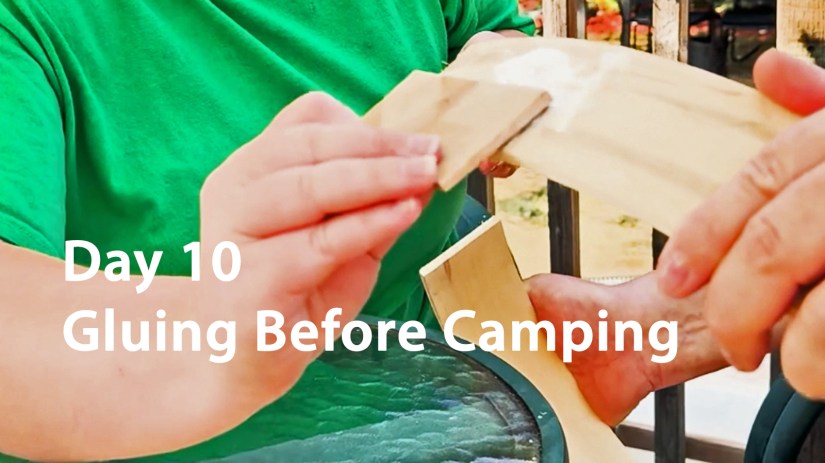
Drum December Day 10 – Po Glues the White Drum Frame Before Clamping the Dry-Bend
Choosing the Right Glue for Handcrafted Drum Frames | Drum December Day 10
At the Love Art by Po studio in Kingston, I believe that building a professional-grade drum frame is as much about the type of glue as it is the technique used to apply it.
Different moisture levels in wood require different chemical bonds. Whether you are working with freshly steamed “green” wood or seasoned dry wood, choosing the wrong adhesive can compromise the sound of your instrument. In today’s update, I’ll explain how to pick the right glue at your local hardware store to ensure a lifetime of pure sound.
The Challenge: Gluing Damp vs. Dry Wood
The first hurdle every drum maker faces is moisture. If you are bending steamed red oak, the wood is naturally damp.
Early in my practice as an installation artist, I treated drum frames like standard carpentry—LePage Pro Carpenter’s Glue. However, standard wood glue and damp, steamed wood do not mix. I would return to my shop table the next morning to find the joint “slimy” and uncured on the inside.
The Polyurethane Solution
To glue damp wood effectively, you need a moisture-activated adhesive like Original Gorilla Glue. This polyurethane glue uses the moisture in the wood to “activate” the bond. It bonds damp frames like a dream, but it comes with a significant trade-off: The Foam.
The Science of Sound: Why “Foaming” Glue Causes Rattle
If you want a pure, resonance-free tone, you must understand how glue affects vibration. Polyurethane glue expands into a foam, creating tiny air pockets within the joint.
Are Drum Frames Meant to Rattle?
The Rattle: If you enjoy a “smooth rattle” or mechanical reverberation, foaming glue is your best friend.
The Pure Tone: If you want a clean strike, never use foaming glue. The drum frame produces sound just as much as the rawhide. If your glue joint contains air pockets, the vibration of the drum strike can cause a “seam rattle” deep within the wood.
How to avoid the rattle:
Glue the frame only when the wood is fully dry.
Use a non-foaming moisture-resistant glue like Gorilla Glue Clear. (Note: “Non-foaming” glues can be slippery, making clamping a damp frame more difficult.)
Three Steps to a Rattle-Free Steamed Frame
If you are new to drum making, remember that hitting a drum with “enthusiastic force” will eventually shake loose any weak or brittle bonds. To ensure your steamed frame remains silent and solid, follow these three steps:
Cooling Time: Let the wood cool until it is no longer steaming, but is still slightly damp before applying glue.
Even Spread: Use a non-foaming polyurethane glue spread evenly across the entire joint.
Pressure: Use 6+ C-clamps, applied two at a time on opposite sides to ensure even compression.
Innovating with Dry Wood Bending
For my premium drums, I prefer to glue the wood when it is fully dry. This produces a beautiful, rattle-free instrument. However, dry hardwood doesn’t like to bend—it behaves like a floor plank!
To solve this, I developed a proprietary dry-bending technique. The wood is pre-bent and shaped before the glue is ever applied. You can see the foundation of this technique in my previous posts: Day 5, Day 7, and Day 8.
Why? It offers a longer working time, becomes “tacky” quickly for better clamping, and is rated for both interior and exterior use.
The Secret: Let the wood and glue “perform their magic” for at least 24 hours before sanding or knocking the frame.
The “Drum Making Golden Rule”
Frame drums are built for life—they go from drizzling rain at a community circle to the dry heat of a bonfire. Because they are exposed to moisture, heat, and travel, your glue must be waterproof.
The Golden Rule:
No matter the purpose of the drum, ALWAYS use a high-strength, waterproof glue that produces zero (or nearly zero) bubbles.
Coming Tomorrow: Join me for Drum December Day 11, where I’ll share a deep-dive tutorial on Professional Clamping. I’ll show you the “tricks of the trade” to ensure your frame is perfectly circular and structurally sound.
[…] Welcome back to Drum December! Today, we are diving into one of the most transformative stages of the process: using my innovative dry-bending technique to compress and clamp the drum frame. This method is born from my preference for non-polyurethane glues, which we explored in our Day 10 tutorial. […]
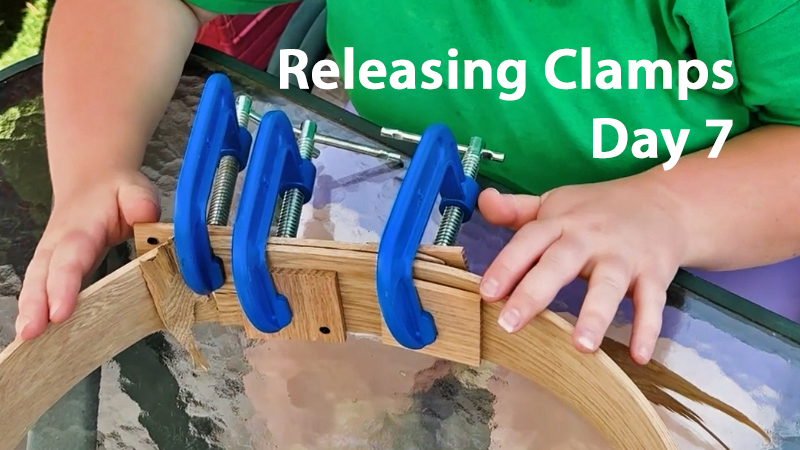
Day 7: Po releases the clamps on the white oak drum frame — the moment of truth in the Drum December bending sequence.
Drum December, Day 7’s update brings you right into one of my favourite moments in the drum-making process — releasing the clamps after a full overnight bend (in this case, it took 48 hours to dry). There’s always a little suspense in the air: did the frame hold its curve? Did yesterday’s small white oak split stay contained? OR… Would I just get slapped in the face?
If you’re new to Drum December, I’m Portia “Po” Chapman — the artist behind these handmade drum frames. You can learn more about my artwork and workshops on my About & Contact page.
Checking the Strength and Integrity of the First Bend
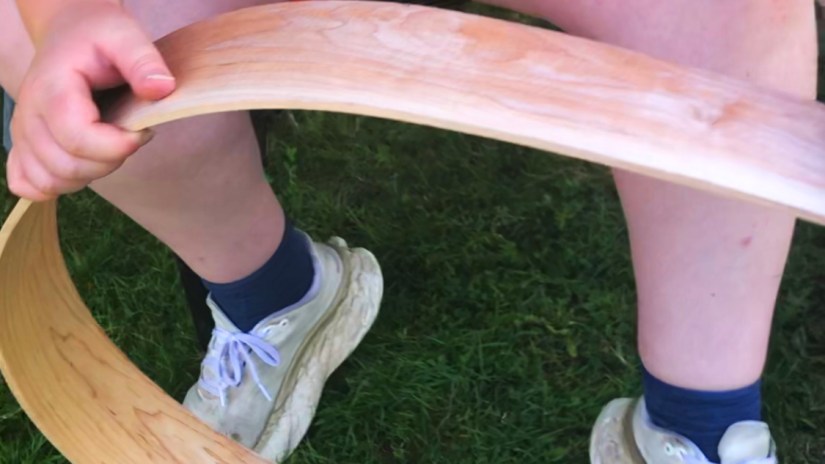
With slow hands and hopeful curiosity, I began removing the clamps one by one. The wood felt settled and responsive, and despite yesterday’s unfortunate split, the frame held together beautifully. The bend set cleanly and the character of the wood showed itself the way only white oak could; it was strong and unpredictable.
This is one of the reasons I love teaching you about the process of drum-making. Every piece of wood has its own story; some bend effortlessly, while others challenge you and reveal their limits as you work. Day 7 reminds me that, some days, drum frame making is as much about bravery as it is about skill.
Come back tomorrow when we will compress the white oak to the size of drum that I want and proceed to draw the cut marks for length.
Shaping the curve of a drum frame — one of the first steps in Po’s rhythm-making process.
Today marks the beginning of Drum December, a month-long glimpse into the rhythm and process inside Po’s Studio. Instead of presenting finished pieces, this series brings you into the quiet, hypnotic motions that form the foundation of Po’s drum works.
The first video is just five seconds long — a looping moment that feels like it could play forever. Simple. Repetitive. Almost meditative. It captures a small piece of the energy that moves through Po’s creative process: the balance of sound, gesture, material, and breath.
Po has always worked from rhythm. Whether she’s painting, shaping rawhide, or exploring new concepts for future installations, there’s a pulse beneath everything she creates. Drum December is a way to share that pulse with you — not through explanation, but through small, visual experiences.
Throughout the month, you’ll see short clips from the studio: textures, movements, tools, surfaces, patterns, and the making behind upcoming work. Some loops will be raw; some will be visually polished. All of them come from Po’s hands and her way of seeing.
This series also sets the stage for the work she is developing for her upcoming installation, where drums and light will play an important role. Think of Drum December as the first heartbeat of that larger project.
Thank you for stepping inside her studio. More rhythm, more movement, and more behind-the-scenes moments will arrive soon.
[…] for the final clamp. If you missed the early stages of this journey, you can catch up on Day 5 and Drum December Begins to see how we prepare the wood to be […]







 Love Art by Po
Let Me Know What You Think! Start or Join the Convesation