Behind the Art, Behind the scenes, Drum December, Drum Works, How Po Makes Hand Drums, Indigenous Art, Po's Drum Making Process, Portia Chapman, Real-Time Crafting, Studio Process, Uncategorized

Drum December Day 17 – How To Varnish a Drum Frame

Close-up of a white oak drum frame stained in Black Cherry, resting on wooden risers for the varnishing stage of Drum December Day 17 at Portia Po Chapman’s studio.
Moving from the deep stain of Day 16 to the protective glow of Day 17: Preparing to varnish the white oak drum frame.

Making the Drum Frame Shine

Varnishing is rarely a single-day task; it is a meticulous 2–3 day process that requires patience, a steady hand, and a keen ear for the wood’s texture. While the varnish gets harder the longer it dries—which is our ultimate goal for a durable instrument—this hardness can make it difficult for the next layer to bond. To ensure a professional, glass-like finish, we must navigate the delicate balance of drying times and sanding.

Choosing the Right Finish: Water-Based vs. Spar Varnish

For drums intended for rugged, outdoor drum circles, I typically use a natural spar varnish. It applies thickly and offers heavy-duty protection, though it requires significant drying time.

However, for this white oak frame, I chose a clear, non-yellowing water-based Varathane finish.

  • The Benefit: It dries much faster than oil-based alternatives.
  • The Challenge: The coats are much thinner, meaning the wood grain often “raises” after the first application.

In the video below, you can actually hear the raised grain as I sweep my hand across the dry surface. This texture must be smoothed before we can move forward.

The Secret to Sanding First Coats

Sanding the first coat of dry varnish is easier than it looks, provided you have the right technique. Because I am on a strict timeline—with the goal of stringing this drum on Day 19 (December 27, 2025)—I chose to sand after just one coat.

Pro Tip for Sanding:

  1. Wet the surface: Lubricating the varnish prevents the sandpaper from “grabbing” too aggressively.
  2. The Paper: Use 400-grit wet/dry sandpaper.
  3. The Motion: Lightly draw the paper along the surface, always following the direction of the grain.

Note: If you are using a very thin acrylic “varnish,” it is often safer to wait until the 3rd coat to sand.

Once sanded, the frame must be wiped down and dried. Always use a tack cloth as your final step to remove every microscopic speck of dust before the next coat of varnish touches the wood.

Controlling the Environment

Timing is everything. I applied the first coat roughly eight hours ago, but the humidity outside was climbing. To ensure the frame dried in time for the second coat, I moved it into my humidity-controlled drum painting studio, which I keep strictly between 45% and 50% humidity. This controlled environment is essential for a consistent cure.

Efficiency on the Turntable: The Game Changer

The way you physically handle the drum during varnishing dictates the final look. I prefer to use a lazy-susan (turntable) painting surface equipped with risen bars.

Why use a turntable?

  • Continuous Motion: It allows for long, fluid brush strokes that follow the grain without the artist having to change positions.
  • Self-Leveling: Fewer brush strokes mean the varnish has a better chance to self-level, resulting in a smoother finish.
  • Drip Management: If excess varnish begins to pool at the bottom edge, you can easily catch and wipe it with just the tips of your bristles as the frame spins.

Using a turntable was a complete game changer for my craft, and it is the secret behind the flawless finish on this white oak frame.

Come back tomorrow when we cut the rawhide and put in the water to soak.

See you on Day 18!

Read more about my art and contact information at Love Art By Po and the many drums I make.
To contact me directly, please use this email:

📧 Portia@loveartbypo.ca

One response to “Drum December Day 17 – How To Varnish a Drum Frame”

Let Me Know What You Think! Start or Join the Convesation

Behind the Art, Behind the scenes, Drum December, Drum Works, How Po Makes Hand Drums, Indigenous Art, Kingston Artist, Po's Drum Making Process, Portia Chapman

Drum December Day 16 – How to Stain a Drum Frame

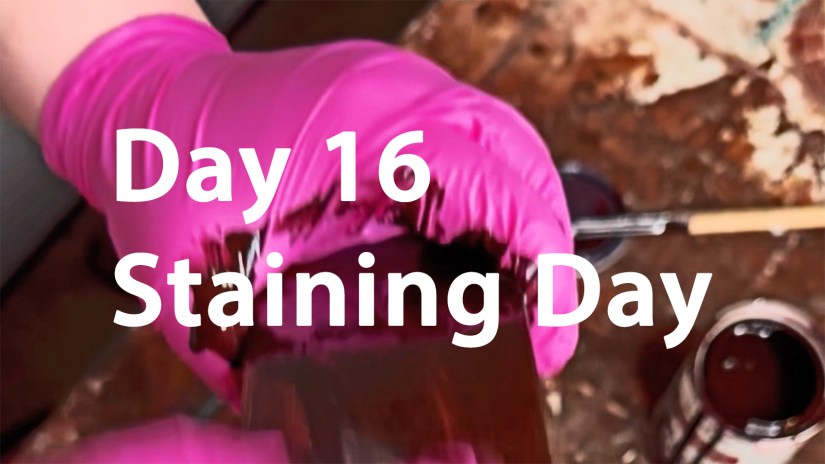
Close-up of Portia Po Chapman’s hands in pink gloves applying a dark mahogany stain to a hardwood drum frame component at Kingston Art Studio for Drum December Day 16.
Transitioning from the smooth finish of Day 15 to the deep, rich tones of Day 16: Applying the first layer of stain to the hardwood drum frame.

The Race to Drum in New Year – 2026

The rhythm of the season is building toward a crescendo. While many were tucked away with holiday films on Christmas Eve, I was in the workshop, continuing our journey toward a finished instrument. To drum in the New Year with a voice that is both resonant and beautiful, we must follow the proper order of operations: sand, stain, varnish, and finally, string.

Reflecting on the Foundation

In our Day 15 video, we tackled the critical task of erasing the overlap seam. Using a portable spindle sander, I smoothed the transition until the wood felt like a single, continuous loop. As you can see in today’s introduction, that seam has completely vanished, leaving us with a flawless canvas for our colour.

Engineering the Workspace: The Staining Station

Success in finishing starts with a stable environment. Whether it is a sunny summer afternoon outside or a brisk winter day in the shop, I rely on a portable, heavy-duty folding table that has weathered years of artistic projects.

Building Your Staining “Cradle”: To ensure the frame is evenly coated without sticking to the work surface, I create a temporary riser system.

  • The Materials: I used trimmings of red oak from my table saw bucket, though bamboo garden stakes work wonderfully in the summer.
  • The Technique: Break your wood trimmings to length so they span the width of your frame.
  • Pro Tip: Use green painter’s tape to secure your sticks to the table. This prevents them from shifting while you work and allows for effortless cleanup, as the stain won’t bond to the tape.

The Art of the Application: “Black Cherry” on White Oak

White oak is a legendary hardwood, prized for its pronounced grain and historical use in antiques. However, its density makes it a challenging student in the workshop. To properly stain a wood with such deep pores, you cannot simply wipe the color on; you must work it into the fibres.

The Staining Process:

Saturate: Use a lint-free cloth soaked in Varathane “Black Cherry” stain.

Rub Across the Grain: This force-feeds the pigment into the deep, open pores of the white oak.

Wipe Along the Grain: A final pass in the direction of the wood’s growth removes excess liquid and creates a uniform, professional finish.

A Christmas Eve Revelation

The timeline for a New Year’s drum is strict: to have the hide stretched and dried by midnight on December 31st, the frame must be strung by December 27th. This meant the staining had to be completed by the 24th to allow for proper curing.

Adding this workshop session to my Christmas Eve festivities—slipping away between wrapping gifts to check on the wood—added a special layer of joy to the holiday. When the stain hit the wood, the result was breathtaking. My shop assistant, the cameraperson, and I were all stunned by the revealed grain. It became clear in that moment why white oak was the choice for the heirlooms I have admired all my life.

White oak has been an adventure—it is stubborn, heavy, and demanding—but seeing this “Black Cherry” finish reveal its hidden patterns has made every hour of labor worth it.

The frame is ready. Join us for Day 17 as we move into the varnishing phase!

See You Tomorrow for Day 17

Read more about my art and contact information at Love Art By Po and the many drums I make.
To contact me directly, please use this email:

📧 Portia@loveartbypo.ca

One response to “Drum December Day 16 – How to Stain a Drum Frame”

Let Me Know What You Think! Start or Join the Convesation