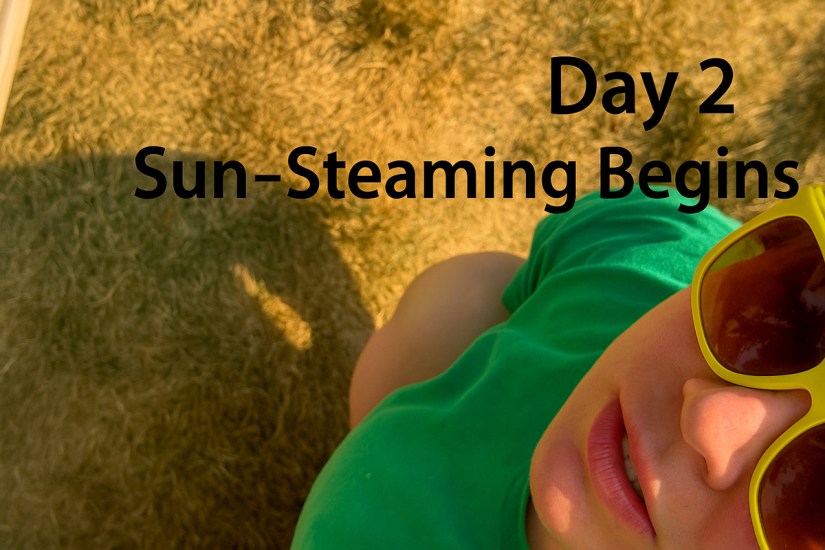
Day 2: Po begins her sun-steaming process for crafting hardwood drum frames.
Welcome to Day 2 of Drum December!
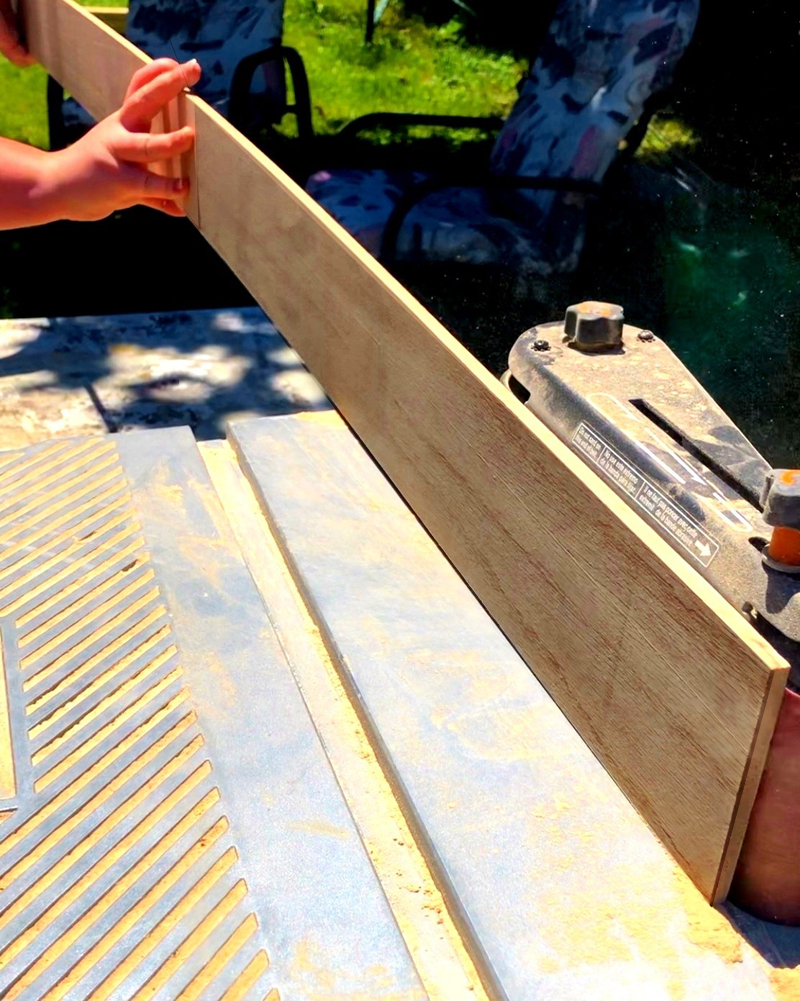
Today, Po begins the very first step in her innovative sun-steaming method — a sustainable process she personally developed to prepare kiln-dried hardwood for her premium drum frames and exposed stretchers.
Sun-steaming is a technique that Po pioneered to reduce the environmental impact of traditional wood steaming. Instead of soaking the kiln-dried wood for two days and then heating it with electricity, Po slides the carefully milled hardwood into a long black tube with ridges along its interior.
The ridges guide the wood as it slides in, producing a distinctive sound — the beginning of the transformation.
Once the hardwood is inside the tube, Po fills it with water and lets the sun do all the work. For three full days, the water naturally heats within the sealed tube, allowing the wood fibres to relax and prepare for bending.
An Energy-Conscious Method for Steaming the Wood:
Removes the two-day soaking stage
Uses no electricity
Reduces water consumption
Produces a more responsive bend
Creates the smooth, elite-quality curves Po’s drum frames are known for
This is where Po’s craftsmanship begins — with innovation, patience, and the sun itself.
Tomorrow, we’ll continue documenting this process as Drum December unfolds, one beautifully authentic step at a time.
Tomorrow, Po continues the transformation as she assesses the wood to see whether it has relaxed enough to become bendy and ready for shaping.
Organic Colour-Blocking Murals in Kingston | Contemporary Hand-Painted Art by Po
Kingston homeowners are increasingly choosing original, hand-painted murals over traditional prints or wallpaper. Why? Contemporary interior design trends incorporate murals because they are more than decoration — they are living, breathing elements of your home.
My style, organic colour blocking, uses precise brushwork to create vivid, flowing shapes and razor-sharp edges. It’s contemporary, sophisticated, and impossible to replicate digitally or with spray cans. Each mural interacts with the light, architecture, and atmosphere of your room.
Benefits of organic colour-block murals for Kingston homes:
Custom fit for your space: Every curve and colour is tailored to your room, wall, and lifestyle.
Adds personality: Your mural reflects your taste, energy, and story.
Timeless impact: Hand-painted murals remain striking for years, unlike printed designs that can fade or feel flat.
A mural in your foyer, living room, bedroom, or studio is more than art — it’s a statement. It changes how you feel in the room, how you move through the space, and how visitors experience your home.
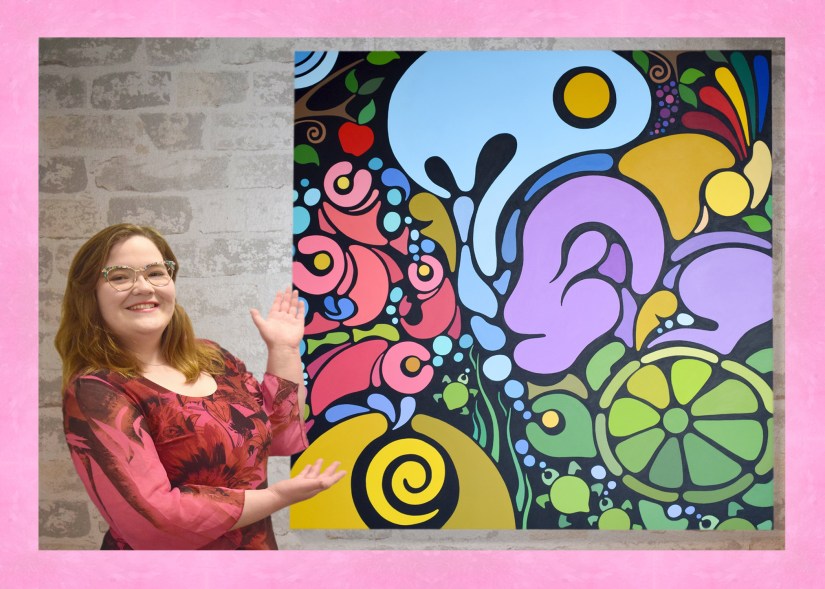
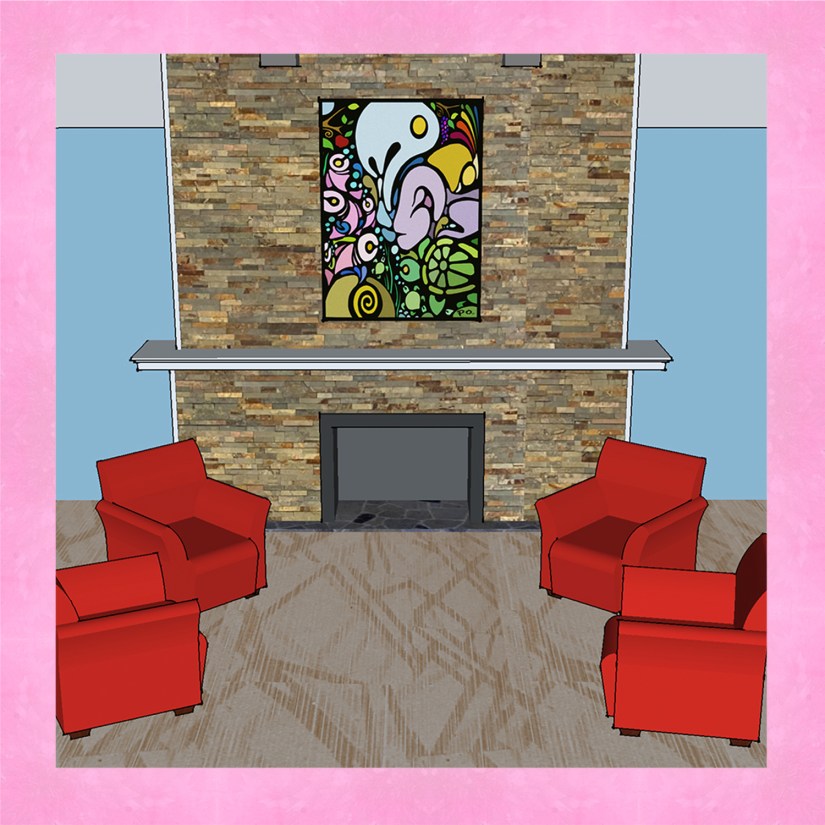
Colour Blocked Mural over Fireplace by Po in Kingston
Using a brush when painting a mural featuring colour blocking achieves crisp, opaque lines and shapes. It takes a painter many years of practice to produce sumptuous, flowing edges that are crisp and fluid. My own technique produces “flat” brush strokes that appear almost textureless.
The power of the murals I paint is the seamless connection with the viewer and the space – only achieved through exactness. The mind and soul immediately understand the imagery because without blurred edges, one need not interpret – just enjoy.
If you’re ready to bring contemporary, hand-painted mural energy into your Kingston home, I can help design and create a space that feels alive, intentional, and completely unique.
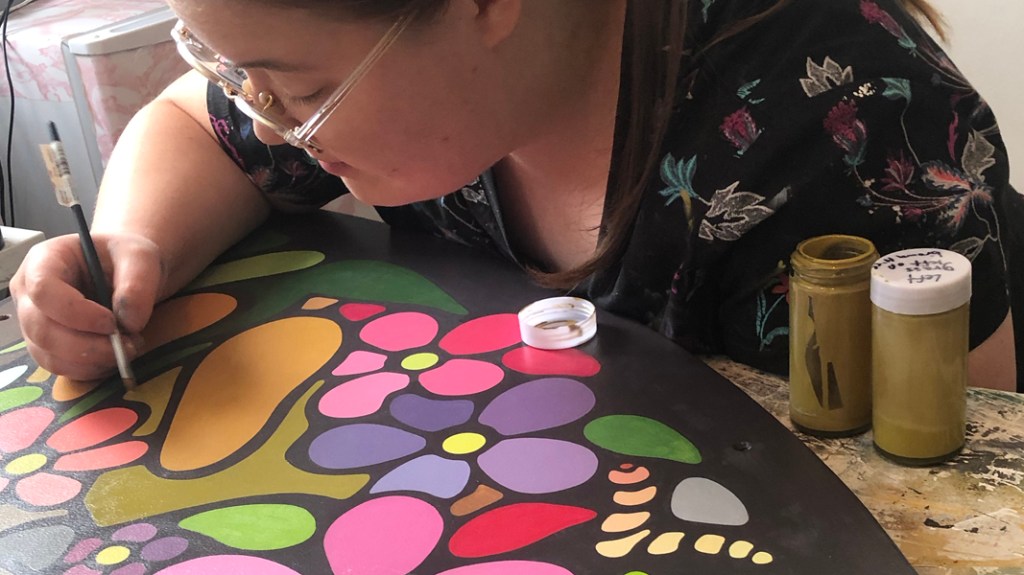
Kingston Mural Artist Portia “Po” Chapman Painting Outlines with a Small Brush using Specialty Exterior Acrylic Paint
Kingston Hand-Painted Murals by Po | Original, Vivid, Organic Colour Blocking
From cozy cafés to modern offices, Kingston is home to incredible spaces. I am sure that we can all agree that every incredible space deserves magnificent artwork. Of any art, nothing transforms a wall like a hand-painted mural. While digital prints or projector-based murals are quick and convenient, they lack the energy, precision, and human touch that a true hand-painted mural delivers.
My work uses organic colour blocking, a contemporary technique I developed that produces razor-sharp edges, fluid forms, and sumptuous colours that seem to breathe. Unlike spray cans or mechanical reproductions, every brush stroke is intentional, every edge precise, every colour alive, every shape beloved.
Why choose a hand-painted mural for your Kingston space?
Presence: Hand-painted murals carry the signature of the artist. They are tactile, alive, and impossible to duplicate digitally.
Custom fit: Each mural is designed for your space, wall dimensions, and the energy you want to create.
Emotional impact: Organic colour blocking resonates on a subconscious level, making rooms feel calm, energized, or expansive — depending on the design.
Clients across the Kingston, Picton and Belleville region have told me that stepping into a room with one of my murals is like stepping into a new world — vibrant, contemporary, and unmistakably personal.
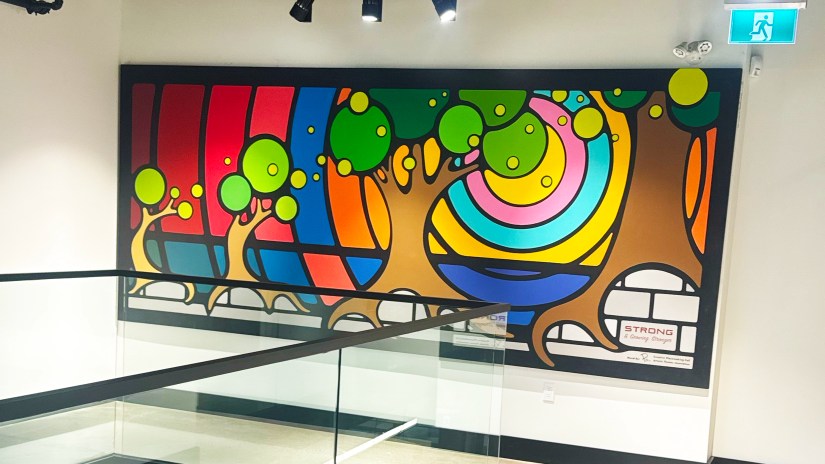
Kingston artist Portia Po Chapman’s mural. “Strong and Growing Stronger” is Installed at the Strong Enterprises Headquarters Office Building in Belleville, Ontario. 2025
If you’re ready to make your space unforgettable, a hand-painted mural is the ultimate investment in art, atmosphere, and identity. To start your mural process, contact me today – e-consultations and quotes are complimentary.
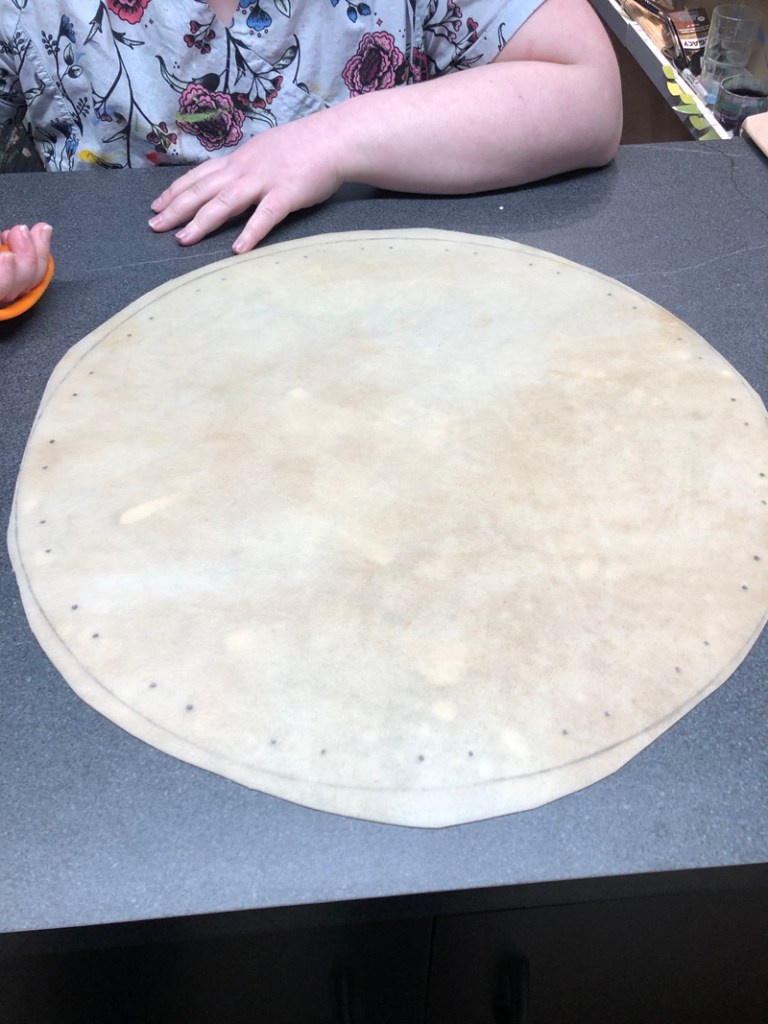
Po has Drawn on Shape and String Holes and is Ready to Cut the Rawhide
In order to cut the shape, I first draw on the pattern. In order to do this, I lay the drum frame on the soaked rawhide and draw the shape with an HB pencil that is not very sharp. The size that I draw on is usually about 2-1/2″ larger all the way around the frame. So for a 14″D frame, I draw on a 19″D shape that is the same shape of the frame. After I do this, I mark the string pleating holes, to be punched out later. This can be a very frustrating step, so I create a paper template and fold the paper to assure that the pleat holes are perfectly symmetrical. I will be posting another how-to concerning this step, but basically the two holes close together are for the pleat and the wider space is where the hide will lay flat against the frame when dry. The number one thing to remember is, the pleats must be evenly spaced and even in number, such as 8, 12, 16 pleats and so on. Keep the string holes about 3/4″ from the edge, all the way around. Premium drums have 16+ pleats. But to begin, I would only use 8 or 12 pleats.
Step 2: Cutting the Rawhide
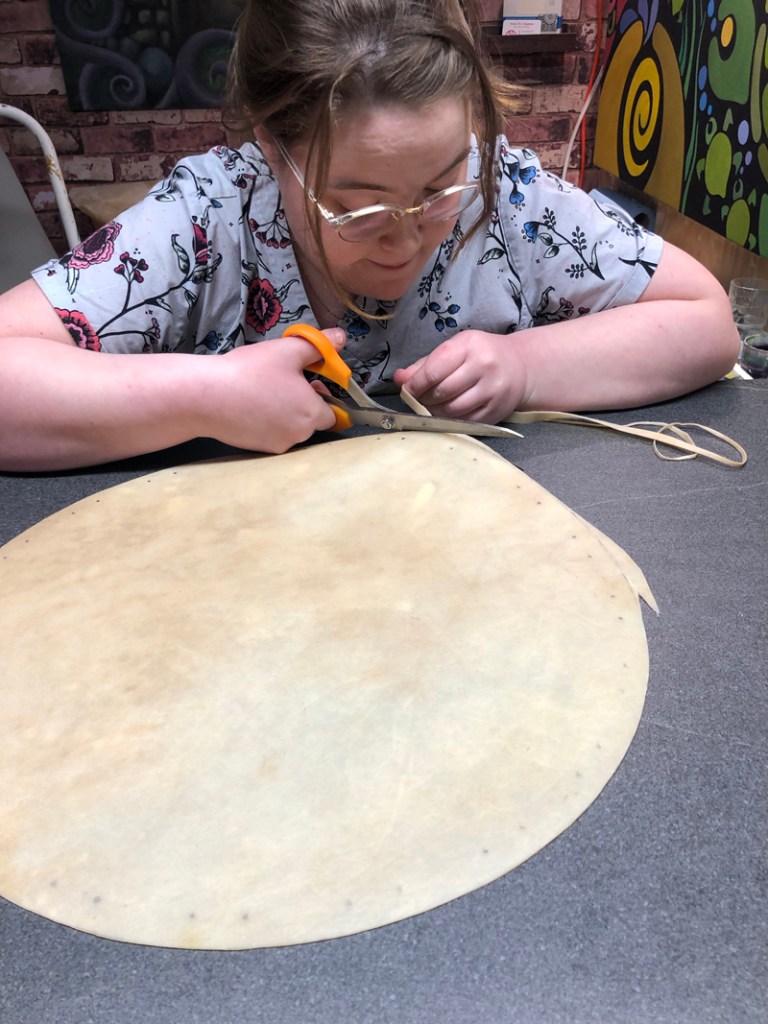
Po Cutting Soaked Rawhide to be Stretched Over the Drum Frame
Cutting rawhide is fairly easy to do if the hide is thin. In this step-by-step guide, I am using opaque elk because this drum head will be painted. Elk and deer are from the same family. Deer is typically the more thin of the two. I will be posting another guide concerning the different rawhides, but for now a rule of thumb is: 14″D and smaller drums use deer or elk. In the photo at the top of this post, I am stringing a 14″ D drum with a coiled white cedar frame that I have painted. In order to cut thin elk, I find that using kitchen sheers or fabric scissors does a good job.
Step 3: Punching the String Holes
Po Punching Hole in Rawhide for Stringing the Frame Drum
This step is quite simple, once you have the hole spacing figured out. After I mark on the dots for stringing the drum skin pleats, I use a leather hole punch. There are two hole punches that are readily available to purchase at craft and building supplies stores, they are: ones that work like scissors (as in the photo above), and punches that resemble awls that you hammer through the rawhide. The former is usually strong enough for deer and elk, but the latter may need to be used when punching moose and bison. Punching holes through rawhide is not like punching holes through note paper. Rawhide is fibrous, almost stringy. When it is soaked, it becomes thick and rubbery too. In other words, every hole punches differently from each other.
Step 4: Situating the Drum Frame
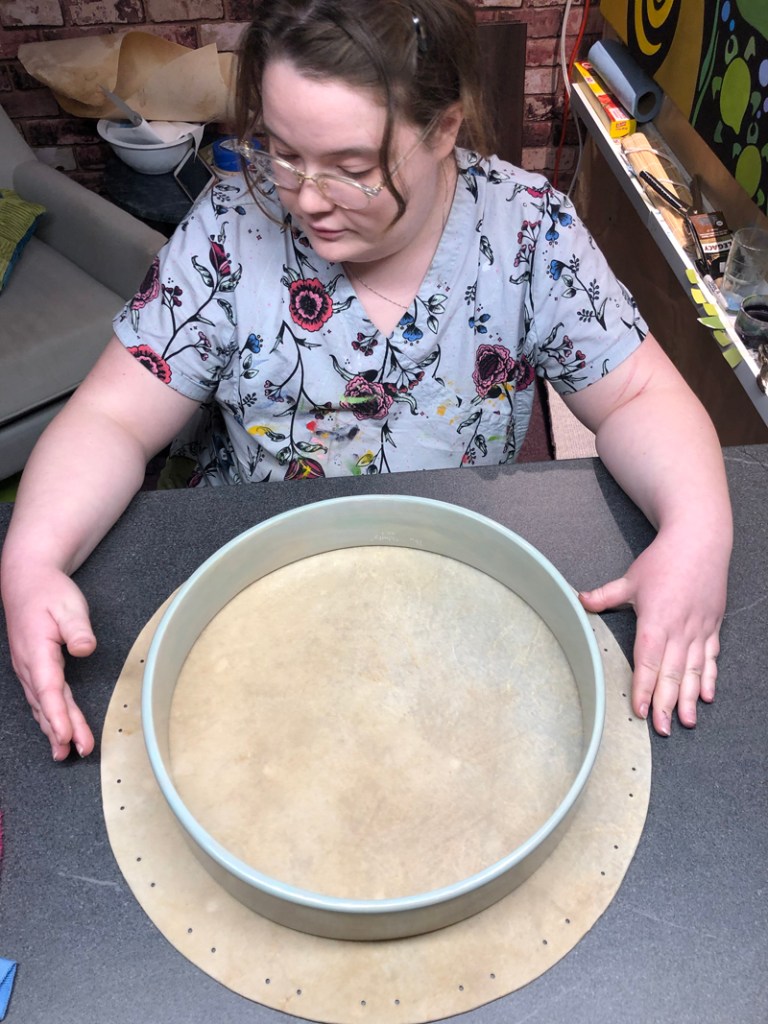
Po Placing Drum Frame in Centre of Cut Rawhide
Before stringing, I check to make sure that everything fits and is evenly spaced. I place the finished drum frame in the centre of the cut and punched rawhide. To assure that it fits the way I want it to fit, I use a ruler and measure the distances between the frame and the edge. All the way around, there should be the same amount of rawhide outside the drum frame.
Step 5: Measuring out the Sinew
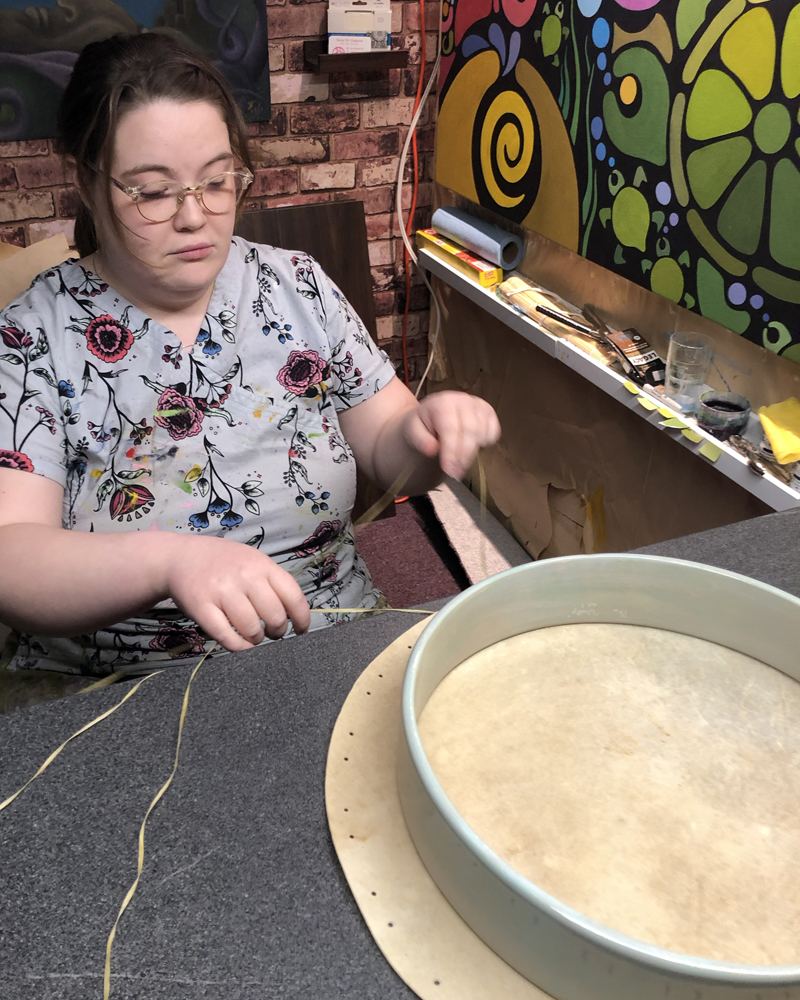
Po Stringing Through First Punched Hole After Measuring Out Sinew String/Lace
I use synthetic sinew for stringing. Some people call the sinew, “string,” and other people call it, “lace.” There are 4 types of string/lace, that are commonly used, they are: sinew (from a deer’s Achilles Tendon), synthetic sinew (buy by the spool), rawhide (thin strips that are cut from the perimeter of a soaked piece of rawhide), and rope for large moose, double headed, pow-wow drums. Measuring out the sinew is a tricky, nerve wrecking procedure. The length you need, needs to be one continuous strip. I measure about 5′ of string for every 1″ of drum frame diameter. So for a 14″D drum, I measure out 70′ of sinew. For a 24″ drum, I measure out 120′ of sinew. Also, just to be safe, I measure out another 20′ of sinew. I ran short once. I never want that to happen again. So now I wheel off extra! “Better safe than sorry,” as they say. This is the number 1 reason I use synthetic sinew. It is the best choice to use 120′ of continuous string.
Step 6: Stringing the Drum
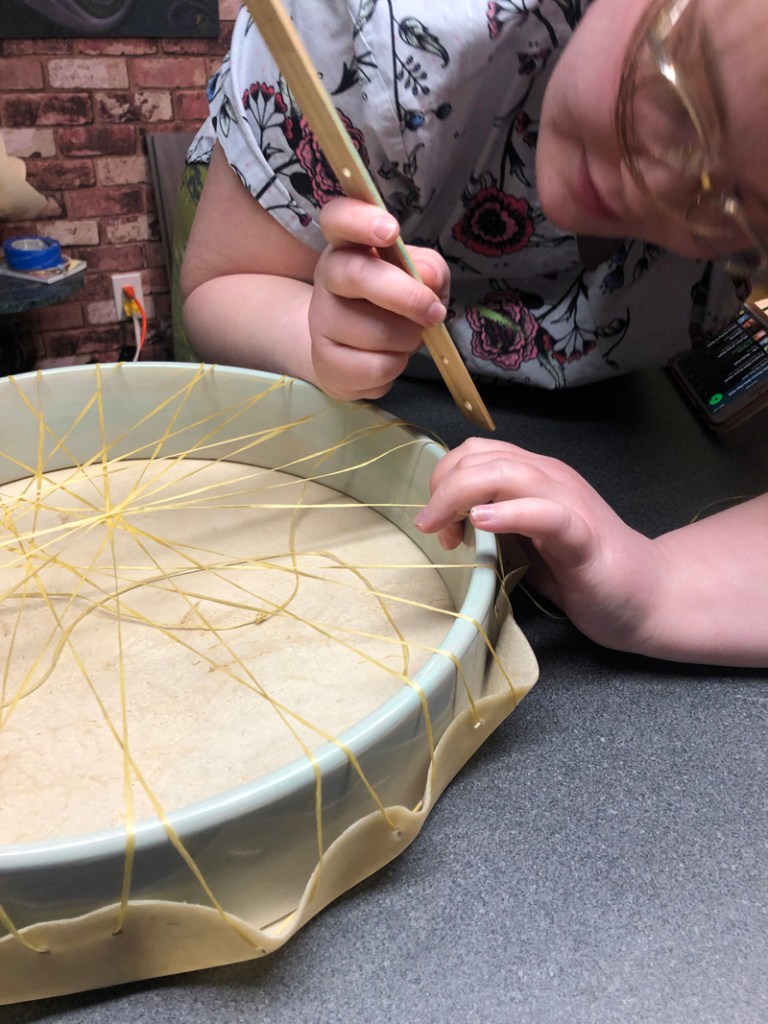
While Stringing the Drum, Po Measures the Edges to Assure that the Drum Frame has Remained in Place
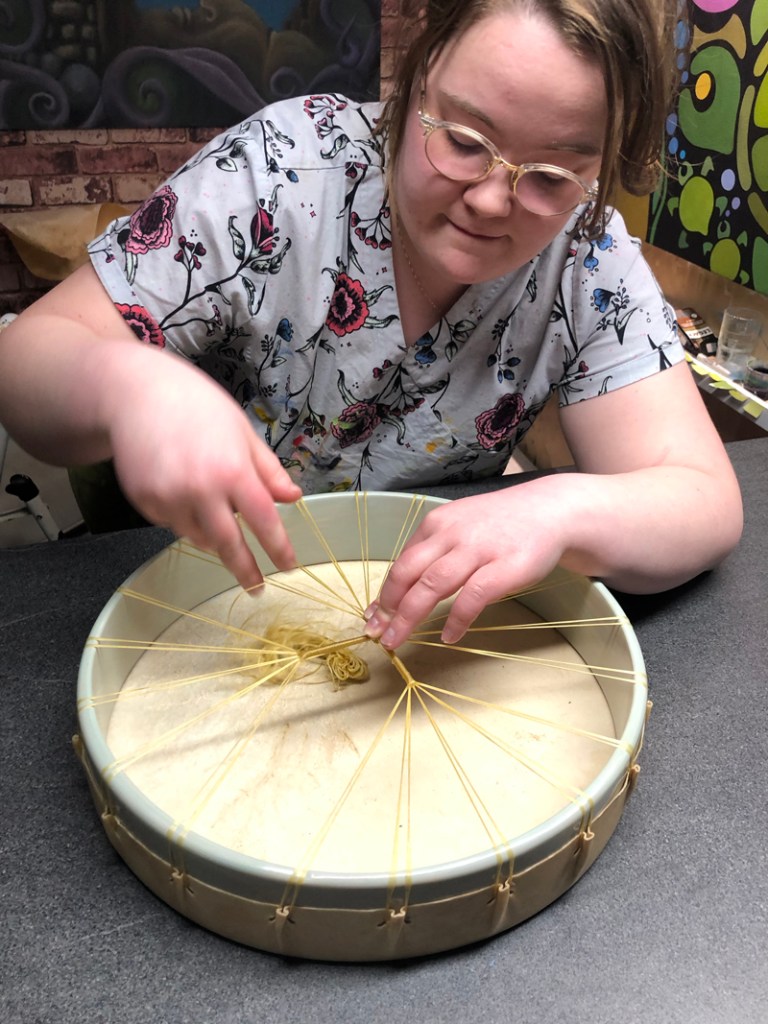
To string a drum, I pull one end of the string through one hole and then through the hole on the exact opposite side. Please note, I pull the entire strand through both holes, leaving about 2′ hanging outside the first hole. Then I continue to do the same, all the way around the drum, crossing the strings through the centre. In the image immediately above, notice that the string passes through the frame-side of the pleats (the two closest hole pairs). This allows for an attractive, elegant pleating of the hide. So when stringing, pass your needle through the outside of the hide, across the inside, and then through the inside to the outside. You’ll catch on. The practical reason I do this is due to physics. By pleating through two holes, rather than one, creates a stronger hold while applying less pulling on the individual holes. If you use one hole, you stand a pretty good chance that the rawhide will rip through. Believe me when I say: “YOU DO NOT WANT THAT!” Please note that I am creating a video to illustrate this more clearly and will be posting in the near future.
Step 7: Creating the Strung Spokes
After Stringing, Po Creates Spokes to Hang Onto While Drumming
Before I begin with this step, take a look at how the pleats look after the rawhide has been stretched and strung. By stringing through the frame side of the pleats, a uniform pleating is created and the pulled holes are firm and uniform. If you want to make a premium drum, you will need to master this step with this method of drum stringing. Now onto the spokes. From what I can tell, in various traditions, the spokes are formed by wrapping cord, sinew, or deer hide. Locally, they are formed and wrapped using split deer hide. I prefer using the continuous synthetic sinew because it is strong and I prefer the appearance. So what I do is, I wrap the sinew around multiple pleat (forming) strings. As you can see in the photo, I am wrapping 10 strings (5 pleats’ worth) together. I wrap them as far up as I want to achieve the desired tightness of hide. When I reach the furthest point desired, I weave the sinew through the individual strings 3 or 4 times. This creates a basket weave appearance. I do this to anchor the spoke so that it won’t slide out of place. When the weaving is complete, I wind the sinew back down the spoke. Once the centre knot of the strings is reached, I wrap the centre knot a few times and pull it tightly. Then I proceed to create another spoke. Once all 4 spokes have been created, I knot off the string behind the main centre knot. At this point, the drum is complete. I then sit the drum in a dryish (50% humidity) location with good ventilation above and below the drum. In just a few days the drum is ready to be drummed.
Hi, I am Portia “Po” Chapman from Kingston Ontario. I am an artist who hand makes unique frame drums. On this post, I will show you how to pick the best hardwood pieces for single-ply, steam bent drum frames. You’d think that it is easy, but it is not. Follow these steps and you will improve your chances of success.
Po Returning from Lumber Supplier
What Types of Wood are Best for Bending Drum Frames
My top 3 woods to use are: red oak, maple, cherry. I have not had much luck using white oak or walnut. All the research I have done, says that white ash is the best, but I cannot find a white ash supplier and the white ash drum frames that I have purchased from other suppliers have been economy grade. So for this article, I will address my preferred 3 woods mentioned above.
Po Sanding End Wedge of Red Oak Board Before Steaming and Bending. Notice the Long Grain Without Knots.
How to Choose Wood for Drum Frames
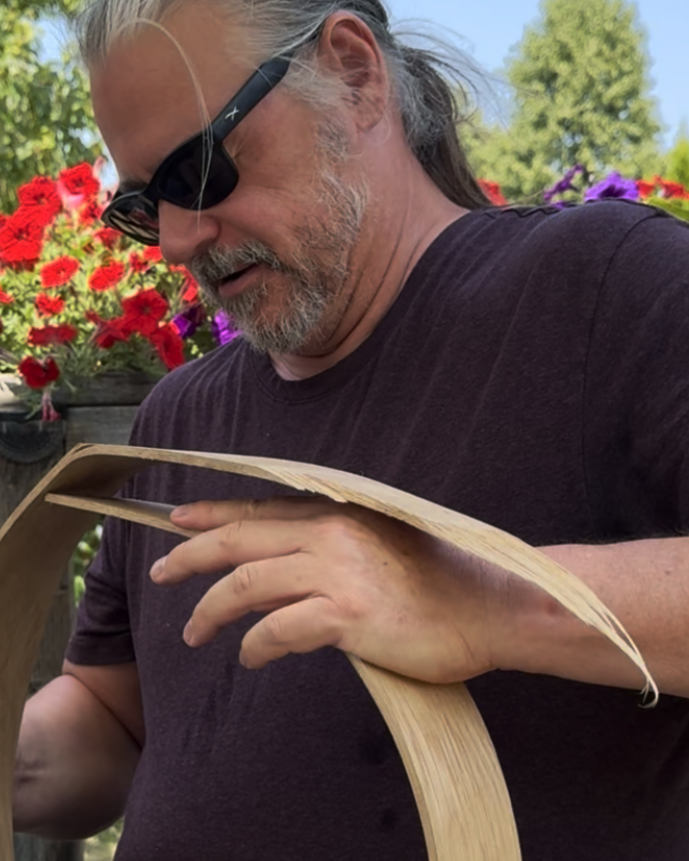
When selecting the lumber at the yard, be sure to choose wood without knots, splits, or swirling/wandering grains. All three of these characteristics will result in drum frames that crack and break while bending them into a drum shape. You want to pick long straight grains that do not drift off to the edges of the board. It will take you some time to find the ideal ones. Note: you pay the same price if they are in the same pile, so take your time to choose the most suitable ones.
What Size of Lumber to Buy for Drum Frames
The next thing with which to concern yourself is the board length and width. Most frame drums / hand drums range from 12″-16″ in diameter. To create drums frames of these diameters, you will require boards between 4′-6′ long. If you can afford it, however, purchase boards 7′-8′ long to assure that you can make drum frames after potential splitting during the bending process.
Notice How the White Oak has Snapped. In this Photo, Po’s Assistant is Compressing the Drum Frame to be Marked for Cutting. Be Sure to Have Enough Wood to Accommodate for Splits and Breaks During the Milling, Steaming and Bending Phases of Frame Drum Making.
Recap – How to Choose Wood for Steam Bending Drum Frames
I choose Red Oak, Maple, or Cherry woods that have long straight grains and have no knots. My preferred stock is 1″ thick, 7′ long and 4″-6″ wide. In Kingston, these boards will run between $50 and $100 each. In short, making steam-bent hardwood drum frames is not a cheap art in which to dabble. At my private art studio in Kingston, I make rawhide drums from 8″-23″ in diameter and range in price from $200-$2000.
How to Make a Painted Drum: Kingston Artist Portia Po Chapman’s Method of Painting a Drum Face
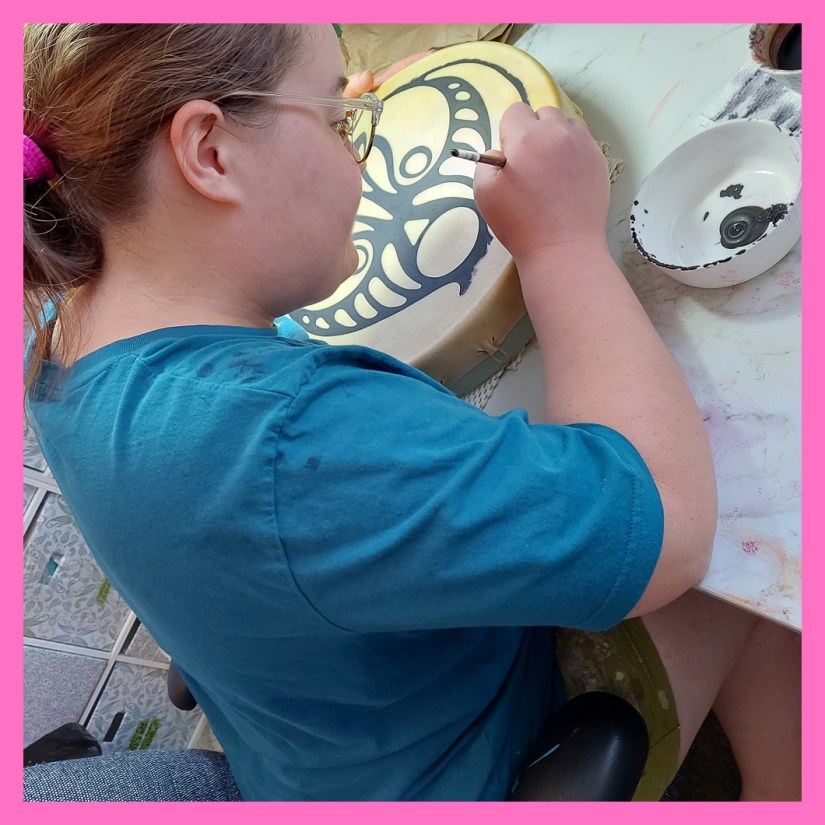
Portia Po Chapman Painting the Face of 14″ Elk Rawhide Drum: “Knowledge.”
Link to Phase 1: How Po Makes a Drum Frame Link to Phase 2: How Po Works with Rawhide – Stretching and Stringing Link to Painted Drum Page
Phase 3: How Po Paints the Face the Drums She Makes
Painting the face of a rawhide drum sounds much simpler than it is. The artist must keep in mind the nature of rawhide. Rawhide stretches and shrinks depending on humidity and temperature. Rawhide vibrates and flexes when it is drummed. Rawhide, is not smooth and sometimes has scars, hair, and wrinkles too. Most of all, each rawhide drum has its own sweet spots – where the drum sounds its best when drummed. Some drums even have multiple sweet spots and a couple locations whereby it makes a quiet sound when drummed. Therefore the paint needs to be thin, flat, translucent, and able to stretch. Po’s drums have addressed all of these issues in order to assure/improve longevity while enabling the drum to be drummed in both interior and exterior environments. When meeting the public at drum shows and art shows, Po is frequently told stories of paint cracking on drums made by other drum makers. Rest assured that Po drums every drum before selling them. Po also encourages clients to drum the drums before purchase as well. As far as the paint longevity – so far so good. Although many of the drums Po makes are sold to clients seeking works of art, Po still seeks to make beautiful drums that can be drummed. In short, whether you want to hang the drum on the wall or take the drum to a drum circle, the same amount of love and time is spent creating your masterpiece – and in so doing, every drum made by Po can be drummed. Po views drum making like this: “Why make a drum if you cannot drum it?!”
Po’s Phase 3 Drum Face Painting is as follows:
The image creation stage can happen overnight or as much as 3 months, it depends on the drum.
Usually Po will see an image in her mind while drumming the drum, but sometimes images visit her in her dreams.
Again, as strange as it sounds, Po says: “I just wait until I see what the drum wants me to see – and each rawhide is different.”
It is something like suddenly knowing what one will knit with the fleece that one has cleaned, carded, spun and dyed – each time is different – and so too is the sheep/goat that offered it in the first place.
Nature has a way of reaching through the noise and smiling upon us.
The image is sketched with a marker and then refined using a light table.
The flow of the lines begin to take over and the image you see appears.
The image is digitally cleaned up and a template is cut using a Cricut.
Upon the dry face of the rawhide drum, the template is traced using a 4H graphite pencil.
It is worthy to note that rawhide is a textile that varies widely in flexibility, texture, scarring marks and amount of hairs still present. This means that each drum is painted using a slightly different method.
Using a very special, flexible acrylic paint the images are lined (free hand brush painted) with “black” (if at all). The “black” is usually a deep, earthy purple.
Po thinly paints the images using #1 to #3 professional grade round acrylic or equivalent watercolour brushes. The images are not stensilled, stamped, or air brushed. The images are not stickers, which some people think because the painted images can appear to float due to the depth of the rawhide’s transparency.
Using Po’s innovative colour-blocking style, Po pulls apart the shades and hues. The result is an unblended image that invites the mind to seam together the colours in its own way. The images shift in different lighting conditions and when drummed, the image appears to leap off the face of the drum.
The image is briefly held up to an intense studio light, enabling Po to see where a second or third coat of paint is preferred.
Once dry, the painted face is lightly sprayed with a mist of archival UV resistant varnish.
I exhibit and sell the drums I make. Please contact me to purchase a completed drum of to discuss a custom hand drum made just for you. I am happy to paint you a drum with the image you choose or one that I create just for you. Custom images are from $250. Drums, with painted and not-painted faces, range from $200-$2000.
I look forward to fitting you with your drum.
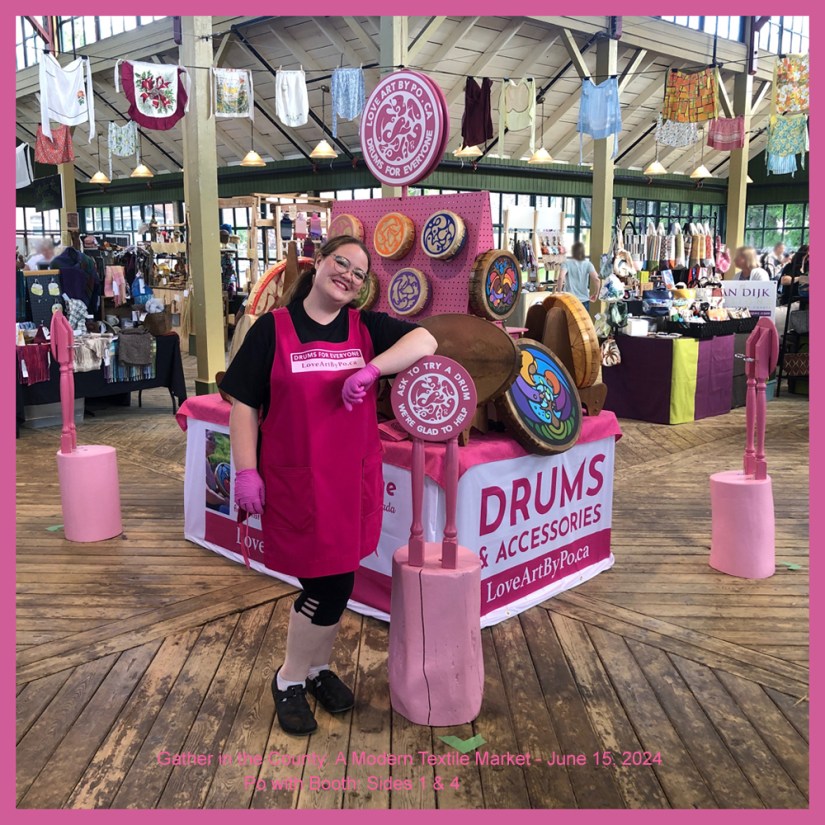
Po Standing with Drum Booth At the Gather in the County – Modern Textile Market – Picton, ON June 15, 2024
How to Stretch and String a Rawhide Hand Drum: Kingston Artist Portia Po Chapman’s Method
Po Stringing Her 24 Inch Elk Rawhide Drum Entitled: “Nature in Me.”
Link to: Phase 1 of Drum Making is Making the Drum Frame Link to: Phase 3 – Painting the Drum Face Link to: Painted Drums Page
Phase 2 of Drum Making is Working with Rawhide: Soaking, Stretching, Stringing
In order to make a drum, there are 3 basic stages of working with the rawhide: Soaking, Stretching and Stringing. Although these stages can be rushed, to achieve a premium drum that sings beautifully, it takes a lot of time, care and love. Hence, from receiving the rawhide to completing a playable tuned instrument, it takes about 1 month, sometimes longer. In my studio, I do all of the steps below. Please note that I do employ a shop hand to help detangle sinew when I am stringing large drums, like the one in the above image, because a 24 inch diameter drum requires a 100+ feet long continuous strand of sinew .
Phase 2 of Drum Making: Working with Raw Hide
Purchase sustainable rawhide that supports Indigenous communities across Canada.
Build relationship with the hide.
Humidity condition hide in the hide room.
Po waits for the hide to “speak” to her – it may sound strange but the hide will choose to make a drum or a drum will not be made. Working with rawhide requires patience and a lot of love.
Once the hide is ready to make a drum and make its voice once-again heard, Po introduces the hide to the frame options – this is a beautifully mystical step in Po’s drum making process whereby a holistic, earthy bond is made between wood, rawhide and drum maker.
With the marriage of drum frame and drum skin, Po designs a drum skin template with the number and placement of stringing pleats marked.
The rawhide is rough cut to match the shape of the template.
The rawhide is cleaned, scrubbed, pealed , rubbed and polished.
Sometimes the rawhide requires a sunshine bath or controlled UV bath.
Using a galvanized wash tub, Po soaks the rawhide for 24-48 hours in a rain water bath as the rawhide is kept submerged using special quartz and/or citrine rocks that she found while diving in her childhood lake.
Once the rawhide has become thick and pliable, it is removed from the water and rubbed with a soft terry towel. It is then cut to the shape of the pre-designed template.
String holes are punched (Po’s premium drums have between 16 and 30 pleats).
Of synthetic and waxed sinew, Po measures out about 5 feet per pleat – yes 80+ feet.
The frame is laid onto the underside of the rawhide and Po begins the lacing process.
As you can see in the above photo, generally, Po strings the drums by putting the string through two holes (to make pleat) on one side of the drum and then does the same on the exact opposite side of the drum. Po uses more decorative / ornate stringing patterns when stringing Po’s non-circular hand-bent drums.
Using a darning needle to string a drum, it takes Po between 2 hours and 8 hours of hand stitching, winding and wrapping the sinew as she pulls the rawhide into place. It can be tricky, when stringing large drums, because the hide begins to dry and become stiff within 30 minutes of being removed from the water. Aligning the timing of stitching and drying is possibly the most difficult thing for a drum maker must grow accustomed.
At this step, Po has found that the hide wins the tugging process. No matter how even the rawhide edge is originally made by Po, the rawhide will pull it to where it wants – resulting in a less uniform rawhide edge around the frame. Synthetic skin head drums do not present this challenge.
It is also worth noting that each animal and species’ rawhide pulls differently – and the spinal ridge pulls differently from the belly region. This takes a long time to get used to. In the case of working with rawhide as a textile, Po has had to relax and work with the rawhide, rather than demanding that it behave as she may want it to.
The drum is placed on the drum drying racks and is dried in a 50% humidity controlled space.
Once the drum is dry, it is taken out into the sunlight and drummed.
Po sings, chants and drums the new drum as they both rejoice. It is a seemingly miraculous happening.
Sometimes the general pitch of the drum is determined by drumming it beside a well tuned 1950’s Heinzman piano.
You cannot get use to the moment when the rawhide seems to come back to life and express its own voice and connection with the drummer.
The drum’s pulse throbs upon the breeze.
The ethers rejoice and the heart smiles with an air of wellness.
The central sinew knot at the back of the drum is then waxed. To try the drums, Po has people use nitrile gloves. When the drum is paid for and drummer is ready, the drummer’s glove is removed. At that time, the drummer & drum imprint. Their bond is marked by the drummer’s hand print pressed into the beeswax.
The drum is then cared for and sung with in the humidity controlled studio until it is to have a painted face (if it is ever painted – some drums refuse to be painted while other drums seek to be painted).
Another phenomenon then occurs – the drum picks the drummer at exactly the same time as when the drummer picks the drum. The moment of bonding is nothing short of magical.
Premium drums made by Po are very, very special – and premium special drums cannot be rushed.
I exhibit and sell the drums I make. Please contact me to purchase a completed drum or to discuss a custom hand drum made just for you. Drums range from $200-$2000.
I look forward to fitting you with your drum, Po
Po Standing with Drum Booth At the Gather in the County – Modern Textile Market – Picton, ON June 15, 2024
Phase 1 of Drum Making is Making / Preparing the Drum Frame
A drum frame takes me about weeks to make from start to finish. In my studio, I do all of the steps below. Please note that, I do employ a shop hand to help clamp and bend the steamed wood – this requires 2 sets of hands.
For coiled wood frames, the wood is planed very thinly and before gluing the coil is created by clamping and re-bending more tightly 3 times over a week’s time.
For both the hand bent in-studio frames and rough pre-coiled frames, the following steps are the same
Sand the frame to desired shape, thickness and smoothness
Paint, rub, dye or stain frame
Polish and finely sand frame
Varnish
I exhibit and sell the drums I make. Please contact me to purchase a completed drum of to discuss a custom hand drum made just for you. Drums range from $200-$2000.
Po Standing with Drum Booth At the Gather in the County – Modern Textile Market – Picton, ON June 15, 2024
Kingston Artist Portia “Po” Chapman CV Internet Links
Over the last couple years, my art and I have been featured in various places on the internet. Instead of extending my CV , I thought that a post with some of the links might be helpful. This is a chart of links that I compiled tonight. It is by no means complete but it gives a good sense of my emerging art career.
A Process of Art Planning Creation by Portia Po Chapman Kingston Artist
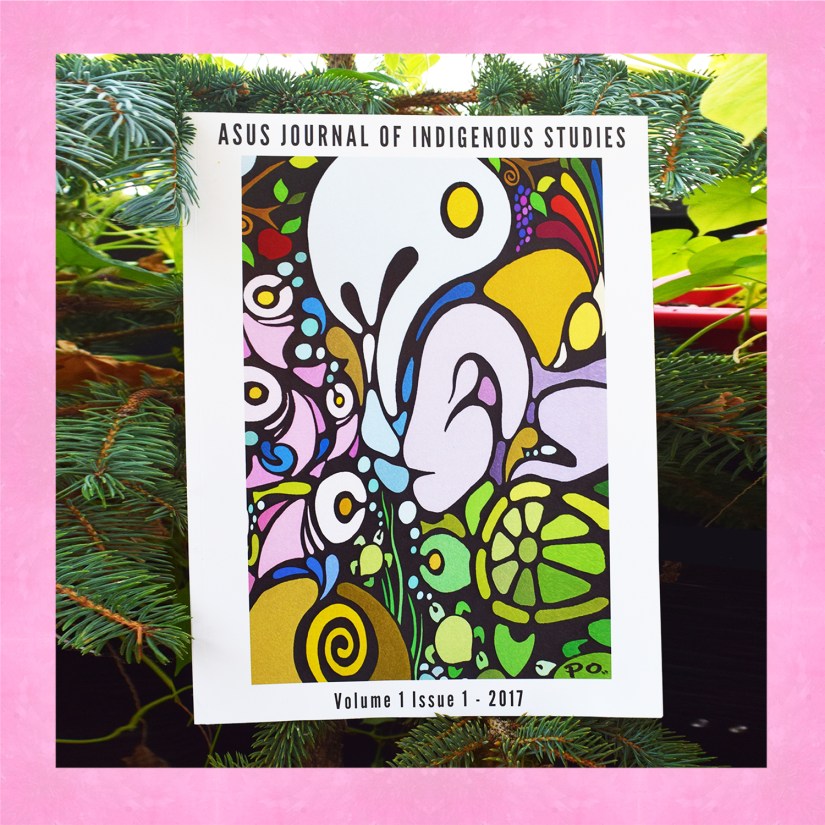
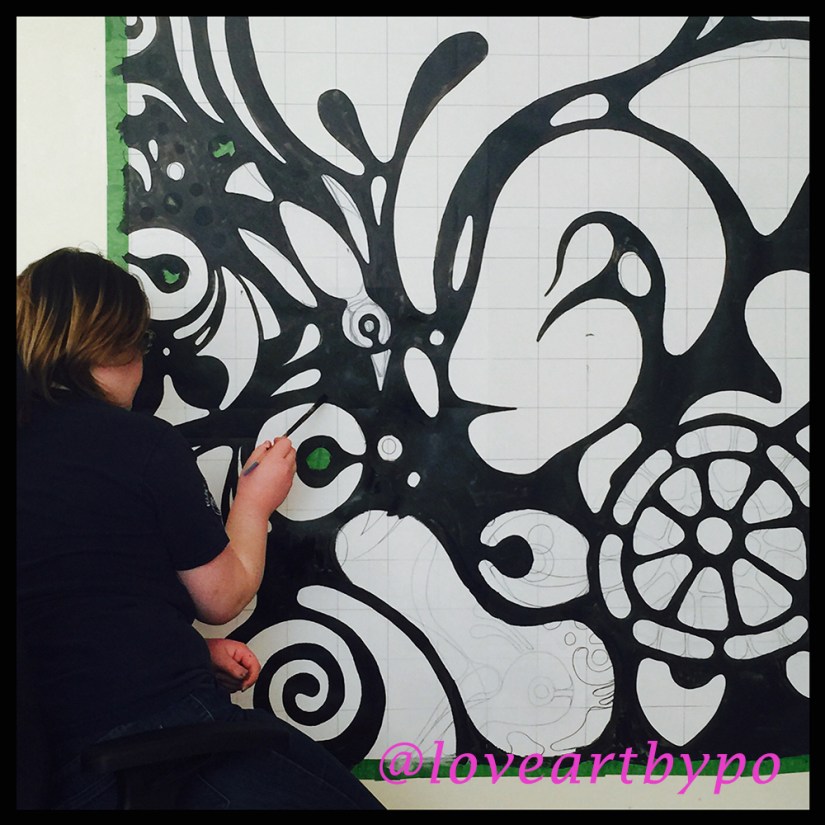
We all have our own method and strategy to create our art pieces. For me, I start with 2 things: 1/ An idea notebook that I enter flashes of visions, ideas, concepts, and sketches of possible cool things to do in the future. I also include inspiration quotes and sometimes reflections about my experiences. I keep sheets of paper on my bedside table to record dreams too. When one idea doesn’t float at one point, it may in the future. The following image was eventually painted in 2022 as a mural for Queen’s University’s Kingston Hall Reflection Room but I first created it in 2018 for my 3rd year BFAH class and it was rejected by the professor because the prof said that, “It looks like something you’d paint in your garage.” The thing is, it was the beginnings of my current art style and landed me several commissions when I finally finished it outside the course. “My Creation” mural took 4 years before it was commissioned and mounted. It began with a simple sketch and grew for years. The mural was created because the ASUS executive adored the original digital image and had been awaiting the chance to have it painted. This is often how commissions work. The organic growth and development of art concepts can take many turns until it reaches its destination. I still find the journey amazing.
“My Creation” Published as Cover Image (the cover is more intense the photo is faded) 2019
“My Creation” Digital Journal Cover Proposal 2018
“My Creation” Began as a Sketch and Then I Painted a Trial Image Which was Rejected by My Prof 2018
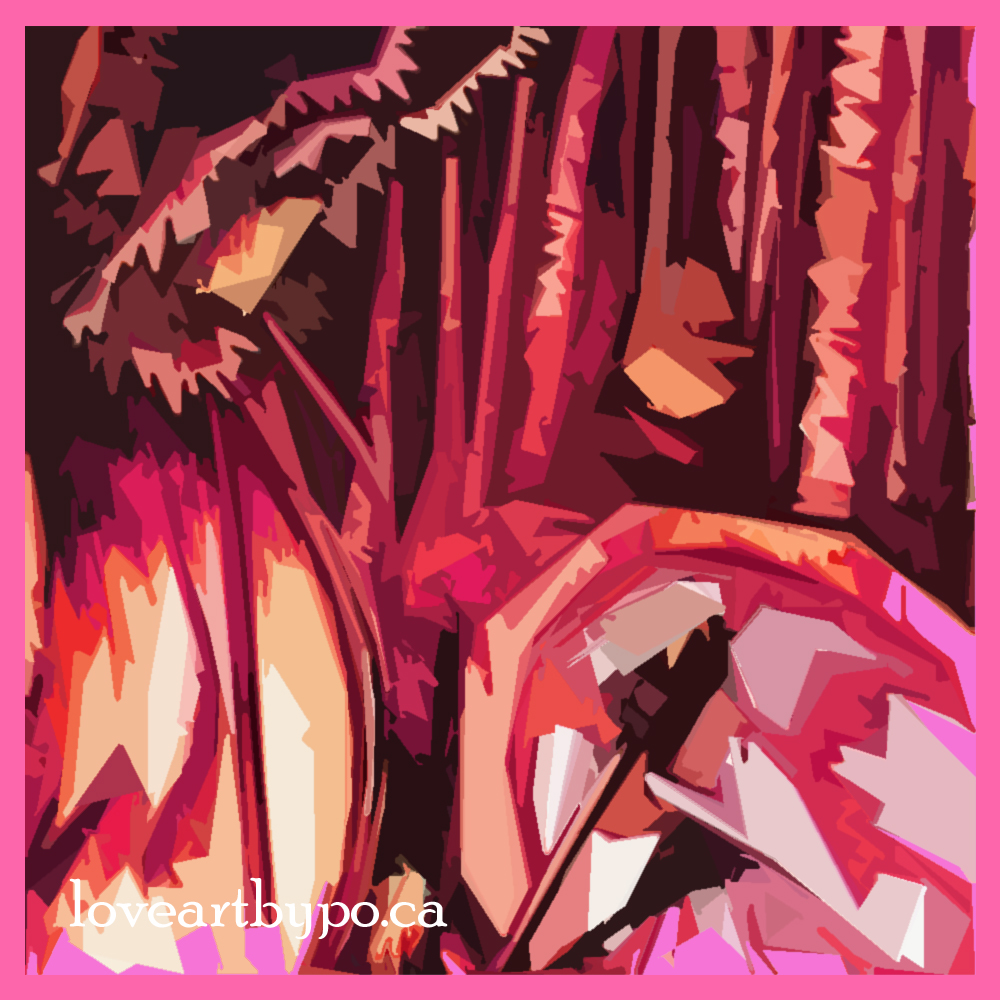
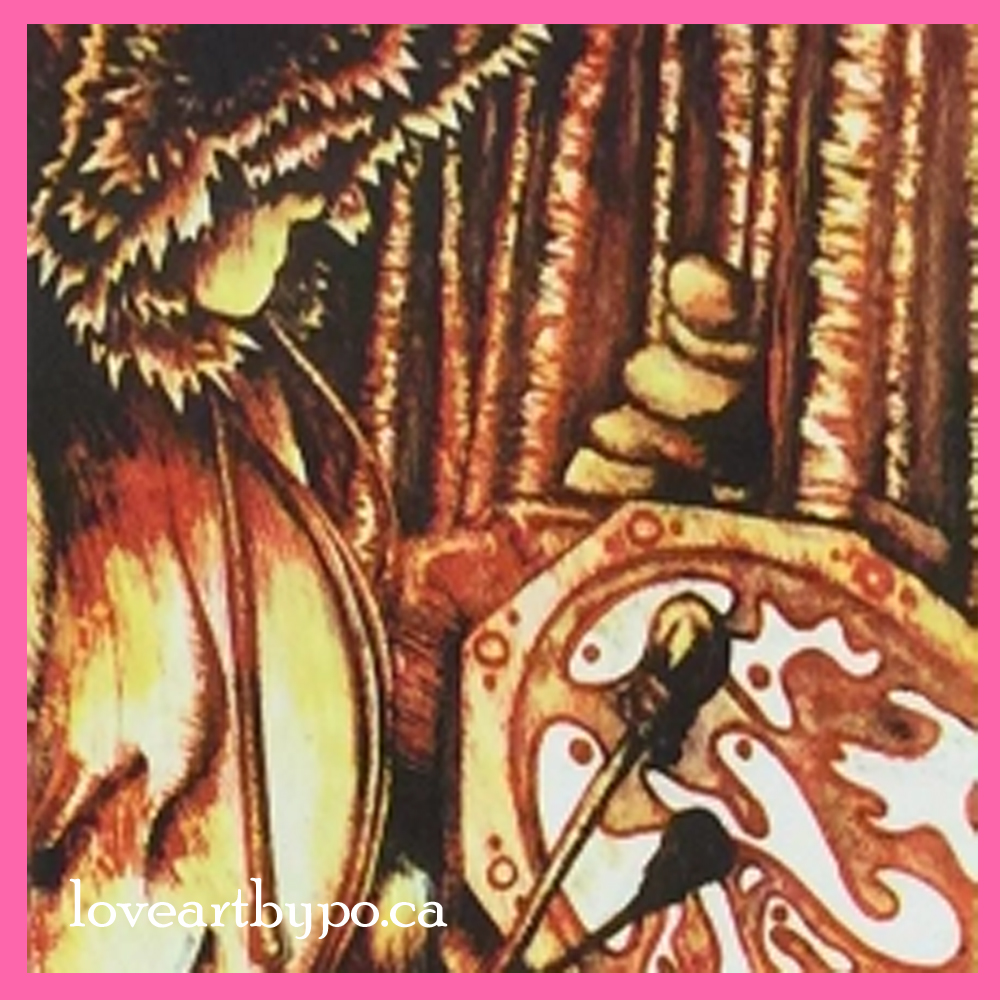
2/ The second thing I do for art creation is take photos or have photos of me in the environment. I like to catch a moment – the nuances of life that happen in a moment in time. The following digital image is a current idea that I am working on as I consider the painting medium and final expression. The piece is entitled, “My Drum and Me.”
“My Drum and Me” Digital Draft for Painting Planning 2023
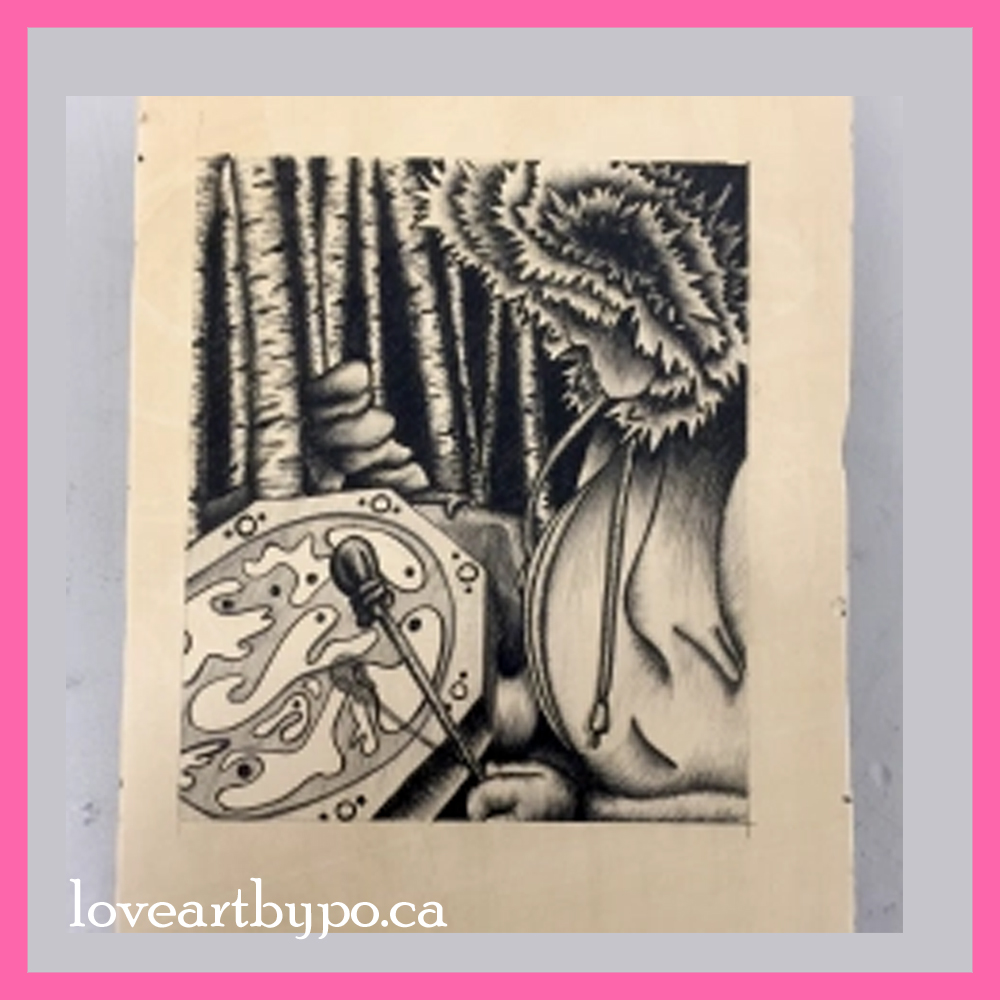
“My Drum and Me” Stone Lithograph Art Print 2018
“My Drum and Me” Hand Drawing Lithographic Stone 2018
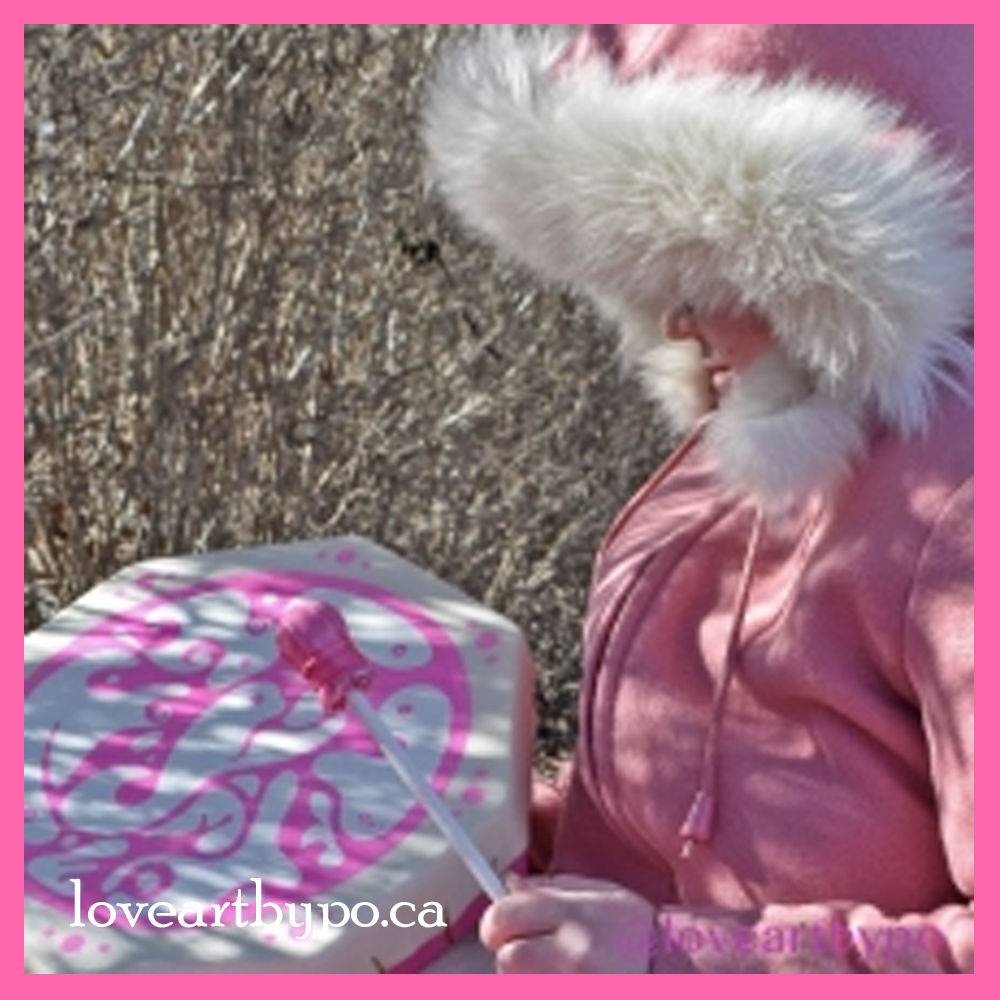
“My Drum and Me” Original Photo A Family Member Took this Photo When I Was Drumming Outside 2017
Again as one can see, a beautiful moment in time captured by a photo and/or inspiration notes and drawings can lead to some really beautiful art pieces in the future. If anything, their journey materializes as life takes its own twists and turns. An art concept never gets old, it simply waits for its time to shine, but as it waits, the inspiration weaves itself through one’s career and the creation of other pieces. Art is not created in a vacuum – it lives and breathes through us as artists and art enthusiasts. Art is alive, even as it awaits its birth.












 Love Art by Po
Let Me Know What You Think! Start or Join the Convesation