Behind the Art, Kingston Artist, Portia Chapman, Studio Process

Recreating Nature’s Glow: How Kingston Artist Portia “Po” Chapman Innovated the Glow Chamberโ€™s Rawhide Vessels

As a multidisciplinary Kingston artist, Portia “Po” Chapman is widely recognized for her nature-focused storytelling art and the high-contrast paintings that adorn her artisanal frame drums. What is less known about her rawhide art, however, is a very deliberate choice she makes: Po does not paint the faces, eyes, or skin of the characters in her images. Instead, she leaves them unpainted so that the natural rawhide becomes the skin of her figures, creating inherently inclusive content. The strategy reveals itself in the lightโ€”when noonday sunlight shines through the back of a painted drum, the figures come alive, with their faces, eyes, and skin literally glowing.
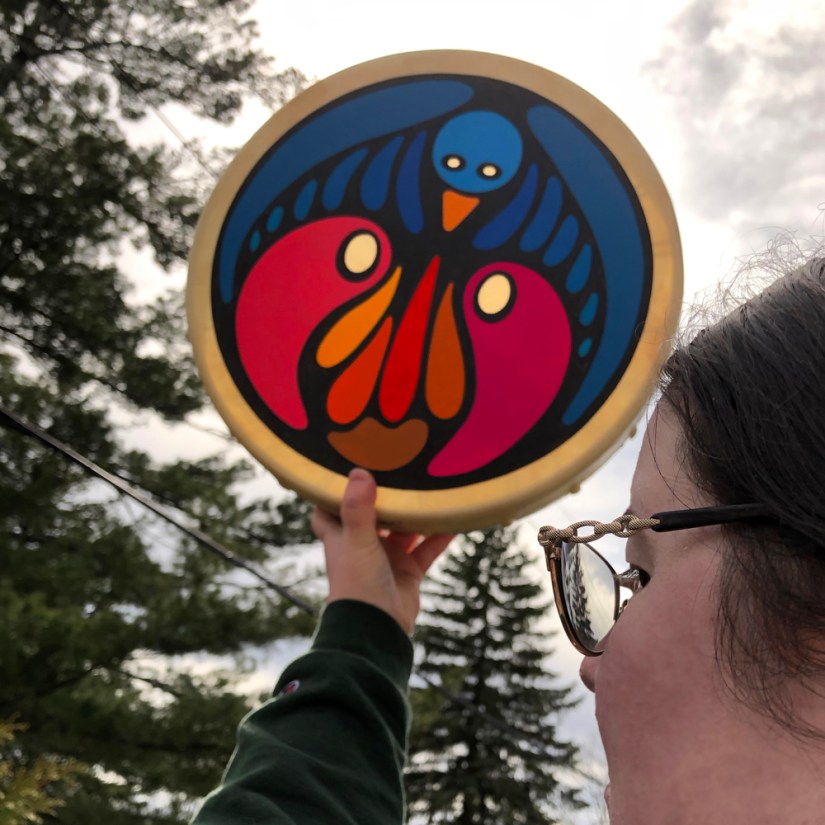
Kingston artist and frame drum maker Portia Po Chapman holds up a vibrant hand-painted drum as natural sunlight illuminates the unpainted rawhide eyes and face.
Held against the sky, natural sunlight passes through the unpainted rawhide skin and eyes of the characters, bringing the high-contrast artwork alive with a golden glow.
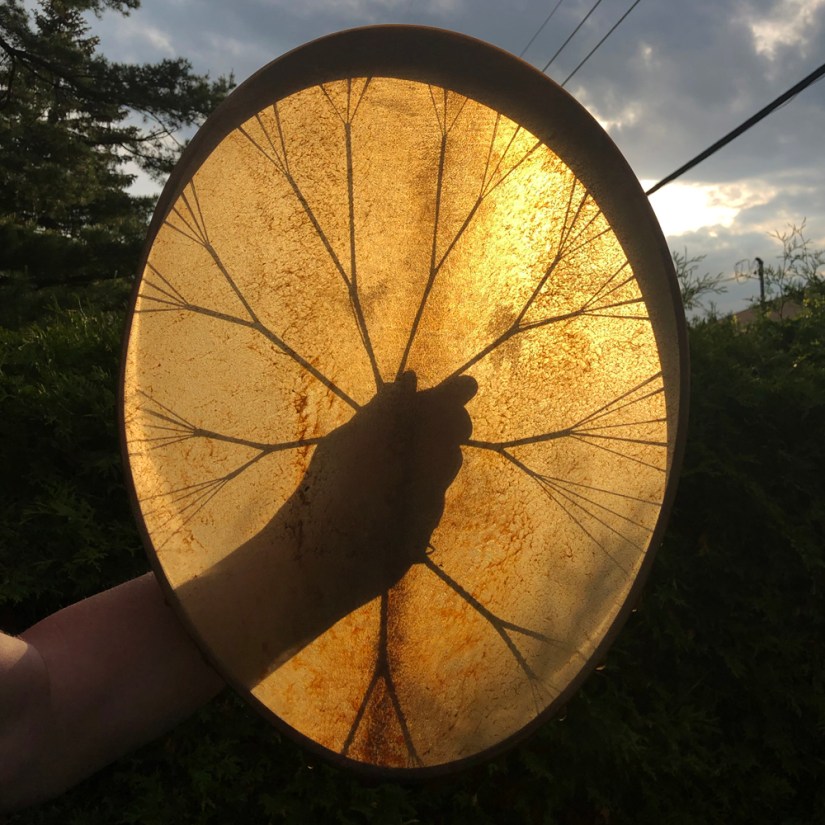
Hand-built bison rawhide on oak frame drum held up to natural sunlight, revealing a translucent golden glow and intricate tree of life stringing pattern.
Sunlight passes through an unpainted bison rawhide drum built at Po’s Kingston studio, illuminating its natural fiber textures and tree of life lacing patternโ€”the primary inspiration for the artificial backlighting engineered in the Being Seen Glow Chamber.

It was the golden, sunlit radiance that inspired the glow for Poโ€™s immersive, interactive art installation, Being Seen: when Being Seen… we glow, hosted at the Kingston Arts Council (KAC) Pocket Gallery in Kingston, Ontarioโ€™s Tett Centre for Creativity and Learning from July 27 to September 18, 2026. To bring this installation to life, she set out to engineer a way, using artificial electrical backlighting, to simulate the natural essence of sunlit rawhide.
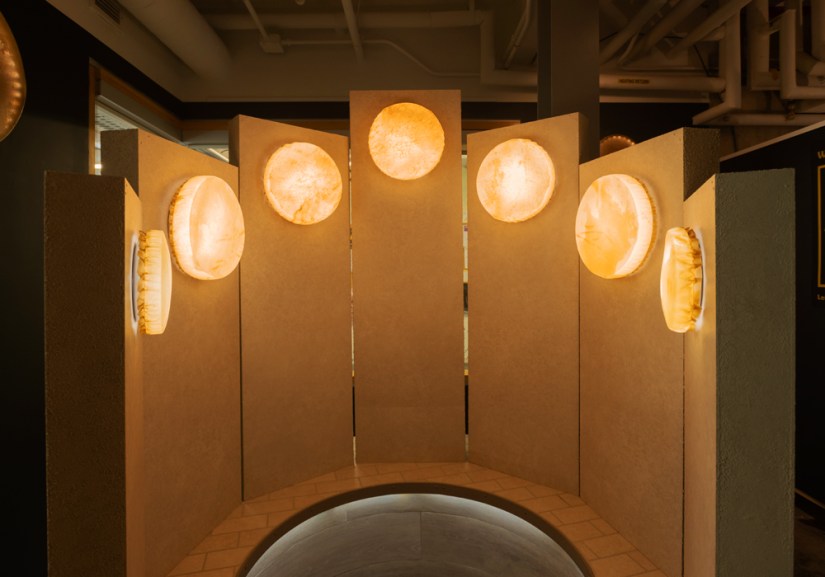
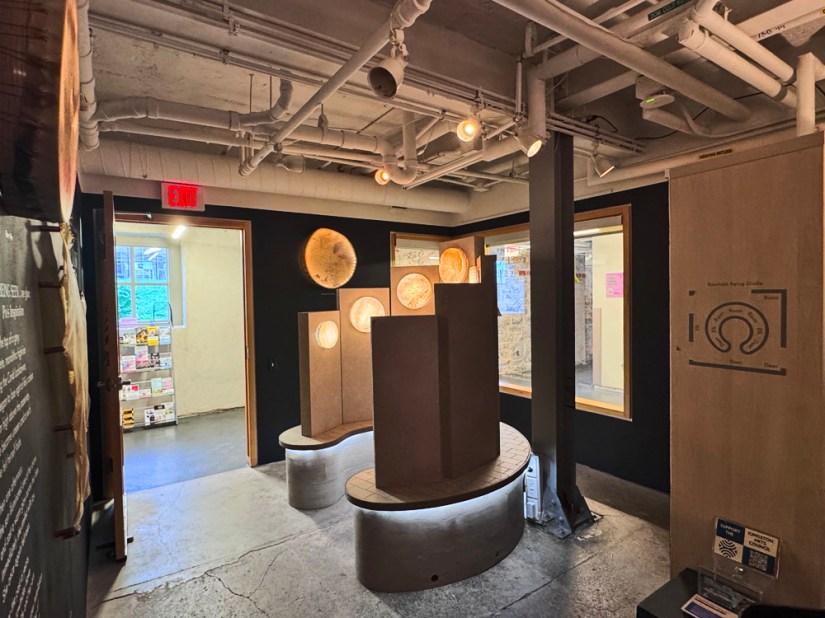
Interactive Glow Chamber installation featuring semi-circular partition walls mounted with circular, illuminated rawhide vessels casting a warm golden glow.
The interactive Glow Chamber from Portia “Po” Chapmanโ€™s exhibition when BEING SEEN… we glow, featuring backlit rawhide vessels radiating the natural golden warmth of sunlit rawhide.

This is the story of how Po engineered the glowing vessels of the Glow Chamber.

The Search for the Perfect Light

Because an installation of this exact existence had never been done before, Po had no existing reference points or guides to follow. She embarked on a long, experimental journey of trial and error to find a light source that could evoke the precise emotional response of feeling truly seen.
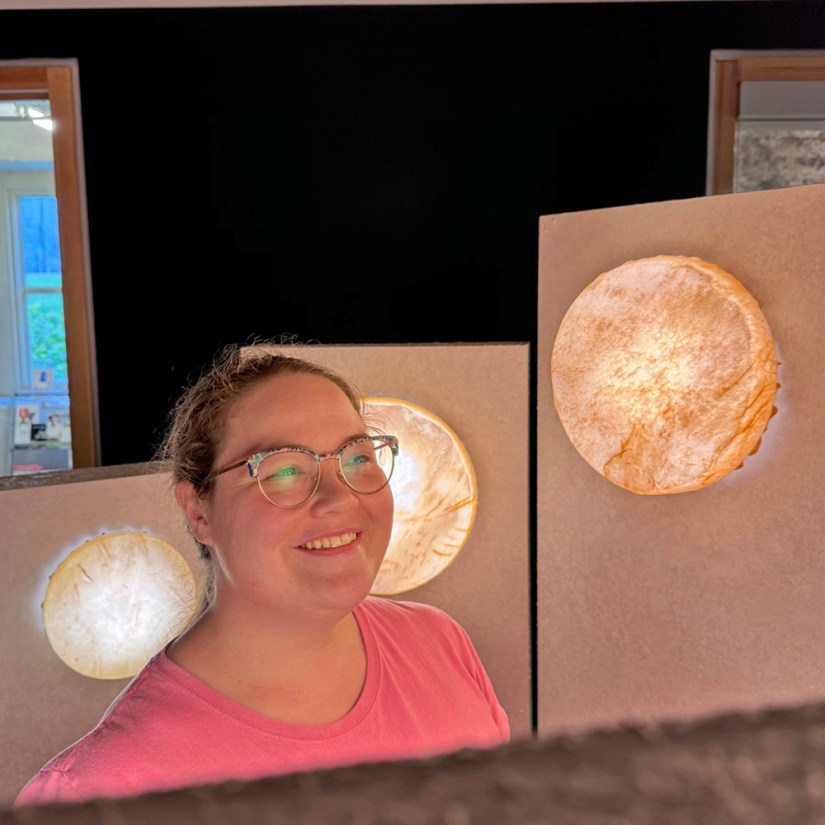
Kingston artist Portia Po Chapman smiling radiantly as she adjusts dimmer lighting behind backlit circular rawhide artworks inside the Glow Chamber installation.
On installation day at the KAC Pocket Gallery, Po uses dimmer switches to fine-tune the backlighting, capturing the exact sunlit radiance that evoked a visceral, womb-like sense of comfort for gallery visitors.

Her first attempts involved sampling incandescent lights. While they provided a comforting hue, the heat generated, even after drilling holes for vents, caused the enclosed rawhide to overheat, crack, ripple, and emit an unpleasant scent.  Next, she tested cool LED strip, tape, and rope lighting. While these options beautifully framed her drums (such as her bison drum, “Not a Second”), they created a spotted effect rather than the unified, radiant glow she sought.
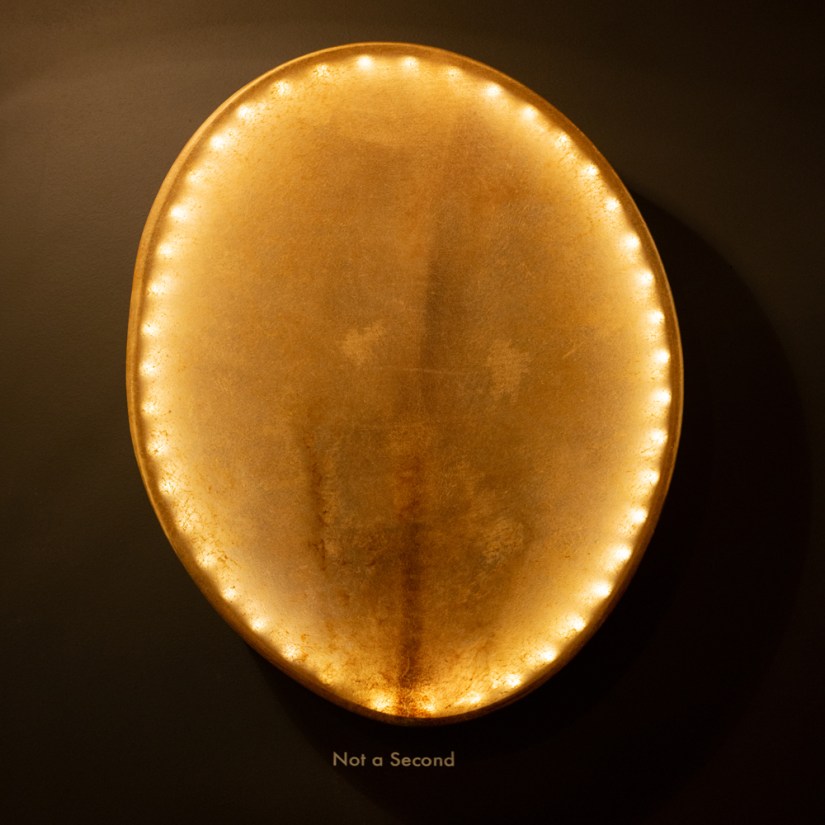
Oval bison rawhide drum titled Not a Second mounted on a dark gallery wall, backlit by circular LED points casting a warm marquee glow along its rim.
Featured in the Being Seen exhibition, the bison rawhide drum titled Not a Second demonstrates an early lighting iteration using LED perimeter lighting, showcasing the drum’s organic texture while highlighting the search for seamless light diffusion.

She then tried LED Flat Panel Flush Mount Ceiling Lights, which produced the right glow but proved cost-prohibitive and offered limited size choices.  Finally, Po discovered an economical, budget-friendly round LED fixture equipped with a colour temperature adjustment switch (allowing selection between soft white, bright white, and daylight) paired with an opaque plastic diffusing shade. This combination yielded the soft, manageable, even glow she needed.
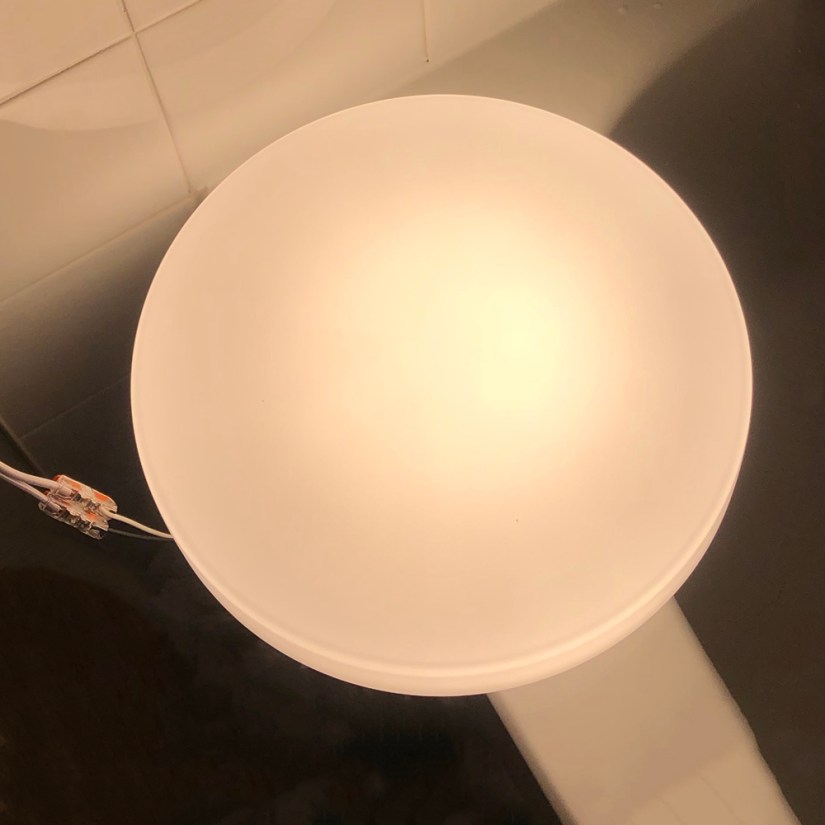
Top-down view of a circular LED light fixture with an opaque plastic diffuser shade glowing softly, wired with quick-connect terminals during a studio test by Portia Po Chapman.
Studio trial of a color-temperature-adjustable LED light featuring a plastic diffusing shade, providing the smooth light dispersion required to safely illuminate rawhide vessels from within.

Selecting and Soaking the Hides

With her light source established, Po turned her attention to selecting the rawhide. Working in her studio, she unrolled various deer, elk, and bison hides to choose pieces for 8, 10, and 12-inch light diffusers. Because rawhide ranges from opaque to nearly transparent, and spans shades from silver to cream, gold, and deep amber, she meticulously curated hides with unique scars, holes, and mottled textures to achieve her desired ambient, glowing story.
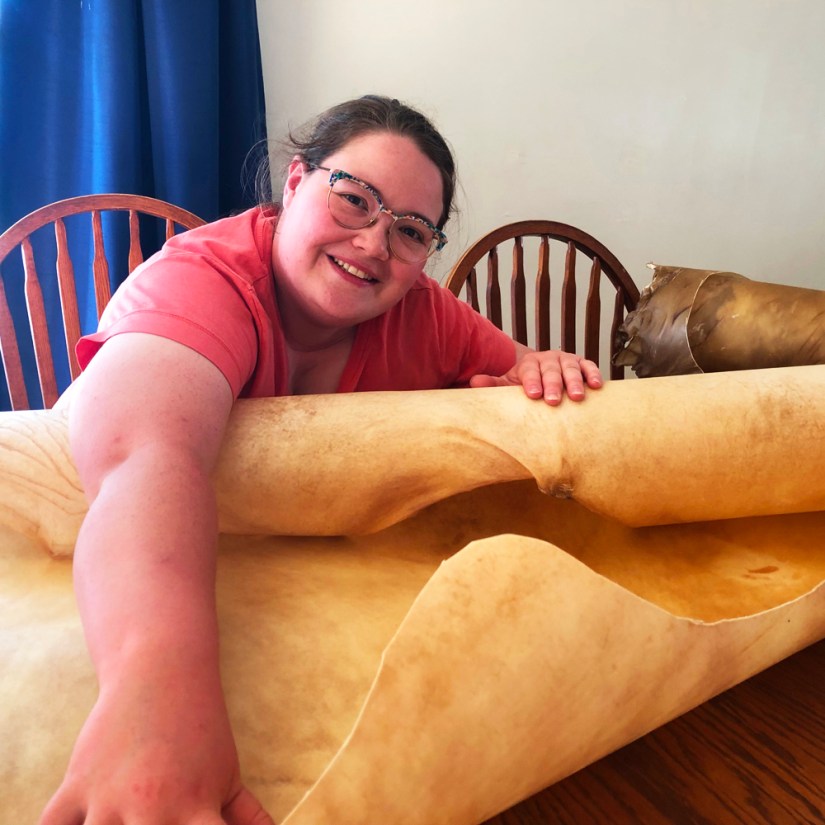
Kingston artist Portia Po Chapman smiling as she unrolls large sheets of rawhide on a wooden table, preparing to cut pieces for her Being Seen Glow Chamber installation.
Rolling out the rawhides (deer, elk, and bison) at Po’s Kingston art studio to select pieces based on their specific colors, textures, and translucency, determining the unique glow each vessel will produce in the Being Seen installation.

After rough-cutting the hide into rounds, Po submerged them two at a time in a dedicated galvanized washtub filled with tap water. The soak times varied significantly by hide type: deer rawhide soaked for 12 hours, elk rawhide soaked for 24 hours, and bison rawhide soaked for 48 hours. To keep the naturally buoyant hides fully submerged, she initially weighted them down with river rocks. Halfway through the soak, she removed the rocks and flipped the hides; once fully hydrated, the rawhide suspended naturally in the water bath like fish staying still in a clear pond.
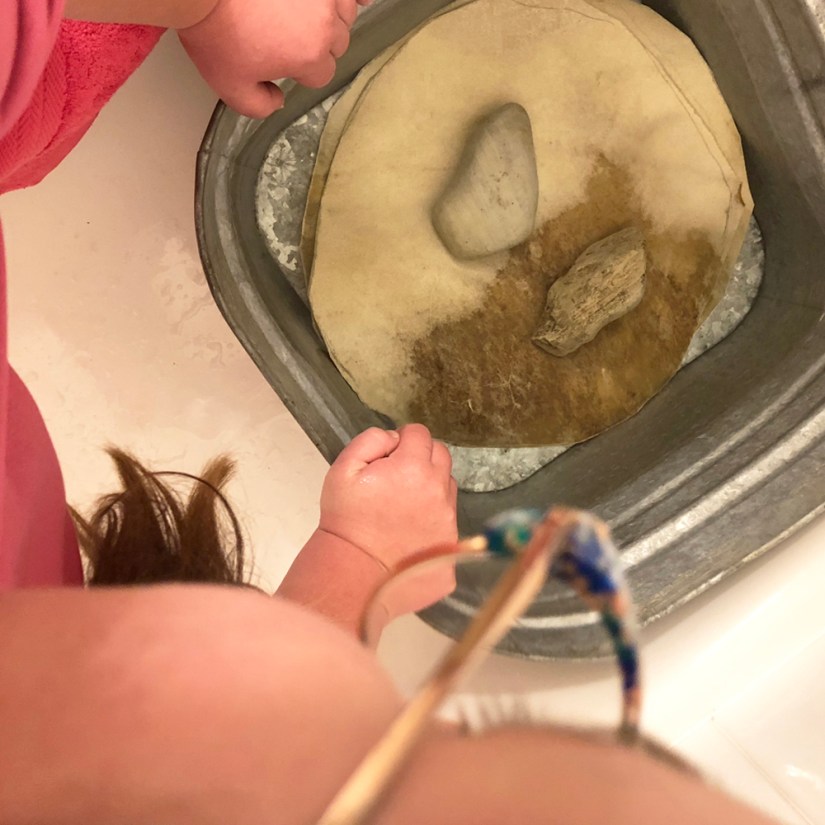
Top-down view of rawhide circles submerged in water inside a vintage galvanized washtub, held down by river rocks during a studio soaking process by Portia Po Chapman
Inside her Kingston studio, Po submerses rough-cut rawhide rounds two at a time in a dedicated galvanized washtub, using river rocks to keep the buoyant hides submerged as they hydrate and soften.

The process differed from Poโ€™s method of soaking rawhide drum skins which are soaked in rain water, weighted by natural crystals, and soaked one at a time for individually specific times.

Giving in to the Rawhide: A Technical Breakthrough

Wrapping wet, pliable rawhide over plastic diffusers proved vastly different from stringing traditional oak or maple frame drums. Rawhide exerts immense force as it dries and shrinks. Poโ€™s early trials failed because pulling the hide tightly with standard drum-lacing techniques warped and buckled the plastic diffusers, preventing them from mounting back onto their LED base units.  Po realized that to succeed, she had to stop strong-arming the material and instead give in to the nature of rawhide, allowing its natural, organic shape to form.  She pioneered an entirely new process that included:

1/ Precision Drilling: She determined a precise location, hole pattern and frequency to drill directly into the plastic diffusers, matching them with holes punched around the hide using a leather punch.
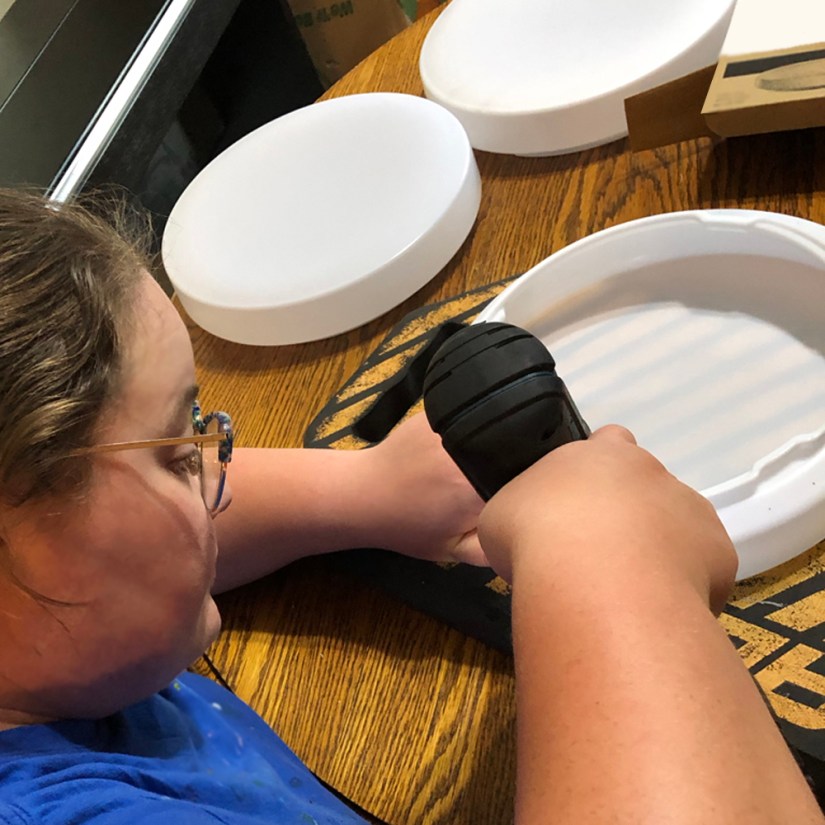
Kingston artist Portia Po Chapman drilling a hole pattern into a white plastic LED light diffuser, supported by a black sponge kneeling pad, in her studio as she prepares the backing for rawhide wrapping.
To successfully wrap the backlighting diffusers with rawhide for the Being Seen installation, Po pioneered a custom hole pattern through the plastic, allowing the shrinking hide and sinew to glide without warping the structure, a breakthrough achieved after initial failures.


2/ Cake Fondant-Style Draping:ย She calculated her cut hide diameter using a dedicated formulaโ€”the diffuser diameter plus twice its depth, plus approximately two inches. Instead of stretching the hide tight, she draped it loosely over the diffuser like fondant icing over a cake.


3/ Backstitch Lacing: Using synthetic sinew and a darning needle, she applied a loose, backstitch stitch pattern, that allowed the rawhide to gently shift as it shrank to fit the diffuser.
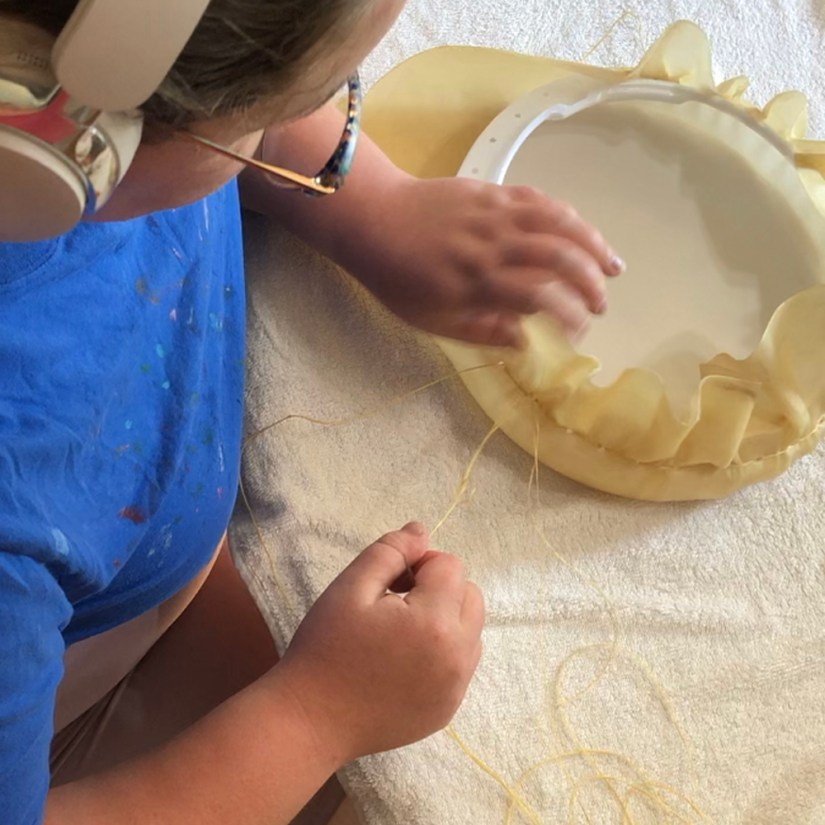
Top-down view of Kingston artist Portia Po Chapman in her studio, wearing headphones and eyeglasses, using synthetic sinew and a backstitch pattern to lace water-soaked rawhide over a pre-drilled plastic LED diffuser frame. An excessive margin of rawhide forms a ruffle, which Po intends to finger-mold and progressively trim to create a hide skirt.
Moving beyond traditional frame drum measurements and tension, Po innovates by employing an innovative backstitch lacing technique on soaked rawhide, draped loosely like fondant over a custom-drilled plastic LED diffuser. This technique allows a natural ruffle to form, which she meticulously molds and trims into a hide skirt to perfectly obscure the fixture hardware.


This technique allowed a natural, flowing ruffle to form, rather than measured exact pleating that she creates for her frame dums. The excessive hide created a skirt that covered the metal mounting hardware. 

Assembly, Engineering, and Testing

Once laced, the vessels were transferred to a wire drying rack in Po’s woodshop. Because the hide rested against a solid plastic diffuser, the drying process took longer than standard open-backed frame drums. During this drying window, Po actively hand-sculpted and finger-molded the curves and flow of the rawhide ruffles, progressively trimming them as they set.
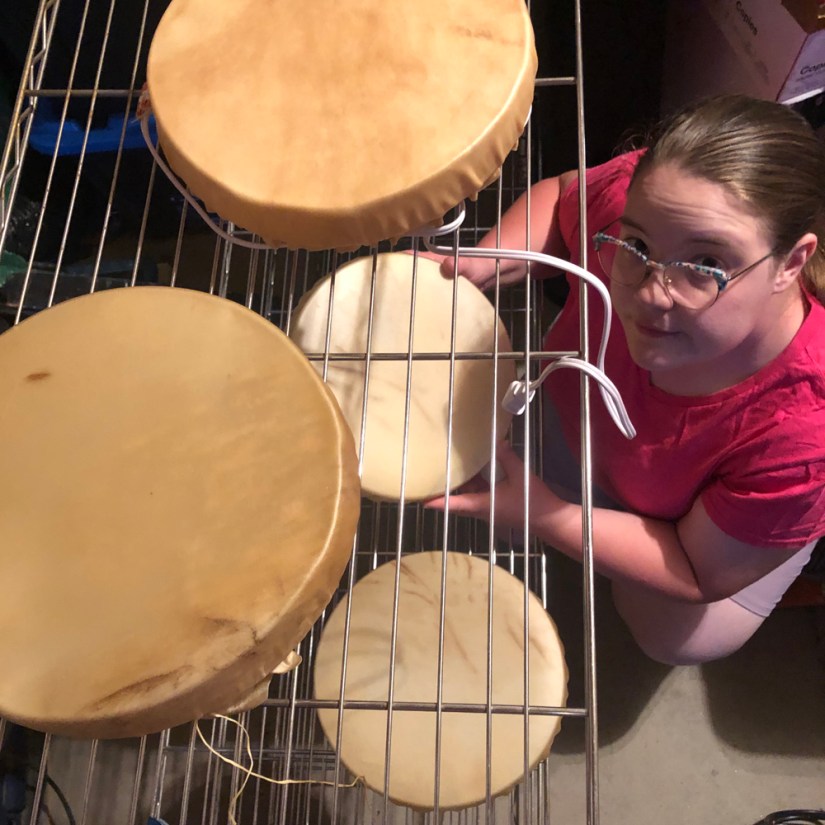
Top-down view of Kingston artist Portia Po Chapman in her woodshop, wearing glasses and a pink t-shirt, carefully placing an illuminated rawhide vessel onto a wire drying rack. Several other partially dried rawhide vessels are already sitting on the rack
In her Kingston woodshop, Po manages the crucial drying phase for the Being Seen installation. She meticulously positions each newly wrapped diffuser vessel on a wire rack, using this precise time window as the hide tightens to sculpt and manipulate the organic curve and flow of the rawhide ruffles.

To prepare the fixtures for gallery mounting, Po converted the hardwired LED ceiling lights into plug-in lamp units using transparent Wago Lever-Nut connectors. This allowed all the monolith-mounted vessels to plug directly into a central power bar controlled by a single master dimmer switch that the gallery staff could use with ease.
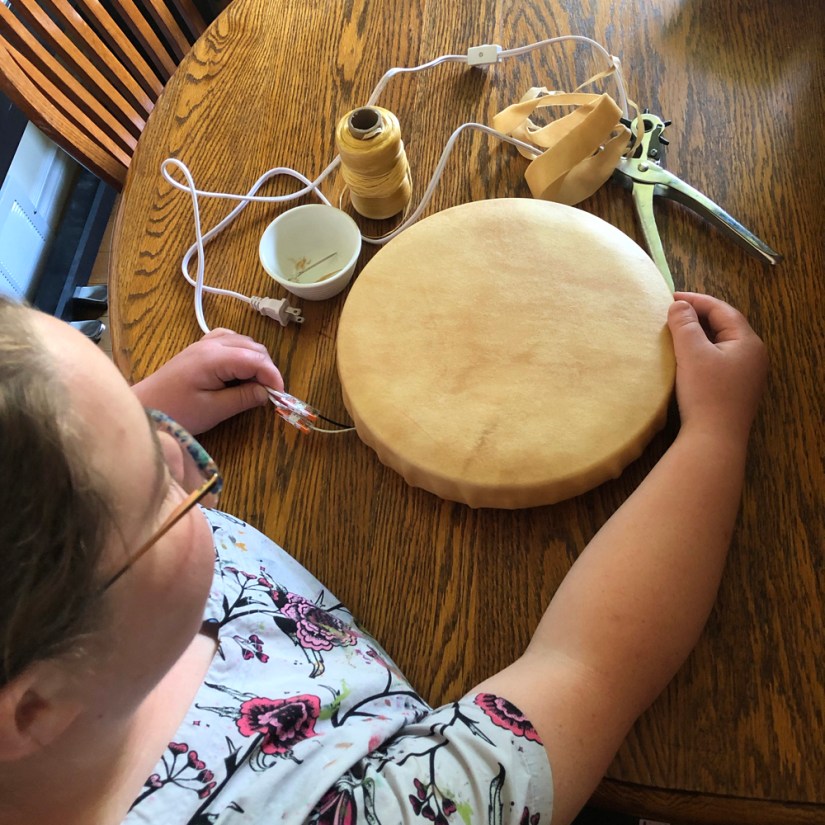
Top-down view of Kingston artist Portia Po Chapman holding orange Wago Lever-Nut connectors in her left hand as she connects a lamp cord to a smooth rawhide-wrapped LED vessel sitting on a wooden studio table surrounded by tools.
Converting ceiling lights into plug-in gallery fixtures, Po uses transparent Wago Lever-Nut connectors to safely join the LED wiring to plug-in lamp cords, enabling the entire monolith display to be powered by a single master power switch.

Before mounting, Po tested each vessel against panels of stone-hybrid sheeting (used to cover the MDF installation monoliths). Seeing the warm light shine through verified that she had successfully recreated the golden, sunlit warmth of a rawhide drum.
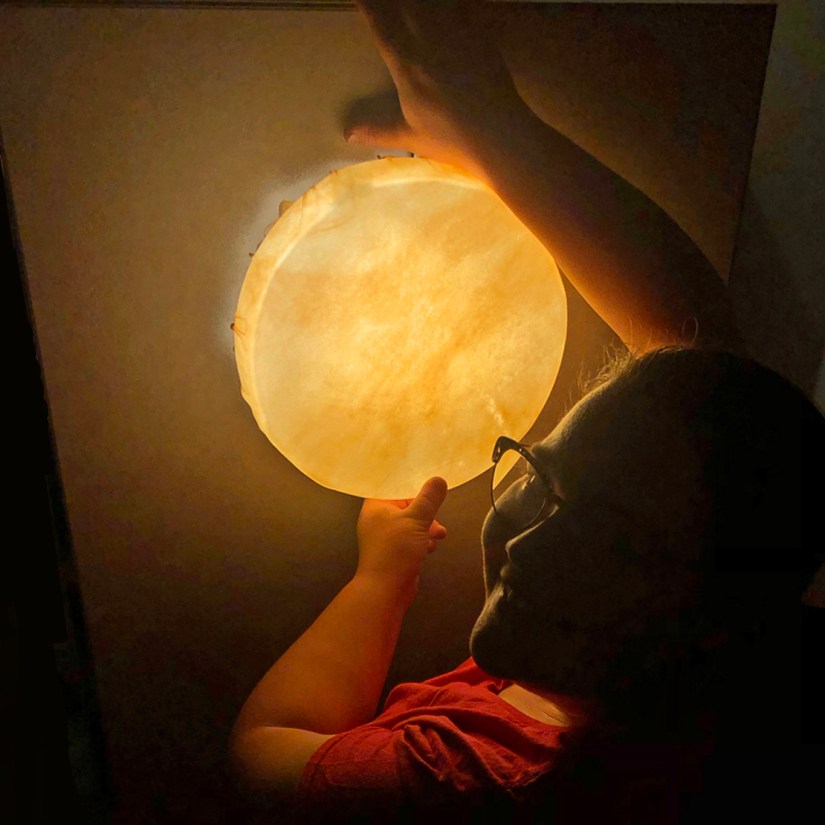
Kingston artist Portia Po Chapman smiling in a dimly lit studio as she holds an illuminated, circular rawhide vessel glowing with a warm golden sunlit light against a panel of stone-hybrid sheeting.
Achieving the ultimate vision: Po holds a finished glowing rawhide vessel up against the stone-hybrid monolith sheeting in her studio, verifying that the backlighting captures the exact golden warmth of noonday sunlight shining through rawhide.

Community Impact and Celestial Alignment

When the Glow Chamber was assembled and lit on installation day, adjusting the dimmer switch immediately brought the desired sunlit warmth into the space. Just three days after the exhibition opened on July 28, nature provided a striking confirmation: on July 31, 2026, a bright full moon rose in the midnight sky, glowing with the exact golden warmth Po had engineered in her studio.
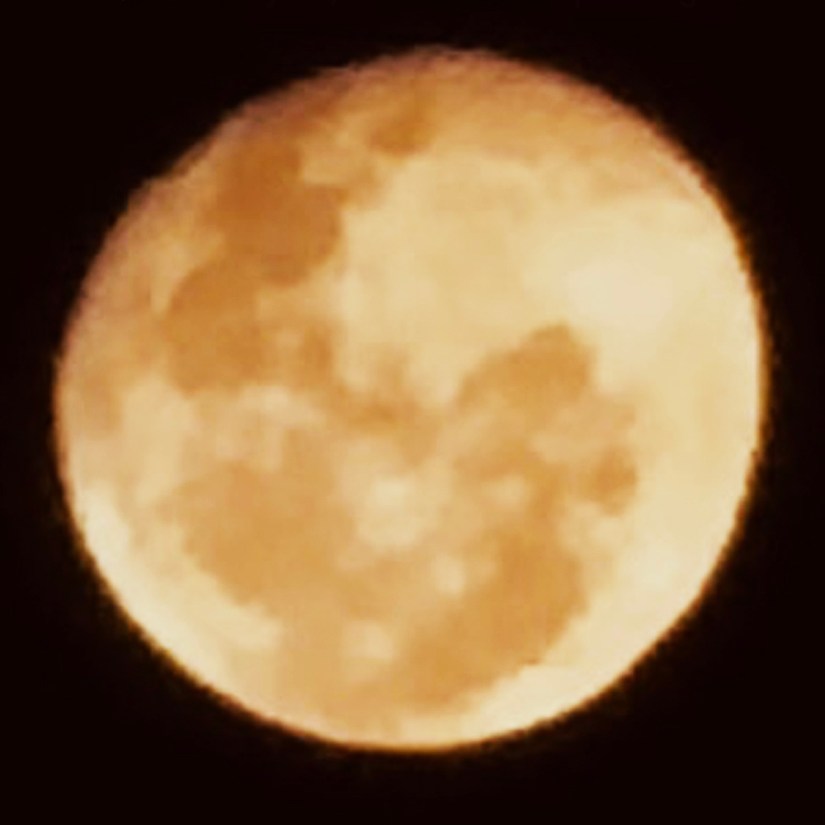
Photograph of a warm golden full moon shining brightly in a night sky, echoing the organic textures and backlighting of rawhide artwork by Portia Po Chapman.
On July 31, 2026โ€”just three days after Being Seen openedโ€”the midnight moon offered natural confirmation, glowing with the exact warmth and organic variance of Po’s sunlit and engineered rawhide creations.

Gallery visitors responded with deep emotion, often describing the Glow Chamber as a comforting, “womb-like” space. As part of the interactive exhibition, 70 guests snapped selfie portraits inside the Glow Chamber and posted them onto an interactive gallery board alongside handwritten reflections of their experience.
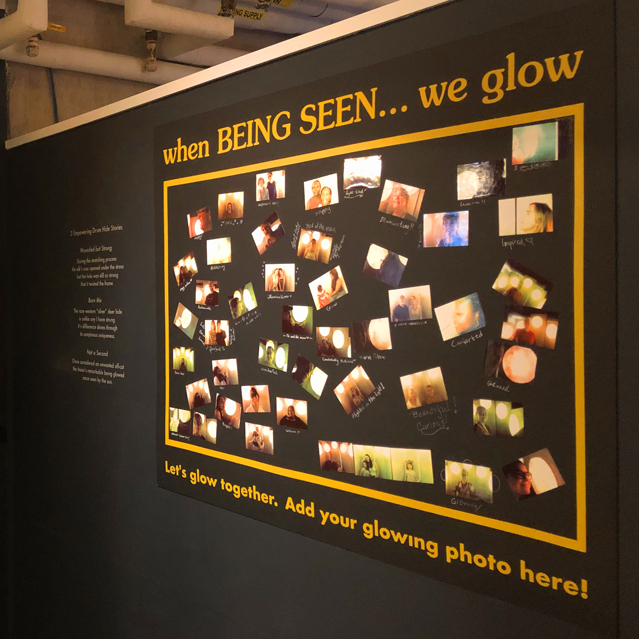
A dark gallery wall displaying a gold-framed interactive photo board titled "when BEING SEEN... we glow" covered in visitor selfie photos and handwritten notes, alongside custom wall text explaining three empowering drum hide stories by Kingston artist Portia Po Chapman.
The heart of the community connection: 70 exhibition visitors posted their glowing selfie portraits and personal reflections on the interactive board inside the Kingston Arts Council Pocket Gallery during Portia “Po” Chapman’s Being Seen exhibition (July 27 โ€“ September 18, 2026).

By capturing the feeling of noonday sunlight through rawhide, Portia “Po” Chapman created a space where visitors could joyously glow togetherโ€”proving her core thesis: โ€œEveryone glows when they feel seen.โ€

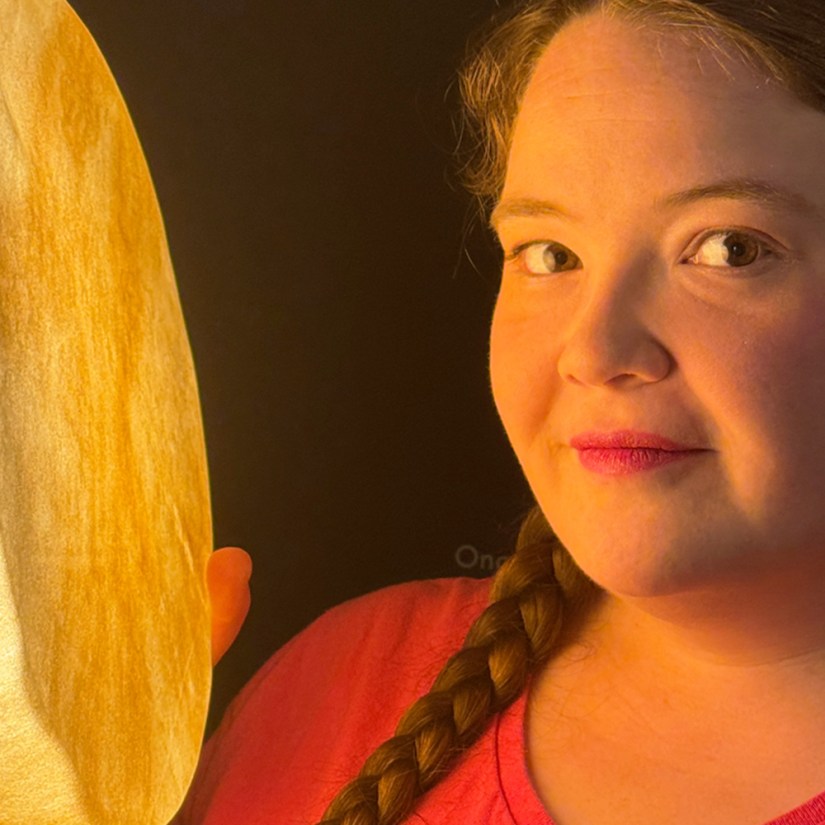
Close-up portrait of Kingston artist Portia Po Chapman in a pink top with her hair braided, illuminated by the warm golden light emitted from a handcrafted rawhide vessel she holds in the dark Pocket Gallery space
Celebrating the realized vision: Po poses in the Kingston Arts Council Pocket Gallery alongside one of her completed backlit rawhide vessels, illuminated by the warm golden glow achieved through months of dedicated experimentation and innovation. Photo by Ann Decker.

Hosted by the Kingston Arts Council at the Tett Centre for Creativity and Learning, Being Seen: when Being Seen… we glow, marked both a community success and a major advancement in Poโ€™s ongoing evolution of rawhide art.

Immersive site-specific installation "Being Seen: when Being Seen... we glow" featuring the monochromatic Glow Chamber, glowing rawhide vessels, vinyl wall text, and photo board inside the Kingston Arts Council Pocket Gallery.
The site-specific Glow Chamber on view inside the Kingston Arts Council Pocket Gallery during the immersive exhibition, “Being Seen: when Being Seen… we glow.”

Portia “Po” Chapman is a Kingston-based multidisciplinary visual artist, muralist, and certified educator (BFAH, B.Ed, OCT) recognized for her site-specific Storytelling Art and signature high-contrast aesthetic. Blending traditional craftโ€”such as artisanal rawhide sculpting and woodworkingโ€”with innovative lighting design and digital tools, she creates immersive, community-driven installations that invite viewers into a shared, radiant dialogue where everyone glows. Discover more of her portfolio, public artworks, and upcoming projects at loveartbypo.ca.

Let Me Know What You Think! Start or Join the Convesation

Serving Kingston, Ontario & Across Canada


Contact Po Using Form Below

โ† Back

Contact Email Confirmation

Hi, Po here! Thanks for sending me an email. I will get back to you within a few days. Have a beautiful day!

Behind the Art, Kingston Artist, Portia Chapman

Beyond the Form: How Didactic Museography Transformed the Glow Chamber into an Interactive Experience | Kingston Artist Portia Po Chapman

A sculpture occupies space, but a true art installation creates a world. For Kingston artist Portia Po Chapman, the central Glow Chamber in her solo exhibition, Being Seen: when Being Seen… we glow, could easily have stood alone as a handcrafted rawhide sculpture. However, her creative vision extended far beyond a static physical formโ€”she set out to build a fully realized, interactive experience.

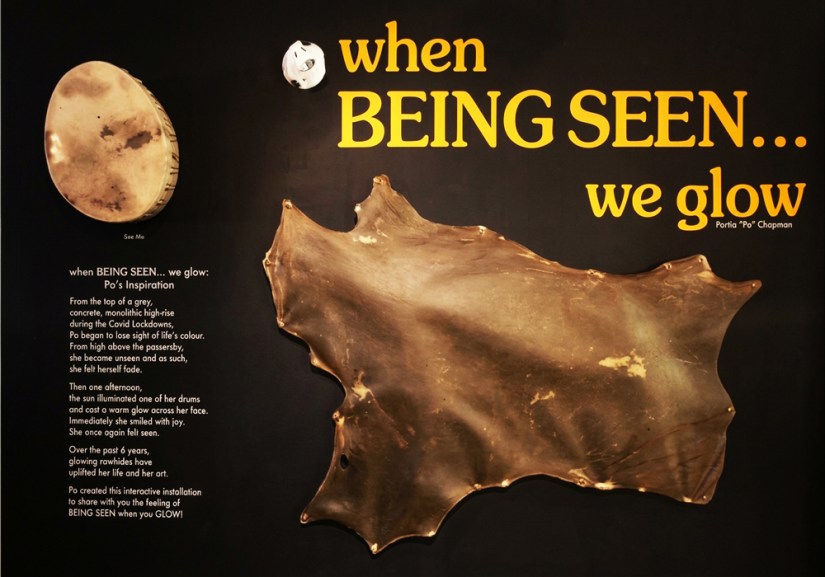
The completed black exhibition title wall for "when Being Seen... we glow" by Kingston artist Portia Po Chapman, featuring gold vinyl lettering, a full deer rawhide mounted 1.5 inches off the wall with copper pipe spacers, an artist statement, and an egg-shaped illuminated silver deer rawhide drum.
The completed interior title wall for “Being Seen: when Being Seen… we glow” by artist in Kingston Portia Po Chapman, showcasing a floating full deer rawhide, an illuminated silver deer rawhide drum, and custom Didactic Museography typography.

The crucial element that elevated this vision from sculpture to immersive installation was Didactic Museography: the intentional, strategic integration of typography, text placement, and spatial narrative design. By treating words not as afterthoughts, but as structural art materials equal to rawhide, wood, and light, the text became the essential bridge guiding viewers into a personal, participatory journey.

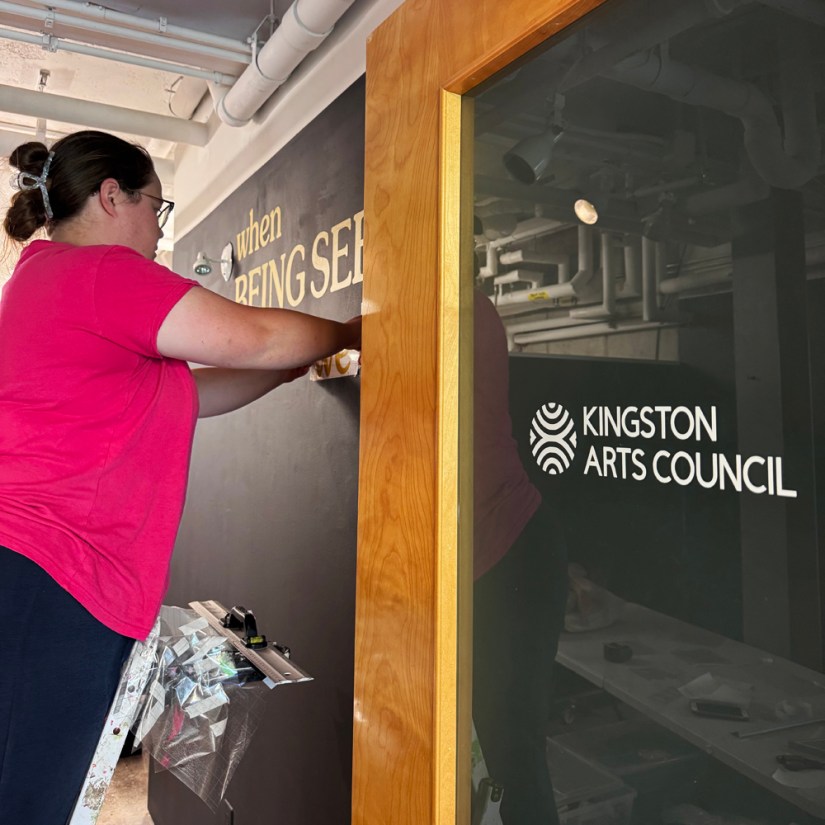
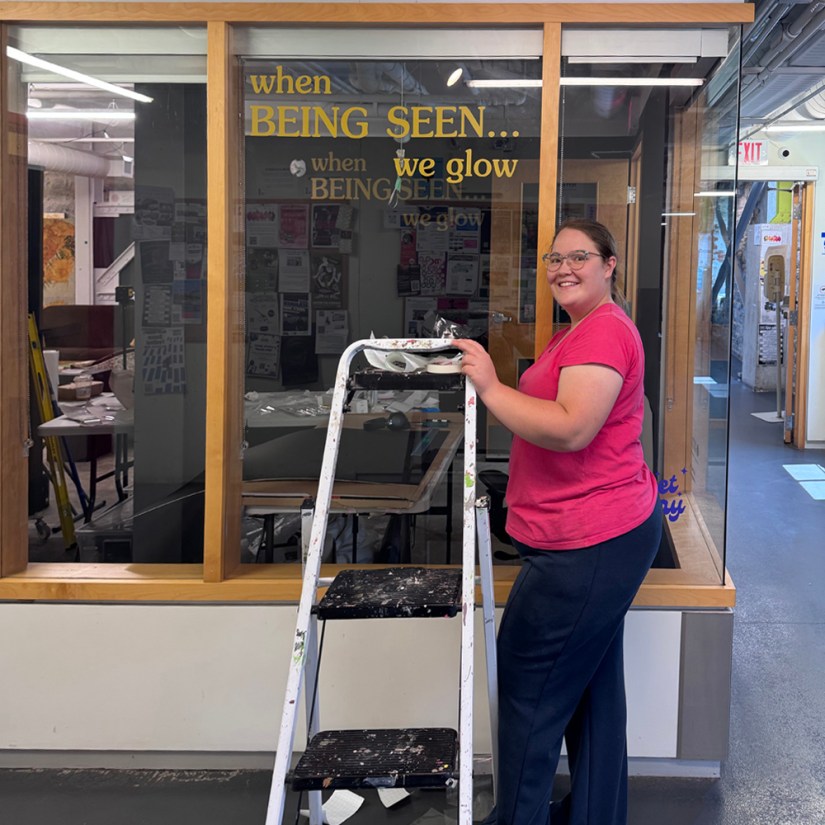
Side-angle view of Kingston artist Portia Po Chapman standing on a ladder inside the Pocket Gallery applying gold vinyl lettering reading "when BEING SEEN..." to the interior black title wall, with the Kingston Arts Council logo visible on the glass door frame in the foreground.
Interior setup in progress: artist in Kingston Portia Po Chapman carefully applies custom CNC-cut vinyl title decals to the dark gallery wall.

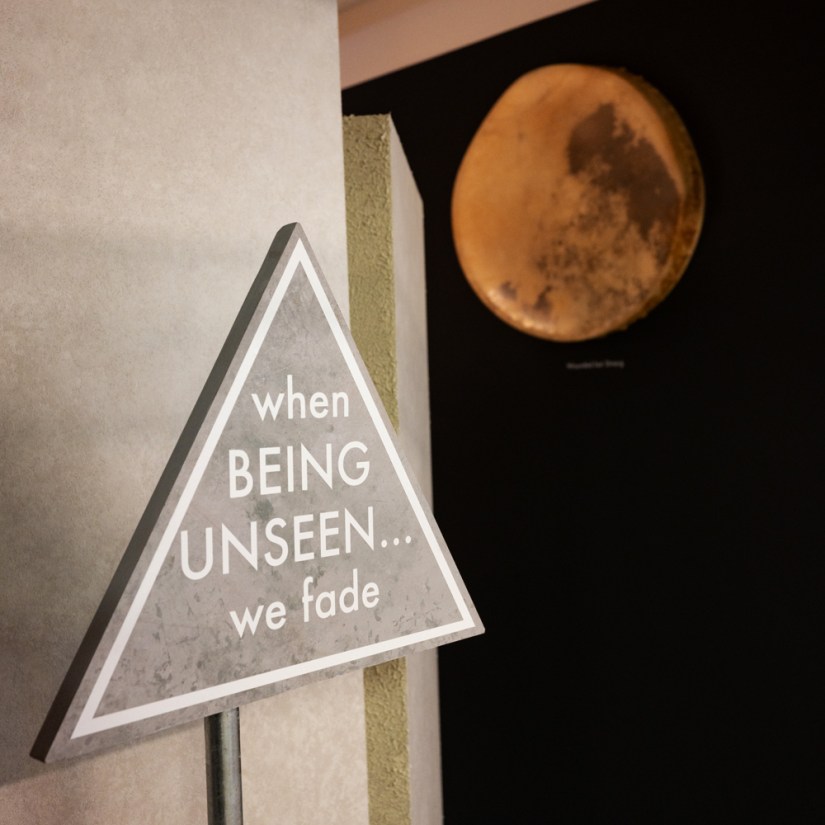
From the muted grey caution sign reading “when Being Unseen… we fade” to the warm gold title lettering and the interactive species guide, every piece of vinyl typography served a deliberate conceptual purpose.

A grey triangular caution sign reading "when Being Unseen... we fade" positioned outside the Glow Chamber installation by Kingston artist Portia Po Chapman, with a glowing golden elk rawhide drum mounted on the dark wall in the background.
A deliberate conceptual contrast by artist in Kingston Portia Po Chapman: the faded, concrete-grey caution sign reading “when Being Unseen… we fade” stands outside the Glow Chamber, set against the warm light of a handcrafted glowing elk rawhide drum.

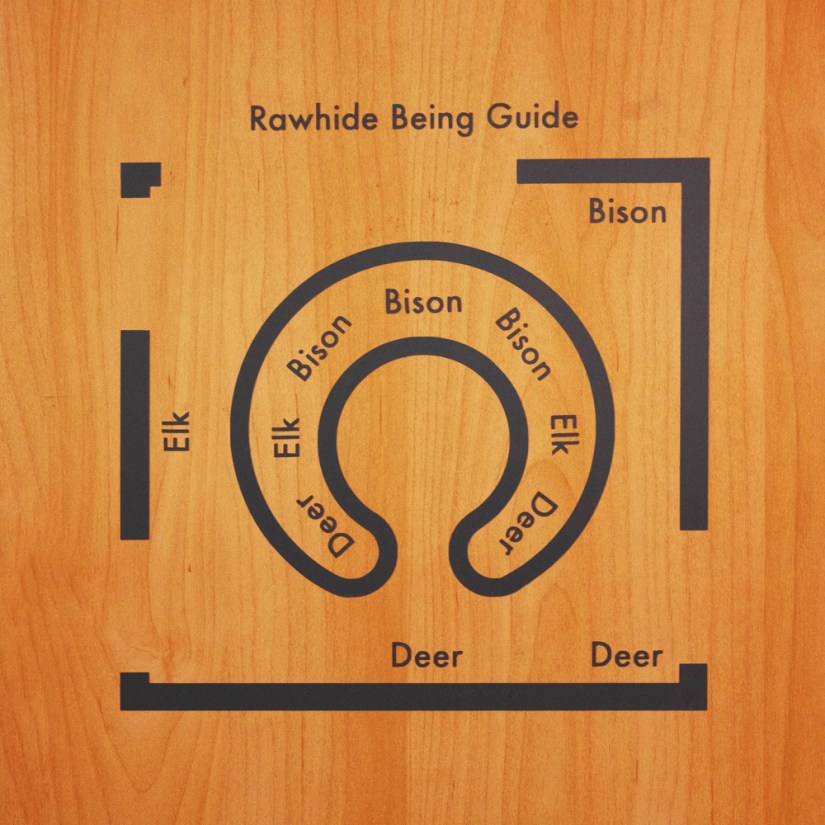
Didactic Museography goes beyond simply delivering information; it curates an emotional arc that shapes how a viewer feels, moves, and connects with the space. As an artist in Kingston known for site-specific precision, Portia Po Chapman carefully planned the layout of every wall graphic and decal,

Close-up view of the "Rawhide Being Guide" vinyl map mounted on a laminated wood panel, showing gallery visitors the specific layout and locations of Deer, Elk, and Bison rawhide species throughout the exhibition space.
“Rawhide Being Guide” legend and floor plan: artist in Kingston Portia Po Chapman provides gallery goers with a visual map detailing the exact placements of Deer, Elk, and Bison hides inside and around the Glow Chamber.

and even balancing spatial composition around fixed gallery fixturesโ€”so that the text acted as an inviting narrator. It prompted passersby in the Tett Centre hallway to pause, contemplate their own visibility, and physically step across the threshold into the glowing interior.

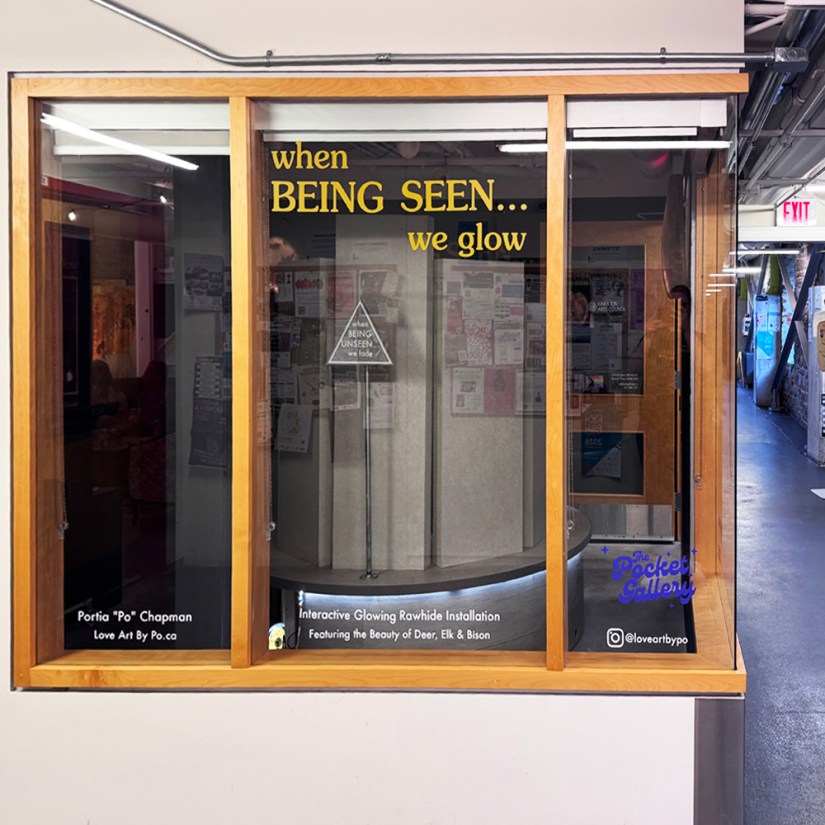
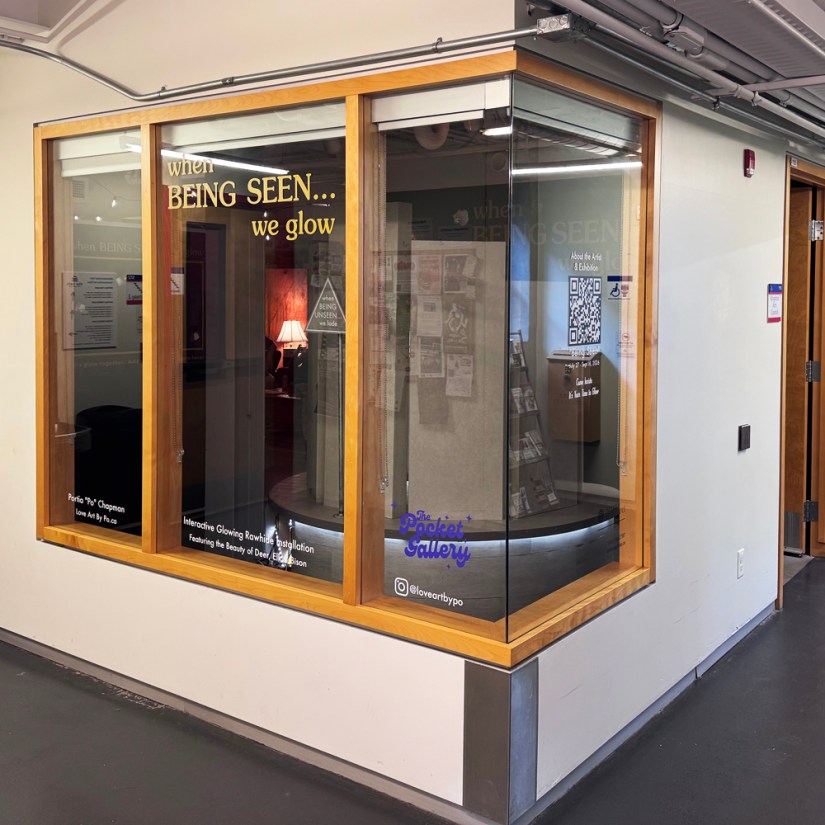
Exhibition Gallery Window Display with Custom Vinyl Decals โ€“ Portia Po Chapman Artist in Kingston.
Exterior view of the Pocket Gallery window at the Tett Centre: custom CNC-cut vinyl graphics by artist in Kingston Portia Po Chapman frame the view of the Glow Chamber and caution sign inside.

The transformative power of this approach was reflected in the overwhelming community response. Throughout the show at the Pocket Gallery, gallery goers repeatedly remarked on how deeply the written narrativesโ€”from the personal reflection in “Poโ€™s Inspiration” to the origin tales in “3 Empowering Drum Hide Stories”โ€”resonated with them.

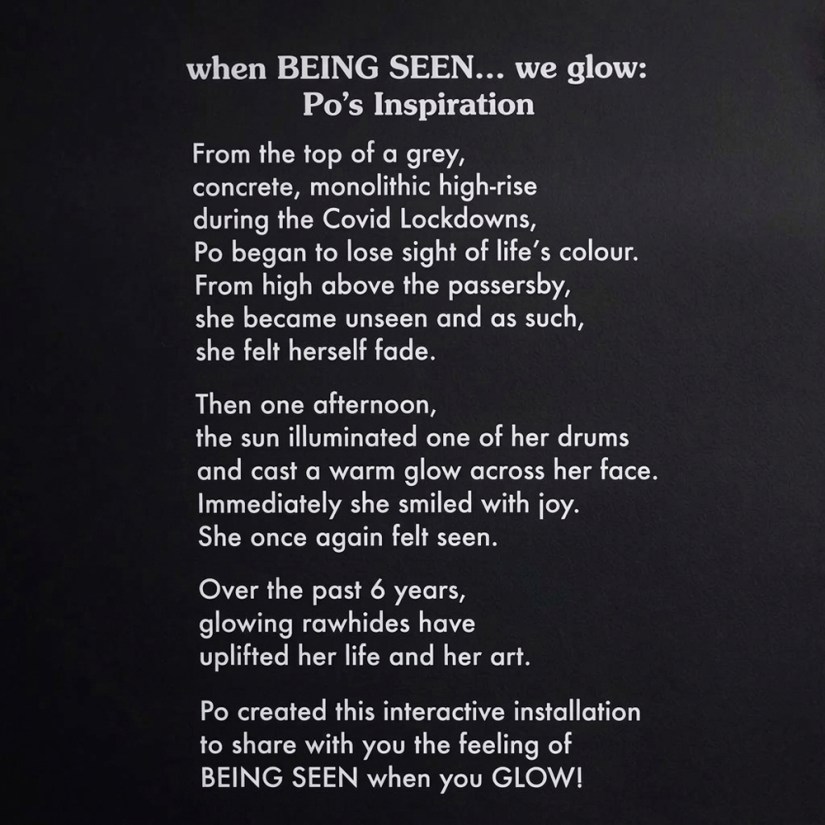
Close-up view of the white vinyl artist statement graphic on the dark title wall, titled "when BEING SEEN... we glow: Po's Inspiration," detailing Kingston artist Portia Po Chapman's story of finding light and joy through glowing rawhides.
“Po’s Inspiration” artist statement on the interior title wall: artist in Kingston Portia Po Chapman shares the personal story behind creating her interactive glowing rawhide installation.
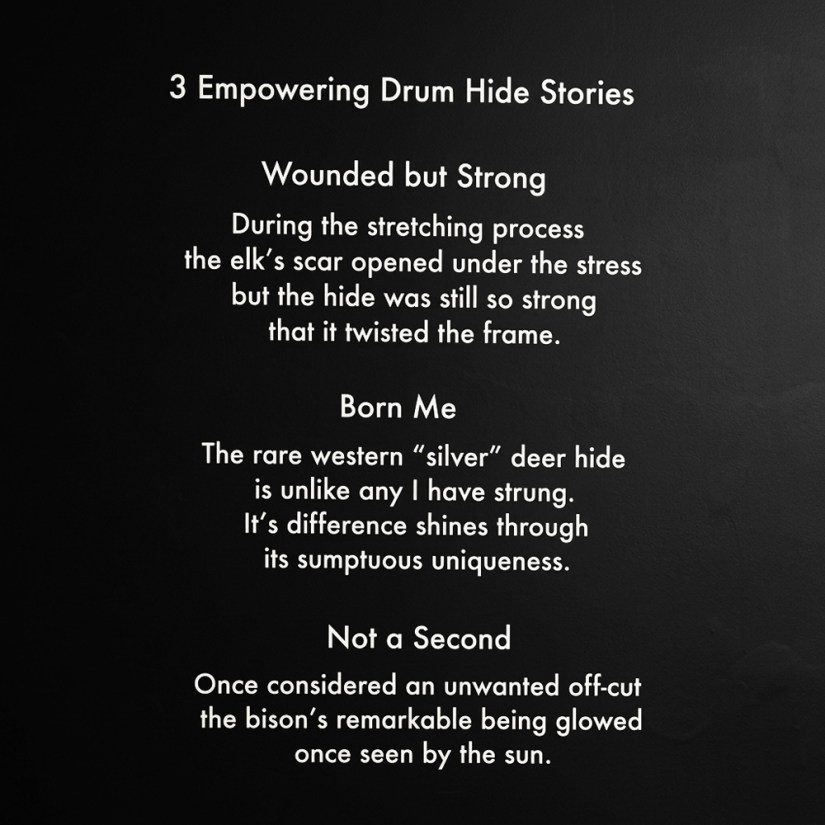
Close-up view of the black didactic wall graphic panel titled "3 Empowering Drum Hide Stories" by Kingston artist Portia Po Chapman, describing the origin stories for her featured glowing rawhide drums: Wounded but Strong, Born Me, and Not a Second.
“3 Empowering Drum Hide Stories” wall panel: artist in Kingston Portia Po Chapman shares the individual narratives and meanings behind three featured glowing rawhide drums.

The text gave voice to the deer, elk, and bison hides, turning natural materials into powerful mirrors for human resilience. Without these carefully crafted words, the Glow Chamber would have been an impressive visual structure; with them, it became a communal experience that invited over 70 visitors to add their own glowing portraits to the interactive selfie board, proving that thoughtful typography is key to making art truly felt and shared.

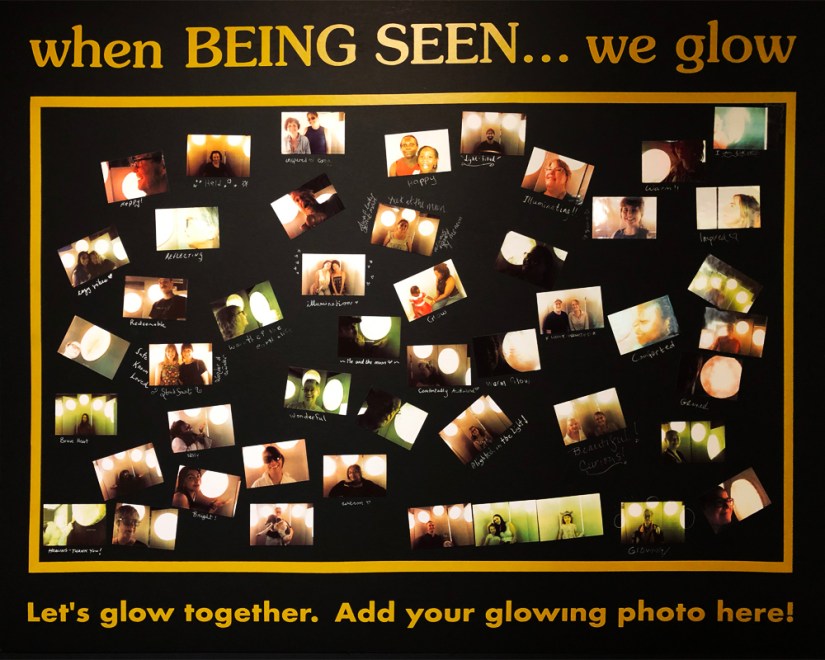
A black display board framed in gold with the gold vinyl title "when BEING SEEN... we glow" at the top and "Let's glow together. Add your glowing photo here!" at the bottom, covered with instant sticker selfies of visitors inside the Glow Chamber installation by Kingston artist Portia Po Chapman.
Community in full glow: artist in Kingston Portia Po Chapman created an interactive photo board where 70 exhibition guests posted instant sticker selfies taken inside the Glow Chamber installation.

Beyond the conceptual framework, the true art lives in the physical execution and attention to detail. A closer look at the behind-the-scenes preparation and gallery window installation reveals how these narrative layers were carefully brought to life. From the close-up views of the custom-cut vinyl typography to the interactive QR codes, social media callouts, and spatial maps, every single graphic element was hand-applied and purposefully placed.

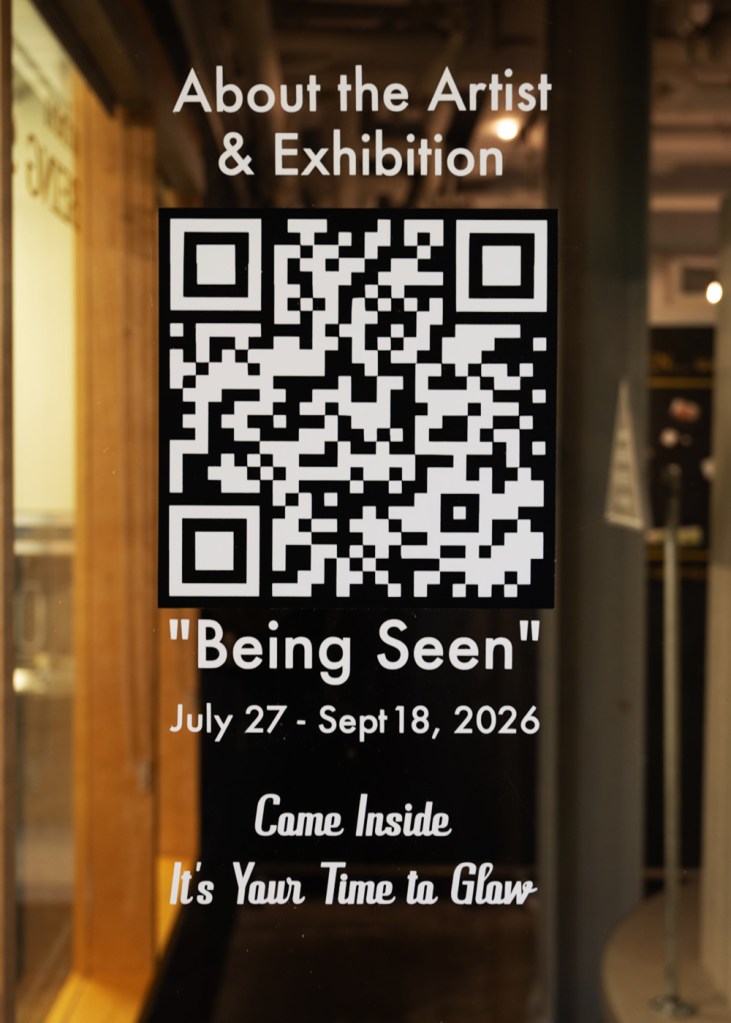
Close-up view of a scannable QR code decal on the Pocket Gallery window at the Tett Centre, titled "About the Artist & Exhibition 'Being Seen'" with dates July 27 โ€“ Sept 18, 2026, and the invitation "Come Inside It's Your Time to Glow" by Kingston artist Portia Po Chapman.
Close-up detail of the interactive QR code window decal facing the Tett Centre hallway, inviting visitors to scan for details about Kingston artist Portia Po Chapman and the “Being Seen” exhibition.

The following collection of close-up images captures these precise didactic components in detailโ€”offering a transparent, step-by-step look at how thoughtful text, strategic window placement, and hands-on craftsmanship transformed the Kingston Arts Council Pocket Gallery into an inviting, fully connected experience for every visitor passing through the Tett Centre for Creativity and Learning.

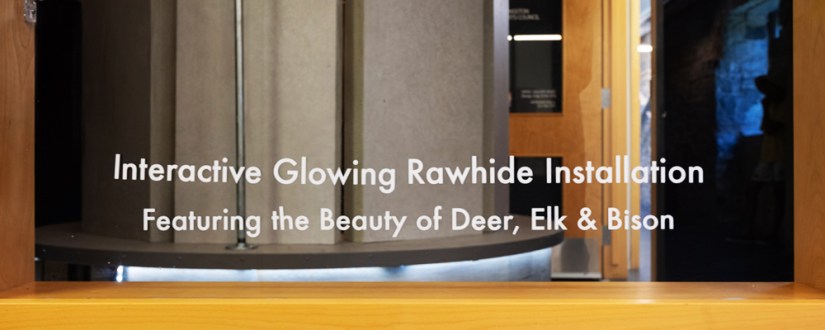
Close-up view of the bottom center gallery window decal at the Tett Centre reading "Interactive Glowing Rawhide Installation Featuring the Beauty of Deer, Elk & Bison" by Kingston artist Portia Po Chapman, with the base of the Glow Chamber visible in the background.
Close-up detail of the vinyl decal on the bottom centre gallery window: artist in Kingston Portia Po Chapman highlights the rawhide species featured within the interactive Glow Chamber installation.
Exterior wide-angle view of the Pocket Gallery corner glass windows at the Tett Centre displaying exhibition vinyl typography and a scannable QR code poster for exhibition details by Kingston artist Portia Po Chapman.
Corner exterior view of the Pocket Gallery at the Tett Centre in Kingston, Ontario: vinyl decals and an interactive QR code poster invite passersby to explore exhibition details for Portia Po Chapman’s interactive rawhide installation.
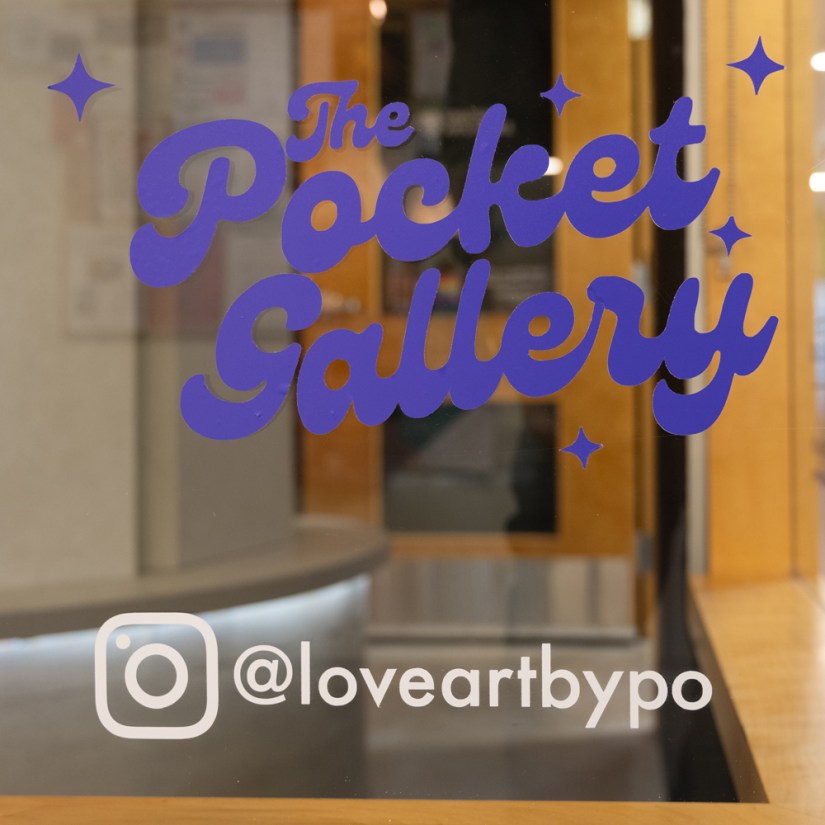
Close-up view of the bottom right gallery window at the Tett Centre displaying artist Portia Po Chapman's white Instagram decal @loveartbypo positioned directly beneath the permanent purple Pocket Gallery logo.
Strategic placement by artist in Kingston Portia Po Chapman: her Instagram handle @loveartbypo sits directly below the permanent Pocket Gallery logo, inviting visitors to view ongoing updates and installation media online.

Behind the Scenes Photos

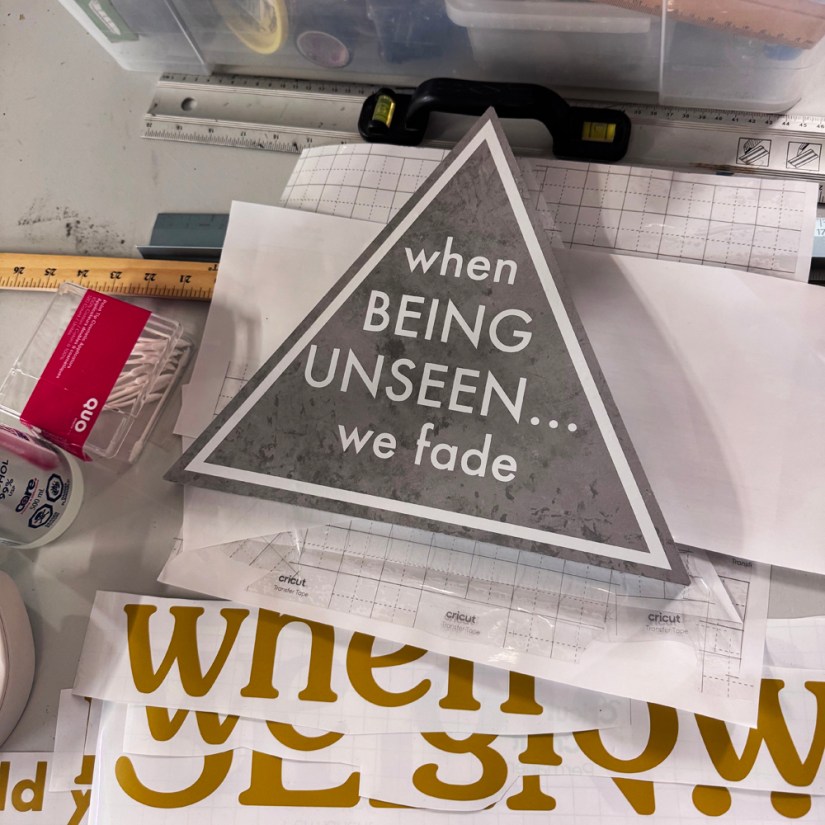
Overhead view of Kingston artist Portia Po Chapmanโ€™s studio workbench displaying the triangular grey "when Being Unseen... we fade" caution sign alongside golden vinyl lettering on transfer paper during the creation of her interactive installation.
Behind the scenes in the Kingston art studio: artist Portia Po Chapman prepares the vinyl typography and grey caution sign reading “when Being Unseen… we fade” for the Glow Chamber installation.
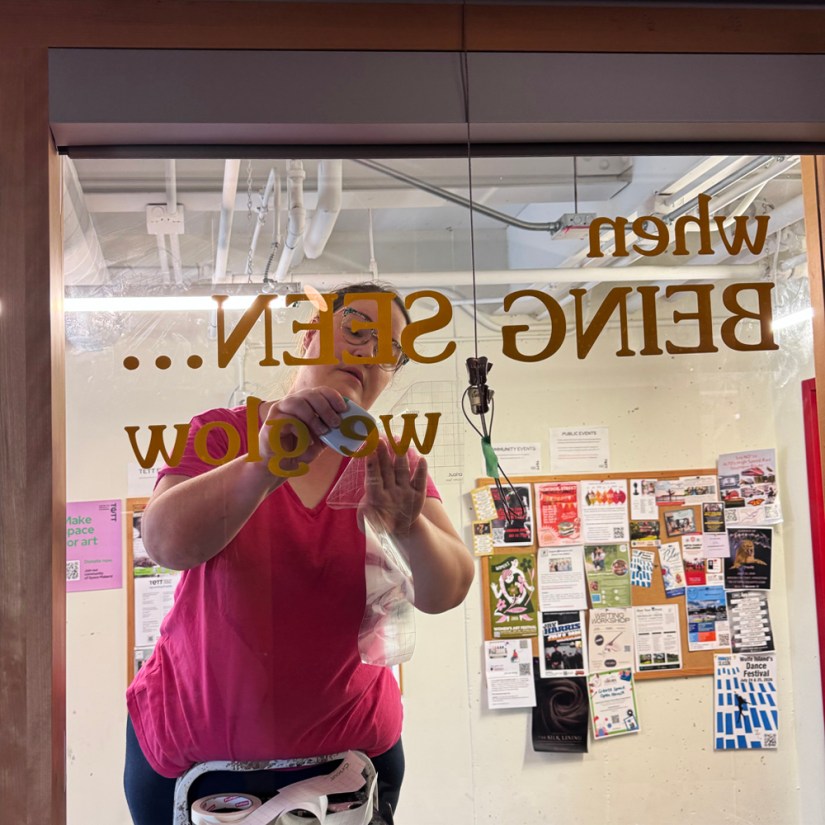
View from inside the gallery showing Kingston artist Portia Po Chapman on a stepladder applying gold vinyl typography reading "when Being Seen... we glow" onto the outer hallway window at the Tett Centre.
Installation in progress: artist in Kingston Portia Po Chapman carefully applies the gold vinyl title sticker onto the gallery window pane prior to the exhibition opening.
Side-angle view of Kingston artist Portia Po Chapman standing on a ladder inside the Pocket Gallery applying gold vinyl lettering reading "when BEING SEEN..." to the interior black title wall, with the Kingston Arts Council logo visible on the glass door frame in the foreground.
Interior setup in progress: artist in Kingston Portia Po Chapman carefully applies custom CNC-cut vinyl title decals to the dark gallery wall.
Kingston artist Portia Po Chapman standing beside a stepladder in the Tett Centre hallway, smiling proudly next to the freshly applied gold vinyl title decal "when Being Seen... we glow" on the gallery window.
Artist in Kingston Portia Po Chapman poses beside her ladder after finishing the application of the gold vinyl exhibition title decal on the Pocket Gallery hallway window.

The Immersive Show Stopper of “Being Seen: when Being Seen… we glow,
The GLOW CHAMBER

Interactive Glow Chamber installation featuring semi-circular partition walls mounted with circular, illuminated rawhide vessels casting a warm golden glow.
The interactive Glow Chamber from Portia “Po” Chapmanโ€™s exhibition when BEING SEEN… we glow, featuring backlit rawhide vessels radiating the natural golden warmth of sunlit rawhide.

Portia Po Chapman is a Kingston-based visual artist, muralist, and educator (BFAH, B.Ed, OCT) recognized for her signature high-contrast aesthetic and site-specific installations. Combining natural materials like hand-sculpted rawhide with modern digital fabrication and Didactic Museography, she crafts immersive, community-driven experiences that invite viewers into active dialogue with the work. Discover more of her portfolio, public artworks, and upcoming exhibitions at loveartbypo.ca.

Let Me Know What You Think! Start or Join the Convesation

Serving Kingston, Ontario & Across Canada


Contact Po Using Form Below

โ† Back

Contact Email Confirmation

Hi, Po here! Thanks for sending me an email. I will get back to you within a few days. Have a beautiful day!

Behind the scenes, Drum December, Drum Works, Kingston Artist, Po's Drum Making Process, Portia Chapman, Sustainable Craft, woodworking

Drum December Day 2: Poโ€™s Sun-Steaming Method Begins

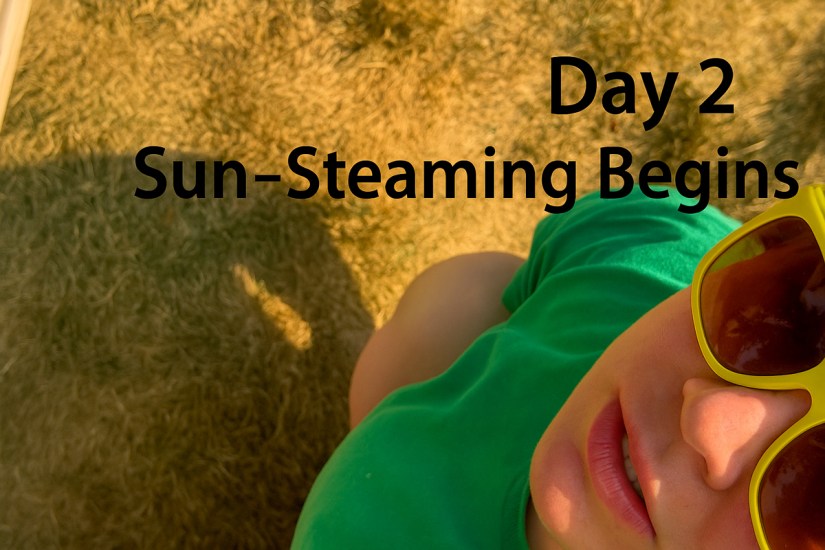
Po Chapman lying in the sun wearing yellow sunglasses and a green shirt, beginning Day 2 of her sun-steaming drum-making process.
Day 2: Po begins her sun-steaming process for crafting hardwood drum frames.

Welcome to Day 2 of Drum December!

Today, Po begins the very first step in her innovative sun-steaming method โ€” a sustainable process she personally developed to prepare kiln-dried hardwood for her premium drum frames and exposed stretchers.

Sun-steaming is a technique that Po pioneered to reduce the environmental impact of traditional wood steaming. Instead of soaking the kiln-dried wood for two days and then heating it with electricity, Po slides the carefully milled hardwood into a long black tube with ridges along its interior.

The ridges guide the wood as it slides in, producing a distinctive sound โ€” the beginning of the transformation.

Once the hardwood is inside the tube, Po fills it with water and lets the sun do all the work. For three full days, the water naturally heats within the sealed tube, allowing the wood fibres to relax and prepare for bending.

An Energy-Conscious Method for Steaming the Wood:

  • Removes the two-day soaking stage
  • Uses no electricity
  • Reduces water consumption
  • Produces a more responsive bend
  • Creates the smooth, elite-quality curves Poโ€™s drum frames are known for

This is where Poโ€™s craftsmanship begins โ€” with innovation, patience, and the sun itself.

Tomorrow, weโ€™ll continue documenting this process as Drum December unfolds, one beautifully authentic step at a time.

Tomorrow, Po continues the transformation as she assesses the wood to see whether it has relaxed enough to become bendy and ready for shaping.

Stay tuned for Day 3!

๐Ÿ“ง Portia@loveartbypo.ca

One response to “Drum December Day 2: Poโ€™s Sun-Steaming Method Begins”

Let Me Know What You Think! Start or Join the Convesation