Behind the Art, Behind the scenes, Drum December, Drum Works, How Po Makes Hand Drums, Indigenous Art, Po's Drum Making Process, Portia Chapman, Real-Time Crafting, Studio Process, Uncategorized

Drum December Day 17 – How To Varnish a Drum Frame

Close-up of a white oak drum frame stained in Black Cherry, resting on wooden risers for the varnishing stage of Drum December Day 17 at Portia Po Chapman’s studio.
Moving from the deep stain of Day 16 to the protective glow of Day 17: Preparing to varnish the white oak drum frame.

Making the Drum Frame Shine

Varnishing is rarely a single-day task; it is a meticulous 2–3 day process that requires patience, a steady hand, and a keen ear for the wood’s texture. While the varnish gets harder the longer it dries—which is our ultimate goal for a durable instrument—this hardness can make it difficult for the next layer to bond. To ensure a professional, glass-like finish, we must navigate the delicate balance of drying times and sanding.

Choosing the Right Finish: Water-Based vs. Spar Varnish

For drums intended for rugged, outdoor drum circles, I typically use a natural spar varnish. It applies thickly and offers heavy-duty protection, though it requires significant drying time.

However, for this white oak frame, I chose a clear, non-yellowing water-based Varathane finish.

  • The Benefit: It dries much faster than oil-based alternatives.
  • The Challenge: The coats are much thinner, meaning the wood grain often “raises” after the first application.

In the video below, you can actually hear the raised grain as I sweep my hand across the dry surface. This texture must be smoothed before we can move forward.

The Secret to Sanding First Coats

Sanding the first coat of dry varnish is easier than it looks, provided you have the right technique. Because I am on a strict timeline—with the goal of stringing this drum on Day 19 (December 27, 2025)—I chose to sand after just one coat.

Pro Tip for Sanding:

  1. Wet the surface: Lubricating the varnish prevents the sandpaper from “grabbing” too aggressively.
  2. The Paper: Use 400-grit wet/dry sandpaper.
  3. The Motion: Lightly draw the paper along the surface, always following the direction of the grain.

Note: If you are using a very thin acrylic “varnish,” it is often safer to wait until the 3rd coat to sand.

Once sanded, the frame must be wiped down and dried. Always use a tack cloth as your final step to remove every microscopic speck of dust before the next coat of varnish touches the wood.

Controlling the Environment

Timing is everything. I applied the first coat roughly eight hours ago, but the humidity outside was climbing. To ensure the frame dried in time for the second coat, I moved it into my humidity-controlled drum painting studio, which I keep strictly between 45% and 50% humidity. This controlled environment is essential for a consistent cure.

Efficiency on the Turntable: The Game Changer

The way you physically handle the drum during varnishing dictates the final look. I prefer to use a lazy-susan (turntable) painting surface equipped with risen bars.

Why use a turntable?

  • Continuous Motion: It allows for long, fluid brush strokes that follow the grain without the artist having to change positions.
  • Self-Leveling: Fewer brush strokes mean the varnish has a better chance to self-level, resulting in a smoother finish.
  • Drip Management: If excess varnish begins to pool at the bottom edge, you can easily catch and wipe it with just the tips of your bristles as the frame spins.

Using a turntable was a complete game changer for my craft, and it is the secret behind the flawless finish on this white oak frame.

Come back tomorrow when we cut the rawhide and put in the water to soak.

See you on Day 18!

Read more about my art and contact information at Love Art By Po and the many drums I make.
To contact me directly, please use this email:

📧 Portia@loveartbypo.ca

Let Me Know What You Think! Start or Join the Convesation

Behind the Art, Behind the scenes, Drum December, Drum Works, How Po Makes Hand Drums, Kingston Artist, Po's Drum Making Process, Portia Chapman, Portia Po Chapman Frames and Stretchers, Studio Process, Uncategorized, woodworking

Drum December Day 12 – How to Make a Drum Frame Using 6 Clamps

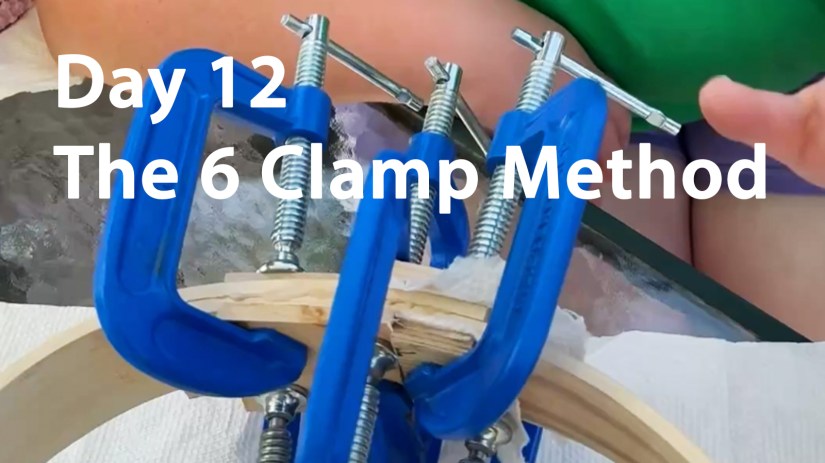
Close-up of several blue C-clamps tightly securing a glued joint on a wooden drum frame using the 6-clamp method, Day 12 tutorial by Portia Po Chapman.
Mastering the “6 Clamp Method” to ensure a secure, even bond on the dry-bent drum frame.

Drum December Day 12: Mastering the 6-Clamp Method

Welcome to Day 12 of Drum December! Today is the day we tackle dry-bending and clamping head-on. In this tutorial, you’ll learn the vital “what-to-dos” (and the painful “what-not-to-dos”) of securing your frame.

Clamping hardwood is a bit like attending your grandmother’s third wedding and being asked to dance by a gentleman who took lessons from Chubby Checker. Just like a dancer from the ’60s, the wood keeps trying to “Twist.” By following my innovative 6-Clamp Method, you’ll have no problem taking the lead in this clamping dance.


The Anatomy of the Dance: Twist and Circularity

When making drum frames, there are two primary style considerations you must face:

  1. The Twist: How much natural “sport” or torsion your finished frame will carry.
  2. The Shape: How perfectly circular or organic you want your finished drum to be.

Both of these decisions are finalized during the clamping stage. This is exactly why I developed the 6-Clamp Method—to give the maker total control over the wood’s final expression.

Avoiding the Tangled Clamp: The Staggering Method

In Day 11, I explained how the shape changes depending on which end overlaps on the outside. Today, we focus on the direction of the clamps.

Because you are using six heavy-duty C-clamps in very close proximity, the handles can easily get stuck against each other. It can be a deeply frustrating process! Below is a video of my own experience trying to turn clamp handles that weren’t staggered. If you find it painful to watch, just imagine being the one trying to turn them under pressure!

To solve this, we stagger the clamps—top and bottom—in a disciplined sequence. This allows us to intricately pull the seam together while “reading” the bend and twist of the frame.

The 6-Clamp Sequence: A Step-by-Step Guide

I have created this incremental schematic to show you the exact order of operations. Note how each clamp is placed to manage the tension of the 3″ to 5″ glued seam:

  1. Clamp #1: Placed on the top, dead-center of the seam.
  2. Clamp #2: Placed directly beneath the first, but facing the opposite direction.
  3. Clamps #3 & #4: Placed on the side of the center clamps closest to the inner board end.
  4. Clamps #5 & #6: Placed on the remaining opposite side.

Shaping with Baffles: Controlling the Curve

In the schematic video above, I omitted the cutoff baffles (the hardwood blocks that protect your frame) for clarity. However, you must use them!

The size of the baffle on the inside of the frame actually alters the drum’s final shape.

  • The Standard: I typically use a 1″ x 3″ piece of oak.
  • The Adjustment: If you want to flatten a side or create an egg-shaped drum, you do this by widening the inner baffle. The wider the baffle, the flatter that section of the frame becomes.
  • The Rule of Thumb: I generally use a 1″ wide piece on the inside and a 2″ wide piece on the outside, adjusting the spacing as I feel the wood react.

The Goldilocks Grip: Just Enough Pressure

By alternating your clamps, you aren’t just preventing a handle jam—you are managing the twist. When the first clamp goes on, you can adjust the shift and slide of the frame. The second clamp adds stability, and clamps three through six do the heavy lifting.

Tighten them as firmly as your hand can turn—no need for tools. You are looking for the glue to “squeeze out” evenly along the seam. Be careful not to over-tighten! If you squeeze out too much glue, you’ll create a “starved” joint. This results in a fragile frame that may snap when the powerful tension of the rawhide eventually pulls it into its final form.

Looking Ahead

If you think a tree has a long memory, just wait until you see the nature of rawhide. Keep following the Drum December series to see how we work with animal skins in the coming days.

Even if you never pick up a clamp yourself, I hope you’ve learned how to straighten out “The Twist.” Just start in the middle of the floor and lead your partner—side-stepping and swaying until the song is done and you both become one with the true drumbeat of life.

See you tomorrow for Day 13!

Read more about my art at Love Art By Po and the many drums I make.

📧 Portia@loveartbypo.ca

Let Me Know What You Think! Start or Join the Convesation

Find Love Art by Po’s Portia “Po” Chapman Kingston Art studio on Google Maps at this link.