The Phenomenology of Spatial Transformation: Defining Installation Art, Distinguishing It from Displayed Sculpture, and Analyzing Site-Specific Architecture in Practice
In contemporary art, few categorizations produce as much analytical confusion as the boundary between a displayed sculpture and an art installation. Viewers, critics, and institutions frequently conflate the two genres because both operate within three-dimensional physical space, often utilizing identical materials ranging from milled timber and cast metal to found industrial components and organic matter. However, classifying an artwork as an installation is not a question of physical medium or scale; it is a question of structural intention, spatial relationship, and viewer agency. While a sculpture is a discrete object positioned within a room, an art installation is an immersive, site-responsive environment that transforms the architecture itself into a primary medium, systematically directing physical movement, dictating spatial perception, and incorporating the spectator’s bodily presence as an indispensable constituent of the work.
What makes art an art installation?
At its theoretical core, installation art describes an artistic practice in which three-dimensional elements are combined, engineered, and positioned to transform the viewer’s perception of a unified space (Bishop 6). Emerging prominently from the conceptual, environmental, and minimalism movements of the 1960s and 1970s, installation art explicitly rejected the traditional premise that artwork must exist as a portable, self-contained commodity (Kwon 11). Instead of presenting an isolated artifact mounted on a wall or raised on a pedestal, installation artists construct holistic environments, often referred to historically as “total artworks” (Gesamtkunstwerke) or architectural interventions (Reiss 23).
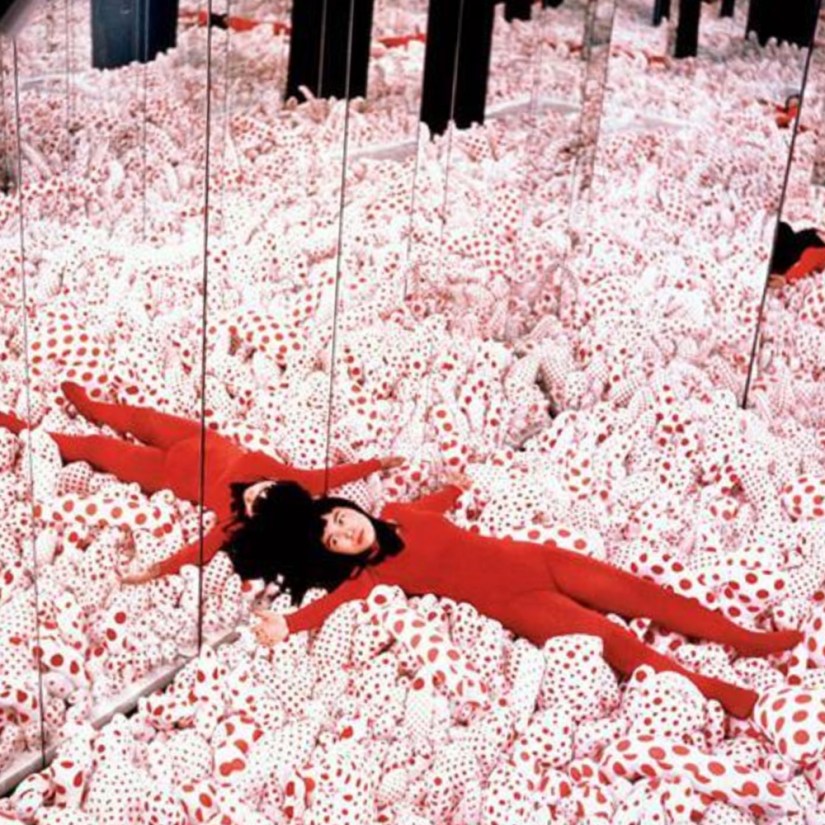
A defining characteristic of an art installation is its inherent spatiality and site-specific responsiveness. For BFA students majoring in Sculpture and Installation, this concept is frequently, at first, a difficult one to comprehend. The vast amount of studio studies centre around creating art (2D and 3D) that people look at. Then suddenly, art students are asked to create spacial experiences with which guests are to interact. Could this substantial perceptual leap be the reason why so very few professional installation artists, like Kingston’s Portia “Po” Chapman, exist? Let’s dig a little deeper.
As art historian Claire Bishop notes, installation art presupposes a viewer who physically enters the spatial envelope of the work, shifting the encounter from a visual inspection of an exterior object to an embodied sensation of being “inside” a curated environment (Bishop 10). Within this framework, space is not merely an empty backdrop or container; space becomes an active, expressive medium. The distance between structural elements, the height of the room’s ceiling, the acoustic reverberation, the intensity and colour of light, and the natural directional flow of human foot traffic are engineered intentionally as primary compositional variables (de Oliveira et al. 14).
Furthermore, installation art operates across a spectrum of interactivity and immersion, ranging from passive spatial framing to active sensory and participatory engagement. In passive installations, such as light-and-space environments, the viewer’s movement through ambient shifts recallibrates their neurological and perceptual awareness (Rosenthal 45). In active or participatory installations, the viewer’s deliberate physical choices, flipping switches, negotiating physical pathways, generating sound, or interacting with structural components, directly alter the physical configuration or narrative output of the space. As photography artist Olivo Barbieri observed, installation practice offers a framework to conceptualize environment as an alterable, temporary state, treating room and reality as “unreal and unfinished” ground open to dynamic transformation.
What is the Core Distinction between Sculpture & Art Installation?
To clarify the persistent confusion between a displayed sculpture and an art installation, one must examine how each structural form frames its boundaries, relates to its surrounding architecture, and positions the human spectator.
| Theoretical Dimension | Displayed Sculpture | Art Installation |
|---|---|---|
| Boundary & Autonomy | Self-Contained Object: Closed physical footprint; retains core identity when relocated. | Spatial System: Open, environmental footprint; bound to structural and architectural surroundings. |
| Architectural Relationship | Occupies Space: Sits within a room; treats architecture as a neutral container or backdrop. | Transforms Space: Alters, redefines, or frames the room itself; space acts as a primary material. |
| Viewer Positioning | External Observer: Viewer stands outside, inspecting formal qualities from a distance. | Inhabitant / Participant: Viewer enters, navigates, and completes the work through physical presence. |
| Site Sensitivity | Autonomous / Portable: Meaning relies primarily on internal form and medium. | Site-Specific / Site-Responsive: Meaning is tied to the physical, social, or spatial context of the site. |
1. Objecthood vs. Environmental Enclosure
The fundamental divergence between a sculpture and an installation lies in the boundary of objecthood. A traditional sculpture, whether a carved marble figure, a welded steel abstraction, or a ceramic vessel, functions as an autonomous, self-contained object. Its aesthetic integrity and formal logic exist within its own physical borders. When a sculpture is placed inside a gallery, it occupies space, but it remains fundamentally distinct from the room surrounding it (Suderburg 52). If the sculpture is picked up and moved to another gallery, another building, or an outdoor plaza, the physical object remains intact, retaining its core identity even as its visual context shifts.
An art installation, by contrast, rejects objecthood in favour of systemhood and spatial enclosure. An installation does not merely sit within a room; it becomes or overhauls the room. As artist Mark Jenkins emphasized, interfacing structural interventions within an environment “turns regular space into art space,” causing surrounding walls, fixtures, pathways, and bystanders to merge into a single, interconnected visual entity. If an installation’s constituent physical objects are dismantled and relocated without accounting for the structural dimensions, lighting, and entry thresholds of the new location, the installation has not simply been moved, it has been destroyed or fundamentally rewritten (Kwon 38).
2. The Pedestal Effect vs. Architectural Integration
The historic mechanism for distinguishing sculpture from its surroundings has been the pedestal, plinth, or framing base. The pedestal serves a key conceptual function: it establishes a physical boundary that separates the viewer’s floor plane from the artwork’s elevated, aesthetic plane (O’Doherty 18). Even when modern and contemporary sculptors remove the pedestal to place a three-dimensional form directly on the floor, the object frequently maintains an invisible perimeter around itself, inviting the viewer to walk around it as an external observer.
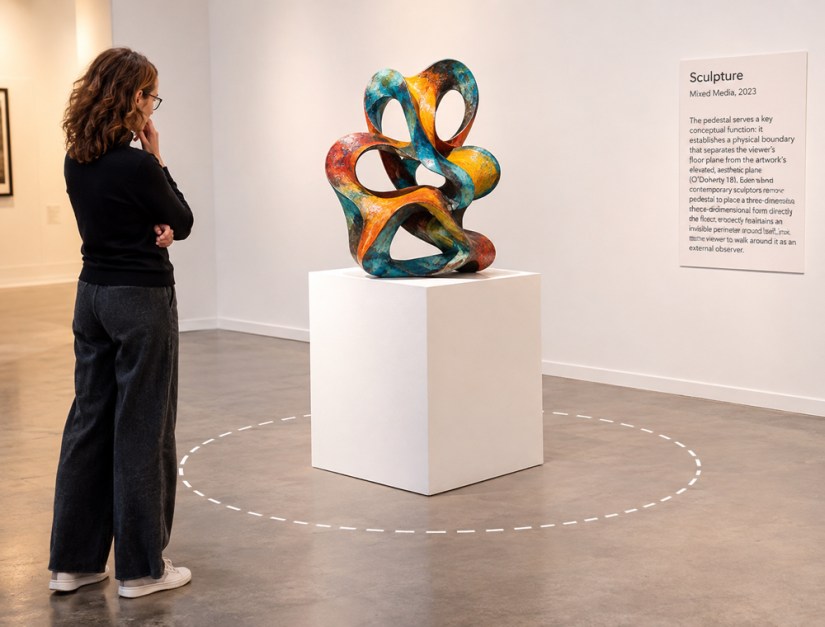
Source GPT Created Image
Installation art systematically dismantles the pedestal effect. It integrates directly with the architectural fabric of the room, utilizing floorboards, ceiling joists, load-bearing columns, entry doorways, and window light as intrinsic components of the composition (Buren 53). Rather than directing the spectator to admire a carved or fabricated form from a respectful distance, an installation uses architectural layout to direct bodily movement, dictating where a visitor can step, where they must bend or pause, and how their sightlines shift as they navigate the site.
3. Phenomenological Spectator Relationship: Looking At vs. Inhabiting
The operational distinction between the two forms is rooted in phenomenology, the study of structures of consciousness as experienced from the first-person point of view (Merleau-Ponty 78). When observing a displayed sculpture, the phenomenological relationship is primarily external and visual. The spectator stands outside the artwork’s perimeter, looking at a form. The viewer’s body acts as a static point of observation, scanning the sculpture’s volume, texture, surface finish, and contours.
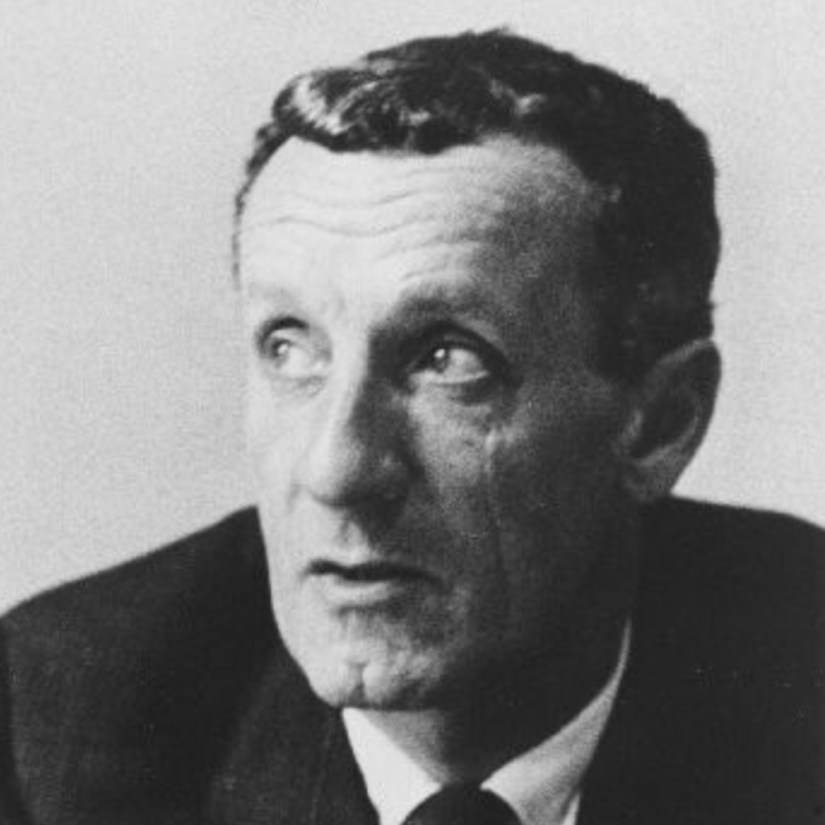
In an art installation, the spectator’s body is brought directly into the spatial equation. Drawing on Maurice Merleau-Ponty’s insight that perception is grounded in embodied physical movement, installation art requires the spectator’s physical traversal to unlock its meaning (Merleau-Ponty 102). The viewer is no longer a passive spectator observing an object from the outside; they become an inhabitant within the artwork. The work unfolds chronologically over time as the viewer walks through doorways, turns corners, senses ambient temperature shifts, hears spatialized sound, or physically touches interactive elements. The presence, weight, and movement of the human body complete the artwork. Without a physical inhabitant navigating its pathways, an installation remains an unactivated architectural shell.
Case Study: Portia “Po” Chapman’s Being Seen: when Being Seen… we glow (2026) and the Glow Chamber as Site-Specific Architecture
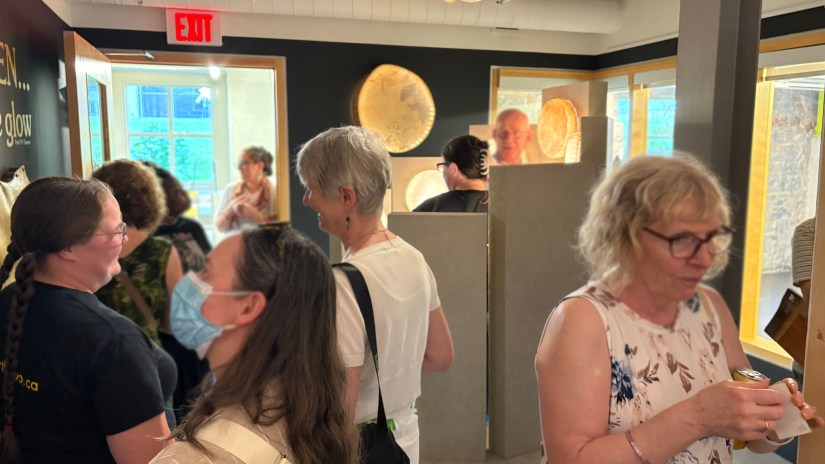
To examine how installation theory operates outside of pure abstraction, one must analyze site-specific installation architecture in practice. A definitive model of this spatial transmutation is Chapman’s solo exhibition Being Seen: when Being Seen… we glow (installed at the Kingston Arts Council Pocket Gallery in Room 115 of the Tett Centre for Creativity & Learning). Rather than utilizing the room as a neutral backdrop for discrete objects, the installation transformed an intimate, constrained physical room into an activated, immersive environment where spatial movement, structural materiality, and human presence formed an indivisible ecosystem.
1. Radical Site-Responsiveness and Spatial Adaptation
A core tenet of site-specific installation theory, as articulated by Kwon and Reiss, is that a site-specific artwork cannot be disconnected from its physical, architectural, and contextual framework without altering its fundamental meaning. Being Seen exemplified this principle through its direct negotiation with the spatial realities of Room 115.
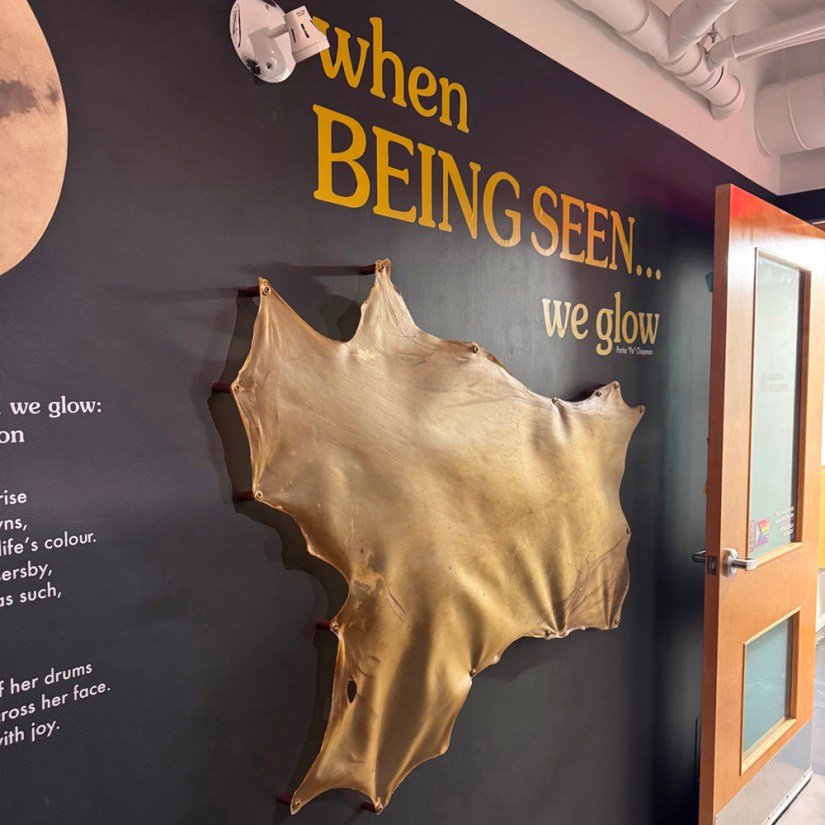
Site-specificity demands that structural plans adapt to the physical constraints of the gallery envelope. In Being Seen, every compositional vector was engineered to direct human movement within a specific architectural footprint. When initial spatial evaluations revealed that mounting an expansive, heavy bison rawhide canvas would overwhelm the physical scale of the gallery wall, the concept pivoted to a deer rawhide element. This was not a compromise of artistic vision, but an essential act of site-responsive design: allowing the physical capacity and proportion of the room to actively dictate the scale, weight, and material choice of the installation.
2. The Glow Chamber: Dismantling the Object-Pedestal Dichotomy
The central interactive component of the installation, the Glow Chamber, serves as an exemplary physical model of how installation art dismantles traditional sculptural objecthood. In a standard exhibition, a stone sculpture or illuminated object would sit atop a wooden pedestal, establishing an invisible boundary that instructs the viewer to remain at a distance.
The Glow Chamber rejected this boundary entirely. Built upon a heavy stone-hybrid base that anchored the lower spatial plane of the gallery, the structure merged raw architectural foundation with interior illumination and suspended organic forms. The chamber did not act as a sculpture on display; it functioned as a micro-architectural environment.
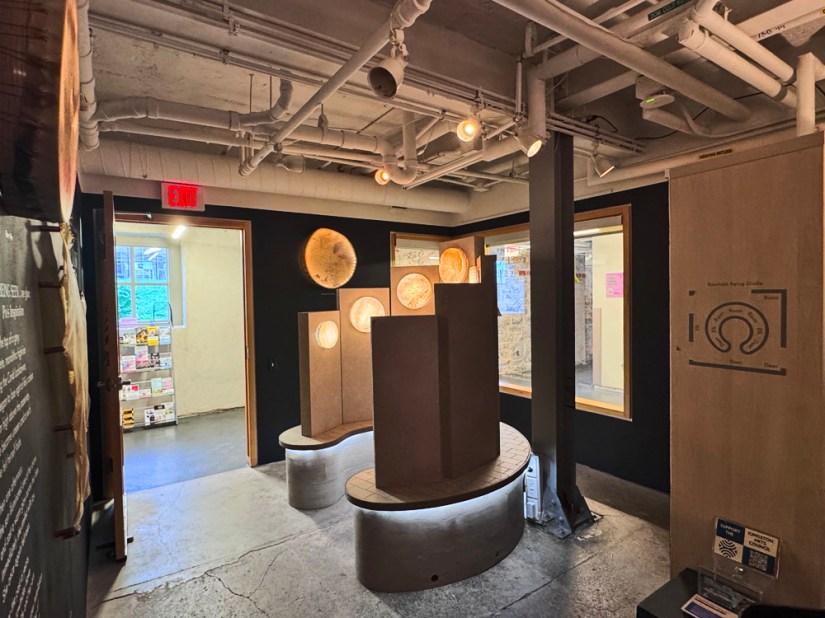
By housing illuminated rawhide vessels directly within and above the structural base, the Glow Chamber activated key architectural variables:
- Light as Material: Light was not shone onto an object from gallery tracks above; instead, light emitted from within the translucent rawhide membranes, using subsurface scattering to project warmth directly into the surrounding room. Light became a volumetric, physical presence filling the gallery air.
- Spatial Framing: The physical height, depth, and orientation of the chamber dictated where visitors could stand, forcing them to adjust their physical posture and step directly into the warm aura of the structural base.
3. Phenomenological Reciprocity and the Participant-Inhabitant
The defining distinction between a sculpture and an installation is the shift from looking at an artifact to inhabiting an environment. In Being Seen, the gallery was engineered as an active feedback loop where lighting temperature, spatial pacing, and structural text orchestrated human movement through subconscious, passive cues.
As visitors crossed the threshold into Room 115, their physical bodies immediately completed the compositional circuit. Deep blue light cast across the floor plane actively drew the eye upward, pulling sightlines directly toward the golden, subsurface glow of the rawhide vessels. Mounted against the black gallery walls, glowing backlit drums functioned as structural beacons, guiding foot traffic along a deliberate path around the exterior of the Glow Chamber.
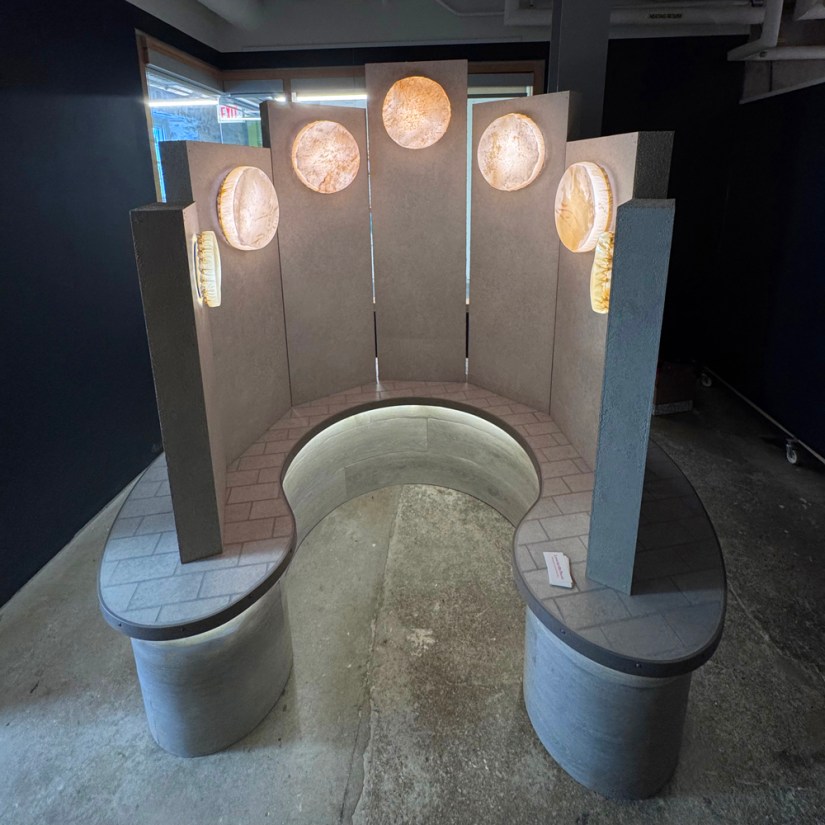
This directional movement intentionally exposed visitors to a stark spatial contrast at the rear of the chamber. There, the pathway narrowed into an uncomfortable spatial squeeze illuminated by the cool, artificial fluorescent glare bleeding through the window from the Tett Centre hallway. In this uninviting light, visitors encountered the subdued greyness of a sign reading “when being unseen… we fade.”
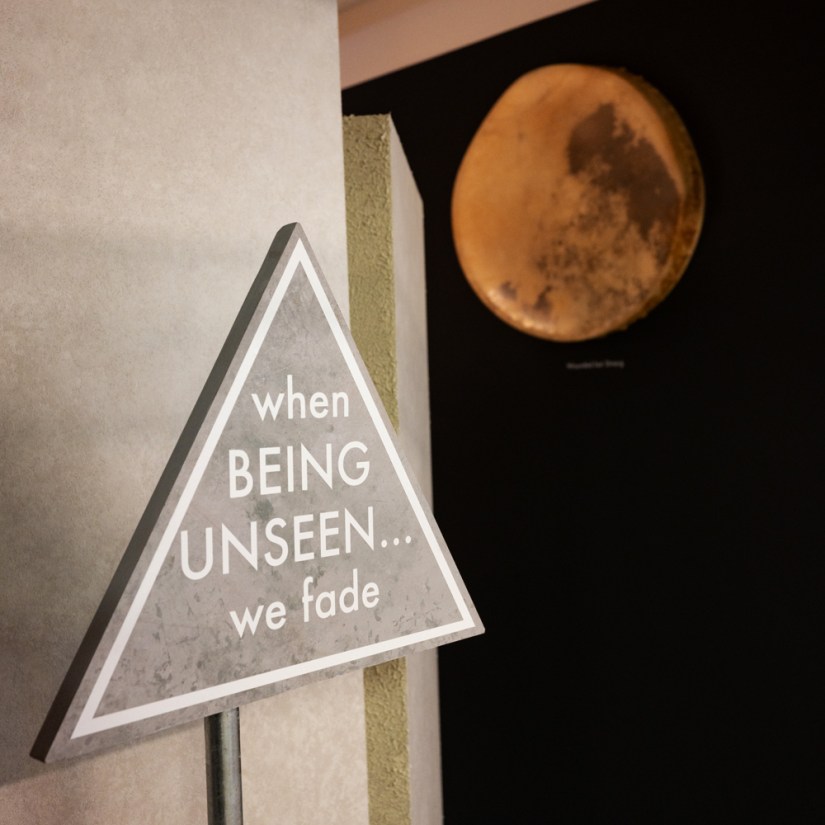
Faced with this unfavourable atmospheric shift and restrictive footprint, visitors naturally recoiled, making a spontaneous U-turn back toward the warmth of the golden light, the interactive community photo-sharing board, and the didactic museography.
Through this intentional choreography of light, colour temperature, and architectural compression, the installation passively steered visitor trajectories without requiring signposts or explicit instructions. Viewers were guided through subtle environmental cues, never consciously registering that their navigation through the space was a primary structural variable of the artwork itself.
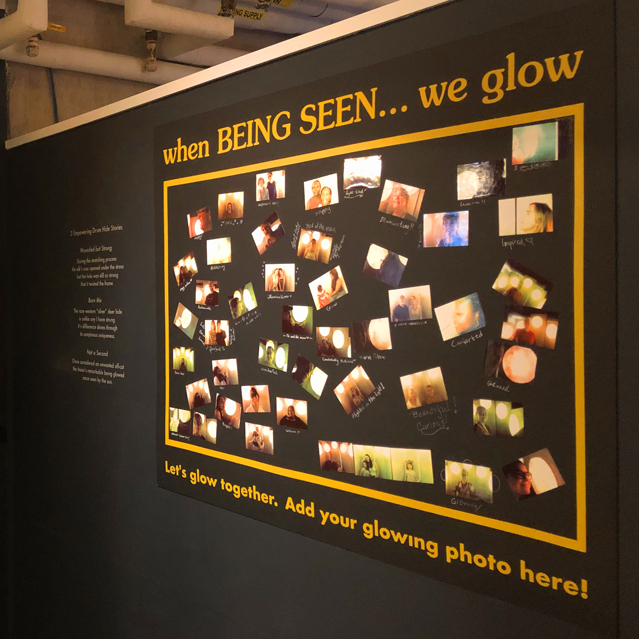
At the photo-sharing board, spectator passivity dissolved entirely. Viewers did not merely experience the site; they contributed physical, visual artifacts to its growing surface. The artwork was not a static, completed monument brought into a room; it was an evolving, living environment activated by community participation. By uniting structural stone-hybrid engineering, light-transmitting rawhide vessels, site-responsive spatial layout, and active spectator engagement, Being Seen and its Glow Chamber demonstrated the absolute threshold of installation art: the physical room, the structural elements, and the human presence merged into a single, unified, and unrepeatable spatial experience.
Conclusion
While sculpture and installation art both inhabit three-dimensional reality, they represent fundamentally distinct ways of framing artistic experience. Sculpture produces autonomous objects designed to be observed from an exterior standpoint. Installation art engineers unified, site-responsive environments designed to be inhabited, navigated, and completed by the physical presence of the viewer. By transforming space into material, and movement into composition, installation art dissolves the boundary between the viewer and the work, converting the act of looking into an active, embodied experience of spatial reality.
Academic References
Bishop, Claire. Installation Art: A Critical History. Tate Publishing, 2005.
Buren, Daniel. “Function of the Studio.” October, vol. 10, 1979, pp. 51–58. JSTOR, https://doi.org/10.2307/778628.
de Oliveira, Nicolas, Nicola Oxley, and Michael Petry. Installation Art in the New Millennium: The Empire of the Senses. Thames & Hudson, 2003.
Kwon, Miwon. One Place after Another: Site-Specific Art and Locational Identity. MIT Press, 2002.
Merleau-Ponty, Maurice. Phenomenology of Perception. Translated by Colin Smith, Routledge & Kegan Paul, 1962.
O’Doherty, Brian. Inside the White Cube: The Ideology of the Gallery Space. Lapis Press, 1986.
Reiss, Julie H. From Margin to Center: The Spaces of Installation Art. MIT Press, 1999.
Rosenthal, Mark. Understanding Installation Art: From Duchamp to Holzer. Prestel Publishing, 2003.
Smithson, Robert. “Cultural Confinement.” Artforum, vol. 11, no. 2, 1972, pp. 39–41.
Suderburg, Erika, editor. Space, Site, Intervention: Situating Installation Art. University of Minnesota Press, 2000.
About the Artist
Portia “Po” Chapman is a Kingston-based contemporary multidisciplinary visual artist, muralist, and certified educator (BFAH, B.Ed, OCT) celebrated for her rigorous, site-specific installations that bridge architectural psychology with intimate material craftsmanship. Awarded the Queen’s University Medal in Visual Art, Chapman combines university-honed discipline in sculpture and installation with specialized expertise in structural woodworking, bespoke rawhide manipulation, and optical material transmutation.
Her acclaimed solo exhibition, Being Seen: when Being Seen… we glow, introduced the groundbreaking Glow Chamber, an architectural intervention that confronts urban alienation by pairing brutalist grey monoliths with translucent, backlit biological rawhide vessels. Through the optical metamorphosis of subsurface scattering, implicit somatic memory, and eye-level relational attunement, Chapman’s work transforms gallery spaces into sanctuaries of restored human presence and shared visibility.
Discover her public murals, gallery exhibitions, and studio practice at loveartbypo.ca.
Contact Po Using Form Below

Portia “Po” Chapman, Kingston Artist
Serving Kingston, Ontario & Across Canada
Contact Po
Email: Portia@LoveArtByPo.ca
Instagram:
Love Art by Po
Facebook:
Love Art by Po Profile
Location
Private Art Studio:
Auden Park Kingston, ON
Google Business Profile:
Professional Listing


1 thought on “What is Installation Art? by Kingston Installation Artist Portia “Po” Chapman”