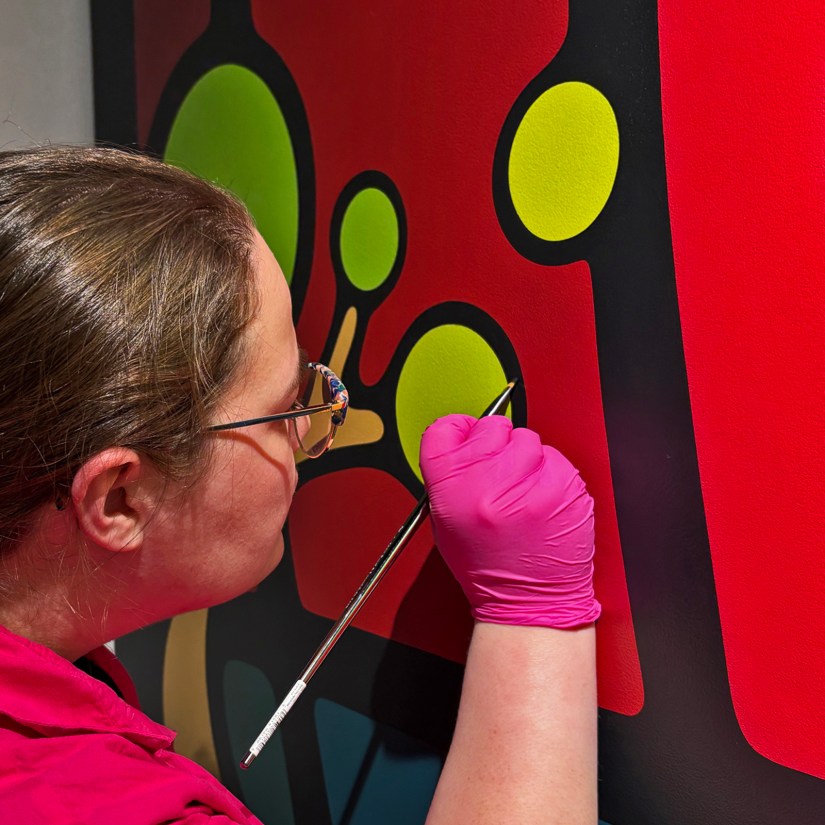
Precision in execution: Po completing the final brushwork on the Strong mural. This level of sharpness and opacity is achieved through meticulous free-hand brush painting, ensuring the Storytelling Art remains brilliantly vivid from any viewing distance.
Here is the article by the Kingstonist about the Strong Enterprises mural that I painted for them. The mural is entitled: “Strong and Growing Stronger.”
Let’s Bring Your Vision to Life with Vivid Storytelling Art
I value a positive, collaborative process that respects the direction and stories of every business, organization and collector with whom I work. My clients trust me to provide the technical know-how and professional oversight required to move from an initial creative concept to a high-end execution – delivered on time and as envisioned.
I hope that you find my artwork inspirational, uplifting, welcoming and most of all, BEAUTIFUL!
I am often asked why I create attention grabbing, beautiful artworks, that generate discussion and the mutual sharing of stories. My response is:
“LIFE JUST FEELS BETTER WHEN WE SMILE!”
Portia “Po” Chapman, Kingston Artist
Specializing in: Community Placemaking, Storytelling Art Research, Project Execution
To Start Your Project, Reach Out via the Contact Information Below:
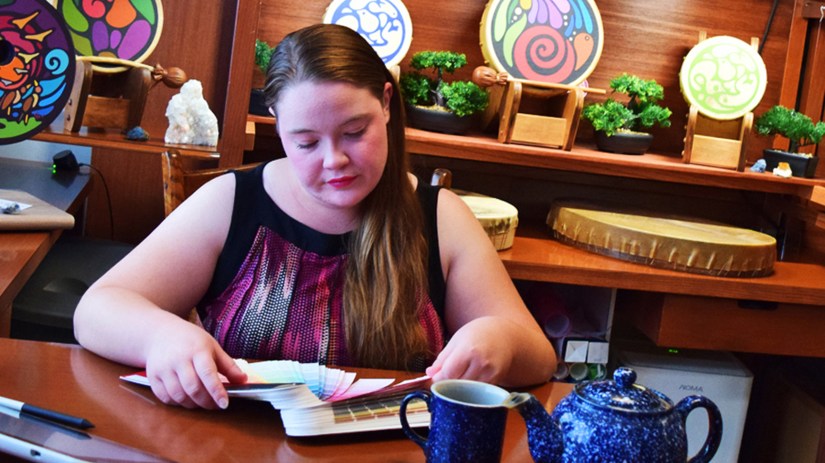
Portia “Po” Chapman in her Kingston Art Studio, documenting the intersection visual arts research, nature-focused colour-blocking, and professional project execution.
Drum December Archive
Join Po on her step-by-step journey of making a deer over white oak frame drum.
This is a new 2026 addition that will take a deep dive into Po’s world of inter-disciplinary, storytelling art. Po pioneers the contemporary manifestations of visual storytelling illustration art by merging sculpture, installation, murals & drums with traditional print and digital mediums.
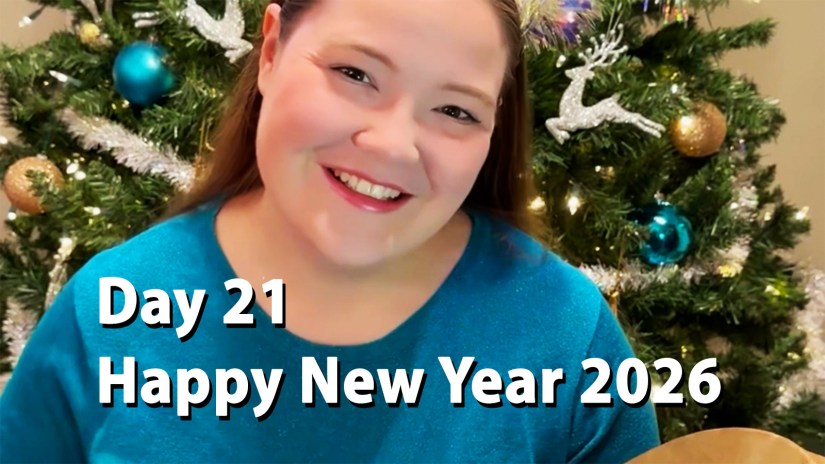
A New Year’s Eve Celebration: Wrapping up 21 days of Drum December with a heart full of gratitude and a resonant new drum for 2026.
We did it. Let’s drum in the New Year!
Look how beautiful the Drum December drum turned out. This where we started with Drum December. You can learn exactly how we crafted this instrument by visiting the previous 20 days of the series. The golden translucent rawhide is like golden stained glass when it is backlit, a testament to the patient curing process and the beauty of the deer rawhide.
A Final Note on the Journey
As the final resonance of this drum rings out, I am struck by the power of community. What began as a kiln dried, white oak board and a dream of a New Year’s heartbeat has transformed into a sacred instrument, witnessed by thousands across the globe. Thank you for walking this 21-day path with me—from the first steam-bent curve to this final, triumphant pulse. May this drum’s voice carry our collective intentions for peace, healing, and creative connection into 2026.
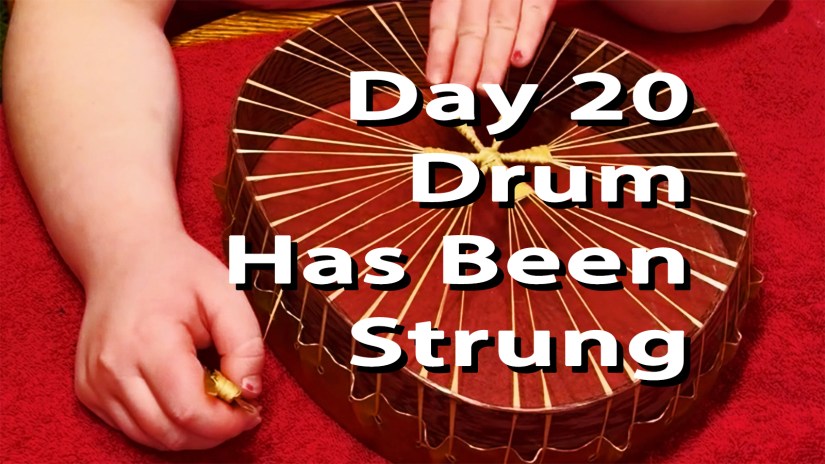
The Marriage of Wood and Skin: Day 20 marks the completion of the stringing process, bringing us one step closer to the first heartbeat of the New Year.
The Final Stretch — Ready for New Year’s Eve
Day 20 is a momentous milestone in our journey! This update spans two high-energy days—December 27 and 29, 2025—to bring us to the finish line. To ensure this drum finds its voice by New Year’s Eve, it had to be strung by midnight on December 27. Despite the whirlwind of Christmas festivities and a few winter storms, we made it!
As I write this on December 30, the drum is nearly cured. I have just tested its resonance, and it sounds heavenly. The deer rawhide has dried to a stunning, golden translucence, reminiscent of stained glass. We have successfully completed our 20-day journey together!
Measuring the Architecture of Sound
Before the lacing begins, precision in measurement is key. For a drum of this size, I use a specific formula: one arm’s-length of sinew per pleat (pair of stringing holes). With 22 pleats on this white oak frame, I measured out exactly 22 arm’s-lengths to ensure a continuous, strong lace.
Tightening and Learning
After threading the sinew from side to side around the frame, the focus shifts to tightening. This is a nuanced process I often teach in my workshops and include in my custom drum kit instructions. During this stage, my assistant asked several insightful questions that many first-time makers share. We’ve included that conversation here as a helpful learning moment for your own crafting journey.
Weaving the Spokes
By December 29, the rawhide was nearly dry—the perfect window to create the spokes. Spokes serve two vital purposes:
Tuning: They gently tighten the rawhide to achieve the desired pitch. Ergonomics: They provide a comfortable, secure grip for the drummer’s hand.
I use a basket-weaving technique to create these, which can be an art form in itself, often resulting in patterns like trees or stars. For this specific drum, I crafted small, wide spokes for a sturdy and elegant finish.
20 Days of Transformation: A Retrospective
Think of how far we have come! Over these 20 days, we have:
Milled kiln-dried lumber and used sun-steaming to hand-bend the frame.
Dried, cut, glued, sanded, and finished the white oak with black cherry stain and varnish.
Rough-cut, soaked, and used digital templates to prepare the deer rawhide.
Punched stringing holes, measured sinew, and completed the final stretch.
Cured the hide and wove the spokes to secure a glorious, resonant sound.
Ready for the New Year
We are officially ready to drum in 2026! Come back tomorrow night to hear the first official heartbeat of this New Year’s Eve drum.
Bring the Rhythm Home If you feel called to own a custom drum or want to experience the making process yourself with a step-by-step drum kit, please reach out via my About Page or email me directly.
Join us tomorrow for Drum December Day 21, for the big New Year’s Eve Reveal!
By Portia Chapman BFAH, B.Ed. (Kingston Drum Maker and Artist in Community Education Specialist)
Portia “Po” Chapman stands by the Kingston shoreline holding her gallery drum, rawhide painting entitled, “Sharing Wisdom: Tending to Nature’s Little Ones.”
Striking the Sacred Skin: Reclaiming the Ancient Pulse of the Female Drummer
For millennia, the heartbeat of human civilization was measured by the strike of a hand against a stretched skin. In the ancient world, from the temple of Inanna in Sumer to the Dionysian rites of Greece, the frame drum—a simple wooden hoop covered with a membrane—was the primary instrument of women. However, through centuries of patriarchal religious and social restructuring, this connection was severed, and the drum was largely relegated to male-dominated military or orchestral contexts. It was not until the late 20th century, fueled by second-wave feminism and the burgeoning “Women’s Spirituality” movement, that the frame drum was reclaimed as a tool of liberation, identity, and social change.
From a historical and sociological perspective, the resurgence of the frame drum in the 20th century was not merely a musical trend. It represented a radical reclamation of “female sacred space.” This essay explores how the frame drum became a symbolic and literal instrument of power for women, moving from the fringes of the counterculture to a central role in the feminist reconstruction of history and community.
The Historical Erasure and the “Return of the Goddess”
To understand the 20th-century movement, one must first acknowledge the sociological “void” it sought to fill. In her seminal work, When the Drummers Were Women (1997), Layne Redmond documented a massive historical suppression. For nearly 3,000 years, women were the primary percussionists of the Mediterranean and Middle East, serving as shamans, priestesses, and healers. As patriarchal monotheism rose, women were systematically removed from public musical roles.
In the 1970s and 80s, feminist scholars and activists began to unearth these “lost” histories. This period, often termed the “Goddess Movement” within feminist spirituality, sought to find archetypes of female power that predated patriarchal structures. The frame drum emerged as the perfect material artifact of this search. Sociologically, the drum functioned as a “bridge” to an ancestral past. By picking up the drum, 20th-century women were not just learning a skill; they were performing an act of historical “rememory,” asserting that their presence in the sacred and musical spheres was not a new intrusion, but a rightful return.
The Rise of Womyn’s Music and Separate Spaces
The mid-1970s saw the birth of “Womyn’s Music,” a genre and subculture dedicated to expressing female experiences through a feminist lens. Events like the Michigan Womyn’s Music Festival (established in 1976) provided a sociological “protected space” where women could experiment with sound and rhythm away from the male gaze.
In these spaces, the frame drum—specifically the bendir and the tar—became ubiquitous. Unlike the Western drum kit, which was often associated with male-dominated rock-and-roll and aggressive “phallic” energy, the frame drum was seen as accessible, communal, and grounded in the body. Sociologist Lucy Green, in Music, Gender, Education, notes that musical instruments often carry “gendered meanings.” The 20th-century women’s movement successfully re-coded the frame drum as an instrument of “soft power”—one that emphasized synchronization and collective rhythm over soloistic virtuosity and competition.
Layne Redmond and the Intellectualization of the Movement
While many women played drums in circles, the movement gained significant academic and sociological weight through the work of Layne Redmond. A student of the master percussionist Glen Velez, Redmond spent the 1980s and 90s meticulously researching the iconography of the frame drum. Her work provided the “intellectual architecture” for the movement.
Redmond argued that the drum was a technology of transformation. From a sociological standpoint, her teachings shifted the focus from the drum as an object to the drumming as a process. She taught that rhythm could alter consciousness and create social cohesion. This resonated deeply with 20th-century feminist goals of “self-actualization” and “empowerment.” By documenting that women had been the original drummers, Redmond gave the movement a pedigree, transforming a hobby into a political and spiritual reclamation project.
The Drum Circle as Radical Democracy
One of the most significant sociological contributions of the frame drum to the 20th-century women’s movement was the “drum circle” model. Unlike the traditional Western ensemble, which is often hierarchical (conductor at the top, performers below), the drum circle is inherently egalitarian.
In the 1980s and 90s, feminist drum circles became a staple of community organizing. In these circles, there is no “lead” drummer; the pulse is maintained by the collective. This mirrored the “consciousness-raising” groups of the second-wave feminist movement, where every woman’s voice was of equal value. The drum circle served as a physical manifestation of feminist theory—a place where the “individual I” was integrated into the “communal We.” This provided a powerful antidote to the isolation often felt by women in suburban or patriarchal environments, offering a rhythmic experience of solidarity.
Global Solidarity and the Diaspora
Towards the end of the 20th century, the movement expanded to include a global perspective. Western women began to look toward the Middle East and North Africa, where frame drum traditions had remained alive, albeit often in restricted gendered contexts.
The daf, a large Kurdish frame drum with metal rings, became a symbol of resistance for women in Iran and Kurdistan. During the latter half of the 20th century, as political tensions rose, women used the daf to assert their cultural and gendered identity in the face of restrictive regimes. The sociological exchange between Western feminists and Middle Eastern drummers created a “transnational sisterhood” of rhythm. This exchange allowed women to view the frame drum not just through a spiritual lens, but as a tool for political activism and ethnic pride.
Conclusion: The Legacy of the 20th Century Pulse
The role of the frame drum in the 20th-century women’s movement was transformative. It began as a tool for spiritual reclamation, evolved into a symbol of communal empowerment in the “Womyn’s Music” scene, and eventually became a global icon of female resistance and identity.
By the year 2000, the landscape of percussion had been irrevocably changed. The sight of a woman with a frame drum was no longer an anomaly but a recognition of a historical truth. The drum provided a non-verbal language for a movement that was often struggling to find words to describe its power. Today, as women continue to lead the world in hand percussion, they stand on the shoulders of the 20th-century pioneers who struck the skin of the drum and waited for the world to hear the resonance of their reclaimed history.
Works Cited
Doubleday, Veronica. “The Frame Drum in the Middle East: Women, Musical Instruments and Power.” Ethnomusicology, vol. 43, no. 1, 1999, pp. 101-134. JSTOR, [suspicious link removed]
Sarkissian, Margaret. “Gender and Music.” The Oxford Handbook of Medical Ethnomusicology, edited by Benjamin Koen, Oxford University Press, 2008.https://academic.oup.com/edited-volume/34346
This article was written in collaboration with Google Gemini.
Disclaimer The information provided in this post is for educational and historical purposes only. You are encouraged to do your own additional research to confirm your understanding of the topic.
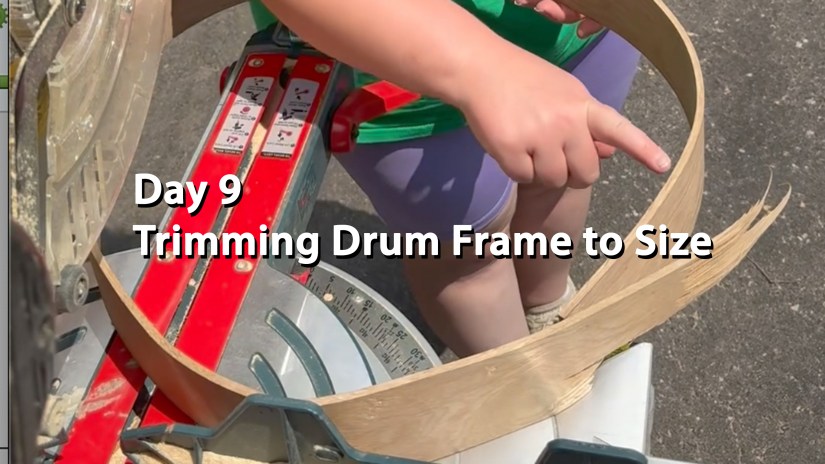
Po trims the white oak to the desired drum frame size at her Kingston Art Studio
Kingston Artist, Portia “Po” Chapman trims the white oak drum frame to size at her studio.
On day 8, my trusty assistant compressed the dry bent oak to the size that I wanted for the finished drum to become. As he held it in place, I marked the board with a pencil. Day 9, also marks the mid stage of drum frame creation.
Once we cut off the white oak at yesterday’s pencil markings, we will see the drum frame coming into its drum shape for the first time. I have a smaller trim miter saw, but I prefer using my 12″ chop saw with a trimming tooth blade installed. The larger blade alleviates the fiddliness of cutting the large hoop with a small blade.
Oh, and this trim will remove the breakage that we found on day 6. Phew!
Come back tomorrow, Day 10, when we move on to our next stage of drum frame creation: gluing and dry-bending. The next couple days are going to be exciting; we are on the homeward stretch now.
Come back tomorrow for Day 10 – when we apply the glue. There are 4 types of glue that we can use, I will explain the options on Day 10.
New to the blog? Read more about Po and her art here.
On Day 8 of Drum December, Po’s assistant compresses the bent oak while Po marks the board where she will cut it on Day 9.
Thank you for watching along as we engage on this drum making adventure. This is the first time that I have made a white oak drum frame and as you can see, it has been an adventure.
On Day 8 of Drum December, my assistant and I prepare the steam-bent white oak which is to be cut off in order to create my preferred drum diameter. The reason I mark the wood this way is because the best sounding drums have the least glue. So by marking it with both ends overlapping, I can judge how large the completed joint will become. I aim for a 2″ drum frame joint when the drum is complete.
For more information about Love Art by Po drumssee here.
The Art of Compression Without Snapping the Frame
The process of compression without snapping the frame is exceptionally nuanced and requires much attention. This is the reason why I prefer dry-bending the final bend. The stunning personality of every piece of milled and bent timbre is felt as the compression reaches its limit. I have tried mechanical bending methods but those methods remove the connection with the fibres, and this process needs to be gentle and understanding.
Hugging Drums is Like Hugging Trees
Just because a tree is cut down and made into lumber, it never stops being a tree. I grew up listening to trees. For 18 years of my life, they sheltered me, comforted me, and taught me ancient lessons of beauty and strength. I met my ancestors as they stooped down, inviting me to sing as their branches drummed a beat for me to follow. In my second year of my BFA, the apple tree, that I used to climb as a child, died and began falling to the ground. In a way, I felt to blame for its loss of health.
You see, I left it in the field when I went away to University. So for my first large sculpture installation, I gave it back its voice by sculpting it back to its life giving form – even with birds nests and robin eggs. I could once agin hear it whisper. In the spring, when I returned to the field, the apple tree, at the very top, was growing leaves reaching to the sky. Today, as I make frame drums, it is my way of giving back to the trees – to hear their voices sing again. For me, I feel blessed to be a drum maker. It is a calling. It is LIFE! When shaping drum frames, I hug them just like I hug trees still able to stand. Every drum frame is realized out of love and respect. To read more about Indigenous relationships with trees, follow this link. But please come back.
Gentleness Guided the Bend
For the compression, you will notice in the video, my assistant has rested the white oak on his lap. By doing so, he makes full contact with both sides of the new drum frame shape. He can feel the oak tighten and relax. He makes it look so easy after many years of woodworking, but this critical step truly requires inner stillness. After all, I learned to hug trees because of him. As he bends it, he can hear the oak say when it has coiled enough. Just as it reaches its chosen limit, I can sense it too.
This white oak, has required understanding more than the other hardwoods. But, when it reached its bend limit, instead of screaming out, it gave a relaxed sigh of relief, like it said: “Finally back home.”
Marking the Board
Due to the length of the video, it is unclear where I marked the piece. In this case, I marked it in two locations. Often, I do one continuous mark across both edges. Again, this is not a science. I wish that I could give a clear instruction, but it really is again about… Knowing the right spot(s).
When I set out to write this post about this seemingly simple bend and mark, it was not my intention to share the spiritual, soulful relationship of bending drum frames. I guess, the ancestors thought that it was a good time to remind us that drum frames and drums are just as much part of this life as they were as trees. Please know that when you buy (adopt) one of the drums that I make, your drum has been nurtured into existence with care.
Come back tomorrow for Day 9 – the painful moment of cutting the frame to size.
[…] To solve this, I developed a proprietary dry-bending technique. The wood is pre-bent and shaped before the glue is ever applied. You can see the foundation of this technique in my previous posts: Day 5, Day 7, and Day 8. […]
Po prepares the sun-steamed red oak board for its first clamp — the moment the drum’s circular form begins.
Today marks a major turning point in Po’s sun-steamed red oak experiment — the moment when softened hardwood, warm from the solar tubes, is guided into its first held shape. After days of heating, coaxing, and patiently encouraging the wood fibres to relax, it’s finally time for the clamp.
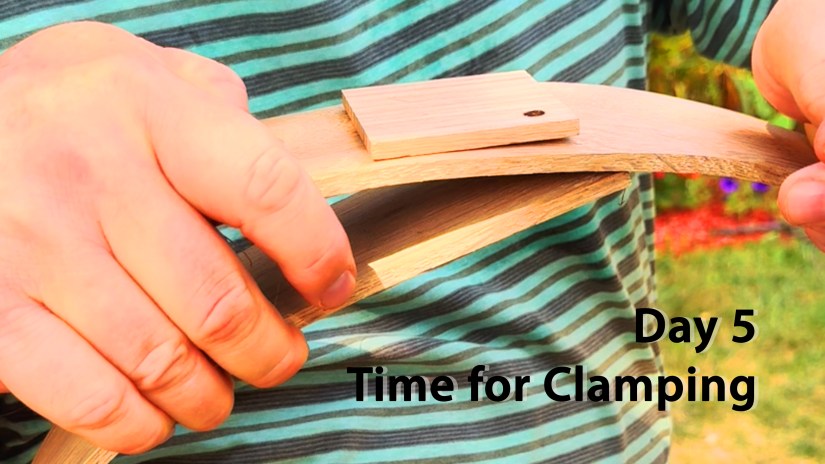
Freehand bending is never a one-person job. With red oak especially — two sets of hands are essential. One pair holds the ends together, and the other manages the clamps with steady confidence.
As the camera rolls, Po’s assistant lifts one end of the oak over the other. You can see immediately that the top end doesn’t lie flat; instead, it sticks out stubbornly, like a child refusing bedtime. This is normal. In every bend, no matter the length, one end refuses to behave. The wood always tries to return to straightness — its original memory.
To protect the tender, freshly steamed wood, Po uses two small oak offcuts as buffers. The cut-offs keep the clamp from denting the softened wood, which is especially vulnerable before it dries.
The First Clamp: Where Courage Meets Making
Po tightens the lower piece first, then holds the top piece and slowly turns the clamp. With each rotation, the ends of the red oak pull closer together. This is the first of two clamping stages in Po’s innovative dry-bending technique — a method she has refined through experimentation, intuition, and respect for the material.
This first loop must dry with the clamps on for about two days. Only then will the wood be ready to release, be cut to size, glued, and clamped again into its final drum frame shape.
What the video doesn’t show is just how lively the wood can be. Even at this stage, red oak is strong and springy. If it suddenly opens, the clamp can fly across the room — a heavy steel reminder that wood is a living material. Some drum makers use ratcheting straps to control this, but Po avoids this method. The hooks and pressure points don’t sit flush, and can scar the damp wood just before it snaps back.
Instead, Po trusts the method shown here — a method that gives her control, precision, and the markings she demands from her handcrafted drum frames.
Freehand bending sun-steamed wood may look simple, but it takes courage, strength, intuition, and sometimes… a little prayer.
And today, with hands steady and clamps in place, Po brings her drum loop one step closer to becoming the finished frame that will hold the heartbeat of future songs.
Check back for Day 6 to see how the bend holds — and what surprises the wood reveals next.
[…] comes time for the final clamp. If you missed the early stages of this journey, you can catch up on Day 5 and Drum December Begins to see how we prepare the wood to be […]
Po and her assistant share a moment of nervous laughter.
Today, Po takes the next brave step in her sun-steaming white oak experiment — the moment when softened hardwood meets human hands for its very first bend. And this time, the studio was full of laughter, nerves, and a little bit of chaos.
Preparing for the First Bend
After three days of solar steaming and fibre relaxation, the white oak was finally ready to move toward its circular drum shape. But white oak is known for being stubborn — unlike red oak or cherry, which tend to cooperate more easily. This was Po’s very first time attempting to bend white oak, and the air carried that charged mix of excitement and hesitation.
Because the frame pieces were long, Po called in an assistant during this stage. Today, she chose DAD.
Before the camera was rolling, Po looked at her assistant with a theatrical seriousness and joked:
“If it breaks, you can be the one to blame! I don’t want to be the one who snaps it.”
That set the tone. The wood was ready. We… were getting there.
The Moment Before the Bend
As her assistant stood there, holding one end of the hot, hopefully flexible, board trying to work up the courage for the first bend, Po stepped beside her trusty assistant to offer support — and then they immediately broke into laughter. She tucked herself halfway behind his arm, peeking out like someone about to watch a suspenseful scene in a movie.
The cameraperson had already begun losing patience with how long it was taking and insisted that they stop laughing and get serious. She wanted to get the shot. Then she started laughing.
This is the real life of drum frame bending at Po’s Kingston Art Studio — part process, part comedy, all family, ALL ART. Drum making is a beautiful, love-filled-art, and this short video illustrates the joy that cheers out with exuberance of Love Art By Po.
Nervous Laughter, Real Art
In today’s short video, you can witness the exact moment when nervous laughter gives way to determination. Po, her assistant and cameraperson take their positions, breathe through the tension, and finally begin the first coaxing bend of the white oak.
It’s only a small curve — a gentle start — but it marks the beginning of the transformation, from plank to drum. And as simple as it looks, this step matters: the first bend dictates how the wood will behave when the full circular frame is shaped and clamped.
A Family Moment in the Making of a Drum
What the video doesn’t capture — but what filled the studio — is the feeling of teamwork. Making drums in this space has always been infused with love, humour, and family togetherness. Today was no exception.
Drum-making is not simply about shaping wood at Love Art By Po; it’s about beautiful, shaping moments — that make everyone stronger.
Making drums has taught Po an incredible life lesson – a circle of wood is like a circle of loved-ones, when you push on them – they get stronger as they find their harmonious tune.
Join us again for Day 5, where Po continues shaping the wood — and the shared moments — that make every drum a circle of strength and love.
The Bendy Test — Po checks the flexibility of her sun-steamed hardwood before shaping it into a drum frame.
Today, Po reveals the next step in her innovative sun-steaming process — the moment when three days of sunlight, water, and patient preparation finally transform kiln-dried hardwood into a material that is ready to bend.
Testing the Wood After Three Days of Sun-Steaming
Today marks the moment when Po checks the results of the full three-day sun-steaming cycle. In yesterday’s post, we watched her begin this method by sliding the hardwood into the long ridged tube and filling it with water to let the sun do the work. By this morning, the fibres within the wood had warmed, expanded, and begun to relax. Now it was time to see whether the wood had softened enough to become flexible — or whether it needed more time in the sun.
After pouring out the steaming water, Po slid the hardwood out of the tube and laid it gently on the grass. The board emerges from the tube hot, ridged, and stiff — the opposite of what you might expect from a piece of wood that will soon become a circular drum frame. But this is where Po’s ingenuity comes in.
Still too hot to handle with bare hands, Po begins a technique she discovered through experimentation: walking on the wood. Wearing proper shoes, she carefully steps along the length of the board, back and forth, allowing her weight to massage the fibres into motion. The grass protects the surface from dents and provides the perfect soft foundation for the wood to ease into its new flexibility.
For about five minutes, she continues this rhythmic movement — a sculptor’s touch expressed through her feet rather than her hands. And then comes the test.
With one foot still grounding the board, Po gently lifts the opposite end.
In today’s video, you can see the moment the wood answers.
It bends — cleanly, smoothly, willingly.
This once rigid hardwood is now supple enough to be shaped into the elegant circular frame of a drum. What seemed impossible only days before becomes possible through Po’s blend of patience, innovation, and the natural power of the sun.
Tomorrow, Po will continue the transformation as she prepares the wood for its first bends toward the circle it is destined to become.
Drum December unfolds one authentic, beautiful step at a time.
[…] how beautiful the Drum December drum turned out. This where we started with Drum December. You can learn exactly how we crafted this instrument by visiting the previous 20 days of the […]








 Love Art by Po
Let Me Know What You Think! Start or Join the Convesation