Introduction
In contemporary gallery culture, visual art frequently operates within an economy of distance. Viewers are conditioned to adopt a posture of clinical detachment, gliding across polished concrete floors past pristine white-cube walls, absorbing visual information through an intellectualized lens. Yet, contemporary public life is haunted by a quieter, more pervasive crisis: a deep, structural sense of social invisibility. Across the post-pandemic landscape, modern individuals experience an acute dissociation from community, finding themselves surrounded by crowds yet profoundly unseen, unregistered, and emotionally unmoored.
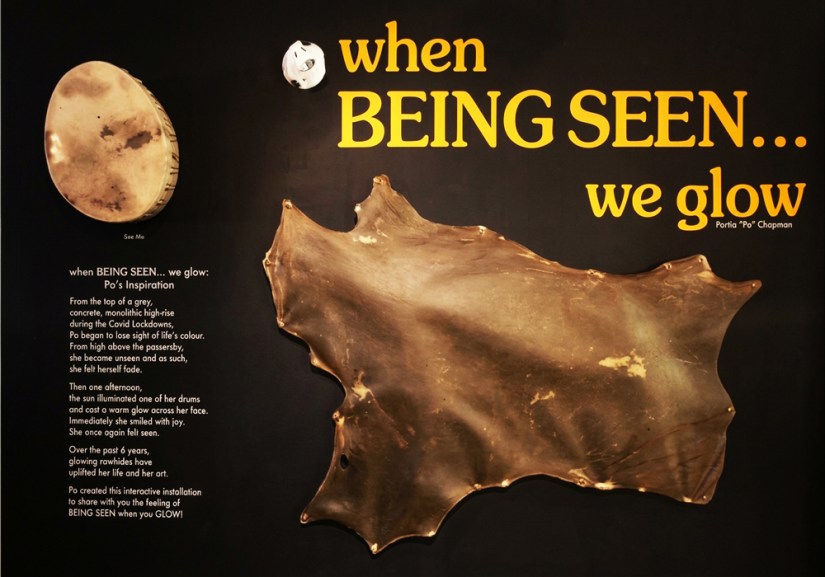
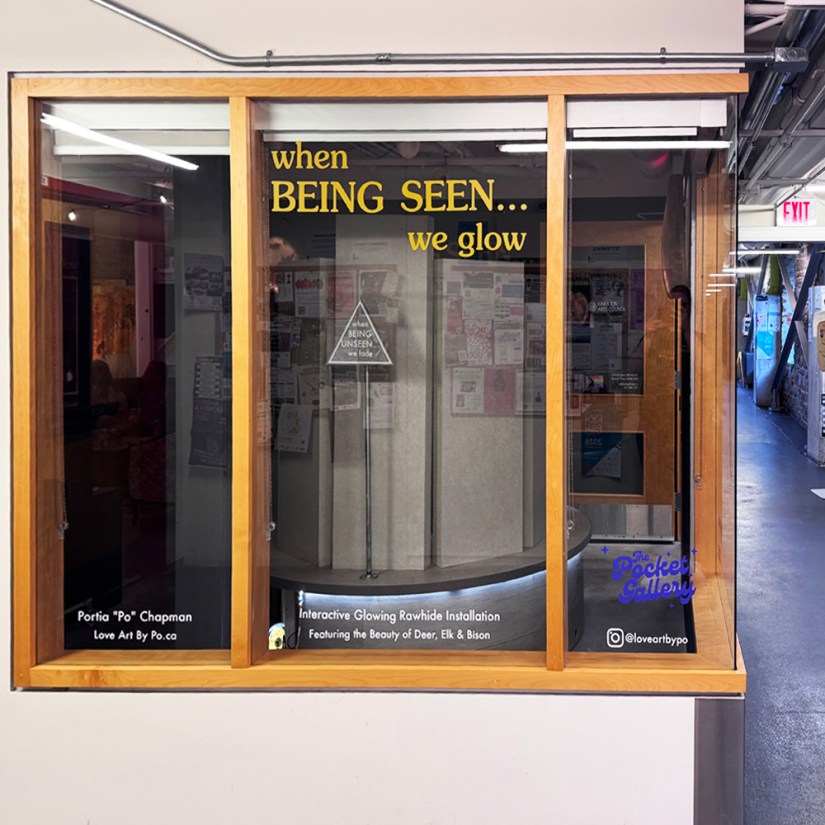
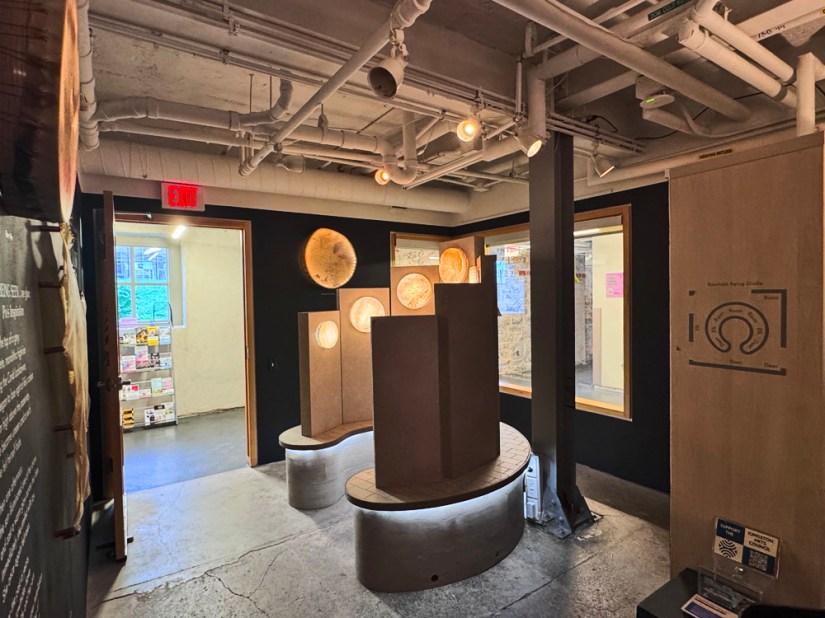
Chapman’s immersive solo exhibition, Being Seen: when Being Seen… we glow, presented at the Kingston Arts Council Pocket Gallery within Kingston’s Tett Centre for Creativity and Learning, was conceived as a direct counter-narrative to this quiet erosion of human presence. At the heart of this exhibition stood the Glow Chamber—an interactive, multi-sensory environment engineered by Chapman to bridge time-honoured artisanal craftsmanship with rigorous spatial psychology.
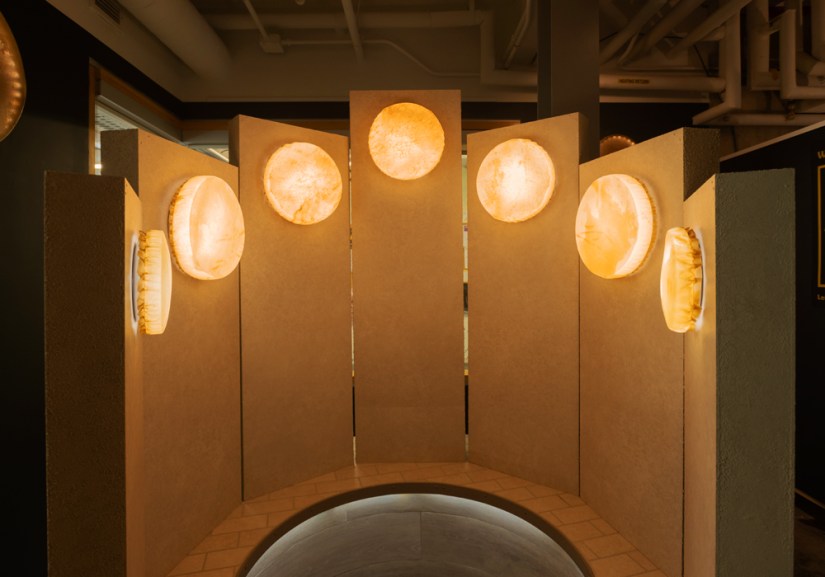
This article unpacks the theoretical, neurobiological, and material foundations of the Glow Chamber. By examining the tension between brutalist urban greyness and translucent biological rawhide, this study explores how environmental design, subsurface optical scattering, and eye-level relational symmetry can coax the human nervous system out of isolation and into a felt, embodied experience of safety, mutual recognition, and visibility.
The Silent Epidemic: Invisibility, Despair, and Post-Pandemic Isolation
To understand why an immersive art installation centred on visibility resonates so deeply with contemporary audiences, one must examine the psychological architecture of being unseen. Invisibility is not merely a metaphor for social neglect; it is a clinical trigger that registers in the human brain as a profound threat to survival.
Foundational psychological research, utilizing paradigms such as the “Cyberball” virtual-exclusion experiments, demonstrates that the immediate sting of social ostracism activates the dorsal anterior cingulate cortex, the neural region that processes physical pain (Hartgerink et al. 2015). When individuals are chronically ignored, overlooked, or treated as invisible, fundamental human needs for belonging, self-esteem, control, and meaningful existence are systematically starved. Over time, this unacknowledged alienation hardens into clinical despair, existential hopelessness, and affective numbness.
The COVID-19 pandemic and its subsequent lockdowns intensified this silent epidemic on a global scale. As rapid public health reviews indicate, the sudden evaporation of traditional support structures, such as schools, collaborative workplaces, peer networks, and public gathering spaces, forced millions of children, adults, and families into prolonged domestic isolation (Loades et al. 2020).
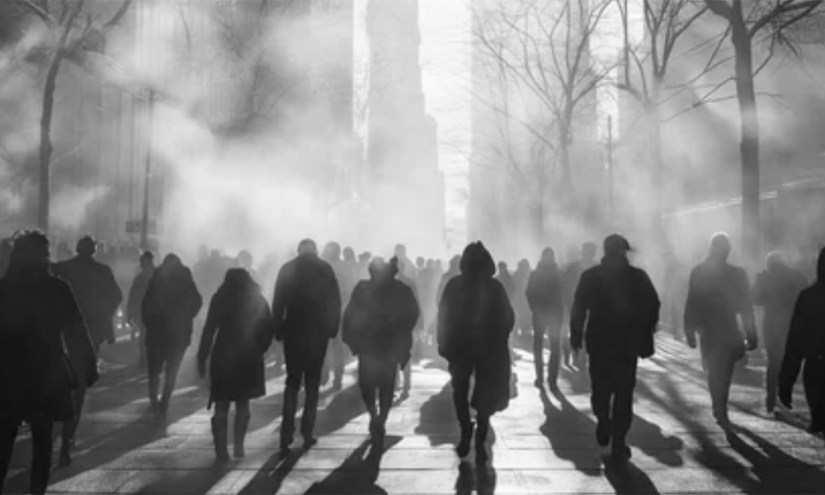
Long after physical restrictions were lifted, post-lockdown studies revealed a persistent residual psychological shadow: hyper-vigilance, emotional exhaustion, social withdrawal, and a deep-seated hesitation to re-establish relational trust (Murata et al. 2021).
People emerged from lockdowns carrying an unarticulated grief, the heavy realization that their absence went largely unnoticed by a society racing relentlessly toward economic and structural recovery. Within this cultural moment, the sensation of being unseen became a dominant baseline of modern existence, breeding an internal landscape of quiet desperation.
The Brutalist Mirror: Urban Greyness and Experiential Avoidance
The spatial design of the Glow Chamber deliberately confronted this modern condition by juxtaposing two opposing emotional and aesthetic poles: a cold, monumental field of brutalist urban greyness against a warm, luminous sanctuary of biological rawhide.
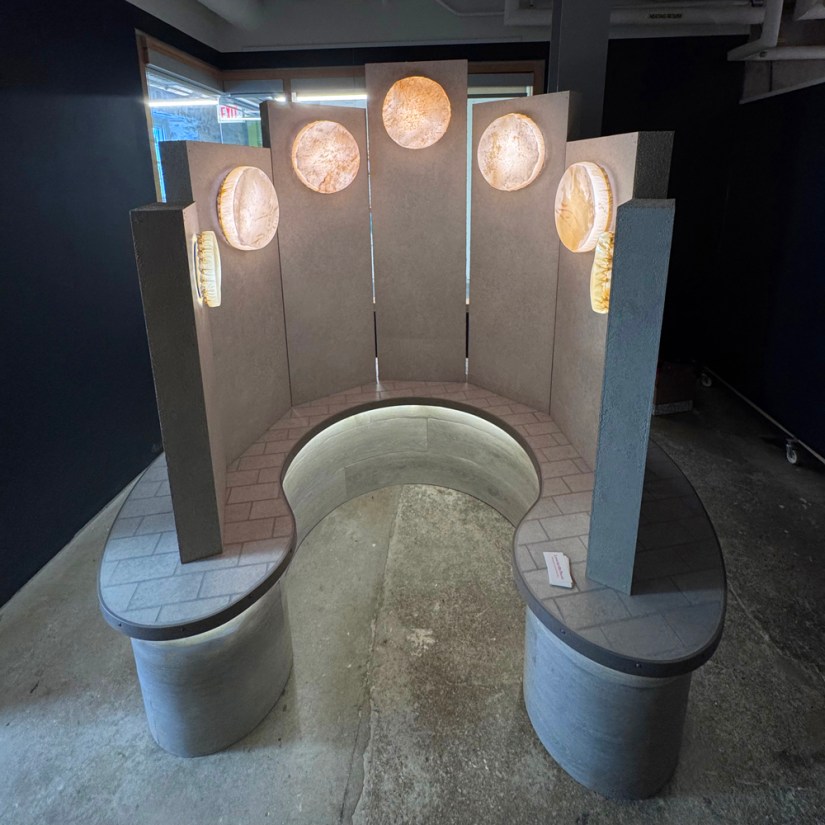
To construct this urban tension, Chapman intentionally engineered stone-hybrid grey monoliths paired with a grey tiled integrated plinth top, simulating the oppressive visual syntax of contemporary architecture. Walking through modern concrete canyons, from tall concrete building to tall concrete building, city dwellers are dwarfed by monumental scale.
Sociologist Georg Simmel, in his seminal analysis of metropolitan life, identified the “blasé attitude” as an essential emotional defence mechanism adopted by urbanites to protect themselves from sensory overstimulation and alienation (Simmel 2016). Because individuals cannot possibly process the overwhelming influx of strangers they encounter daily, they tune out. They rush to their destinations, keeping their minds industriously occupied to avoid confronting the profound isolation humming beneath the surface of urban crowds.
This psychological dynamic explains a striking observational phenomenon documented during the exhibition: the public’s active avoidance of the grey caution sign.
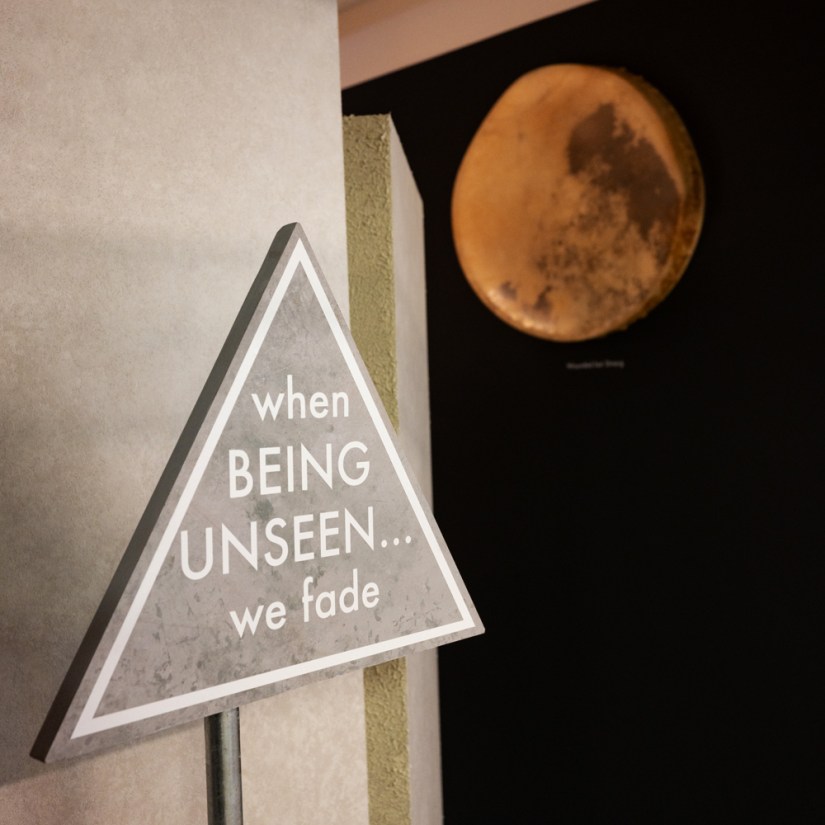
Positioned discreetly on the rear framework of the Glow Chamber, visible through the gallery glass, a grey warning, created by Chapman, read: “When being unseen… we fade.” Remarkably, almost nobody mentioned the grey caution sign. The few visitors who did acknowledge it expressed immediate discomfort, noting an active aversion to its cold, stark reality.
In clinical psychology, this behaviour is understood as experiential avoidance, the automatic human impulse to turn away from thoughts, visual stimuli, or emotional truths that provoke existential anxiety (Hayes et al. 1996). Confronting the proposition that invisibility leads to fading requires an emotional bandwidth that visitors, habituated to urban coping strategies, naturally seek to bypass.
Instead, the public demanded warmth. They gravitated instinctively toward the polar opposite of the grey monoliths: the radiant, amber glow of the rawhide vessels. In alignment with Roger Ulrich’s Stress Recovery Theory (SRT), hard, monochromatic, industrial grey surfaces elevate sympathetic nervous system arousal and signal environmental rejection, whereas organic, warm environments rapidly initiate physiological restoration and stress reduction (Ulrich 1979). The exhibition visitors did not merely admire the golden glow; their nervous systems demanded it as a vital refuge from the concrete alienation mirrored all around them.
Material Transmutation: Subsurface Scattering, Implicit Memory, and the Womb Matrix
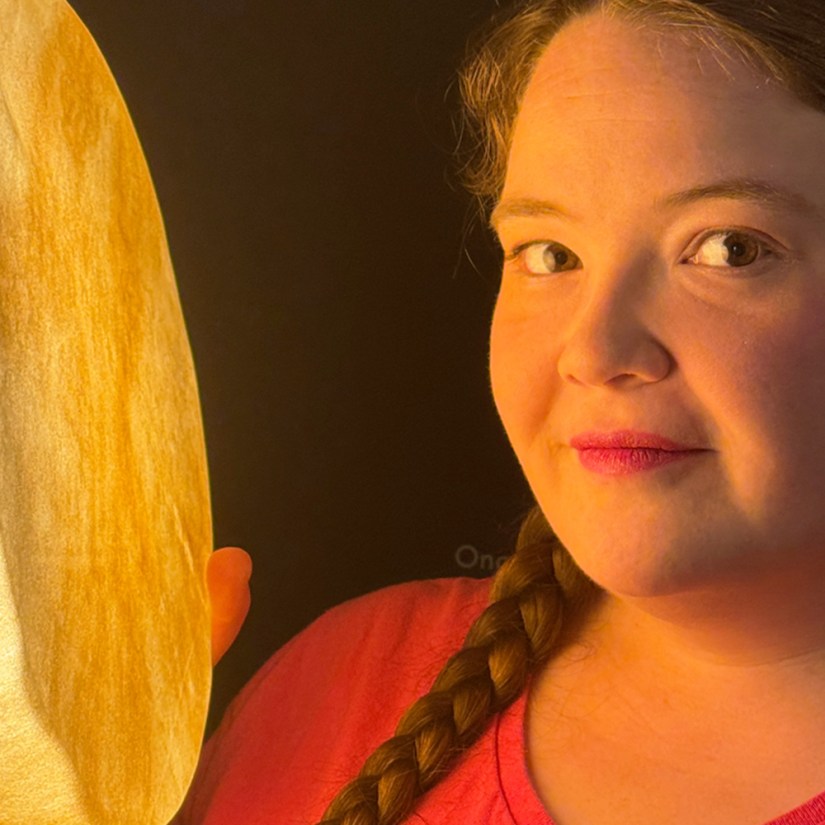
What made the glowing vessels so effective was not simply the presence of light, but the specific medium through which the light traveled. Through rigorous studio prototyping, Chapman discovered that standard amber bulbs and coloured glass shades failed to produce the desired psychological impact; the light remained flat, uniform, and overtly artificial, failing to make viewers feel genuinely seen. The transformative shift occurred when light was passed through untanned animal rawhide, a biological membrane retaining its natural cellular variance, fibre density, and vascular topography.
Subsurface Scattering and Biological Recognition
In optical physics and computer graphics, subsurface scattering describes how light penetrates a semi-translucent material, bounces internally among micro-structures, and scatters outward with a soft diffusion. Human visual processing relies heavily on subsurface scattering to identify living tissue; it is the optical signature of skin, flesh, and vitality (Gigilashvili et al. 2021). When light encounters the dense collagen bundles and vein networks of rawhide, the brain decodes the resulting radiance not as an inorganic projection, but as a living, organic presence.
Implicit Memory and the Womb Matrix
Perhaps the most profound reaction reported by exhibition visitors was the sensation of being cradled inside a “loving, safe womb,” reminiscent of prenatal existence. Yet, when questioned, these same visitors readily acknowledged an obvious biological paradox: they could not consciously remember being in their mother’s womb. This phenomenon is explained in neurobiology through the distinction between declarative (explicit) memory and implicit (somatic) memory. Declarative memory, which requires a fully matured hippocampus to encode conscious recollections and narratives, does not develop until early childhood. However, the amygdala, brainstem, and somatosensory nervous systems operate fully during gestation and early infancy (Fagard et al. 2018).
The intrauterine environment is never absolute darkness; daylight and ambient warmth filter through maternal tissue, bathing the developing fetus in a muted, amber-ish glow accompanied by the rhythmic cadence of the maternal pulse. When adult visitors stood among the backlit rawhide vessels crafted in Chapman’s studio, observing the organic vein-iness and irregular modelling under warm amber illumination, their conscious minds had no memory of gestation to draw upon. Instead, their autonomic nervous systems accessed deep implicit somatic memory. The optical signature of light filtered through biological tissue acted as a somatic key, unlocking an ancient, pre-verbal architecture of safety, containment, and unconditional belonging. Furthermore, the irregular modelling of the hide embodies natural statistical fractals. According to Attention Restoration Theory, while man-made geometric grids demand directed, fatiguing cognitive attention, organic patterns induce “soft fascination,” a state of effortless visual absorption that quiets mental chatter, lowers heart rate variability, and invites deep psychological restoration.
Engineering Eye-Level Encounter: Pareidolia, Vertical Gaze, and the Blue-Base Anchor
Beyond material selection, the spatial choreography of the Glow Chamber was engineered by Chapman to transform static sculptures into active, relational entities. The installation utilized a deliberate vertical hierarchy: a hidden blue ribbon light strip cast cool illumination across the base of the artificial-oak-surfaced-plinth, while varying heights of grey monoliths supported glowing rawhide vessels at the top. While varying the heights was intentionally designed by Chapman to maximize physical accessibility for diverse visitors, it yielded an unexpected psychological revelation: visitors systematically sought out and gravitated toward the specific vessels that aligned precisely with their own facial height.
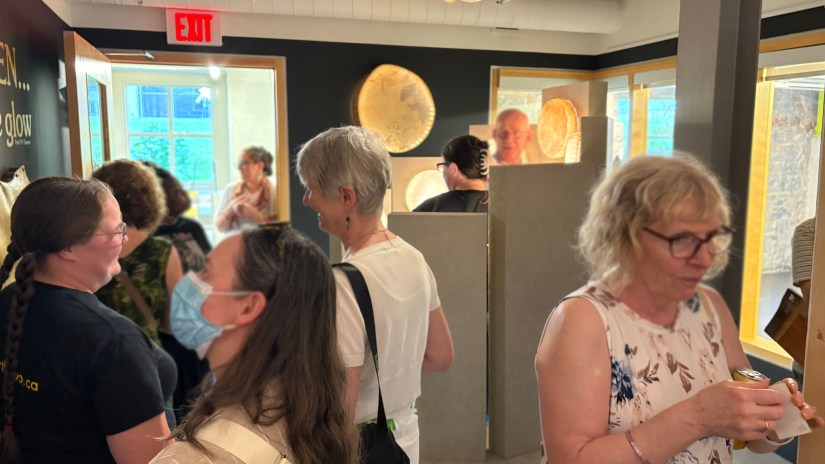
This behaviour exposes several converging mechanisms in visual neurobiology and spatial psychology such as:
- Facial Pareidolia and Mutual Eye Contact: Human brains possess a hyper-sensitivity to facial configurations, governed by the fusiform face area (FFA). Because rawhide features natural irregularities, asymmetric shadowing, and organic contours, viewers, without being conscious of doing so, experienced spontaneous pareidolia, projecting facial features onto the glowing rawhide vessels. When a vessel was positioned precisely at eye level, the brain registered the encounter not as viewing an art object, but as making mutual eye contact with another presence.
- Vertical Gaze and Interpersonal Equality: In non-verbal communication, vertical gaze angles dictate relational power dynamics. Looking down implies dominance; looking up evokes submission or awe. Eye-level alignment eliminates vertical asymmetry, signalling peer-to-peer parity and relational attunement. By standing face-to-face with a vessel scaled to their exact height, visitors experienced the neurological conditions of being truly seen—matched, recognized, and mirrored by an equal presence.
- The Blue-Base Upward Anchor: The placement of cool blue light at the floor level played a crucial structural role. Operating against the human visual system’s default “light-from-above” prior (Bowers 2024), under-lighting with short-wavelength blue light created a striking chromatic contrast. This cool base anchored the floor plane while compelling the eye to travel upward toward the warm, amber vessels above. This upward visual journey mirrored the psychological transition from urban ground-level alienation toward transcendent emotional warmth.
- The Museum Selfie as Co-Presence: The frequent choice by visitors to photograph themselves beside eye-aligned vessels represents modern identity work through co-presence (Kozinets et al. 2017). By framing a selfie alongside a glowing, eye-level rawhide vessel, visitors captured proof of an authentic relational encounter. They were not posing next to pedestals; they were documenting a moment of shared visibility.
Historical Lineage and Contemporary Groundwork
In surveying contemporary installation art, the convergence of translucent biological hide, optical backlighting, brutalist spatial tension, and interactive relational encounter occupies a unique and previously unmapped territory. While historical and contemporary artists have engaged with animal hide and translucent membranes, Chapman’s Glow Chamber establishes an entirely distinct conceptual synthesis. The following five artists, although not producing similar works to Chapman’s Glow Chamber, they provided the ground work, the lineage, for Chapman’s immersive, interactive glowing rawhide art exhibition:
- Jeffrey Gibson utilizes stretched rawhide in sculptures and wall works, infusing traditional craft with high-impact contemporary colour-blocking and geometric patterns. However, Gibson’s work emphasizes exterior surface vibrancy and cultural storytelling rather than immersive, intimate subsurface backlighting (Berlo 2018).
- Eva Hesse pioneered post-minimalist sculptures using translucent, skin-mimicking polymers and latex to evoke visceral vulnerability and somatic containment (Lippard 1992). While Hesse explored organic containment, her works remained abstract industrial materials rather than living biological membranes.
- Rebecca Belmore employs hide and natural membranes to address voice, presence, and political visibility, famously constructing massive acoustic megaphones from stretched hide (Augaitis et al. 2018). Belmore’s practice uses hide as a megaphone to project human voice outward, whereas the Glow Chamber uses hide as an optical receiver to draw the viewer inward.
- Wolfgang Laib constructs immersive chambers illuminated entirely by warm light filtering through natural beeswax walls, creating sacred, cocoon-like sanctuaries that slow human respiration (Ottmann 2000). While Laib achieves atmospheric containment, his installations lack the individualized, eye-level face-to-face relational encounter engineered in the Glow Chamber.
- James Turrell manipulates spatial light frequencies and architectural voids to alter human visual self-awareness (Adcock 1990). The Glow Chamber intersects with Turrell’s rigorous light control but grounds abstract optical phenomena into tangible, organic biological textures.
Chapman’s Glow Chamber Breaks New Ground
Positioned among these artistic lineages, Chapman’s Glow Chamber breaks new ground. It bridges the structural austerity of architectural brutalism with the biological intimacy of animal skin, engineering an environment where material science, psychological safety, and interactive sculpture merge into a singular healing intervention.
The Living Archive: Community Co-Presence and the Glow
The ultimate validation of the Glow Chamber‘s conceptual framework emerged not merely from academic theory, but from active community participation. Within the gallery space during the summer 2026 exhibition run, an interactive selfie board curated by Chapman invited visitors to contribute printed instant-camera portrait stickers, resulting in approximately 70 community members actively embedding their faces into a collaborative collective display. This participatory archive literalized the exhibition’s central thesis. Surrounded by the brutalist grey exterior yet nurtured by the golden glow of the rawhide vessels, visitors transitioned from passive observers into active participants in a shared community of visibility. As the public became art, the public, collectively, became one with the art installation.
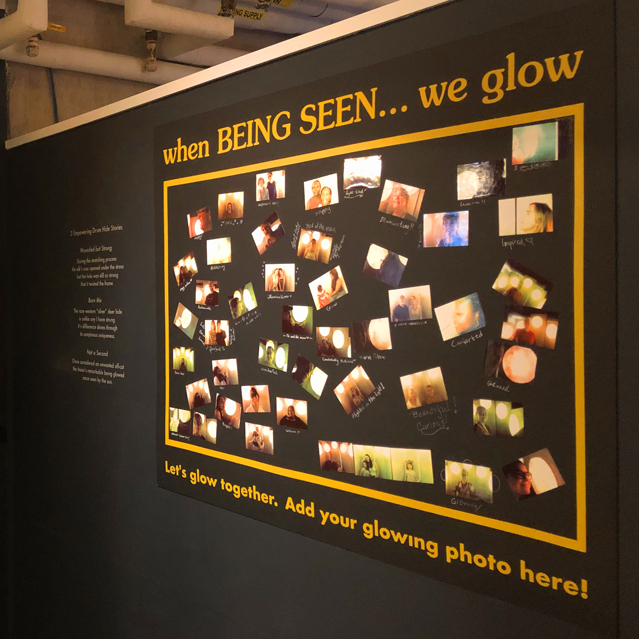
As captured on the title wall illuminated by the warm radiance of the chamber, the governing axiom of the entire installation remained indelibly clear: “when Being Seen… we glow.”
Conclusion
The Glow Chamber demonstrates that art can transcend aesthetic contemplation to become a technology of healing. By engineering an environment that honours human biological memory, “utilizes the optical metamorphosis of subsurface scattering” and rejects urban alienation in favour of eye-level relational attunement, the immersive, interactive art installation offered visitors a rare sanctuary:
A place where the quiet weight of invisibility
is lifted, and where the human spirit, warmed
by organic light, is safely reassembled.
Works Cited
Adcock, Craig. James Turrell: The Art of Light and Space. University of California Press, 1990.
Augaitis, Daina, et al. Rebecca Belmore: Beauty of a Fierce Longing. Art Gallery of Ontario / Information Office, 2018.
Berlo, Janet Catherine. “Jeffrey Gibson: Like a Hammer.” Denver Art Museum Review, vol. 42, no. 2, 2018, pp. 88–95.
Bowers, T. “Gaze Perception under Vertical Asymmetries in Illumination.” Scientific Reports, vol. 14, 2024, p. 13111.
Fagard, Jacqueline, et al. “Fetal Origin of Sensorimotor Behavior.” Frontiers in Neurorobotics, vol. 12, 2018, p. 23. https://doi.org/10.3389/fnbot.2018.00023.
Gehl, Jan. Life Between Buildings: Using Public Space. Translated by Jo Koch, Island Press, 2011.
Gerstel, Sharon E. J. “The Iconography of Light in Sacred Architecture.” Studies in Byzantine and Medieval Art, 2020, pp. 231–45.
Gigilashvili, Davit, et al. “Translucency Perception: A Review.” Journal of Vision, vol. 21, no. 8, 2021, p. 4. https://doi.org/10.1167/jov.21.8.4.
Groarke, Jenny M., et al. “Loneliness and Social Disconnection in the COVID-19 Era: The Impact of Psychological Interventions.” Journal of Affective Disorders, vol. 285, 2021, pp. 335–47. https://doi.org/10.1016/j.jad.2021.02.045.
Hartgerink, Chris H. J., et al. “The Ordinal Effects of Ostracism: A Meta-Analysis of 120 Cyberball Studies.” PLOS ONE, vol. 10, no. 5, 2015, p. e0127002. https://doi.org/10.1371/journal.pone.0127002.
Hayes, Steven C., et al. “Experiential Avoidance and Behavioral Disorders: A Functional Dimensional Approach to Diagnosis and Treatment.” Journal of Consulting and Clinical Psychology, vol. 64, no. 6, 1996, pp. 1152–68. https://doi.org/10.1037/0022-006X.64.6.1152.
Kozinets, Robert, Ulrike Gretzel, and Anja Dinhopl. “Self in Art/Self As Art: Museum Selfies As Identity Work.” Frontiers in Psychology, vol. 8, 2017, p. 731. https://doi.org/10.3389/fpsyg.2017.00731.
Laubin, Reginald, and Gladys Laubin. The Indian Tipi: Its History, Construction, and Use. 2nd ed., University of Oklahoma Press, 1989.
Leder, Helmut, et al. “A Model of Aesthetic Appreciation and Aesthetic Judgments.” British Journal of Psychology, vol. 95, no. 4, 2004, pp. 489–508. https://doi.org/10.1348/0007126042369811.
Lippard, Lucy R. Eva Hesse. Da Capo Press, 1992.
Loades, Maria Elizabeth, et al. “Rapid Review: The Impact of Social Isolation and Loneliness on the Mental Health of Children and Adolescents in the Context of COVID-19.” Journal of the American Academy of Child & Adolescent Psychiatry, vol. 59, no. 11, 2020, pp. 1218–39. https://doi.org/10.1016/j.jaac.2020.05.009.
McKenna-Plumley, Phoebe E., et al. ““It’s a Feeling of Complete Disconnection”: Experiences of Existential Loneliness from Youth to Older Adulthood.” BMC Psychology, vol. 11, no. 1, 2023, p. 408. https://doi.org/10.1186/s40359-023-01452-4.
Murata, Shinya, et al. “Psychological Distress and Loneliness Beyond the Acute Phase of the COVID-19 Pandemic.” Psychiatry Research, vol. 305, 2021, p. 114164. https://doi.org/10.1016/j.psychres.2021.114164.
Murray, Scott. Translucent Building Skins: Materiality, Light, and Space in Contemporary Architecture. Routledge, 2013.
Ottmann, Klaus. Wolfgang Laib: A Retrospective. American Federation of Arts, 2000.
Prizeman, Katie, Netta Weinstein, and Ciara McCabe. “Effects of Mental Health Stigma on Loneliness, Social Isolation, and Relationships in Young People with Depression Symptoms.” BMC Psychiatry, vol. 23, no. 1, 2023, p. 527. https://doi.org/10.1186/s12888-023-04991-7.
Simmel, Georg. “The Metropolis and Mental Life.” The City Reader, edited by Richard T. LeGates and Frederic Stout, 6th ed., Routledge, 2016, pp. 37–44.
Ulrich, Roger S. “Visual Landscapes and Psychological Well-Being.” Landscape Research, vol. 4, no. 1, 1979, pp. 17–23. https://doi.org/10.1080/01426397908705892.
Note: This article was written with the assistance of Gemini.
About the Artist
Portia “Po” Chapman is a Kingston-based contemporary multidisciplinary visual artist, muralist, and certified educator (BFAH, B.Ed, OCT) celebrated for her rigorous, site-specific installations that bridge architectural psychology with intimate material craftsmanship. Awarded the Queen’s University Medal in Visual Art, Chapman combines university-honed discipline in sculpture and installation with specialized expertise in structural woodworking, bespoke rawhide manipulation, and optical material transmutation.
Her acclaimed solo exhibition, Being Seen: when Being Seen… we glow, introduced the groundbreaking Glow Chamber—an architectural intervention that confronts urban alienation by pairing brutalist grey monoliths with translucent, backlit biological rawhide vessels. Through the optical metamorphosis of subsurface scattering, implicit somatic memory, and eye-level relational attunement, Chapman’s work transforms gallery spaces into sanctuaries of restored human presence and shared visibility.
Discover her public murals, gallery exhibitions, and studio practice at loveartbypo.ca.
Contact Po Using Form Below


Portia “Po” Chapman, Kingston Artist
Serving Kingston, Ontario & Across Canada
Contact Po
Email: Portia@LoveArtByPo.ca
Instagram:
Love Art by Po
Facebook:
Love Art by Po Profile
Location
Private Art Studio:
Auden Park Kingston, ON
Google Business Profile:
Professional Listing


Let Me Know What You Think! Start or Join the Convesation