Behind the Art, Kingston Artist, Portia Chapman

Architectures of Attunement: Invisibility, Somatic Containment, and the Translucent Rawhide Membrane in the Glow Chamber | Kingston Artist Portia “Po” Chapman

Introduction

In contemporary gallery culture, visual art frequently operates within an economy of distance. Viewers are conditioned to adopt a posture of clinical detachment, gliding across polished concrete floors past pristine white-cube walls, absorbing visual information through an intellectualized lens. Yet, contemporary public life is haunted by a quieter, more pervasive crisis: a deep, structural sense of social invisibility. Across the post-pandemic landscape, modern individuals experience an acute dissociation from community, finding themselves surrounded by crowds yet profoundly unseen, unregistered, and emotionally unmoored.
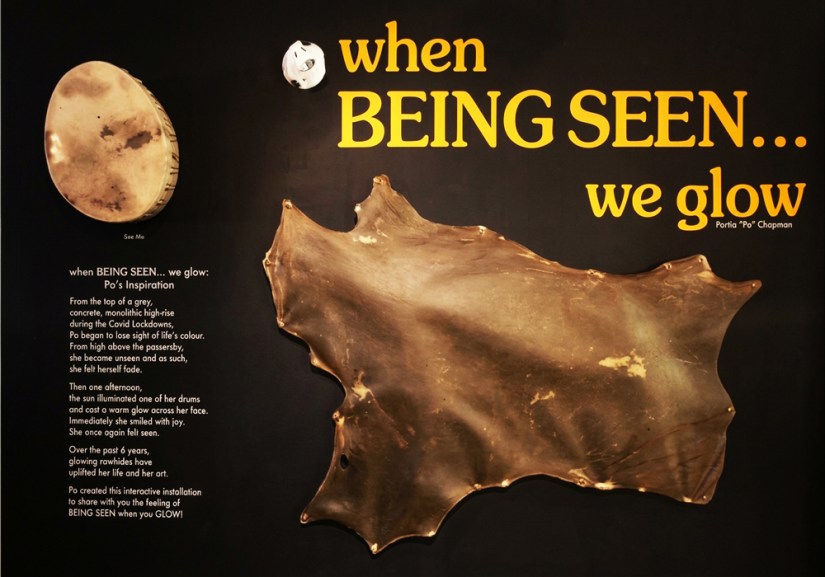
The completed black exhibition title wall for "when Being Seen... we glow" by Kingston artist Portia Po Chapman, featuring gold vinyl lettering, a full deer rawhide mounted 1.5 inches off the wall with copper pipe spacers, an artist statement, and an egg-shaped illuminated silver deer rawhide drum.
The completed interior title wall for “Being Seen: when Being Seen… we glow” by Kingston artist Portia “Po” Chapman, showcasing a floating full deer rawhide, an illuminated silver deer rawhide drum, and custom typography.

Chapmanโ€™s immersive solo exhibition, Being Seen: when Being Seen… we glow, presented at the Kingston Arts Council Pocket Gallery within Kingstonโ€™s Tett Centre for Creativity and Learning, was conceived as a direct counter-narrative to this quiet erosion of human presence. At the heart of this exhibition stood the Glow Chamberโ€”an interactive, multi-sensory environment engineered by Chapman to bridge time-honoured artisanal craftsmanship with rigorous spatial psychology.
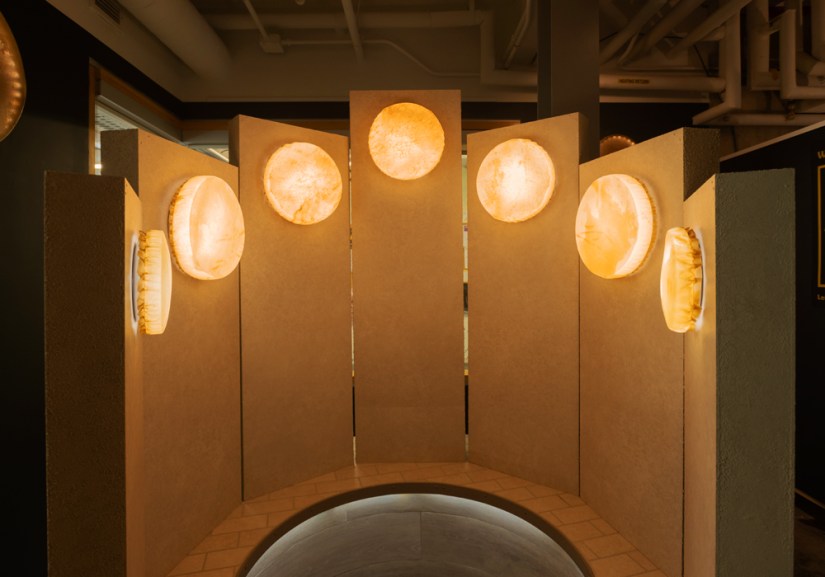
Interactive Glow Chamber installation featuring semi-circular partition walls mounted with circular, illuminated rawhide vessels casting a warm golden glow.
The interactive Glow Chamber from Portia “Po” Chapmanโ€™s exhibition when BEING SEEN… we glow, featuring backlit rawhide vessels radiating the natural golden warmth of sunlit rawhide.

This article unpacks the theoretical, neurobiological, and material foundations of the Glow Chamber. By examining the tension between brutalist urban greyness and translucent biological rawhide, this study explores how environmental design, subsurface optical scattering, and eye-level relational symmetry can coax the human nervous system out of isolation and into a felt, embodied experience of safety, mutual recognition, and visibility.


The Silent Epidemic: Invisibility, Despair, and Post-Pandemic Isolation

To understand why an immersive art installation centred on visibility resonates so deeply with contemporary audiences, one must examine the psychological architecture of being unseen. Invisibility is not merely a metaphor for social neglect; it is a clinical trigger that registers in the human brain as a profound threat to survival.

Foundational psychological research, utilizing paradigms such as the “Cyberball” virtual-exclusion experiments, demonstrates that the immediate sting of social ostracism activates the dorsal anterior cingulate cortex, the neural region that processes physical pain (Hartgerink et al. 2015). When individuals are chronically ignored, overlooked, or treated as invisible, fundamental human needs for belonging, self-esteem, control, and meaningful existence are systematically starved. Over time, this unacknowledged alienation hardens into clinical despair, existential hopelessness, and affective numbness.

The COVID-19 pandemic and its subsequent lockdowns intensified this silent epidemic on a global scale. As rapid public health reviews indicate, the sudden evaporation of traditional support structures, such as schools, collaborative workplaces, peer networks, and public gathering spaces, forced millions of children, adults, and families into prolonged domestic isolation (Loades et al. 2020).
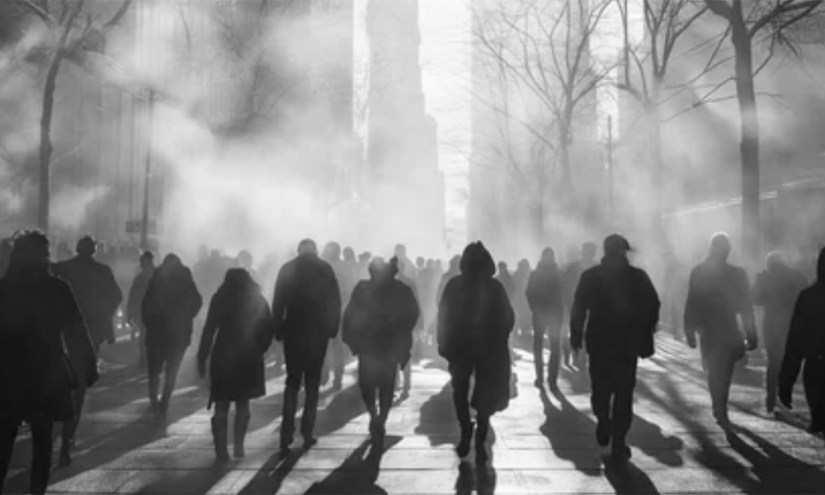
“When feeling unseen… we fade.” AI rendering of people feeling unseen on a concrete urban street even though there are many people to see each other.

Long after physical restrictions were lifted, post-lockdown studies revealed a persistent residual psychological shadow: hyper-vigilance, emotional exhaustion, social withdrawal, and a deep-seated hesitation to re-establish relational trust (Murata et al. 2021).

People emerged from lockdowns carrying an unarticulated grief, the heavy realization that their absence went largely unnoticed by a society racing relentlessly toward economic and structural recovery. Within this cultural moment, the sensation of being unseen became a dominant baseline of modern existence, breeding an internal landscape of quiet desperation.


The Brutalist Mirror: Urban Greyness and Experiential Avoidance

The spatial design of the Glow Chamber deliberately confronted this modern condition by juxtaposing two opposing emotional and aesthetic poles: a cold, monumental field of brutalist urban greyness against a warm, luminous sanctuary of biological rawhide.
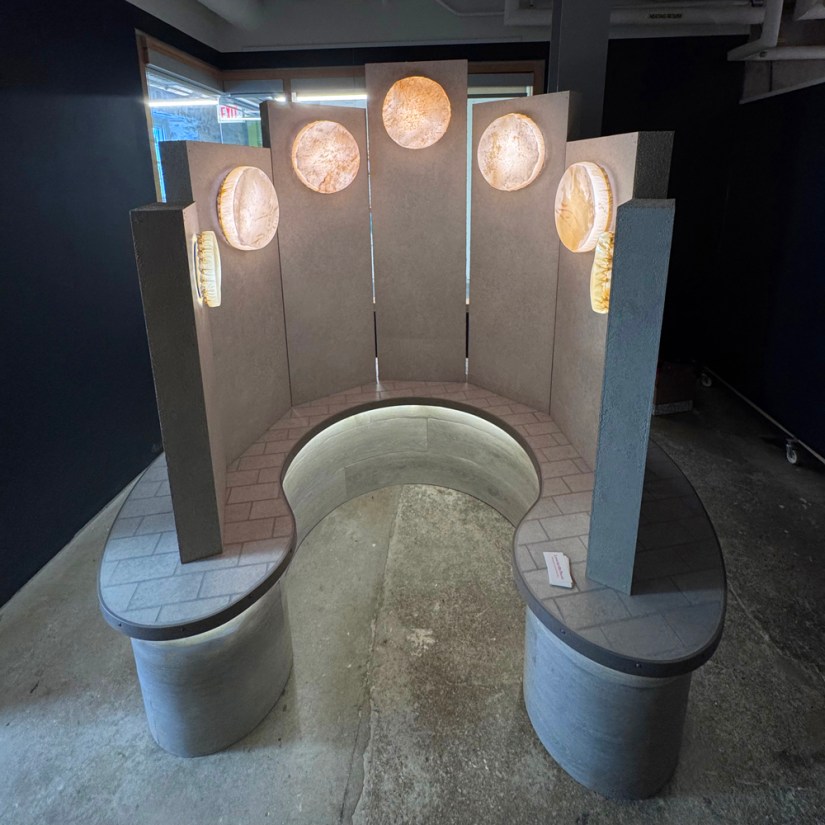
The completed Glow Chamber sculpture glowing softly in the Pocket Gallery with all seven rawhide vessels illuminated against textured monoliths and business cards placed on the tiled plinth.
the Glow Chamber …

To construct this urban tension, Chapman intentionally engineered stone-hybrid grey monoliths paired with a grey tiled integrated plinth top, simulating the oppressive visual syntax of contemporary architecture. Walking through modern concrete canyons, from tall concrete building to tall concrete building, city dwellers are dwarfed by monumental scale.

Sociologist Georg Simmel, in his seminal analysis of metropolitan life, identified the “blasรฉ attitude” as an essential emotional defence mechanism adopted by urbanites to protect themselves from sensory overstimulation and alienation (Simmel 2016). Because individuals cannot possibly process the overwhelming influx of strangers they encounter daily, they tune out. They rush to their destinations, keeping their minds industriously occupied to avoid confronting the profound isolation humming beneath the surface of urban crowds.

This psychological dynamic explains a striking observational phenomenon documented during the exhibition: the public’s active avoidance of the grey caution sign.
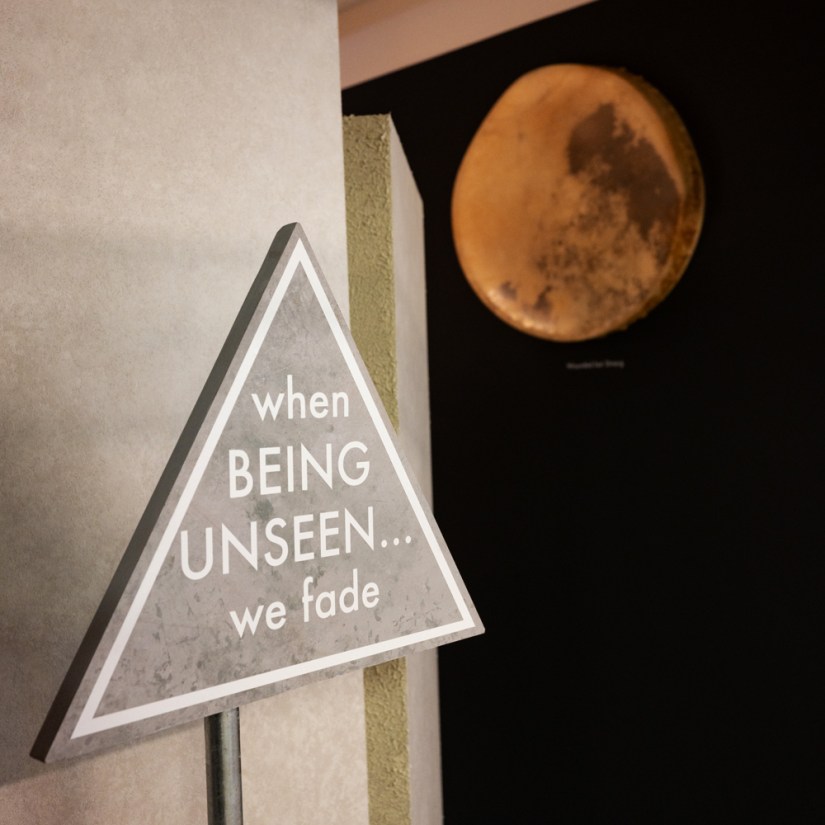
A grey triangular caution sign reading "when Being Unseen... we fade" positioned outside the Glow Chamber installation by Kingston artist Portia Po Chapman, with a glowing golden elk rawhide drum mounted on the dark wall in the background.
A deliberate conceptual contrast by artist in Kingston Portia Po Chapman: the faded, concrete-grey caution sign reading “when Being Unseen… we fade” stands outside the Glow Chamber, set against the warm light of a handcrafted glowing elk rawhide drum.


Positioned discreetly on the rear framework of the Glow Chamber, visible through the gallery glass, a grey warning, created by Chapman, read: “When being unseen… we fade.” Remarkably, almost nobody mentioned the grey caution sign. The few visitors who did acknowledge it expressed immediate discomfort, noting an active aversion to its cold, stark reality.

In clinical psychology, this behaviour is understood as experiential avoidance, the automatic human impulse to turn away from thoughts, visual stimuli, or emotional truths that provoke existential anxiety (Hayes et al. 1996). Confronting the proposition that invisibility leads to fading requires an emotional bandwidth that visitors, habituated to urban coping strategies, naturally seek to bypass.
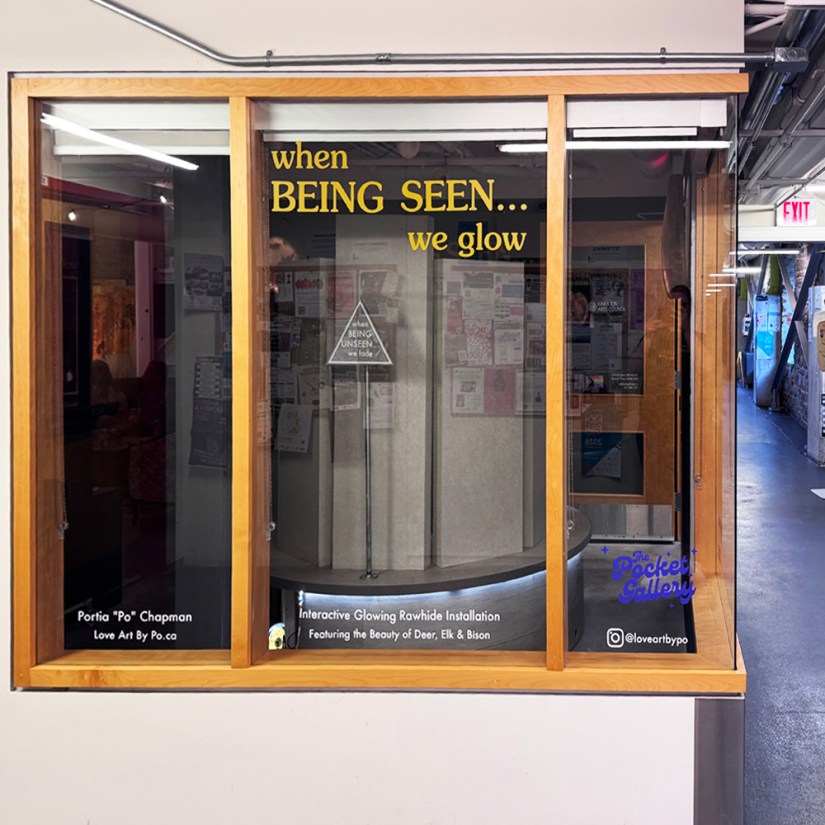
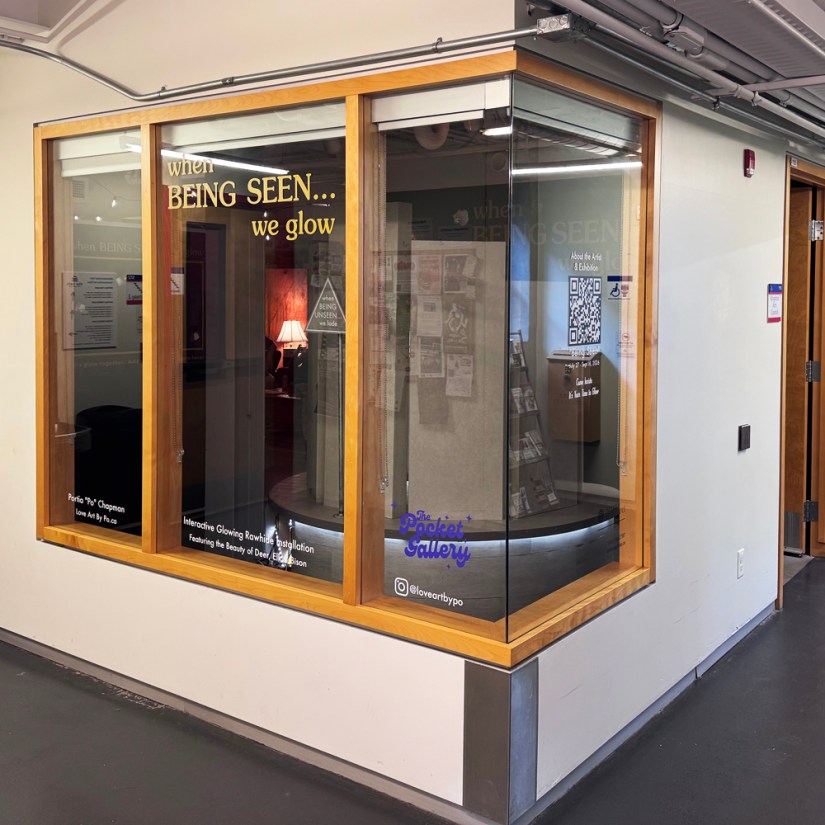
Exhibition Gallery Window Display with Custom Vinyl Decals โ€“ Portia Po Chapman Artist in Kingston.
Exterior view of the Pocket Gallery window at the Tett Centre: custom CNC-cut vinyl graphics by artist in Kingston Portia Po Chapman frame the view of the Glow Chamber and caution sign inside.

Instead, the public demanded warmth. They gravitated instinctively toward the polar opposite of the grey monoliths: the radiant, amber glow of the rawhide vessels. In alignment with Roger Ulrichโ€™s Stress Recovery Theory (SRT), hard, monochromatic, industrial grey surfaces elevate sympathetic nervous system arousal and signal environmental rejection, whereas organic, warm environments rapidly initiate physiological restoration and stress reduction (Ulrich 1979). The exhibition visitors did not merely admire the golden glow; their nervous systems demanded it as a vital refuge from the concrete alienation mirrored all around them.


Material Transmutation: Subsurface Scattering, Implicit Memory, and the Womb Matrix

What made the glowing vessels so effective was not simply the presence of light, but the specific medium through which the light traveled. Through rigorous studio prototyping, Chapman discovered that standard amber bulbs and coloured glass shades failed to produce the desired psychological impact; the light remained flat, uniform, and overtly artificial, failing to make viewers feel genuinely seen.  The transformative shift occurred when light was passed through untanned animal rawhide, a biological membrane retaining its natural cellular variance, fibre density, and vascular topography.

Subsurface Scattering and Biological Recognition

In optical physics and computer graphics, subsurface scattering describes how light penetrates a semi-translucent material, bounces internally among micro-structures, and scatters outward with a soft diffusion. Human visual processing relies heavily on subsurface scattering to identify living tissue; it is the optical signature of skin, flesh, and vitality (Gigilashvili et al. 2021). When light encounters the dense collagen bundles and vein networks of rawhide, the brain decodes the resulting radiance not as an inorganic projection, but as a living, organic presence.
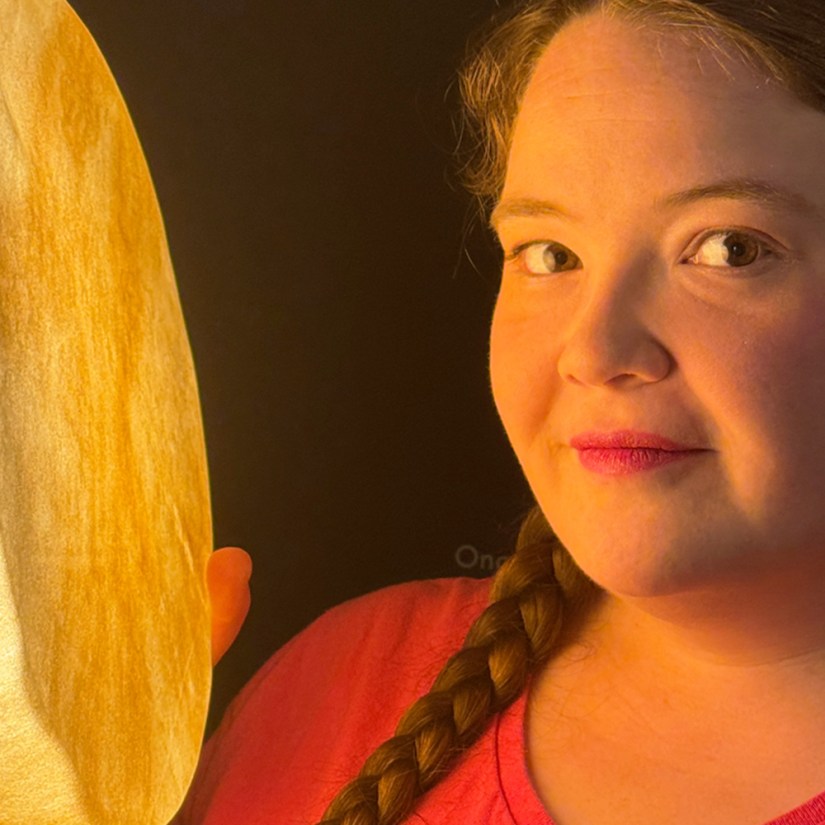
Close-up portrait of Kingston artist Portia Po Chapman in a pink top with her hair braided, illuminated by the warm golden light emitted from a handcrafted rawhide vessel she holds in the dark Pocket Gallery space
Celebrating the realized vision: Po poses in the Kingston Arts Council Pocket Gallery alongside one of her completed backlit rawhide vessels, illuminated by the warm golden glow achieved through months of dedicated experimentation and innovation. Photo by Ann Decker.

Implicit Memory and the Womb Matrix

Perhaps the most profound reaction reported by exhibition visitors was the sensation of being cradled inside a “loving, safe womb,” reminiscent of prenatal existence. Yet, when questioned, these same visitors readily acknowledged an obvious biological paradox: they could not consciously remember being in their mother’s womb. This phenomenon is explained in neurobiology through the distinction between declarative (explicit) memory and implicit (somatic) memory. Declarative memory, which requires a fully matured hippocampus to encode conscious recollections and narratives, does not develop until early childhood. However, the amygdala, brainstem, and somatosensory nervous systems operate fully during gestation and early infancy (Fagard et al. 2018).

The intrauterine environment is never absolute darkness; daylight and ambient warmth filter through maternal tissue, bathing the developing fetus in a muted, amber-ish glow accompanied by the rhythmic cadence of the maternal pulse. When adult visitors stood among the backlit rawhide vessels crafted in Chapman’s studio, observing the organic vein-iness and irregular modelling under warm amber illumination, their conscious minds had no memory of gestation to draw upon. Instead, their autonomic nervous systems accessed deep implicit somatic memory. The optical signature of light filtered through biological tissue acted as a somatic key, unlocking an ancient, pre-verbal architecture of safety, containment, and unconditional belonging.  Furthermore, the irregular modelling of the hide embodies natural statistical fractals. According to Attention Restoration Theory, while man-made geometric grids demand directed, fatiguing cognitive attention, organic patterns induce “soft fascination,โ€ a state of effortless visual absorption that quiets mental chatter, lowers heart rate variability, and invites deep psychological restoration.


Engineering Eye-Level Encounter: Pareidolia, Vertical Gaze, and the Blue-Base Anchor

Beyond material selection, the spatial choreography of the Glow Chamber was engineered by Chapman to transform static sculptures into active, relational entities.  The installation utilized a deliberate vertical hierarchy: a hidden blue ribbon light strip cast cool illumination across the base of the artificial-oak-surfaced-plinth, while varying heights of grey monoliths supported glowing rawhide vessels at the top. While varying the heights was intentionally designed by Chapman to maximize physical accessibility for diverse visitors, it yielded an unexpected psychological revelation: visitors systematically sought out and gravitated toward the specific vessels that aligned precisely with their own facial height.
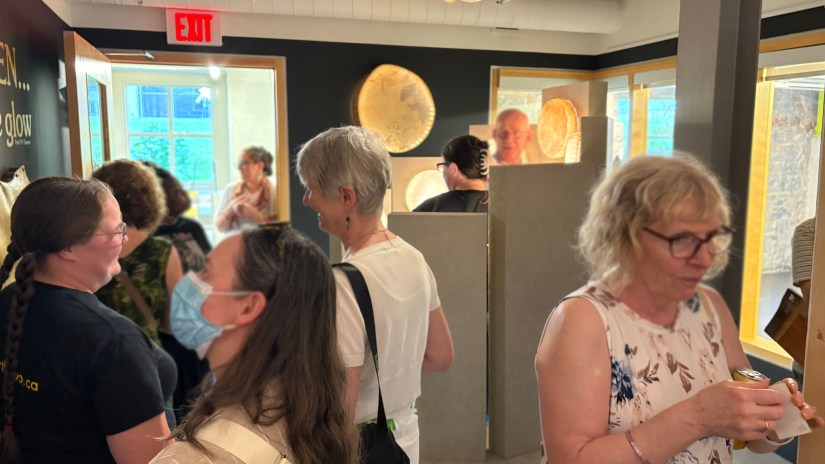
Exhibition guests gathering and lining up to take photos inside the Glow Chamber installation at Kingston artist Portia Po Chapman's Being Seen opening reception.
Following the artist talk, guests gather and line up to take selfie photos inside the Glow Chamber installation during the opening reception of Being Seen: when Being Seen… we glow.

This behaviour exposes several converging mechanisms in visual neurobiology and spatial psychology such as:

  • Facial Pareidolia and Mutual Eye Contact: Human brains possess a hyper-sensitivity to facial configurations, governed by the fusiform face area (FFA). Because rawhide features natural irregularities, asymmetric shadowing, and organic contours, viewers, without being conscious of doing so, experienced spontaneous pareidolia, projecting facial features onto the glowing rawhide vessels. When a vessel was positioned precisely at eye level, the brain registered the encounter not as viewing an art object, but as making mutual eye contact with another presence.
  • Vertical Gaze and Interpersonal Equality: In non-verbal communication, vertical gaze angles dictate relational power dynamics. Looking down implies dominance; looking up evokes submission or awe. Eye-level alignment eliminates vertical asymmetry, signalling peer-to-peer parity and relational attunement. By standing face-to-face with a vessel scaled to their exact height, visitors experienced the neurological conditions of being truly seenโ€”matched, recognized, and mirrored by an equal presence.
  • The Blue-Base Upward Anchor: The placement of cool blue light at the floor level played a crucial structural role. Operating against the human visual system’s default “light-from-above” prior (Bowers 2024), under-lighting with short-wavelength blue light created a striking chromatic contrast. This cool base anchored the floor plane while compelling the eye to travel upward toward the warm, amber vessels above. This upward visual journey mirrored the psychological transition from urban ground-level alienation toward transcendent emotional warmth.
  • The Museum Selfie as Co-Presence: The frequent choice by visitors to photograph themselves beside eye-aligned vessels represents modern identity work through co-presence (Kozinets et al. 2017). By framing a selfie alongside a glowing, eye-level rawhide vessel, visitors captured proof of an authentic relational encounter. They were not posing next to pedestals; they were documenting a moment of shared visibility.

Historical Lineage and Contemporary Groundwork

In surveying contemporary installation art, the convergence of translucent biological hide, optical backlighting, brutalist spatial tension, and interactive relational encounter occupies a unique and previously unmapped territory. While historical and contemporary artists have engaged with animal hide and translucent membranes, Chapman’s Glow Chamber establishes an entirely distinct conceptual synthesis.ย  The following five artists, although not producing similar works to Chapmanโ€™s Glow Chamber, they provided the ground work, the lineage, for Chapmanโ€™s immersive, interactive glowing rawhide art exhibition:

  • Jeffrey Gibson utilizes stretched rawhide in sculptures and wall works, infusing traditional craft with high-impact contemporary colour-blocking and geometric patterns. However, Gibsonโ€™s work emphasizes exterior surface vibrancy and cultural storytelling rather than immersive, intimate subsurface backlighting (Berlo 2018).
  • Eva Hesse pioneered post-minimalist sculptures using translucent, skin-mimicking polymers and latex to evoke visceral vulnerability and somatic containment (Lippard 1992). While Hesse explored organic containment, her works remained abstract industrial materials rather than living biological membranes.
  • Rebecca Belmore employs hide and natural membranes to address voice, presence, and political visibility, famously constructing massive acoustic megaphones from stretched hide (Augaitis et al. 2018). Belmoreโ€™s practice uses hide as a megaphone to project human voice outward, whereas the Glow Chamber uses hide as an optical receiver to draw the viewer inward.
  • Wolfgang Laib constructs immersive chambers illuminated entirely by warm light filtering through natural beeswax walls, creating sacred, cocoon-like sanctuaries that slow human respiration (Ottmann 2000). While Laib achieves atmospheric containment, his installations lack the individualized, eye-level face-to-face relational encounter engineered in the Glow Chamber.
  • James Turrell manipulates spatial light frequencies and architectural voids to alter human visual self-awareness (Adcock 1990). The Glow Chamber intersects with Turrellโ€™s rigorous light control but grounds abstract optical phenomena into tangible, organic biological textures.

Chapmanโ€™s Glow Chamber Breaks New Ground

Positioned among these artistic lineages, Chapmanโ€™s Glow Chamber breaks new ground. It bridges the structural austerity of architectural brutalism with the biological intimacy of animal skin, engineering an environment where material science, psychological safety, and interactive sculpture merge into a singular healing intervention.
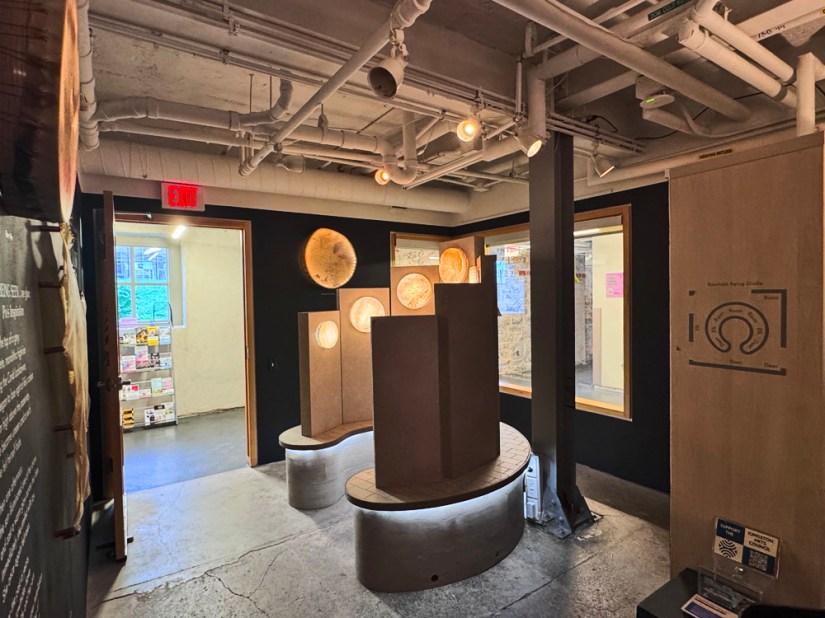
Immersive site-specific installation "Being Seen: when Being Seen... we glow" featuring the monochromatic Glow Chamber, glowing rawhide vessels, vinyl wall text, and photo board inside the Kingston Arts Council Pocket Gallery.
The site-specific Glow Chamber on view inside the Kingston Arts Council Pocket Gallery during the immersive exhibition, “Being Seen: when Being Seen… we glow.”

The Living Archive: Community Co-Presence and the Glow

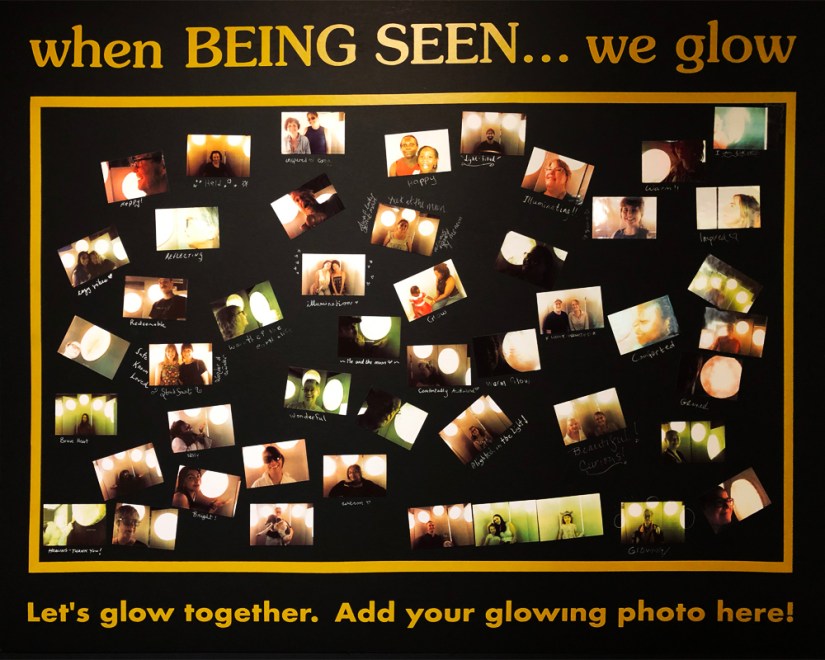
The ultimate validation of the Glow Chamber‘s conceptual framework emerged not merely from academic theory, but from active community participation. Within the gallery space during the summer 2026 exhibition run, an interactive selfie board curated by Chapman invited visitors to contribute printed instant-camera portrait stickers, resulting in approximately 70 community members actively embedding their faces into a collaborative collective display.  This participatory archive literalized the exhibition’s central thesis. Surrounded by the brutalist grey exterior yet nurtured by the golden glow of the rawhide vessels, visitors transitioned from passive observers into active participants in a shared community of visibility.  As the public became art, the public, collectively, became one with the art installation.
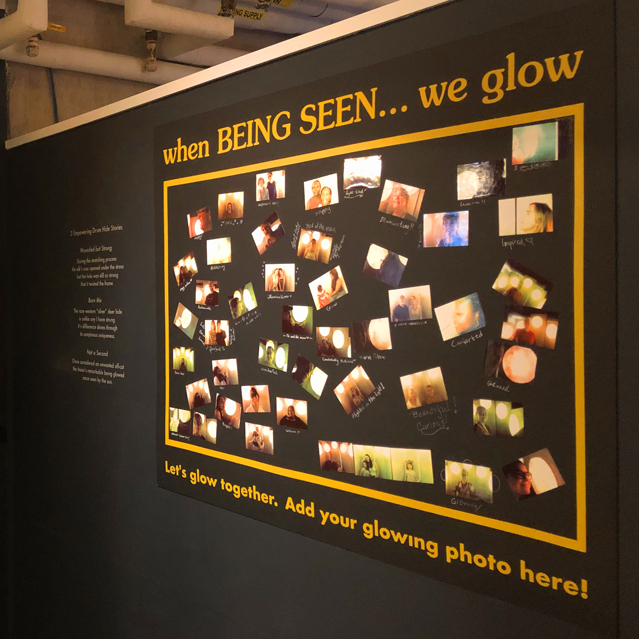
A dark gallery wall displaying a gold-framed interactive photo board titled "when BEING SEEN... we glow" covered in visitor selfie photos and handwritten notes, alongside custom wall text explaining three empowering drum hide stories by Kingston artist Portia Po Chapman.
The heart of the community connection: 70 exhibition visitors posted their glowing selfie portraits and personal reflections on the interactive board inside the Kingston Arts Council Pocket Gallery during Portia “Po” Chapman’s Being Seen exhibition (July 27 โ€“ September 18, 2026).

As captured on the title wall illuminated by the warm radiance of the chamber, the governing axiom of the entire installation remained indelibly clear: “when Being Seen… we glow.”


Conclusion

The Glow Chamber demonstrates that art can transcend aesthetic contemplation to become a technology of healing. By engineering an environment that honours human biological memory, โ€œutilizes the optical metamorphosis of subsurface scattering” and rejects urban alienation in favour of eye-level relational attunement, the immersive, interactive art installation offered visitors a rare sanctuary:

A place where the quiet weight of invisibility
is lifted, and where the human spirit, warmed
by organic light, is safely reassembled.


Works Cited

Adcock, Craig. James Turrell: The Art of Light and Space. University of California Press, 1990.

Augaitis, Daina, et al. Rebecca Belmore: Beauty of a Fierce Longing. Art Gallery of Ontario / Information Office, 2018.

Berlo, Janet Catherine. “Jeffrey Gibson: Like a Hammer.” Denver Art Museum Review, vol. 42, no. 2, 2018, pp. 88โ€“95.

Bowers, T. “Gaze Perception under Vertical Asymmetries in Illumination.” Scientific Reports, vol. 14, 2024, p. 13111.

Fagard, Jacqueline, et al. “Fetal Origin of Sensorimotor Behavior.” Frontiers in Neurorobotics, vol. 12, 2018, p. 23. https://doi.org/10.3389/fnbot.2018.00023.

Gehl, Jan. Life Between Buildings: Using Public Space. Translated by Jo Koch, Island Press, 2011.

Gerstel, Sharon E. J. “The Iconography of Light in Sacred Architecture.” Studies in Byzantine and Medieval Art, 2020, pp. 231โ€“45.

Gigilashvili, Davit, et al. “Translucency Perception: A Review.” Journal of Vision, vol. 21, no. 8, 2021, p. 4. https://doi.org/10.1167/jov.21.8.4.

Groarke, Jenny M., et al. “Loneliness and Social Disconnection in the COVID-19 Era: The Impact of Psychological Interventions.” Journal of Affective Disorders, vol. 285, 2021, pp. 335โ€“47. https://doi.org/10.1016/j.jad.2021.02.045.

Hartgerink, Chris H. J., et al. “The Ordinal Effects of Ostracism: A Meta-Analysis of 120 Cyberball Studies.” PLOS ONE, vol. 10, no. 5, 2015, p. e0127002. https://doi.org/10.1371/journal.pone.0127002.

Hayes, Steven C., et al. “Experiential Avoidance and Behavioral Disorders: A Functional Dimensional Approach to Diagnosis and Treatment.” Journal of Consulting and Clinical Psychology, vol. 64, no. 6, 1996, pp. 1152โ€“68. https://doi.org/10.1037/0022-006X.64.6.1152.

Kozinets, Robert, Ulrike Gretzel, and Anja Dinhopl. “Self in Art/Self As Art: Museum Selfies As Identity Work.” Frontiers in Psychology, vol. 8, 2017, p. 731. https://doi.org/10.3389/fpsyg.2017.00731.

Laubin, Reginald, and Gladys Laubin. The Indian Tipi: Its History, Construction, and Use. 2nd ed., University of Oklahoma Press, 1989.

Leder, Helmut, et al. “A Model of Aesthetic Appreciation and Aesthetic Judgments.” British Journal of Psychology, vol. 95, no. 4, 2004, pp. 489โ€“508. https://doi.org/10.1348/0007126042369811.

Lippard, Lucy R. Eva Hesse. Da Capo Press, 1992.

Loades, Maria Elizabeth, et al. “Rapid Review: The Impact of Social Isolation and Loneliness on the Mental Health of Children and Adolescents in the Context of COVID-19.” Journal of the American Academy of Child & Adolescent Psychiatry, vol. 59, no. 11, 2020, pp. 1218โ€“39. https://doi.org/10.1016/j.jaac.2020.05.009.

McKenna-Plumley, Phoebe E., et al. “โ€œItโ€™s a Feeling of Complete Disconnectionโ€: Experiences of Existential Loneliness from Youth to Older Adulthood.” BMC Psychology, vol. 11, no. 1, 2023, p. 408. https://doi.org/10.1186/s40359-023-01452-4.

Murata, Shinya, et al. “Psychological Distress and Loneliness Beyond the Acute Phase of the COVID-19 Pandemic.” Psychiatry Research, vol. 305, 2021, p. 114164. https://doi.org/10.1016/j.psychres.2021.114164.

Murray, Scott. Translucent Building Skins: Materiality, Light, and Space in Contemporary Architecture. Routledge, 2013.

Ottmann, Klaus. Wolfgang Laib: A Retrospective. American Federation of Arts, 2000.

Prizeman, Katie, Netta Weinstein, and Ciara McCabe. “Effects of Mental Health Stigma on Loneliness, Social Isolation, and Relationships in Young People with Depression Symptoms.” BMC Psychiatry, vol. 23, no. 1, 2023, p. 527. https://doi.org/10.1186/s12888-023-04991-7.

Simmel, Georg. “The Metropolis and Mental Life.” The City Reader, edited by Richard T. LeGates and Frederic Stout, 6th ed., Routledge, 2016, pp. 37โ€“44.

Ulrich, Roger S. “Visual Landscapes and Psychological Well-Being.” Landscape Research, vol. 4, no. 1, 1979, pp. 17โ€“23. https://doi.org/10.1080/01426397908705892.

Note: This article was written with the assistance of Gemini.


About the Artist

Portia โ€œPoโ€ Chapman is a Kingston-based contemporary multidisciplinary visual artist, muralist, and certified educator (BFAH, B.Ed, OCT) celebrated for her rigorous, site-specific installations that bridge architectural psychology with intimate material craftsmanship. Awarded the Queenโ€™s University Medal in Visual Art, Chapman combines university-honed discipline in sculpture and installation with specialized expertise in structural woodworking, bespoke rawhide manipulation, and optical material transmutation.

Her acclaimed solo exhibition, Being Seen: when Being Seen… we glow, introduced the groundbreaking Glow Chamberโ€”an architectural intervention that confronts urban alienation by pairing brutalist grey monoliths with translucent, backlit biological rawhide vessels. Through the optical metamorphosis of subsurface scattering, implicit somatic memory, and eye-level relational attunement, Chapmanโ€™s work transforms gallery spaces into sanctuaries of restored human presence and shared visibility.

Discover her public murals, gallery exhibitions, and studio practice at loveartbypo.ca.

Let Me Know What You Think! Start or Join the Convesation

Serving Kingston, Ontario & Across Canada


Behind the Art, Kingston Artist, Portia Chapman, Studio Process

Recreating Nature’s Glow: How Kingston Artist Portia “Po” Chapman Innovated the Glow Chamberโ€™s Rawhide Vessels

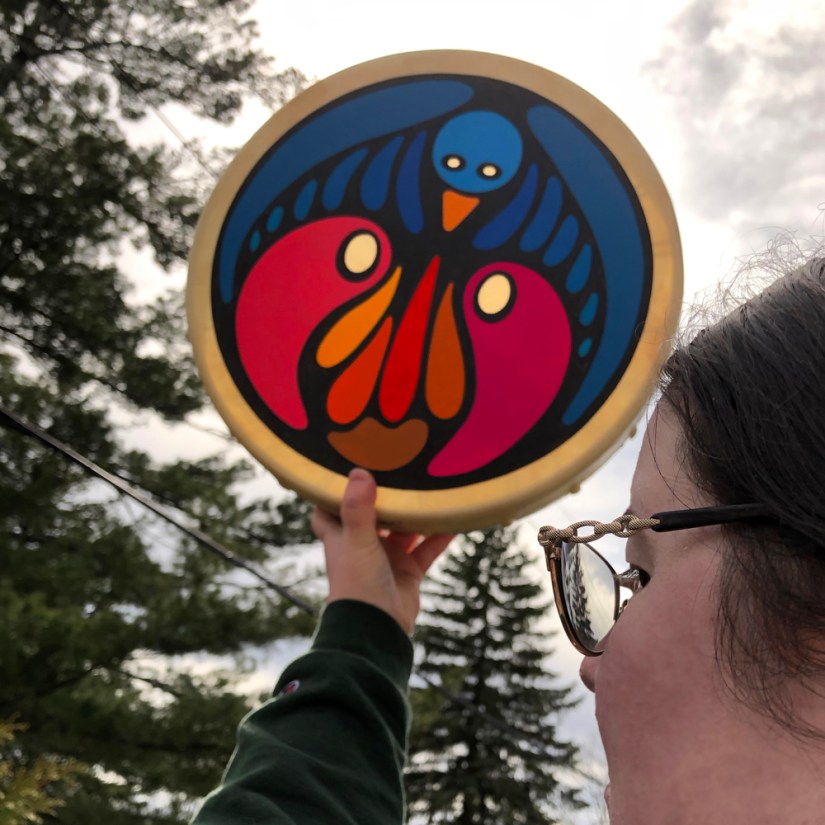
As a multidisciplinary Kingston artist, Portia “Po” Chapman is widely recognized for her nature-focused storytelling art and the high-contrast paintings that adorn her artisanal frame drums. What is less known about her rawhide art, however, is a very deliberate choice she makes: Po does not paint the faces, eyes, or skin of the characters in her images. Instead, she leaves them unpainted so that the natural rawhide becomes the skin of her figures, creating inherently inclusive content. The strategy reveals itself in the lightโ€”when noonday sunlight shines through the back of a painted drum, the figures come alive, with their faces, eyes, and skin literally glowing.

Kingston artist and frame drum maker Portia Po Chapman holds up a vibrant hand-painted drum as natural sunlight illuminates the unpainted rawhide eyes and face.
Held against the sky, natural sunlight passes through the unpainted rawhide skin and eyes of the characters, bringing the high-contrast artwork alive with a golden glow.
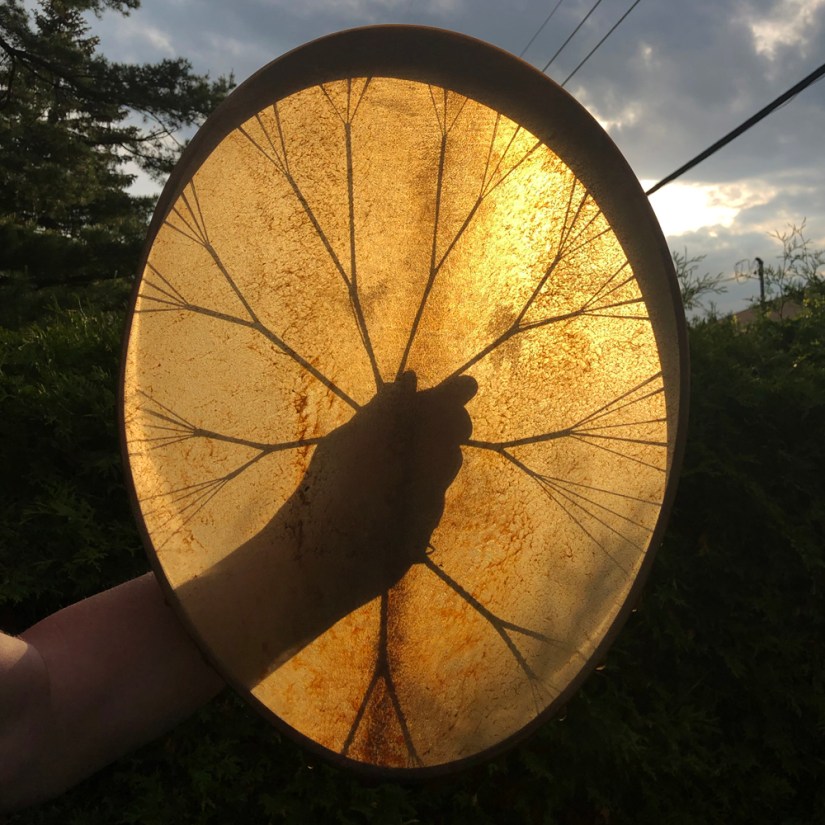
Hand-built bison rawhide on oak frame drum held up to natural sunlight, revealing a translucent golden glow and intricate tree of life stringing pattern.
Sunlight passes through an unpainted bison rawhide drum built at Po’s Kingston studio, illuminating its natural fiber textures and tree of life lacing patternโ€”the primary inspiration for the artificial backlighting engineered in the Being Seen Glow Chamber.

It was the golden, sunlit radiance that inspired the glow for Poโ€™s immersive, interactive art installation,

Being Seen: when Being Seen… we glow, hosted at the Kingston Arts Council (KAC) Pocket Gallery in Kingston, Ontarioโ€™s Tett Centre for Creativity and Learning from July 27 to September 18, 2026. To bring this installation to life, she set out to engineer a way, using artificial electrical backlighting, to simulate the natural essence of sunlit rawhide.

Interactive Glow Chamber installation featuring semi-circular partition walls mounted with circular, illuminated rawhide vessels casting a warm golden glow.
The interactive Glow Chamber from Portia “Po” Chapmanโ€™s exhibition when BEING SEEN… we glow, featuring backlit rawhide vessels radiating the natural golden warmth of sunlit rawhide.

This is the story of how Po engineered the glowing vessels of the Glow Chamber.

The Search for the Perfect Light

Because an installation of this exact existence had never been done before, Po had no existing reference points or guides to follow. She embarked on a long, experimental journey of trial and error to find a light source that could evoke the precise emotional response of feeling truly seen.

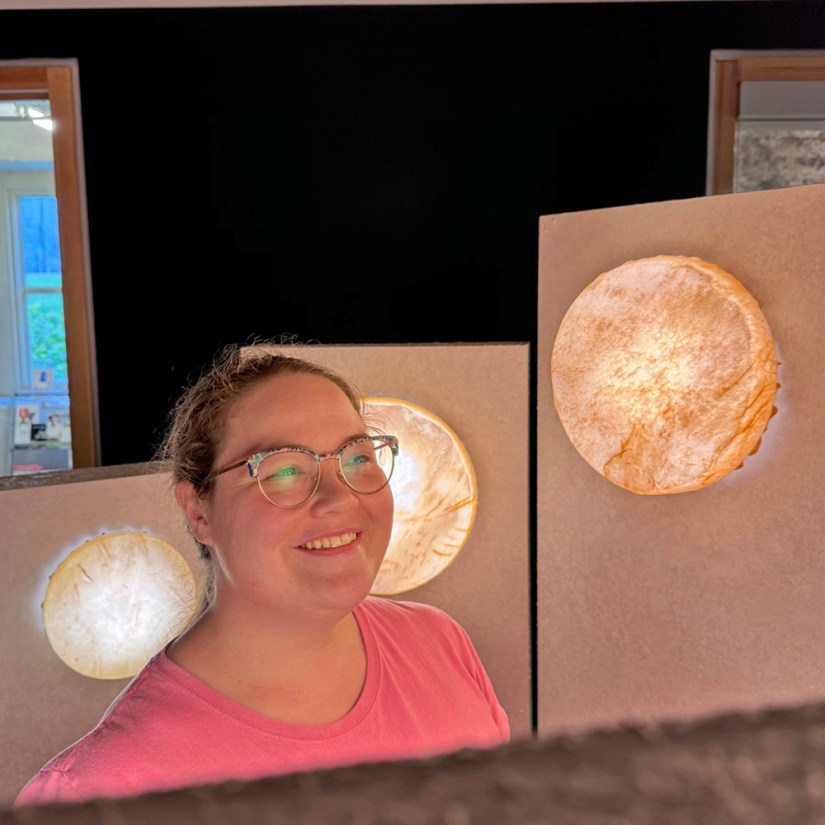
Kingston artist Portia Po Chapman smiling radiantly as she adjusts dimmer lighting behind backlit circular rawhide artworks inside the Glow Chamber installation.
On installation day at the KAC Pocket Gallery, Po uses dimmer switches to fine-tune the backlighting, capturing the exact sunlit radiance that evoked a visceral, womb-like sense of comfort for gallery visitors.

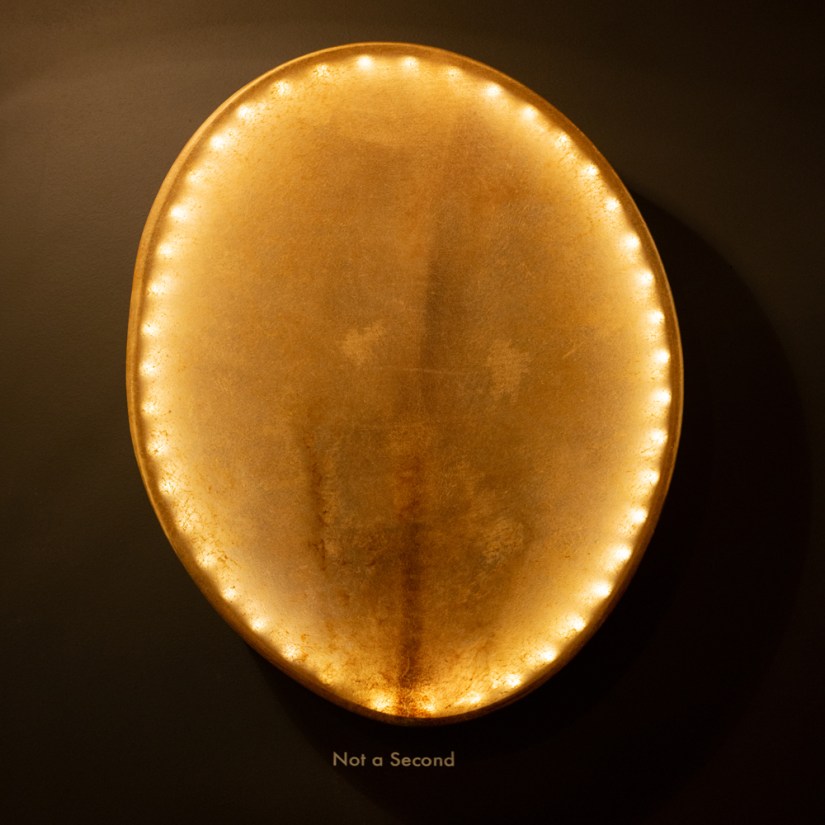
Her first attempts involved sampling incandescent lights. While they provided a comforting hue, the heat generated, even after drilling holes for vents, caused the enclosed rawhide to overheat, crack, ripple, and emit an unpleasant scent.  Next, she tested cool LED strip, tape, and rope lighting. While these options beautifully framed her drums (such as her bison drum, “Not a Second”), they created a spotted effect rather than the unified, radiant glow she sought.

Oval bison rawhide drum titled Not a Second mounted on a dark gallery wall, backlit by circular LED points casting a warm marquee glow along its rim.
Featured in the Being Seen exhibition, the bison rawhide drum titled Not a Second demonstrates an early lighting iteration using LED perimeter lighting, showcasing the drum’s organic texture while highlighting the search for seamless light diffusion.

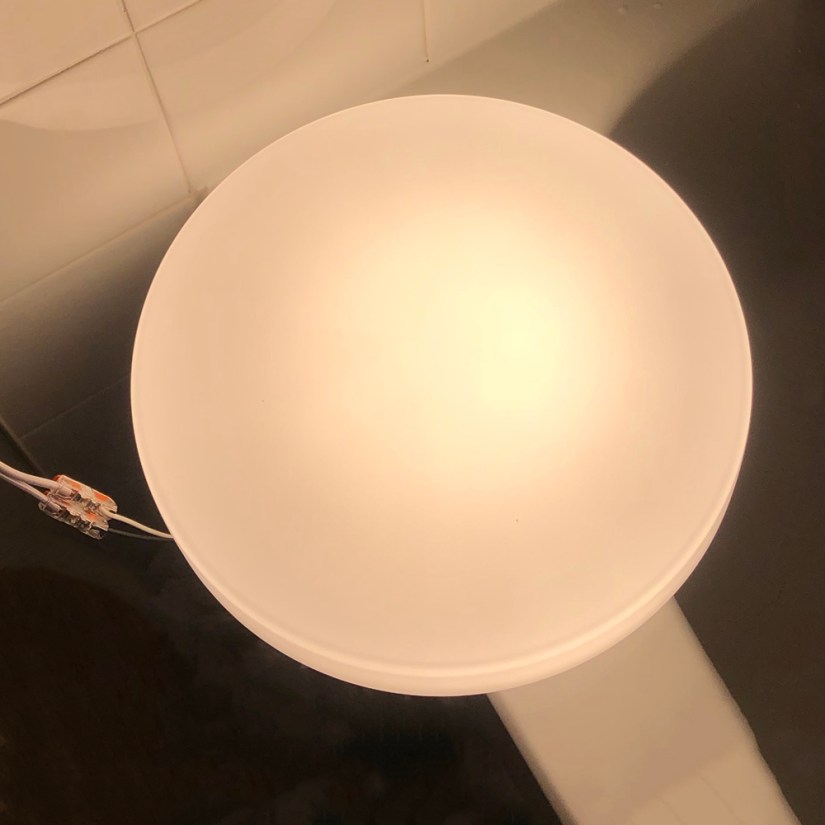
She then tried LED Flat Panel Flush Mount Ceiling Lights, which produced the right glow but proved cost-prohibitive and offered limited size choices.  Finally, Po discovered an economical, budget-friendly round LED fixture equipped with a colour temperature adjustment switch (allowing selection between soft white, bright white, and daylight) paired with an opaque plastic diffusing shade. This combination yielded the soft, manageable, even glow she needed.

Top-down view of a circular LED light fixture with an opaque plastic diffuser shade glowing softly, wired with quick-connect terminals during a studio test by Portia Po Chapman.
Studio trial of a color-temperature-adjustable LED light featuring a plastic diffusing shade, providing the smooth light dispersion required to safely illuminate rawhide vessels from within.

Selecting and Soaking the Hides

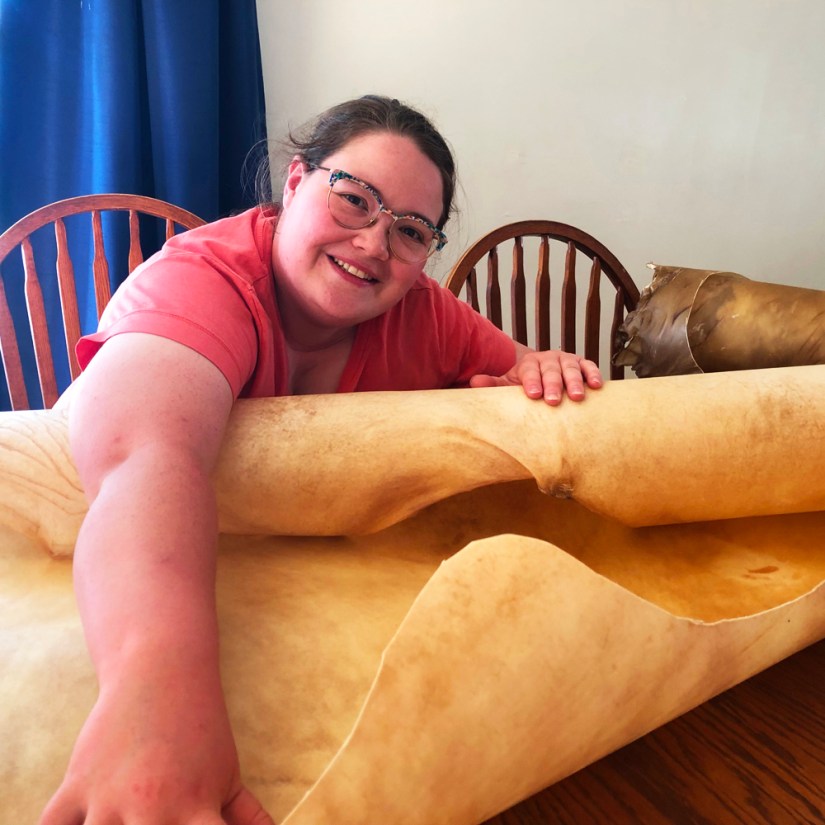
With her light source established, Po turned her attention to selecting the rawhide. Working in her studio, she unrolled various deer, elk, and bison hides to choose pieces for 8, 10, and 12-inch light diffusers. Because rawhide ranges from opaque to nearly transparent, and spans shades from silver to cream, gold, and deep amber, she meticulously curated hides with unique scars, holes, and mottled textures to achieve her desired ambient, glowing story.

Kingston artist Portia Po Chapman smiling as she unrolls large sheets of rawhide on a wooden table, preparing to cut pieces for her Being Seen Glow Chamber installation.
Rolling out the rawhides (deer, elk, and bison) at Po’s Kingston art studio to select pieces based on their specific colors, textures, and translucency, determining the unique glow each vessel will produce in the Being Seen installation.

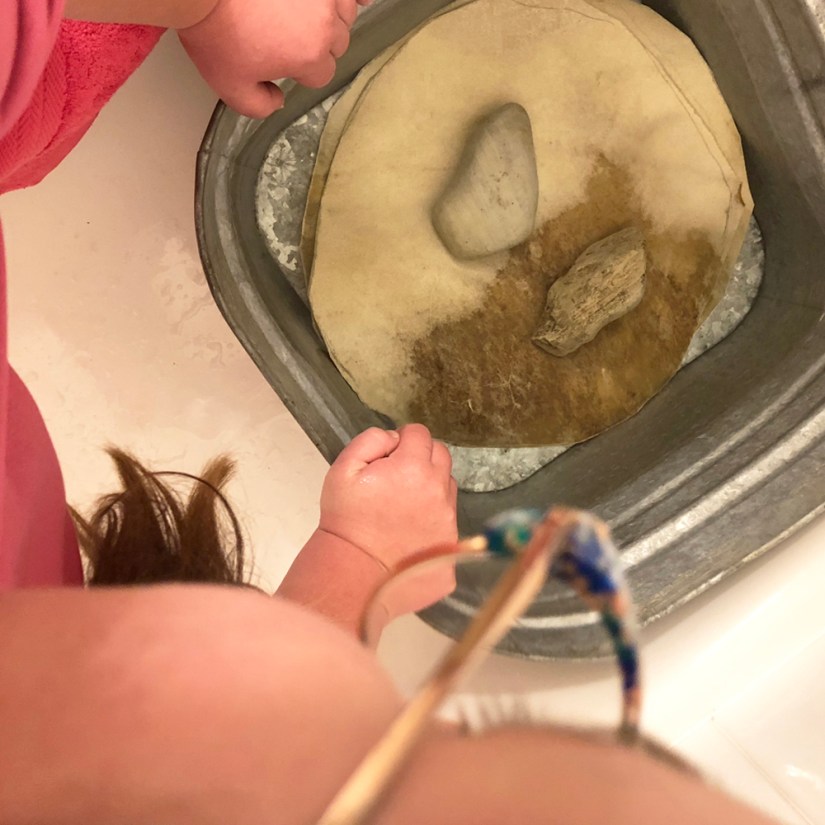
After rough-cutting the hide into rounds, Po submerged them two at a time in a dedicated galvanized washtub filled with tap water. The soak times varied significantly by hide type: deer rawhide soaked for 12 hours, elk rawhide soaked for 24 hours, and bison rawhide soaked for 48 hours. To keep the naturally buoyant hides fully submerged, she initially weighted them down with river rocks. Halfway through the soak, she removed the rocks and flipped the hides; once fully hydrated, the rawhide suspended naturally in the water bath like fish staying still in a clear pond.

Top-down view of rawhide circles submerged in water inside a vintage galvanized washtub, held down by river rocks during a studio soaking process by Portia Po Chapman
Inside her Kingston studio, Po submerses rough-cut rawhide rounds two at a time in a dedicated galvanized washtub, using river rocks to keep the buoyant hides submerged as they hydrate and soften.

The process differed from Poโ€™s method of soaking rawhide drum skins which are soaked in rain water, weighted by natural crystals, and soaked one at a time for individually specific times.

Giving in to the Rawhide: A Technical Breakthrough

Wrapping wet, pliable rawhide over plastic diffusers proved vastly different from stringing traditional oak or maple frame drums. Rawhide exerts immense force as it dries and shrinks. Poโ€™s early trials failed because pulling the hide tightly with standard drum-lacing techniques warped and buckled the plastic diffusers, preventing them from mounting back onto their LED base units.  Po realized that to succeed, she had to stop strong-arming the material and instead give in to the nature of rawhide, allowing its natural, organic shape to form.  She pioneered an entirely new process that included:

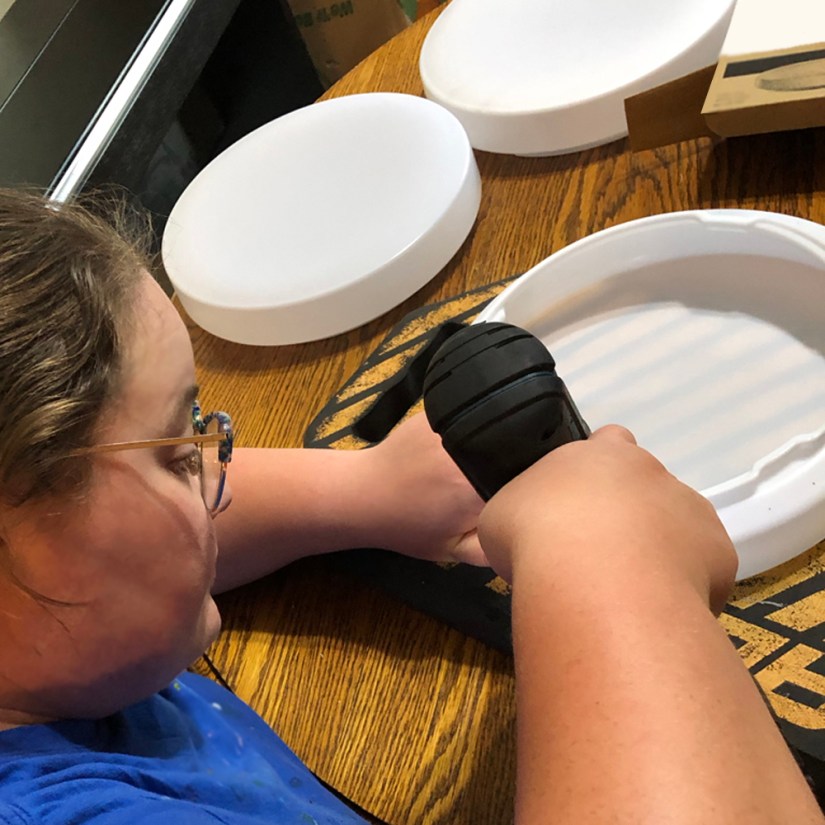
1/ Precision Drilling: She determined a precise location, hole pattern and frequency to drill directly into the plastic diffusers, matching them with holes punched around the hide using a leather punch.

Kingston artist Portia Po Chapman drilling a hole pattern into a white plastic LED light diffuser, supported by a black sponge kneeling pad, in her studio as she prepares the backing for rawhide wrapping.
To successfully wrap the backlighting diffusers with rawhide for the Being Seen installation, Po pioneered a custom hole pattern through the plastic, allowing the shrinking hide and sinew to glide without warping the structure, a breakthrough achieved after initial failures.


2/ Cake Fondant-Style Draping: She calculated her cut hide diameter using a dedicated formulaโ€”the diffuser diameter plus twice its depth, plus approximately two inches. Instead of stretching the hide tight, she draped it loosely over the diffuser like fondant icing over a cake.


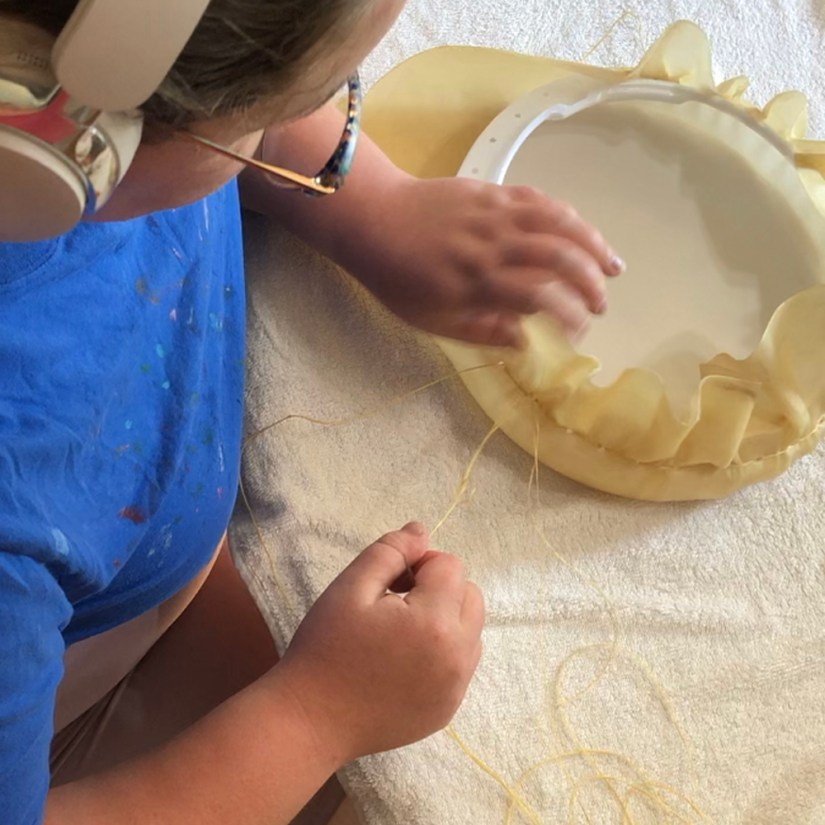
3/ Backstitch Lacing: Using synthetic sinew and a darning needle, she applied a loose, backstitch stitch pattern, that allowed the rawhide to gently shift as it shrank to fit the diffuser.

Top-down view of Kingston artist Portia Po Chapman in her studio, wearing headphones and eyeglasses, using synthetic sinew and a backstitch pattern to lace water-soaked rawhide over a pre-drilled plastic LED diffuser frame. An excessive margin of rawhide forms a ruffle, which Po intends to finger-mold and progressively trim to create a hide skirt.
Moving beyond traditional frame drum measurements and tension, Po innovates by employing an innovative backstitch lacing technique on soaked rawhide, draped loosely like fondant over a custom-drilled plastic LED diffuser. This technique allows a natural ruffle to form, which she meticulously molds and trims into a hide skirt to perfectly obscure the fixture hardware.


This technique allowed a natural, flowing ruffle to form, rather than measured exact pleating that she creates for her frame drums. The excessive hide created a skirt that covered the metal mounting hardware.ย 

Assembly, Engineering, and Testing

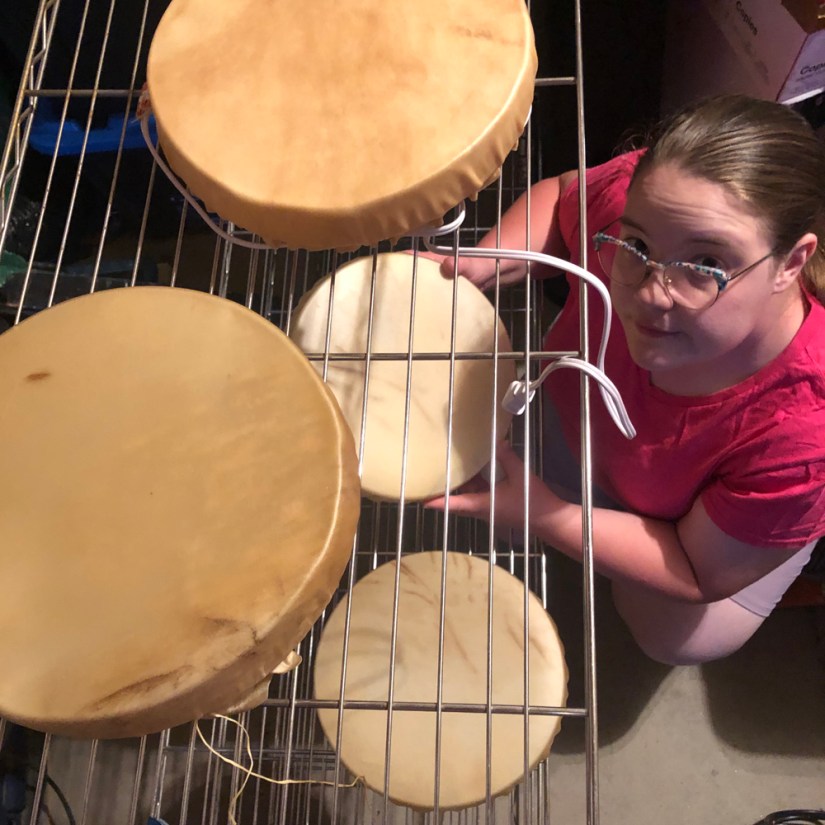
Once laced, the vessels were transferred to a wire drying rack in Po’s woodshop. Because the hide rested against a solid plastic diffuser, the drying process took longer than standard open-backed frame drums. During this drying window, Po actively hand-sculpted and finger-molded the curves and flow of the rawhide ruffles, progressively trimming them as they set.

Top-down view of Kingston artist Portia Po Chapman in her woodshop, wearing glasses and a pink t-shirt, carefully placing an illuminated rawhide vessel onto a wire drying rack. Several other partially dried rawhide vessels are already sitting on the rack
In her Kingston woodshop, Po manages the crucial drying phase for the Being Seen installation. She meticulously positions each newly wrapped diffuser vessel on a wire rack, using this precise time window as the hide tightens to sculpt and manipulate the organic curve and flow of the rawhide ruffles.

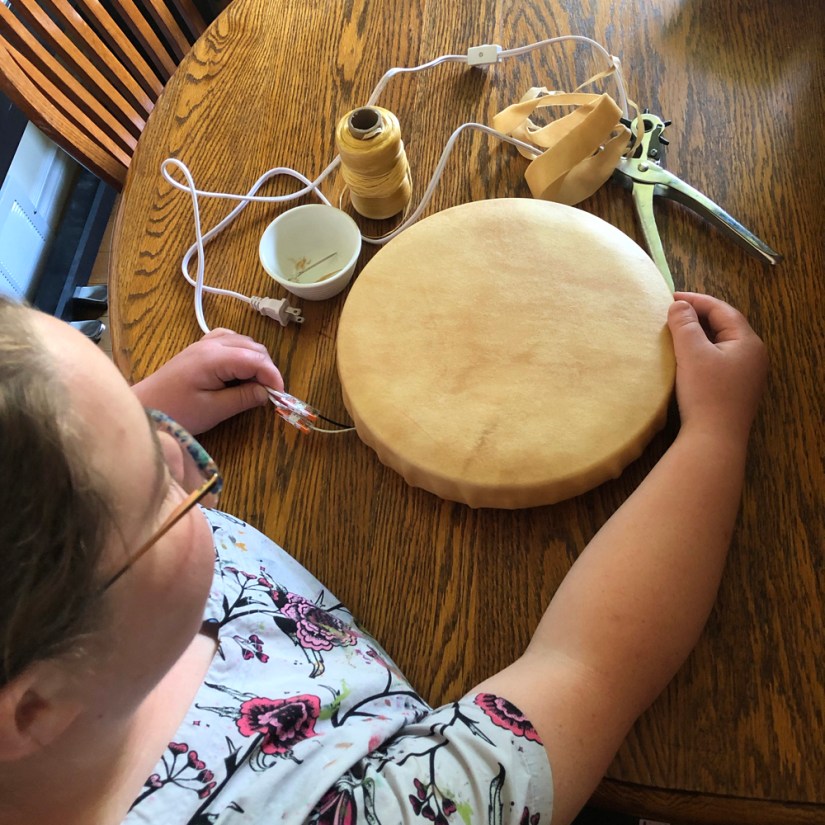
To prepare the fixtures for gallery mounting, Po converted the hardwired LED ceiling lights into plug-in lamp units using transparent Wago Lever-Nut connectors. This allowed all the monolith-mounted vessels to plug directly into a central power bar controlled by a single master dimmer switch that the gallery staff could use with ease.

Top-down view of Kingston artist Portia Po Chapman holding orange Wago Lever-Nut connectors in her left hand as she connects a lamp cord to a smooth rawhide-wrapped LED vessel sitting on a wooden studio table surrounded by tools.
Converting ceiling lights into plug-in gallery fixtures, Po uses transparent Wago Lever-Nut connectors to safely join the LED wiring to plug-in lamp cords, enabling the entire monolith display to be powered by a single master power switch.

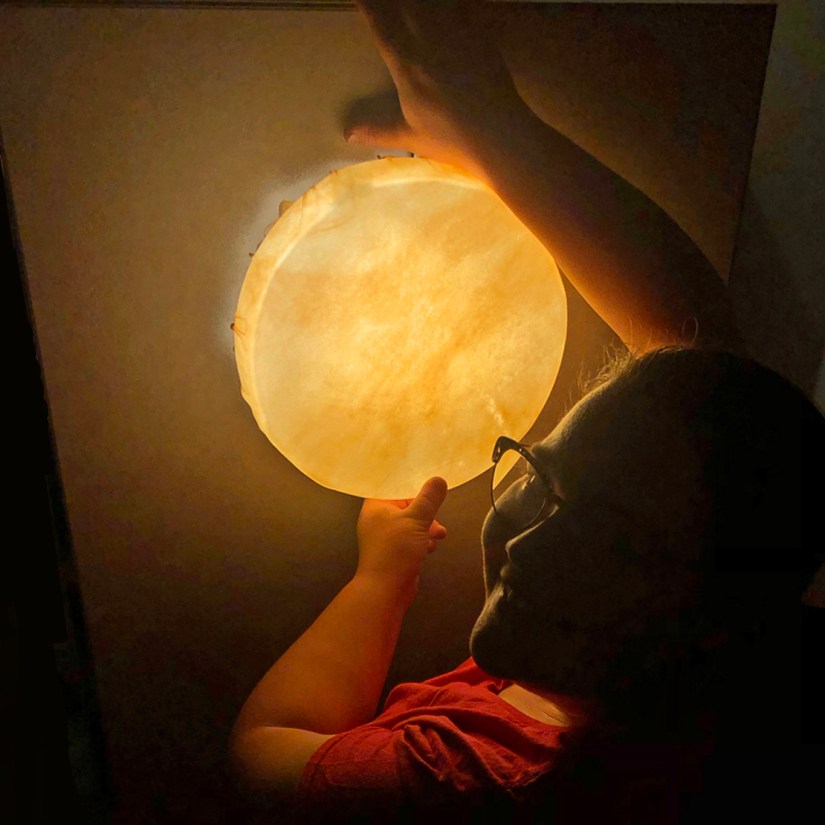
Before mounting, Po tested each vessel against panels of stone-hybrid sheeting (used to cover the MDF installation monoliths). Seeing the warm light shine through verified that she had successfully recreated the golden, sunlit warmth of a rawhide drum.

Kingston artist Portia Po Chapman smiling in a dimly lit studio as she holds an illuminated, circular rawhide vessel glowing with a warm golden sunlit light against a panel of stone-hybrid sheeting.
Achieving the ultimate vision: Po holds a finished glowing rawhide vessel up against the stone-hybrid monolith sheeting in her studio, verifying that the backlighting captures the exact golden warmth of noonday sunlight shining through rawhide.

Community Impact and Celestial Alignment

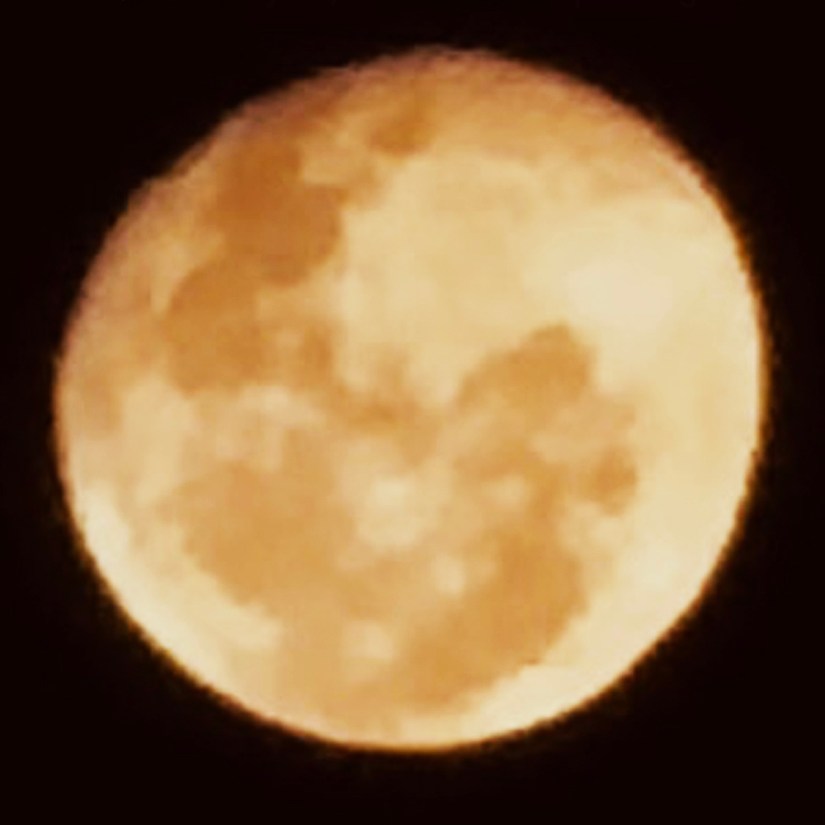
When the Glow Chamber was assembled and lit on installation day, adjusting the dimmer switch immediately brought the desired sunlit warmth into the space. Just three days after the exhibition opened on July 28, nature provided a striking confirmation: on July 31, 2026, a bright full moon rose in the midnight sky, glowing with the exact golden warmth Po had engineered in her studio.

Photograph of a warm golden full moon shining brightly in a night sky, echoing the organic textures and backlighting of rawhide artwork by Portia Po Chapman.
On July 31, 2026โ€”just three days after Being Seen openedโ€”the midnight moon offered natural confirmation, glowing with the exact warmth and organic variance of Po’s sunlit and engineered rawhide creations.

Gallery visitors responded with deep emotion, often describing the Glow Chamber as a comforting, “womb-like” space. As part of the interactive exhibition, 70 guests snapped selfie portraits inside the Glow Chamber and posted them onto an interactive gallery board alongside handwritten reflections of their experience.

A dark gallery wall displaying a gold-framed interactive photo board titled "when BEING SEEN... we glow" covered in visitor selfie photos and handwritten notes, alongside custom wall text explaining three empowering drum hide stories by Kingston artist Portia Po Chapman.
The heart of the community connection: 70 exhibition visitors posted their glowing selfie portraits and personal reflections on the interactive board inside the Kingston Arts Council Pocket Gallery during Portia “Po” Chapman’s Being Seen exhibition (July 27 โ€“ September 18, 2026).

By capturing the feeling of noonday sunlight through rawhide, Portia “Po” Chapman created a space where visitors could joyously glow togetherโ€”proving her core thesis: โ€œEveryone glows when they feel seen.โ€

Close-up portrait of Kingston artist Portia Po Chapman in a pink top with her hair braided, illuminated by the warm golden light emitted from a handcrafted rawhide vessel she holds in the dark Pocket Gallery space
Celebrating the realized vision: Po poses in the Kingston Arts Council Pocket Gallery alongside one of her completed backlit rawhide vessels, illuminated by the warm golden glow achieved through months of dedicated experimentation and innovation. Photo by Ann Decker.

Hosted by the Kingston Arts Council at the Tett Centre for Creativity and Learning, Being Seen: when Being Seen… we glow, marked both a community success and a major advancement in Poโ€™s ongoing evolution of rawhide art.

Immersive site-specific installation "Being Seen: when Being Seen... we glow" featuring the monochromatic Glow Chamber, glowing rawhide vessels, vinyl wall text, and photo board inside the Kingston Arts Council Pocket Gallery.
The site-specific Glow Chamber on view inside the Kingston Arts Council Pocket Gallery during the immersive exhibition, “Being Seen: when Being Seen… we glow.”

Portia “Po” Chapman is a Kingston-based multidisciplinary visual artist, muralist, and certified educator (BFAH, B.Ed, OCT) recognized for her site-specific Storytelling Art and signature high-contrast aesthetic. Blending traditional craftโ€”such as artisanal rawhide sculpting and woodworkingโ€”with innovative lighting design and digital tools, she creates immersive, community-driven installations that invite viewers into a shared, radiant dialogue where everyone glows. Discover more of her portfolio, public artworks, and upcoming projects at loveartbypo.ca.

Let Me Know What You Think! Start or Join the Convesation

Serving Kingston, Ontario & Across Canada


Behind the Art, Kingston Artist, Portia Chapman

Beyond the Form: How Didactic Museography Transformed the Glow Chamber into an Interactive Experience | Kingston Artist Portia Po Chapman

A sculpture occupies space, but a true art installation creates a world. For Kingston artist Portia Po Chapman, the central Glow Chamber in her solo exhibition, Being Seen: when Being Seen… we glow, could easily have stood alone as a handcrafted rawhide sculpture. However, her creative vision extended far beyond a static physical formโ€”she set out to build a fully realized, interactive experience.

The completed black exhibition title wall for "when Being Seen... we glow" by Kingston artist Portia Po Chapman, featuring gold vinyl lettering, a full deer rawhide mounted 1.5 inches off the wall with copper pipe spacers, an artist statement, and an egg-shaped illuminated silver deer rawhide drum.
The completed interior title wall for “Being Seen: when Being Seen… we glow” by artist in Kingston Portia Po Chapman, showcasing a floating full deer rawhide, an illuminated silver deer rawhide drum, and custom Didactic Museography typography.

The crucial element that elevated this vision from sculpture to immersive installation was Didactic Museography: the intentional, strategic integration of typography, text placement, and spatial narrative design. By treating words not as afterthoughts, but as structural art materials equal to rawhide, wood, and light, the text became the essential bridge guiding viewers into a personal, participatory journey.

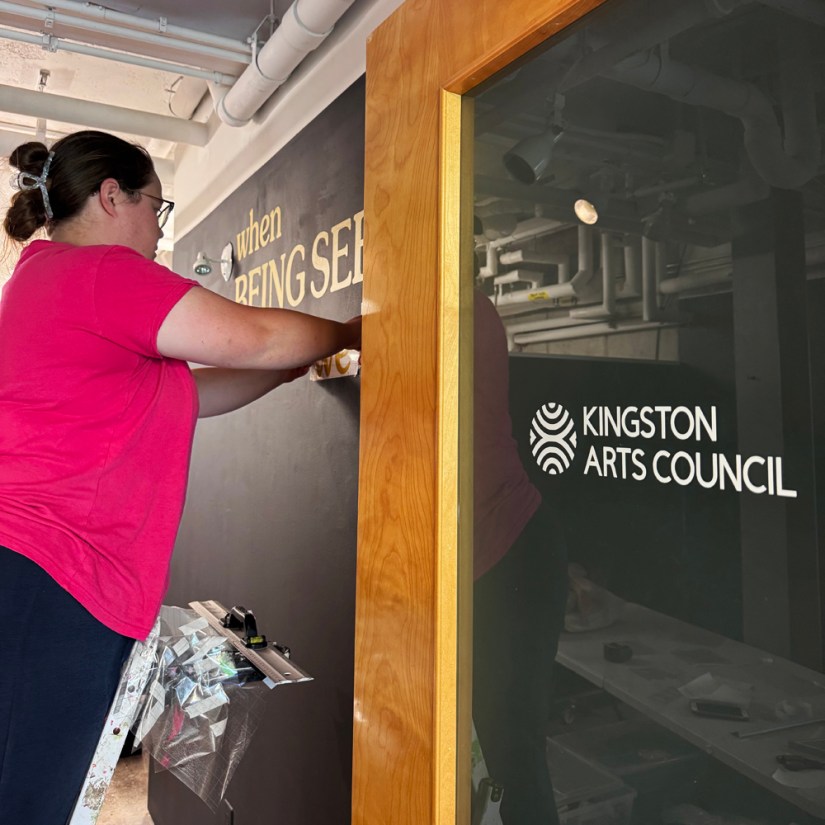
Side-angle view of Kingston artist Portia Po Chapman standing on a ladder inside the Pocket Gallery applying gold vinyl lettering reading "when BEING SEEN..." to the interior black title wall, with the Kingston Arts Council logo visible on the glass door frame in the foreground.
Interior setup in progress: artist in Kingston Portia Po Chapman carefully applies custom CNC-cut vinyl title decals to the dark gallery wall.

From the muted grey caution sign reading “when Being Unseen… we fade” to the warm gold title lettering and the interactive species guide, every piece of vinyl typography served a deliberate conceptual purpose.

A grey triangular caution sign reading "when Being Unseen... we fade" positioned outside the Glow Chamber installation by Kingston artist Portia Po Chapman, with a glowing golden elk rawhide drum mounted on the dark wall in the background.
A deliberate conceptual contrast by artist in Kingston Portia Po Chapman: the faded, concrete-grey caution sign reading “when Being Unseen… we fade” stands outside the Glow Chamber, set against the warm light of a handcrafted glowing elk rawhide drum.

Didactic Museography goes beyond simply delivering information; it curates an emotional arc that shapes how a viewer feels, moves, and connects with the space. As an artist in Kingston known for site-specific precision, Portia Po Chapman carefully planned the layout of every wall graphic and decal,

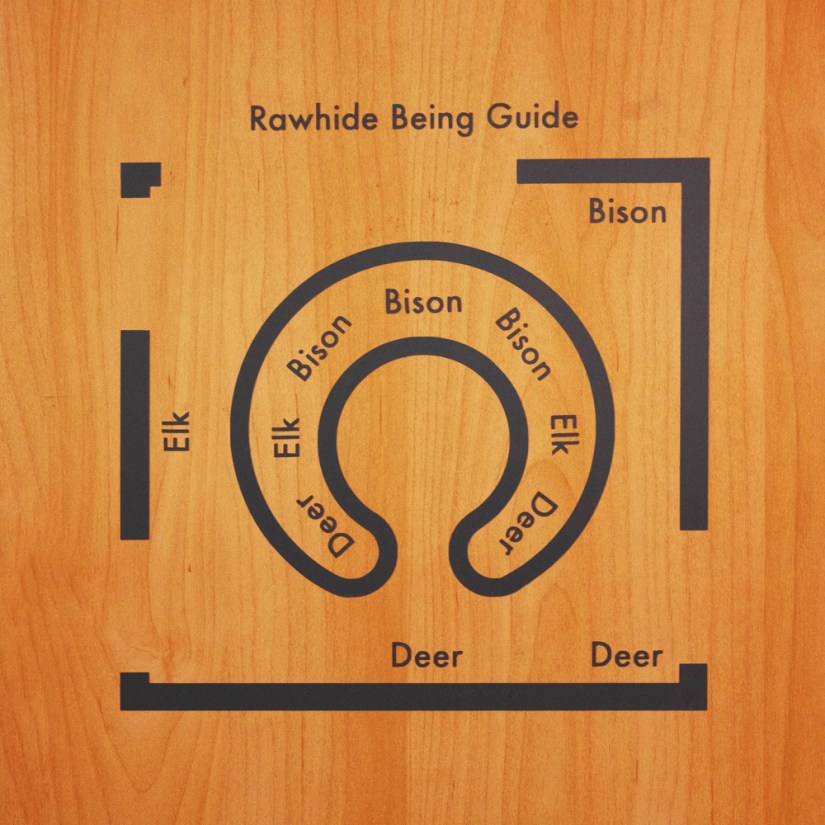
Close-up view of the "Rawhide Being Guide" vinyl map mounted on a laminated wood panel, showing gallery visitors the specific layout and locations of Deer, Elk, and Bison rawhide species throughout the exhibition space.
“Rawhide Being Guide” legend and floor plan: artist in Kingston Portia Po Chapman provides gallery goers with a visual map detailing the exact placements of Deer, Elk, and Bison hides inside and around the Glow Chamber.

and even balancing spatial composition around fixed gallery fixturesโ€”so that the text acted as an inviting narrator. It prompted passersby in the Tett Centre hallway to pause, contemplate their own visibility, and physically step across the threshold into the glowing interior.

Exhibition Gallery Window Display with Custom Vinyl Decals โ€“ Portia Po Chapman Artist in Kingston.
Exterior view of the Pocket Gallery window at the Tett Centre: custom CNC-cut vinyl graphics by artist in Kingston Portia Po Chapman frame the view of the Glow Chamber and caution sign inside.

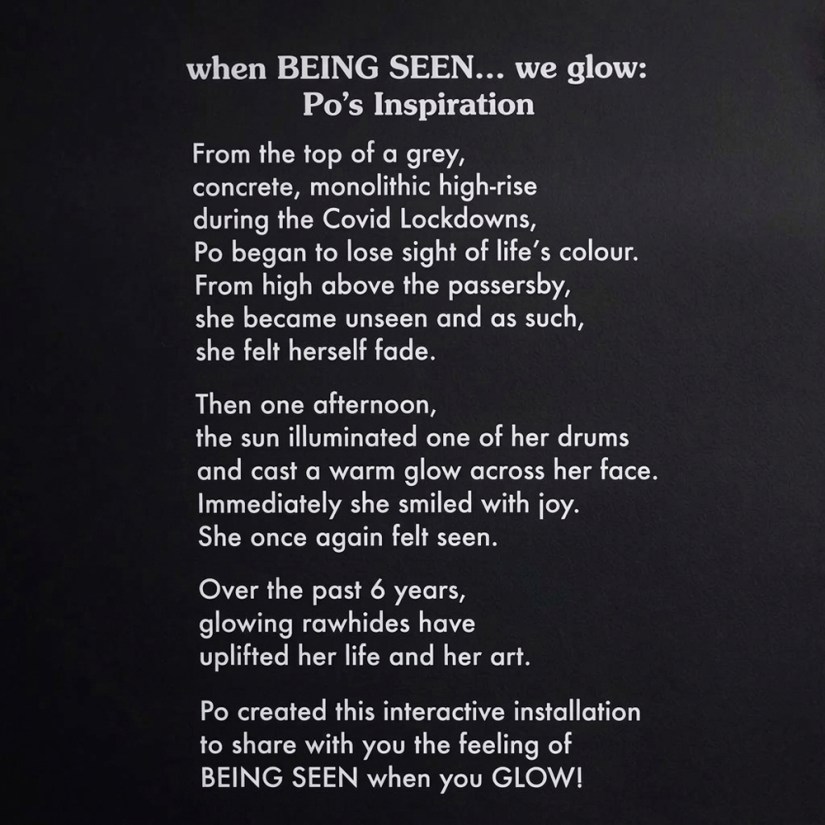
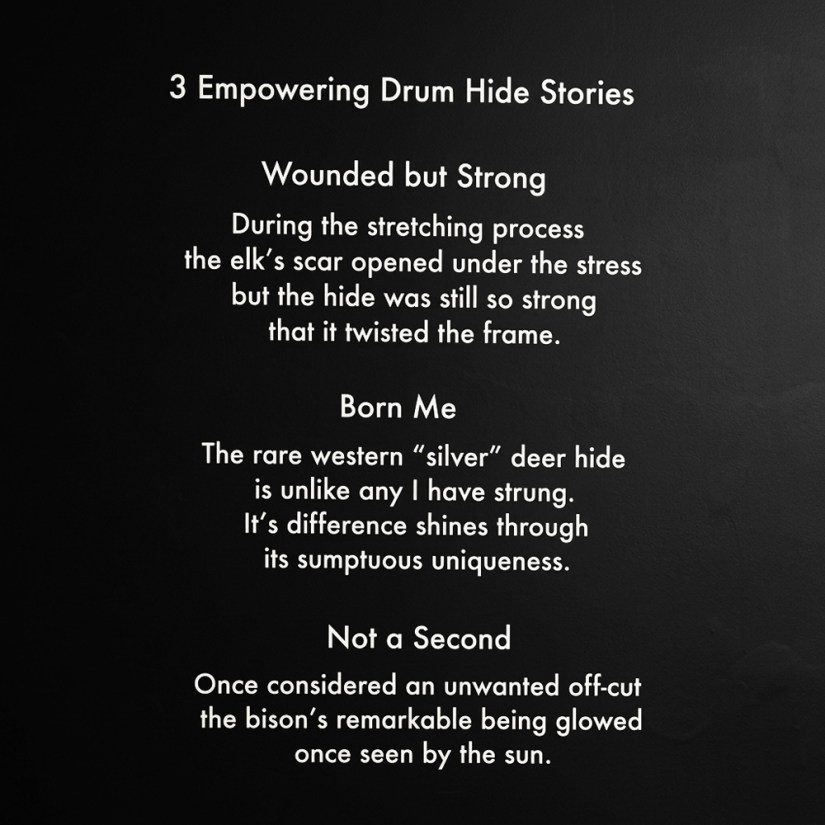
The transformative power of this approach was reflected in the overwhelming community response. Throughout the show at the Pocket Gallery, gallery goers repeatedly remarked on how deeply the written narrativesโ€”from the personal reflection in “Poโ€™s Inspiration” to the origin tales in “3 Empowering Drum Hide Stories”โ€”resonated with them.

Close-up view of the white vinyl artist statement graphic on the dark title wall, titled "when BEING SEEN... we glow: Po's Inspiration," detailing Kingston artist Portia Po Chapman's story of finding light and joy through glowing rawhides.
“Po’s Inspiration” artist statement on the interior title wall: artist in Kingston Portia Po Chapman shares the personal story behind creating her interactive glowing rawhide installation.
Close-up view of the black didactic wall graphic panel titled "3 Empowering Drum Hide Stories" by Kingston artist Portia Po Chapman, describing the origin stories for her featured glowing rawhide drums: Wounded but Strong, Born Me, and Not a Second.
“3 Empowering Drum Hide Stories” wall panel: artist in Kingston Portia Po Chapman shares the individual narratives and meanings behind three featured glowing rawhide drums.

The text gave voice to the deer, elk, and bison hides, turning natural materials into powerful mirrors for human resilience. Without these carefully crafted words, the Glow Chamber would have been an impressive visual structure; with them, it became a communal experience that invited over 70 visitors to add their own glowing portraits to the interactive selfie board, proving that thoughtful typography is key to making art truly felt and shared.

A black display board framed in gold with the gold vinyl title "when BEING SEEN... we glow" at the top and "Let's glow together. Add your glowing photo here!" at the bottom, covered with instant sticker selfies of visitors inside the Glow Chamber installation by Kingston artist Portia Po Chapman.
Community in full glow: artist in Kingston Portia Po Chapman created an interactive photo board where 70 exhibition guests posted instant sticker selfies taken inside the Glow Chamber installation.

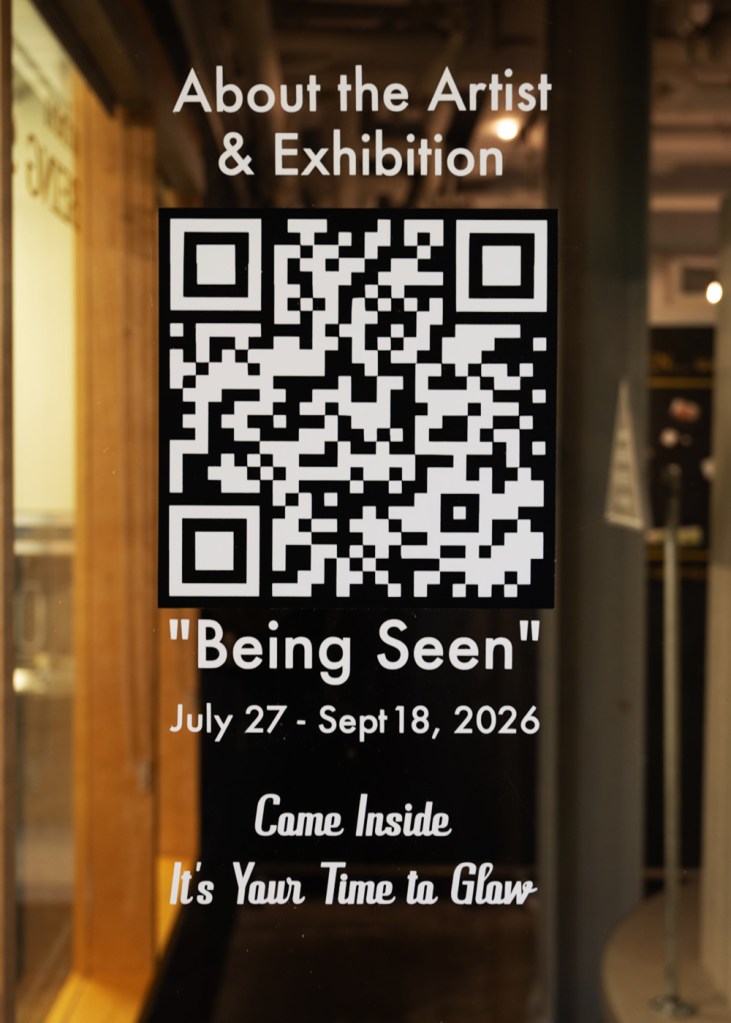
Beyond the conceptual framework, the true art lives in the physical execution and attention to detail. A closer look at the behind-the-scenes preparation and gallery window installation reveals how these narrative layers were carefully brought to life. From the close-up views of the custom-cut vinyl typography to the interactive QR codes, social media callouts, and spatial maps, every single graphic element was hand-applied and purposefully placed.

Close-up view of a scannable QR code decal on the Pocket Gallery window at the Tett Centre, titled "About the Artist & Exhibition 'Being Seen'" with dates July 27 โ€“ Sept 18, 2026, and the invitation "Come Inside It's Your Time to Glow" by Kingston artist Portia Po Chapman.
Close-up detail of the interactive QR code window decal facing the Tett Centre hallway, inviting visitors to scan for details about Kingston artist Portia Po Chapman and the “Being Seen” exhibition.

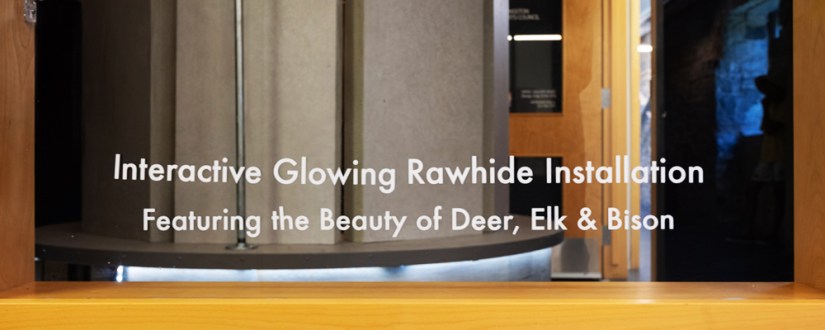
The following collection of close-up images captures these precise didactic components in detailโ€”offering a transparent, step-by-step look at how thoughtful text, strategic window placement, and hands-on craftsmanship transformed the Kingston Arts Council Pocket Gallery into an inviting, fully connected experience for every visitor passing through the Tett Centre for Creativity and Learning.

Close-up view of the bottom center gallery window decal at the Tett Centre reading "Interactive Glowing Rawhide Installation Featuring the Beauty of Deer, Elk & Bison" by Kingston artist Portia Po Chapman, with the base of the Glow Chamber visible in the background.
Close-up detail of the vinyl decal on the bottom centre gallery window: artist in Kingston Portia Po Chapman highlights the rawhide species featured within the interactive Glow Chamber installation.
Exterior wide-angle view of the Pocket Gallery corner glass windows at the Tett Centre displaying exhibition vinyl typography and a scannable QR code poster for exhibition details by Kingston artist Portia Po Chapman.
Corner exterior view of the Pocket Gallery at the Tett Centre in Kingston, Ontario: vinyl decals and an interactive QR code poster invite passersby to explore exhibition details for Portia Po Chapman’s interactive rawhide installation.
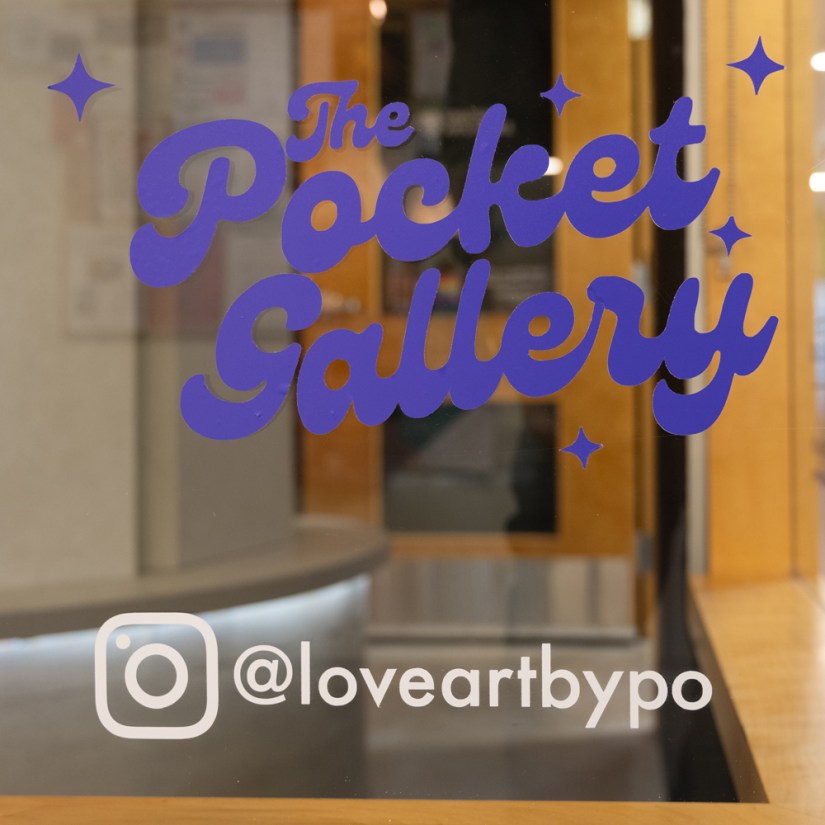
Close-up view of the bottom right gallery window at the Tett Centre displaying artist Portia Po Chapman's white Instagram decal @loveartbypo positioned directly beneath the permanent purple Pocket Gallery logo.
Strategic placement by artist in Kingston Portia Po Chapman: her Instagram handle @loveartbypo sits directly below the permanent Pocket Gallery logo, inviting visitors to view ongoing updates and installation media online.

Behind the Scenes Photos

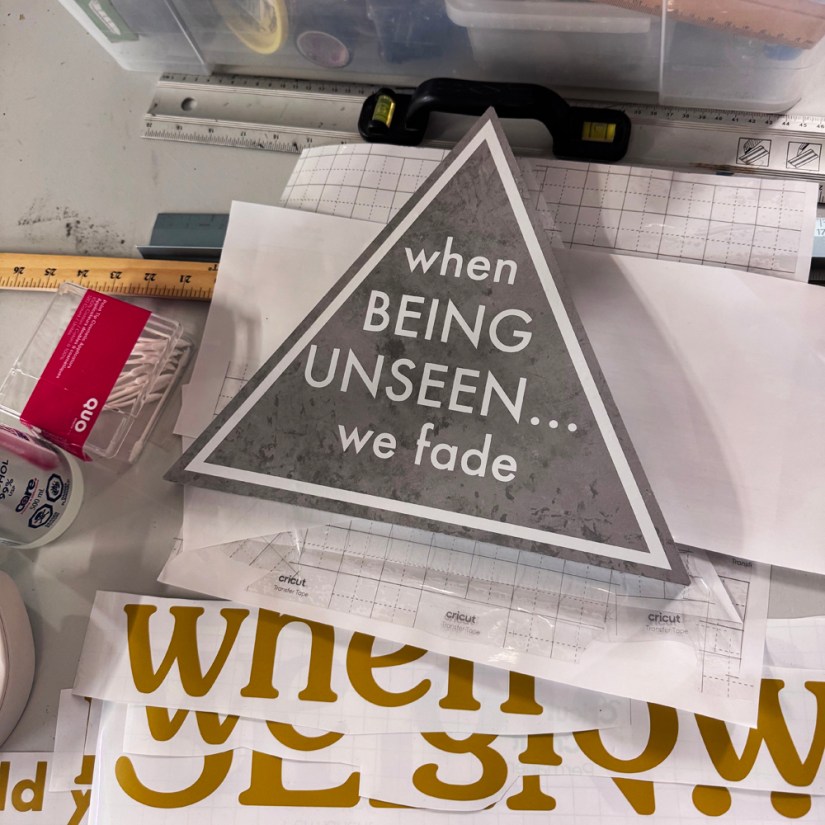
Overhead view of Kingston artist Portia Po Chapmanโ€™s studio workbench displaying the triangular grey "when Being Unseen... we fade" caution sign alongside golden vinyl lettering on transfer paper during the creation of her interactive installation.
Behind the scenes in the Kingston art studio: artist Portia Po Chapman prepares the vinyl typography and grey caution sign reading “when Being Unseen… we fade” for the Glow Chamber installation.
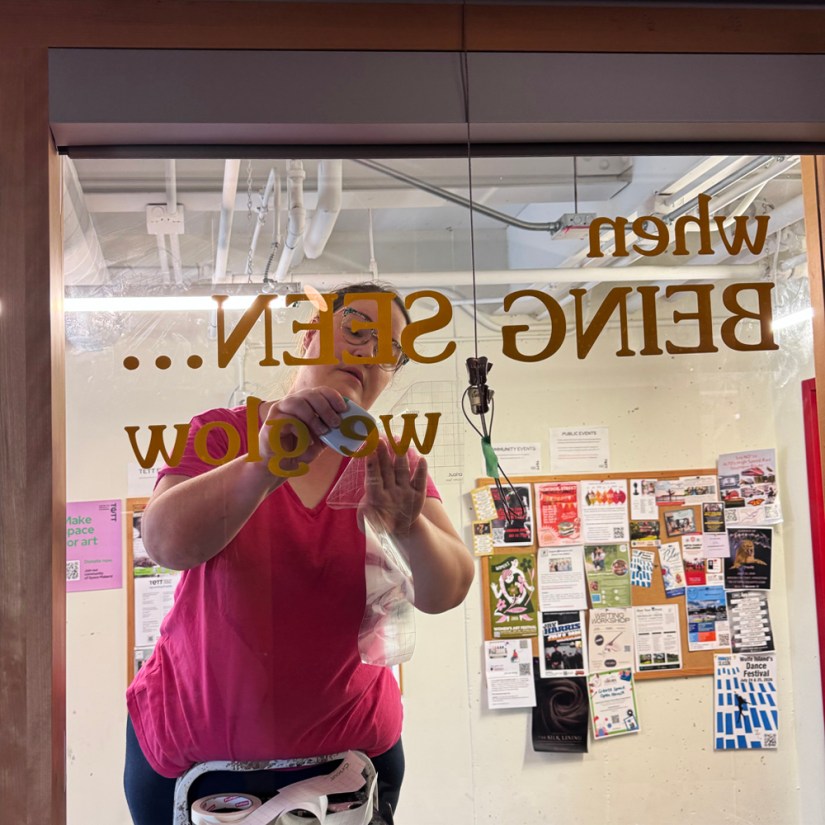
View from inside the gallery showing Kingston artist Portia Po Chapman on a stepladder applying gold vinyl typography reading "when Being Seen... we glow" onto the outer hallway window at the Tett Centre.
Installation in progress: artist in Kingston Portia Po Chapman carefully applies the gold vinyl title sticker onto the gallery window pane prior to the exhibition opening.
Side-angle view of Kingston artist Portia Po Chapman standing on a ladder inside the Pocket Gallery applying gold vinyl lettering reading "when BEING SEEN..." to the interior black title wall, with the Kingston Arts Council logo visible on the glass door frame in the foreground.
Interior setup in progress: artist in Kingston Portia Po Chapman carefully applies custom CNC-cut vinyl title decals to the dark gallery wall.
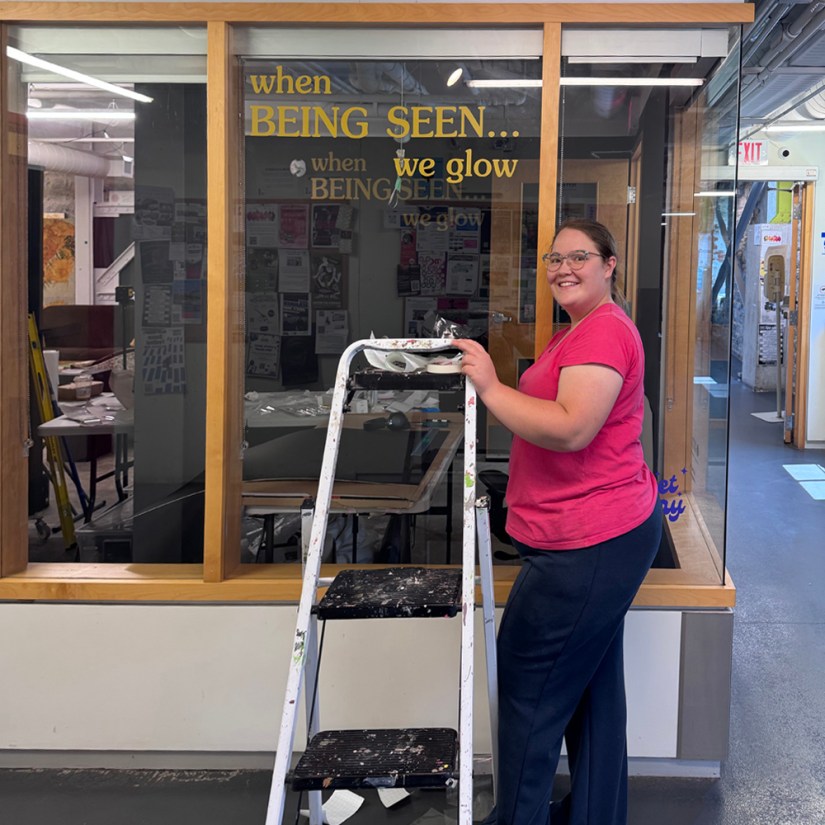
Kingston artist Portia Po Chapman standing beside a stepladder in the Tett Centre hallway, smiling proudly next to the freshly applied gold vinyl title decal "when Being Seen... we glow" on the gallery window.
Artist in Kingston Portia Po Chapman poses beside her ladder after finishing the application of the gold vinyl exhibition title decal on the Pocket Gallery hallway window.

The Immersive Show Stopper of “Being Seen: when Being Seen… we glow,
The GLOW CHAMBER

Interactive Glow Chamber installation featuring semi-circular partition walls mounted with circular, illuminated rawhide vessels casting a warm golden glow.
The interactive Glow Chamber from Portia “Po” Chapmanโ€™s exhibition when BEING SEEN… we glow, featuring backlit rawhide vessels radiating the natural golden warmth of sunlit rawhide.

Portia Po Chapman is a Kingston-based visual artist, muralist, and educator (BFAH, B.Ed, OCT) recognized for her signature high-contrast aesthetic and site-specific installations. Combining natural materials like hand-sculpted rawhide with modern digital fabrication and Didactic Museography, she crafts immersive, community-driven experiences that invite viewers into active dialogue with the work. Discover more of her portfolio, public artworks, and upcoming exhibitions at loveartbypo.ca.

Let Me Know What You Think! Start or Join the Convesation

Serving Kingston, Ontario & Across Canada